


Salkantay Trek 3 Days to Machu Picchu
A 3-day Salkantay Trek to Machu Picchu is a compressed itinerary with two main hiking days and the Machu Picchu visit on Day 3. Most short versions cover about 24–33 mi (38–53 km), cross Salkantay Pass at around 15,190 ft (4,630 m), and use transfers to shorten parts of the lower valley. Before booking, confirm the trailhead, first-night camp, Humantay Lake, Llactapata, the Hidroeléctrica–Aguas Calientes section and the exact Machu Picchu circuit.
Table of Contents
The detail that changes a three-day trek most is often not the headline mileage but where Day 1 ends and what happens after Salkantay Pass. One itinerary may stop at Huayracmachay; another may continue several hours farther toward Chaullay or Collpapampa; another may return toward Soraypampa and connect with Machu Picchu by road and train. All can be sold as a 3-day Salkantay Trek, yet the physical effort and the amount of trail you actually walk can be very different. Before comparing prices, compare the walking line.

Salkantay Trek 3 Days at a Glance
| Planning point | Useful 3-day reference |
| Typical structure | 2 main hiking days + Machu Picchu on Day 3 |
| Route design | No single standard itinerary; the first-night stop, Humantay, Llactapata and transfer points vary by operator. |
| Through-trek hiking distance | Commonly about 24–33 mi (38–53 km); train-heavy highlight versions can be substantially shorter. |
| Highest point | Salkantay Pass, around 15,190 ft (4,630 m) as a practical planning reference. |
| Difficulty | Usually hard; aggressive through-routes can be very hard because most of the trekking load is compressed into Days 1 and 2. |
| Humantay Lake | Included on some versions, optional on others and omitted on many fast through-routes. |
| Night before Machu Picchu | Usually Aguas Calientes on Day 2. |
Service note:
Inkayni currently publishes 4-day and 5-day Salkantay services rather than a standard 3-day group departure. The three-day distances, route patterns and price ranges below are therefore planning references based on current short Salkantay itineraries offered in Cusco, not a fixed Inkayni itinerary.
GLACIER MOUNTAIN TREKSalkantay Trek
Discover one of Peru’s most scenic treks beneath snowy peaks and changing landscapes.
What a 3-Day Salkantay Trek Actually Changes
There is no single official three-day itinerary. To fit Salkantay Pass and Machu Picchu into the same short calendar, operators compress different parts of the route. The result is not one trek with minor variations, but several recognizable ways of building a three-day experience.
| 3-day route style | Typical walking line | Main trade-off |
| Balanced through-route | Soraypampa → Salkantay Pass → Huayracmachay on Day 1; cloud forest → lower valley → Hidroeléctrica → Aguas Calientes on Day 2. | Keeps a real mountain-to-cloud-forest crossing without pushing Day 1 as far as the hardest challenge itineraries. |
| Aggressive through-route | Soraypampa → Salkantay Pass → Chaullay or Collpapampa on Day 1, then another long lower-valley stage on Day 2. | Preserves more continuous trekking, but Day 1 can reach roughly 13–15 mi (21–24 km) and become the defining challenge of the trip. |
| Llactapata challenge | Long Day 1 across Salkantay toward Chaullay/Lucmabamba; Day 2 climbs to Llactapata, descends to Hidroeléctrica and continues to Aguas Calientes. | Keeps more hiking and the Llactapata viewpoint, but can create two back-to-back days around 13–15 mi (22–24 km). |
| Humantay + Pass + train | Humantay Lake on Day 1; Salkantay Pass on Day 2, then return toward Soraypampa and connect by road and train with Aguas Calientes. | Keeps Humantay and Salkantay Pass, but sacrifices much of the continuous descent through the cloud forest toward Machu Picchu. |
Three days tells you the calendar. The actual route tells you the experience. The trailhead, first-night camp, walking distance, whether the route continues beyond Salkantay Pass and where transport begins are more useful than the tour name alone.
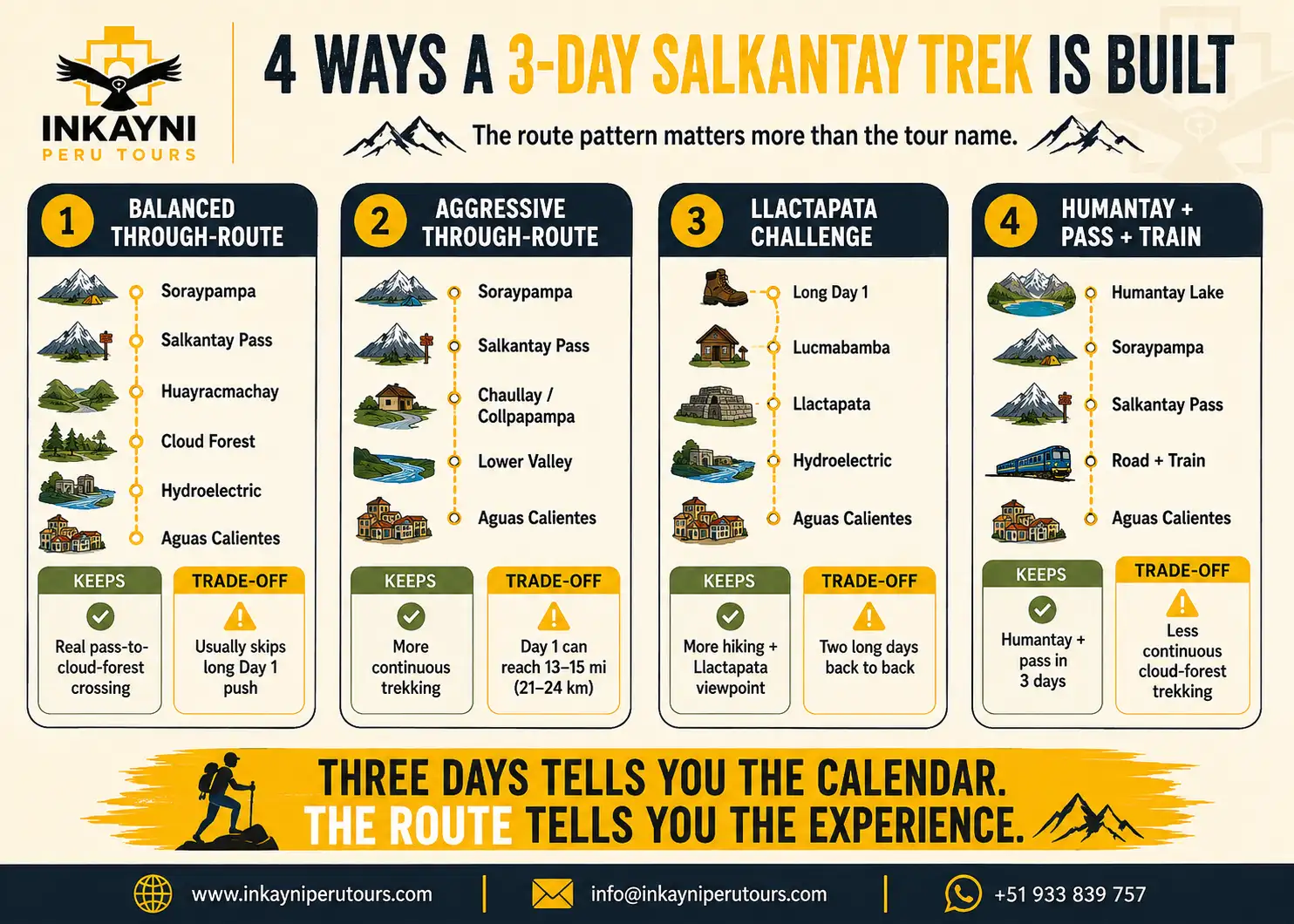
3-day Salkantay Trek route options.
3-Day Salkantay Trek Itinerary: How the Main Variants Work
The accordions below use a through-trekking route as the main spine because it preserves the defining transition from Salkantay Pass into the cloud forest. The bullet points inside each day show where other three-day versions diverge. For the broader route context, use the complete Salkantay Trek to Machu Picchu guide.
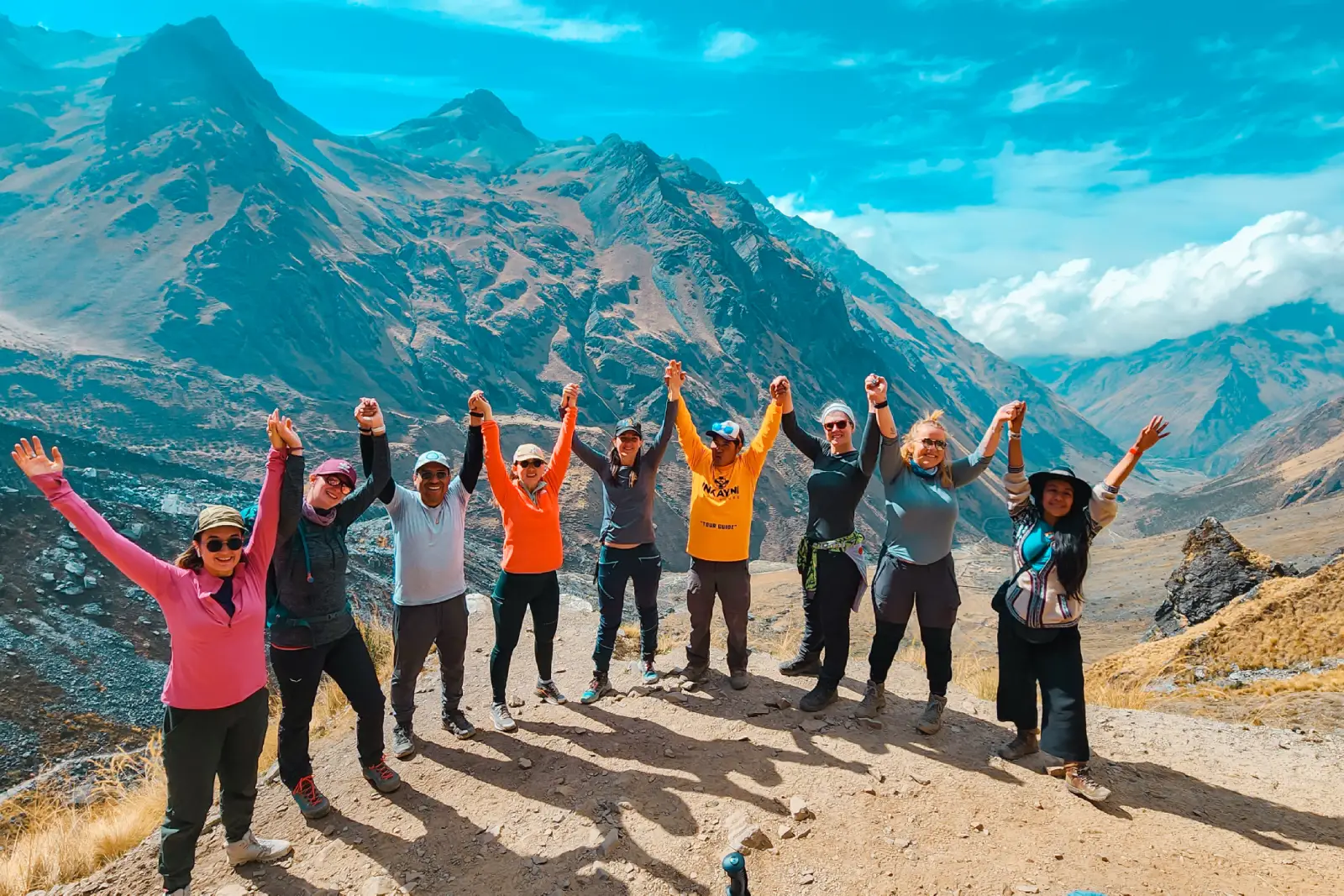
Hikers before Salkantay Pass.
Day 1: Cusco → Soraypampa → Salkantay Pass → High or Cloud-Forest Camp
The day normally starts very early with a road transfer from Cusco toward Mollepata and the upper trailhead. Starting near Soraypampa allows a three-day itinerary to attack the high section immediately instead of spending a separate trekking day approaching Salkantay Pass.
The pass reaches about 15,190 ft (4,630 m). What happens after reaching it is the main separator between three-day routes: some groups descend only as far as Huayracmachay, while challenge-style itineraries continue for several additional hours toward Chaullay or Collpapampa.
- Balanced through-route: a current short-route example publishes about 9.9 mi (16 km) and 6–7 hours, crossing Salkantay Pass before stopping at Huayracmachay.
- Aggressive through-route: challenge itineraries may continue to Chaullay or Collpapampa and publish roughly 13–14.6 mi (21–23.5 km) with around 9–11 hours on foot.
- Llactapata challenge: some versions push across the pass and far down the valley on Day 1, then use a short transfer toward Lucmabamba so Day 2 can include Llactapata.
- Humantay + Pass + train: a different route design uses Day 1 for Humantay Lake and returns to sleep near Soraypampa rather than crossing deeply into the cloud forest.
A route that reaches Chaullay or Collpapampa on the first day is not simply “shorter.” It is concentrating a large high-altitude ascent and a long descent into one opening stage. That is why acclimatization and preparation matter more here than the phrase “only three days” suggests. Use the Salkantay preparation and training guide before departure.
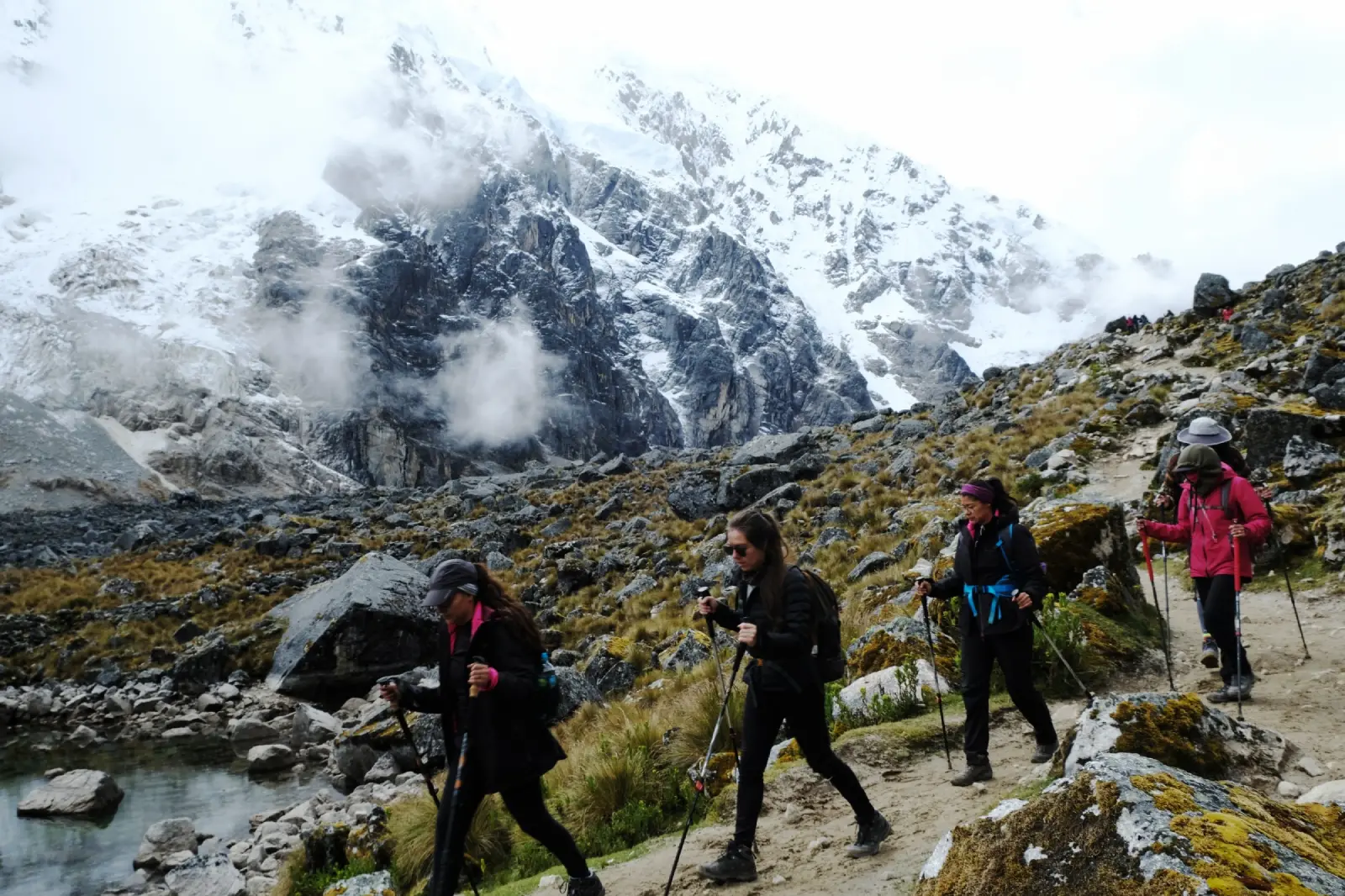
Hiking the alpine trail below Salkantay mountain.
The trek crosses the pass below Salkantay Mountain; it is not a summit climb of the mountain itself.
Day 2: Cloud Forest or Soraypampa → Aguas Calientes
For through-trekking versions, Day 2 normally trades glacial terrain for warmer cloud forest and lower-valley vegetation. The exact mileage depends heavily on where Day 1 ended and how much road transport replaces hiking.
- Balanced through-route: descend from Huayracmachay through the cloud forest toward Chaullay, continue through part of the lower valley, transfer toward Hidroeléctrica, and walk beside the railway to Aguas Calientes. A current example publishes about 13.7 mi (22 km) for this day.
- Aggressive through-route: after sleeping much lower around Chaullay or Collpapampa, the itinerary may walk a substantial section toward La Playa or Lucmabamba before using transport and finishing at Hidroeléctrica/Aguas Calientes.
- Llactapata challenge: climb from Lucmabamba for roughly three hours to Llactapata, descend for about two hours to Hidroeléctrica, then continue roughly three more hours beside the railway to Aguas Calientes. Current examples publish around 15 mi (24 km) and 8–9 hours on foot.
- Humantay + Pass + train: climb to Salkantay Pass from Soraypampa, then return by the same high-mountain line instead of descending toward Chaullay. Road transport connects with Ollantaytambo, followed by train travel to Aguas Calientes.
For itineraries that reach Hidroeléctrica, the final walk beside the railway is roughly 6.2 mi (10 km) and commonly takes about 2–3 hours. Some operators replace this section with the short train.
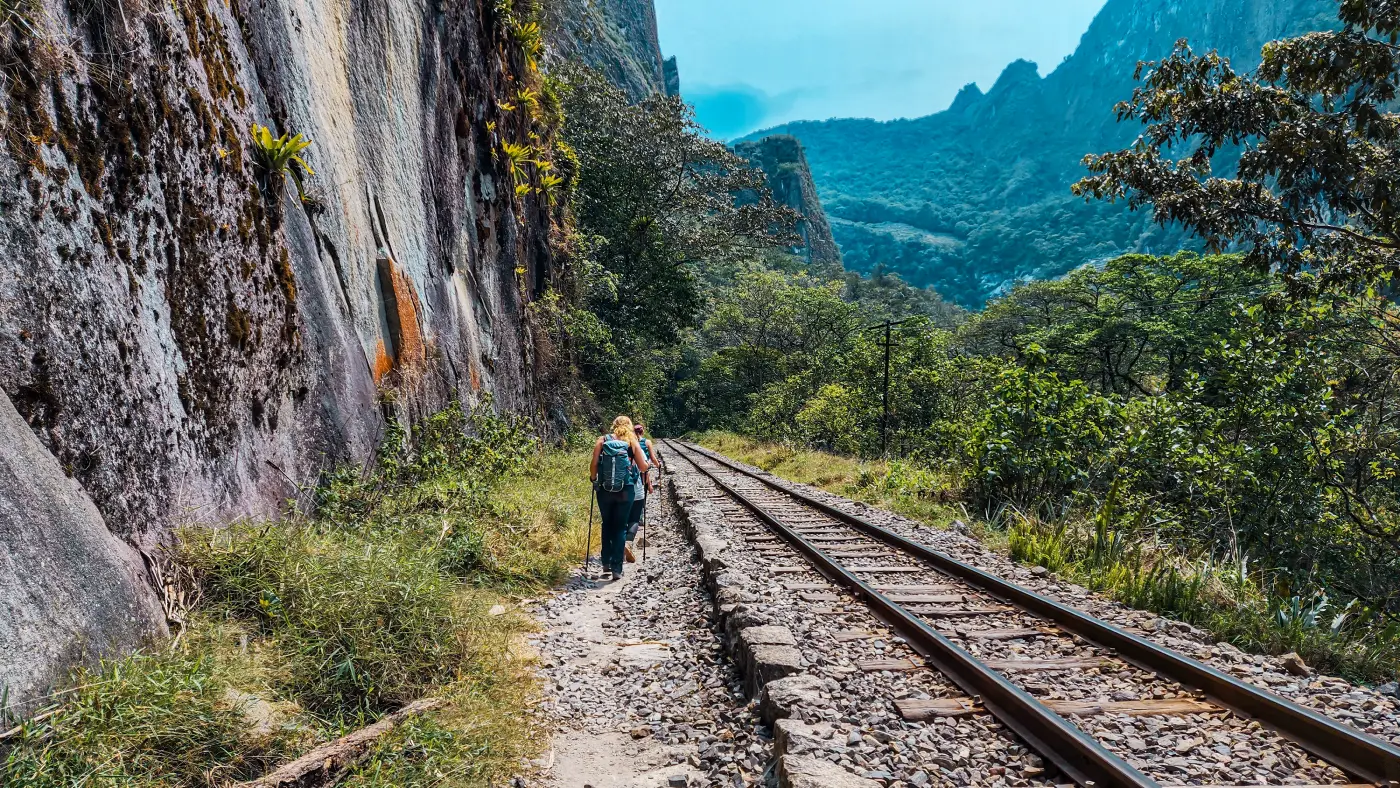
Railway section on the lower Salkantay, Hidroelectrica route.
This is also why Llactapata should never be assumed. Keeping it adds archaeological interest and a distant Machu Picchu viewpoint, but it also adds climbing and makes an already compressed Day 2 considerably more demanding. For a route-by-route distance comparison rather than another itinerary explanation, use the Salkantay Trek length and walking-time guide.
Day 3: Aguas Calientes → Machu Picchu → Cusco
Day 3 is normally the archaeological visit and return journey rather than another full trekking stage. Machu Picchu sits at about 7,972 ft (2,430 m), well below Salkantay Pass.
- Most organized versions: use the shuttle from Aguas Calientes to Machu Picchu, complete the guided visit, then return by train toward Ollantaytambo and continue by road to Cusco.
- More walking: some travelers hike from Aguas Calientes to the Machu Picchu entrance instead of taking the shuttle, adding a steep ascent before the archaeological visit.
- Return logistics: lower-cost packages can use different train classes or car-based combinations, so the return method should be confirmed before comparing tour prices.
Machu Picchu tickets are route-specific. Peru currently operates three main circuits divided into multiple routes, so confirm the exact Machu Picchu circuit and route instead of accepting only “entrance included.”
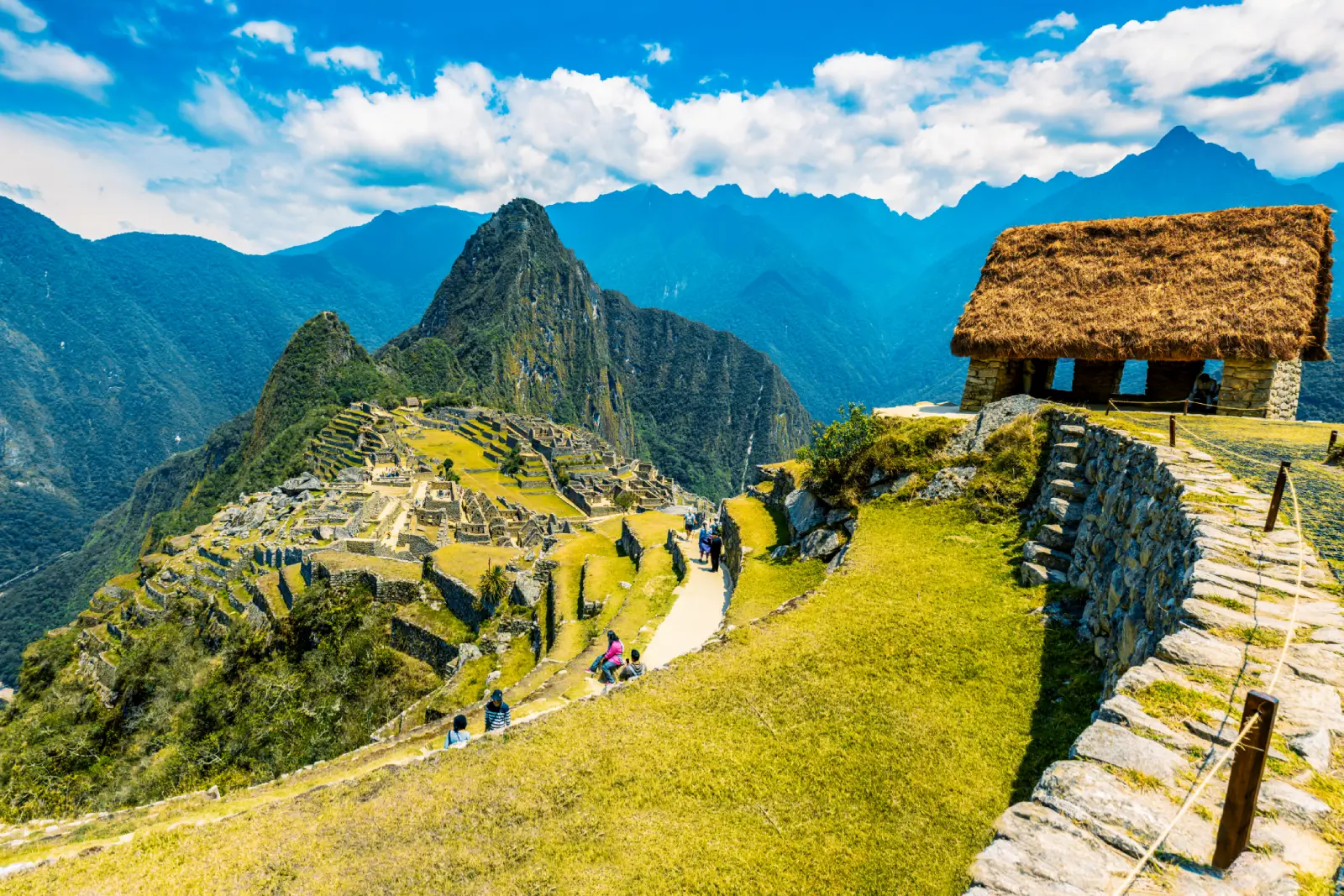
Machu Picchu at the end of Salkantay.
How Difficult Is the Salkantay Trek in 3 Days?
There is no single difficulty rating for every three-day route because the walking line is not standardized. What makes the format hard is usually not technical terrain but the combination of high altitude, long descents, substantial daily mileage and very limited recovery time.
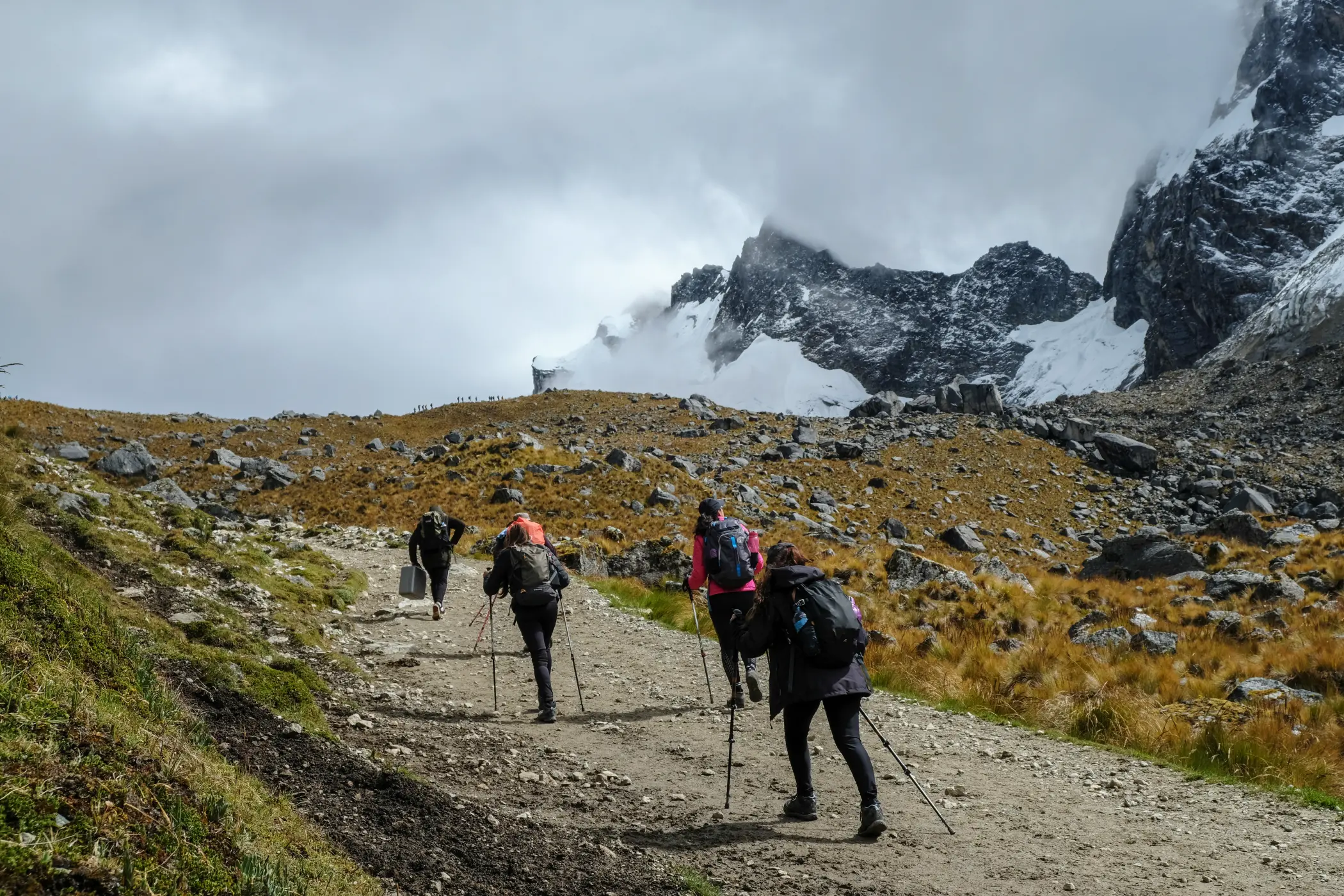
Approach to Salkantay Pass.
| Route style | Typical workload | Practical difficulty |
| Balanced through-route | About 9.9 mi (16 km) on Day 1, followed by another substantial cloud-forest day. | Hard; high altitude still arrives immediately. |
| Aggressive through-route | Often around 13–14.6 mi (21–23.5 km) on Day 1 with the pass and long descent combined. | Very hard; the opening day can be punishing if you are not acclimatized. |
| Llactapata challenge | Current examples publish roughly 13.7 mi (22 km) on Day 1 and 15 mi (24 km) on Day 2. | Very hard; two long days back to back with little recovery. |
| Humantay + Pass + train | Less continuous trail mileage, but separate high-altitude efforts to Humantay Lake and Salkantay Pass. | Moderate to challenging for a fit, acclimatized traveler; altitude remains the main stressor. |
Keep this in mind:
The toughest three-day versions are not simply shortened Salkantay treks; they are compressed ones. A shorter calendar can mean a much harsher workload per trekking day.
Travelers attempting a through-route should arrive in the Cusco region already acclimatized and with a reasonable hiking base. The Cusco altitude guide covers acclimatization, while the Salkantay Trek difficulty guide goes deeper into terrain, altitude load and the hardest sections. The preparation guide covers training and readiness rather than repeating them here.
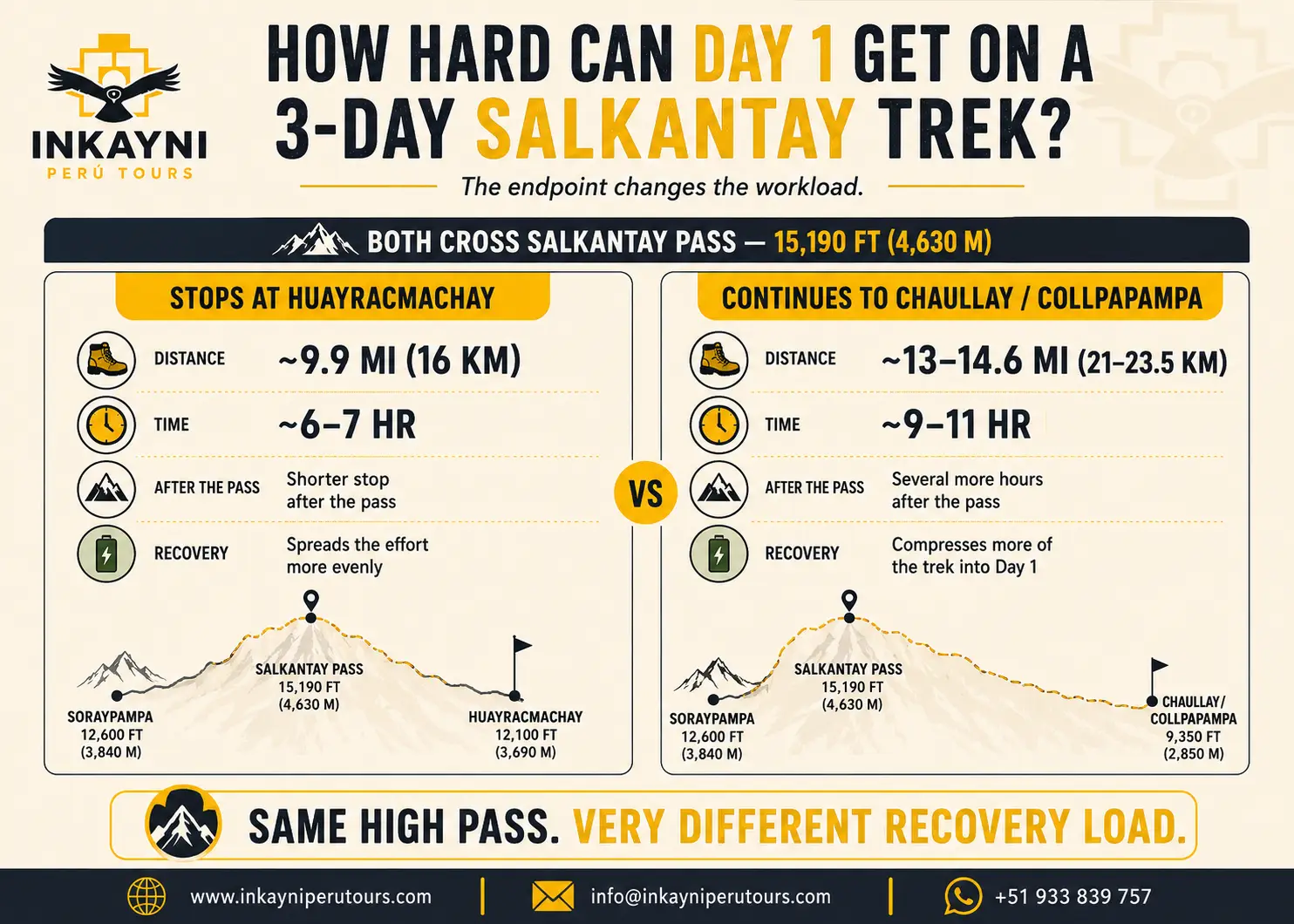
Day 1 difficulty on the 3-day Salkantay Trek.
How Far Is the Salkantay Trek in 3 Days?
Through-trekking versions commonly publish about 24–33 mi (38–53 km) of hiking. That range is useful only when the itinerary actually continues beyond Salkantay Pass toward the cloud forest and Aguas Calientes.
Train-heavy highlight versions can be substantially shorter because they replace the lower-valley crossing with road and rail transport. That is why a single headline mileage figure cannot describe every product sold as a “3-day Salkantay Trek.”
A route that stops at Huayracmachay on Day 1 and uses more transport later tends toward the lower end. A version that reaches Chaullay, preserves Llactapata or walks more of the lower approach moves toward the upper end.
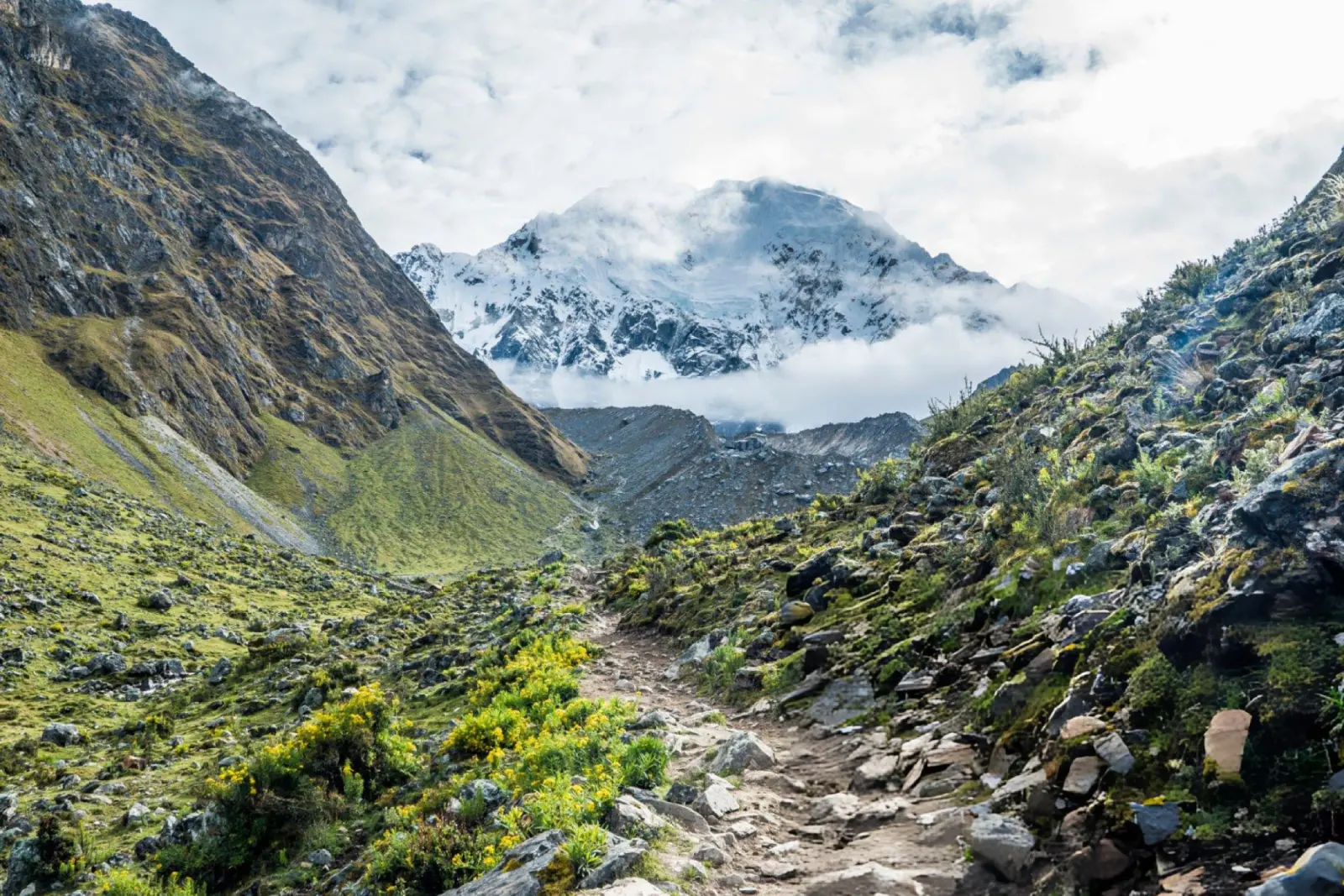
Trail views toward Salkantay Mountain on the route.
Keep this in mind:
Before comparing two distance totals, check the actual trailhead, the first-night camp, whether the route continues beyond Salkantay Pass, where vehicle transport begins, whether Llactapata is included and whether the Hidroeléctrica–Aguas Calientes section is walked or replaced by train.
The dedicated Salkantay distance and duration guide compares wider mileage and walking-time patterns without turning this 3-day itinerary page into a general distance article.
Is Humantay Lake Included in a 3-Day Salkantay Trek?
Not always. Humantay Lake sits around 13,780 ft (4,200 m), and fitting it into a three-day schedule forces the itinerary to make a trade-off somewhere else.
A fast through-route may omit Humantay so the group can reach Salkantay Pass and descend farther on Day 1. Another version may include the lake but stop overnight at Soraypampa. Some highlight-focused itineraries then climb to Salkantay Pass on Day 2, return toward Soraypampa and use road plus train transport to reach Aguas Calientes instead of continuing through the cloud forest.
That distinction matters: Humantay Lake + Salkantay Pass + Machu Picchu can all fit into three days, but keeping all three highlights does not necessarily mean you are walking the same continuous Salkantay route toward Machu Picchu.
If Humantay is a must-have rather than a bonus, confirm both that it is included and what the itinerary does after Salkantay Pass.
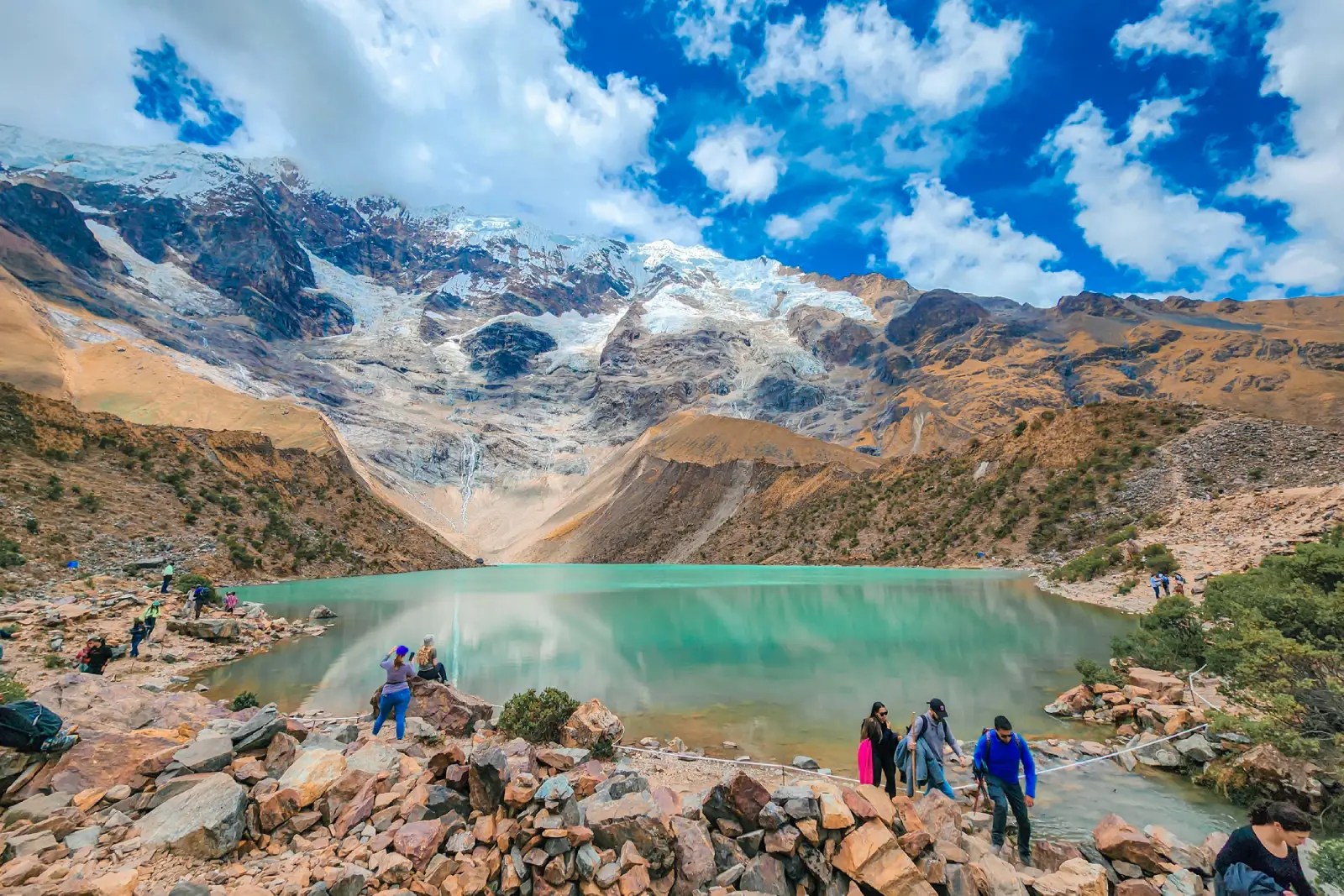
Humantay Lake below snowy peaks.
Is a 3-Day Salkantay Trek Right for You?
| 3 days can make sense if… | A longer route is usually better if… |
| Three days is a hard limit in your Peru itinerary. | You can spare one or two extra days. |
| You are already acclimatized and reasonably fit. | You are arriving in Cusco immediately before departure. |
| You care more about reaching key Salkantay highlights than following one fixed “classic” walking line. | You want Humantay, Salkantay Pass, cloud forest and Llactapata without compressing or trading away major sections. |
| You accept road or train transfers as part of the compressed design. | You want to keep a larger percentage of the route on foot. |
| You are comfortable with two substantial hiking days back to back. | You prefer more recovery between demanding stages. |
If you have more time, compare the 4-day Salkantay Trek or the 5-day Salkantay Trek. Those pages explain their own route designs; this one remains focused on what makes a three-day Salkantay itinerary work.
How Much Does a 3-Day Salkantay Trek Cost?
Current public three-day services vary widely because the routes and inclusions are not standardized. Across current Cusco-market examples, a practical planning range for organized group-style options is roughly US$320–700 per person. Private or upgraded versions commonly move into roughly the US$650–800+ per person range.
The ranges overlap because a higher price does not automatically mean more walking. A train-heavy itinerary can cost more because of rail tickets and accommodation, while a demanding through-route may cost less or more depending on camp quality, group size and included support.
| Market pattern | Planning range | What usually moves the price |
| Lean/shared services | US$320–500 | Simpler accommodation, larger groups, lower-cost return logistics or fewer upgrades. |
| Fuller group/challenge services | US$450–700 | More trail support, upgraded camps, hotel night, train logistics and broader inclusions. |
| Private or upgraded services | US$650–800+ | Private guiding, smaller groups, upgraded lodging, higher train class or customized logistics. |
Before comparing price ranges, confirm what is actually included:
| Before comparing prices | Confirm what is actually included |
| Machu Picchu | Entrance ticket and exact circuit/route. |
| Aguas Calientes | Hotel category and meals. |
| Return | Tourist train, train class or car-based return. |
| Trail support | Meals, camping, luggage allowance, horses/muleteers and emergency support. |
| Route | Humantay Lake, Llactapata, first-night camp and how much of the lower valley remains on foot. |
| Rental gear | Sleeping bag, trekking poles and any other equipment not included. |
Important note:
Inkayni does not currently publish a standard 3-day Salkantay group product, so there is no live Inkayni 3-day price to quote. Treat the ranges above as market-planning references and confirm the exact route and inclusions for your travel dates.
What to Confirm Before Booking a 3-Day Salkantay Trek
The shorter the itinerary, the more important the exact walking line becomes. Ask for the written route before paying and check these points:
- Starting point: Challacancha, Soraypampa or another trailhead?
- Day 1 endpoint: Huayracmachay, Chaullay, Collpapampa, Lucmabamba or somewhere else?
- After Salkantay Pass: do you continue toward Wayracmachay/Chaullay or return toward Soraypampa?
- Humantay Lake: included, optional or omitted?
- Total hiking distance: how many miles are actually walked, day by day?
- Lower-valley transport: where does a vehicle replace hiking?
- Llactapata: included on foot or bypassed?
- Hidroeléctrica: walk to Aguas Calientes or use the train?
- Aguas Calientes: what hotel category is included?
- Machu Picchu: which circuit and route will be booked?
- Return logistics: what train service or car return is included?
- Luggage support: how much personal gear can be carried for you?
Salkantay does not use the limited Classic Inca Trail permit system, but Machu Picchu still uses date-, time- and route-specific tickets. If you are trying to build a compressed route independently, the Salkantay Trek on your own guide covers the additional transport, lodging and navigation decisions.
Continue Planning Your Salkantay Trek
Only Have Three Days? Choose the Route Before You Book
A well-designed 3-day Salkantay itinerary can still give you Salkantay Pass, dramatic Andean scenery, Machu Picchu and—depending on the route—part of the cloud-forest transition, Humantay Lake or Llactapata. The trade-off is that three days leave almost no room to keep everything without adding very long hiking days or more transport.
Inkayni currently publishes a 4-day Salkantay route and a 5-day Salkantay route. If three days is a hard limit, talk to a travel specialist about what is currently possible for your dates and ask for the exact walking line before choosing by price alone.
Frequently Asked Questions About the Salkantay Trek 3 Days
Is there one standard 3-day Salkantay Trek itinerary?
No. Current three-day itineraries use different trailheads, camps and transfer sections. Some continue through Salkantay Pass toward the cloud forest, some add Llactapata, and others preserve Humantay Lake by using more road and train transport.
How many miles is the Salkantay Trek in 3 days?
Through-trekking versions commonly publish roughly 24–33 mi (38–53 km) of hiking. Train-heavy highlight versions can be substantially shorter, so compare the day-by-day walking line instead of relying on one headline total.
Does a 3-day Salkantay Trek include Humantay Lake?
Not always. Fast through-routes often omit Humantay so they can cross Salkantay Pass and descend farther on Day 1. Other versions keep Humantay, then compensate with more road or train transport later.
What is the highest point on a 3-day Salkantay Trek?
For itineraries that cross the standard pass, the highest point is Salkantay Pass at about 15,190 ft (4,630 m). Published operator figures can differ slightly because of GPS readings and rounding.
Is the 3-day Salkantay Trek harder than longer routes?
It can be much harder per hiking day. Aggressive through-routes may combine Salkantay Pass with a long descent on Day 1 and another major cloud-forest stage on Day 2. Train-heavy versions remove more walking, so not every 3-day itinerary has the same difficulty.
What is the hardest 3-day Salkantay route?
The hardest current patterns are the walking-focused challenge routes that push beyond Salkantay Pass toward Chaullay/Collpapampa on Day 1 and then keep a long Day 2, especially versions that also include Llactapata. Some publish roughly 13–15 mi (22–24 km) on each of the first two days.
Can beginners do the Salkantay Trek in 3 days?
A fit, acclimatized first-time multi-day trekker can complete some three-day routes, but the through-trekking versions are less forgiving than longer itineraries because the first two days can be long and recovery time is limited. A train-heavy version may be more realistic for travelers who prioritize the highlights over continuous trekking.
How much does a 3-day Salkantay Trek cost?
Current group-style services commonly fall around US$320–700 per person, while private or upgraded versions can move into roughly the US$650–800+ per person range. Compare the walking route, Machu Picchu ticket, hotel, return transport and trail support before comparing price ranges.
Does the 3-day Salkantay Trek include Machu Picchu?
Most tours specifically sold as a “3-day Salkantay Trek to Machu Picchu” use Day 3 for the archaeological visit and return to Cusco. Confirm the exact Machu Picchu circuit, route and entry time before booking.
Autor
Shared:


If you liked this article and the information you found, give us 5 stars!
 (2 votos, promedio: 5.00 de 5)
 Loading...