


How Long Is the Salkantay Trek?
The Salkantay Trek to Machu Picchu usually takes 4 or 5 days, but there is no single official distance for every itinerary. A 4-day route commonly covers about 27–38 mi (44–61 km), while fuller 5-day routes often cover about 37–46 mi (60–74 km). Distances vary because operators may use different trailheads, include or skip Humantay Lake or Llactapata, and replace some lower-valley sections with vehicle or train transfers.
Table of Contents
The familiar question “how long is the Salkantay Trek?” therefore has more than one correct answer. A shorter itinerary does not simply remove a night from the same route: it can change the trailhead, daily mileage, transfers and the way the mountain-to-cloud-forest journey is divided. That is why two genuine Salkantay itineraries can reach Machu Picchu in different numbers of days and report different total distances.
For planning, it is more useful to compare Salkantay Trek length, daily walking time, miles and kilometers together rather than relying on one headline number. If you still need the route, camps, weather and overall logistics before comparing duration, start with the complete Salkantay Trek to Machu Picchu guide.

Salkantay distance depends on the itinerary, but most complete routes require several long hiking days before Machu Picchu.
Important:
There is no single official Salkantay Trek duration or distance. The day count describes an itinerary, not one fixed trail. That is why distances are more useful as approximate ranges: a 3-day route may use more transfers, a 4-day route may concentrate the walking into fewer days, and a 5-day route may keep more of the lower approach on foot. Compare the actual walking line, miles, daily hours and transfers before comparing tour names.
Salkantay Trek Duration at a Glance
For most travelers, 4 or 5 days is the normal planning range for a complete Salkantay journey to Machu Picchu. The table below goes wider because the same Salkantay name is also used for compressed 3-day itineraries, a short 2-day high-mountain circuit and longer combinations with the Inca Trail.
| Format | How the route works | Approx. walking distance | Machu Picchu? |
| 2 days | A high-mountain circuit through the Humantay and Salkantay Pass sector, then back toward Cusco. | Most comparable 2-day Humantay + Salkantay Pass routes are about 13–15 mi (21–24 km). Inkayni’s current itinerary sits near the upper end at about 14.9 mi (24 km) across the two trekking days. | No. It is not the full trekking route to Machu Picchu. |
| 3 days | A compressed Salkantay-to-Machu-Picchu format. To fit the route into three days, operators normally shorten or transfer part of the lower-valley journey. | Compressed 3-day routes commonly work out to roughly 24–28 mi (38–45 km) on foot, but the number changes quickly when agencies count vehicle sections differently. | Yes, when sold specifically as a 3-day Salkantay Trek to Machu Picchu. |
| 4 days | A complete Salkantay-to-Machu-Picchu itinerary with three main trekking days before the archaeological visit. | A practical range is about 32–38 mi (52–61 km) for many 4-day configurations. Inkayni’s current itinerary is about 32.3 mi (52 km). | Yes. |
| 5 days | A fuller classic-style route with four main trekking days before Machu Picchu and more of the lower approach kept on foot. | A useful range is about 43–49 mi (69–79 km), depending on how much of the lower approach and final-day walking is counted. Inkayni’s current itinerary lists 42.9 mi (69 km) across the four main trekking days before Machu Picchu. | Yes. |
| 7 days | A Salkantay + Inca Trail combination. It changes route family partway through the journey rather than simply adding two slower days to the 5-day trek. | Seven-day Salkantay + Inca Trail combinations commonly fall around 43–55 mi (69–88 km). Inkayni’s current itinerary is about 48.5 mi (78 km) across the seven days. | Yes, through the regulated Inca Trail section. |
Warning:
A label such as “4-day Salkantay” does not guarantee the same mileage from one agency to another. One itinerary may start hiking closer to Soraypampa, another may count the Humantay Lake detour, and the lower valley can include different combinations of walking, vehicle transfer and train.
Before booking, check four concrete things: total walking distance, expected walking hours per day, which sections use a vehicle or train, and whether the Machu Picchu visit day is included in the advertised mileage. The ranges above are more useful than one headline number because they show what travelers can realistically encounter across different itineraries.
The Inkayni routes used throughout this article provide concrete examples inside those broader patterns: about 14.9 mi (24 km) for the 2-day high-mountain circuit, 32.3 mi (52 km) for the 4-day route, 42.9 mi (69 km) across the four main trekking days of the 5-day route, and 48.5 mi (78 km) for the 7-day Salkantay + Inca Trail combination.
The 2-day route above is the exception: it explores the high-mountain Salkantay sector but returns toward Cusco instead of continuing to Machu Picchu.
GLACIER MOUNTAIN TREKSalkantay Trek
Discover one of Peru’s most scenic treks beneath snowy peaks and changing landscapes.
Compare the 4-Day and 5-Day Salkantay Route Maps
The maps make the pacing difference easier to see: the 4-day reference concentrates about 32.3 mi (52 km) into three main trekking days, while the 5-day reference spreads about 42.9 mi (69 km) across four. The extra day is not just another night—it changes how much of the lower route remains part of the walk.

4-day Salkantay route: about 32.3 mi (52 km) across three main trekking days.

5-day Salkantay route: about 42.9 mi (69 km) across four main trekking days.
How Long Is the Salkantay Trek to Machu Picchu?
For a complete organized Salkantay route to Machu Picchu, plan on 4 or 5 days in most cases. A 3-day Salkantay Trek is possible, but it achieves that schedule by compressing the route and using transfers more aggressively. A 7-day version is a different proposition because it combines Salkantay with the Inca Trail.
The distance usually falls into a recognizable band, even though the exact itinerary still matters:
- 4 days: commonly about 32–38 mi (52–61 km). The route used here is about 32.3 mi (52 km) across three main trekking days before Machu Picchu.
- 5 days: commonly about 43–49 mi (69–79 km) when published itineraries count more of the lower approach and/or final-day walking. The route used here is 42.9 mi (69 km) across four main trekking days before Machu Picchu.
So the fifth day does not simply make the same 4-day walk slower. The route itself can retain more mileage and more of the lower-valley approach. If your concern is whether that pace is physically manageable, use the Salkantay Trek difficulty guide.
How Many Kilometers Is the Salkantay Trek?
There is no single official distance for every itinerary. For a fuller Salkantay Trek to Machu Picchu, 5-day routes commonly land around 43–49 miles (69–79 km), while many 4-day versions sit closer to 32–38 miles (52–61 km). The exact total depends on the starting point, side hikes, transfers and where the operator stops counting the walk.
On the current 5-day itinerary used here as a reference, the published trekking stages are:
| Day | Main section | Distance |
| Day 1 | Soraypampa / Humantay Lake area | 7.5 mi (12 km) |
| Day 2 | Soraypampa → Salkantay Pass → Chaullay | 13.7 mi (22 km) |
| Day 3 | Chaullay → La Playa → Lucmabamba | 11.2 mi (18 km) |
| Day 4 | Lucmabamba → Llactapata → Hydroelectric → Aguas Calientes | 10.6 mi (17 km) |
Those four stages total about 42.9 miles (69 km) before the Machu Picchu visit, which places this itinerary at the lower edge of the typical 5-day range. The 4-day route used here is about 32.3 miles (52 km), also near the lower end of the common 4-day range. The roughly 10.6-mile (17 km) Day 4 section through Llactapata, Hydroelectric and Aguas Calientes shows why another 5-day itinerary can end up several miles longer if it keeps more of the lower approach on foot.
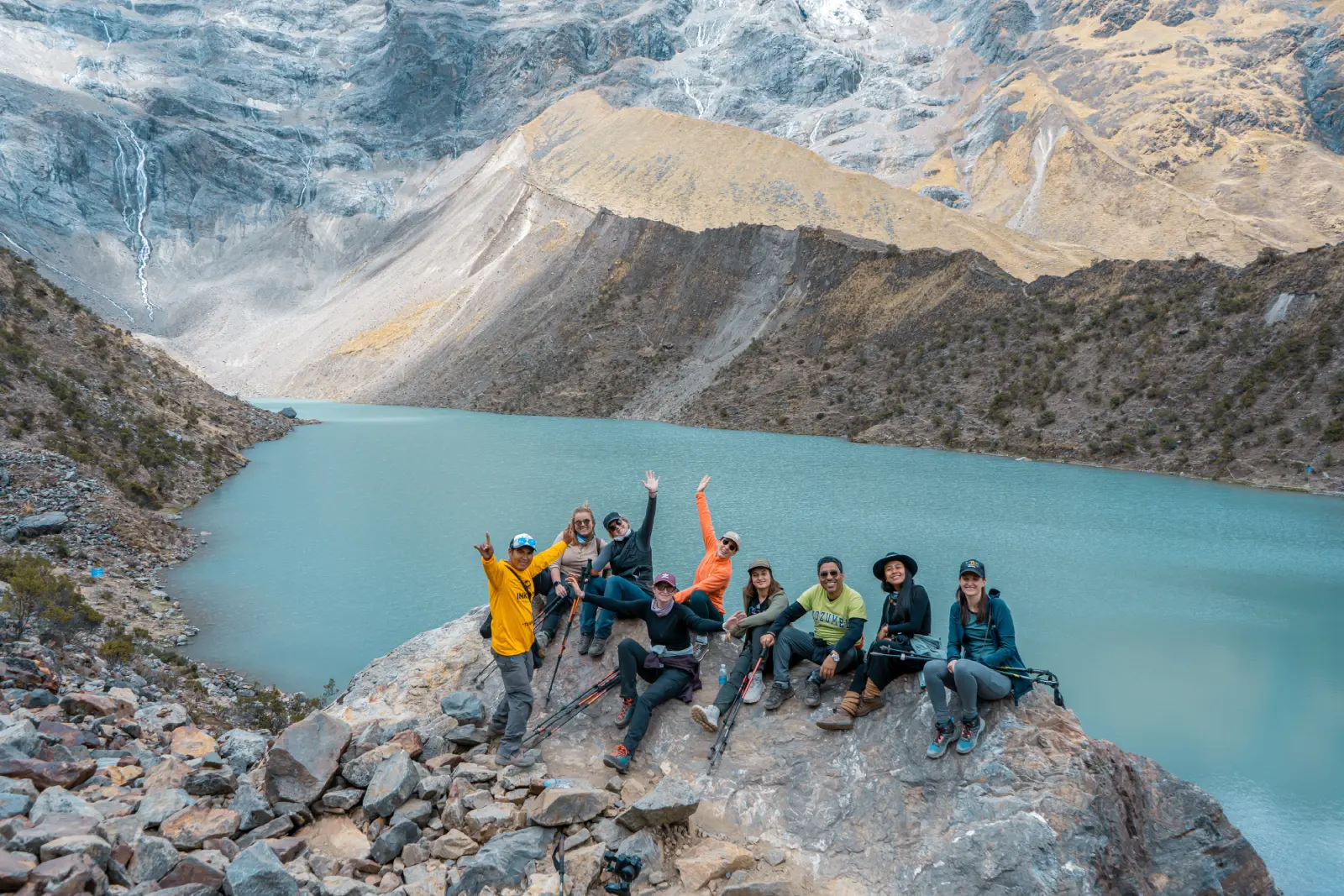
Hikers at Humantay Lake.
How Long Is the Salkantay Trek in Miles?
For U.S. travelers, a practical planning range is about 32–38 mi (52–61 km) for many 4-day routes and roughly 43–49 mi (69–79 km) for many 5-day routes. The itineraries used as examples here are about 32.3 mi (52 km) and 42.9 mi (69 km) across their main trekking days.
If one tour advertises 43 miles and another 49 miles, the difference can be real. Check whether Humantay Lake, Llactapata, Hydroelectric–Aguas Calientes and the Machu Picchu visit day are walked, transferred or counted separately.
How Many Hours Do You Walk Each Day?
On the 5-day itinerary used here, the four main trekking days add up to roughly 28 hours of walking using the published day estimates: about 6, 9, 6 and 7 hours. That does not include road transfers, train travel or the time spent visiting Machu Picchu.
The daily number matters more than the average because Day 2 combines the longest mileage with the highest point of the route.
| Day | Distance | Approx. walking time | What affects the pace |
| Day 1 | 7.5 mi (12 km) | About 6 hours | Altitude and the Humantay Lake side hike. |
| Day 2 | 13.7 mi (22 km) | About 9 hours | Salkantay Pass plus the long descent toward Chaullay. |
| Day 3 | 11.2 mi (18 km) | About 6 hours | Lower altitude but warmer, more humid terrain. |
| Day 4 | 10.6 mi (17 km) | About 7 hours | Llactapata ascent, descent and the final walk to Aguas Calientes. |
Treat those hours as itinerary planning figures rather than a finish-time promise. Breaks, weather and individual pace can shift them, but the table still gives a useful workload picture: 13.7 mi (22 km) can take about 9 hours on the pass day, while 11.2 mi (18 km) is listed at about 6 hours lower in the route.

Daily walking time depends on terrain and altitude as much as the number of kilometers.
Which Is the Longest Day on the Salkantay Trek?
On the 5-day reference used here, Day 2 is the longest stage: about 13.7 mi (22 km) and roughly 9 hours on foot. It also crosses Salkantay Pass at about 15,190 ft (4,630 m), the highest point of this route.
That combination—not mileage alone—is why the day matters. You climb to the pass and then continue through a long descent toward Chaullay. By comparison, Day 3 covers about 11.2 mi (18 km) in roughly 6 hours at lower elevations.
For elevation gain and the physical effects of the pass, continue with the Salkantay Trek difficulty guide. If the numbers already look manageable and you are moving into training, use how to prepare for the Salkantay Trek next.
Why Does Salkantay Elevation Affect Walking Time?
Altitude matters here because it helps explain why mileage does not translate neatly into hours. Two points anchor the 5-day reference:
- Soraypampa: about 12,795 ft (3,900 m).
- Salkantay Pass: about 15,190 ft (4,630 m).
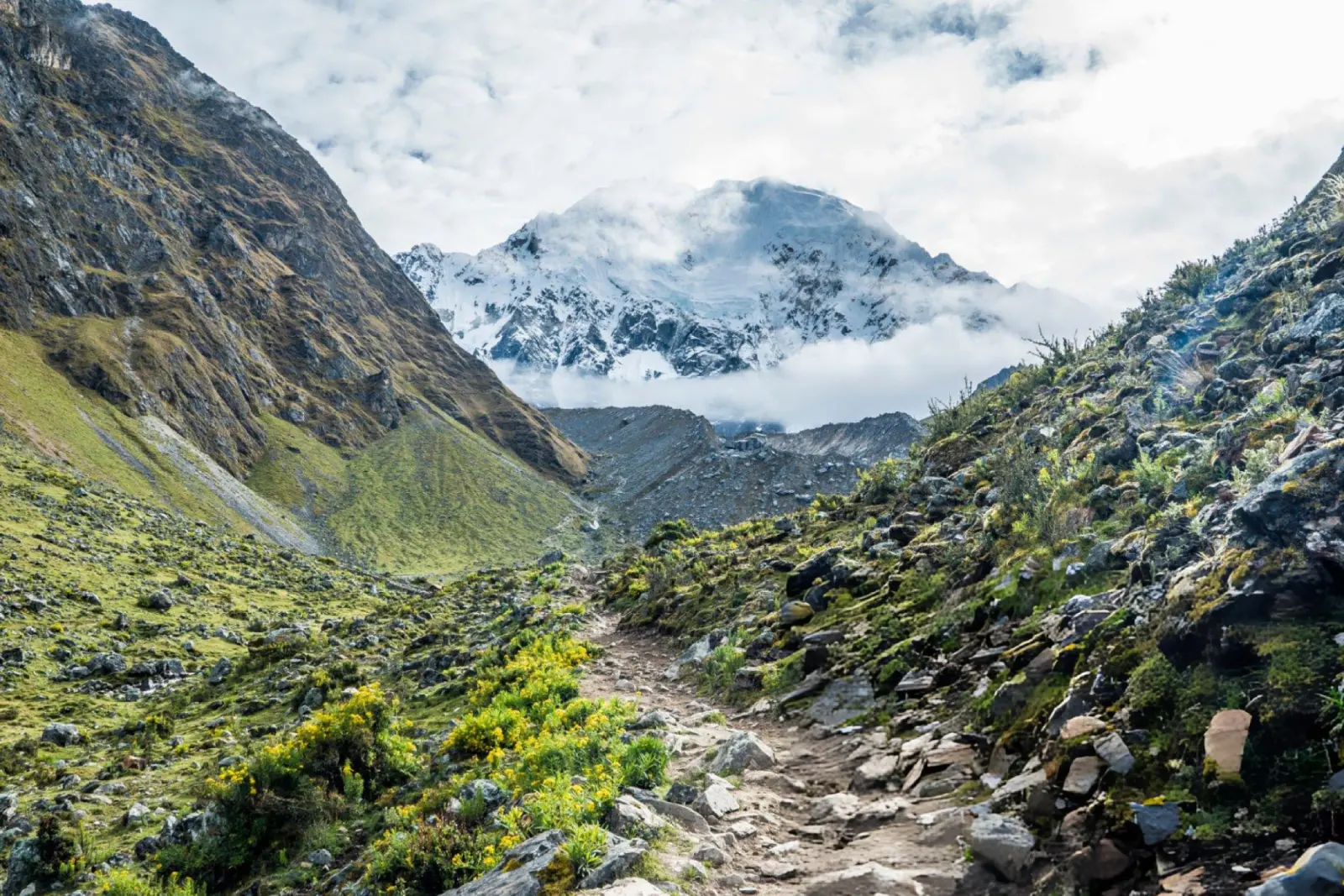
Trail views toward Salkantay Mountain on the route.
The clearest example is Day 2: 13.7 mi (22 km) is scheduled at about 9 hours as the route climbs to the pass and then descends. Day 3 is still long at 11.2 mi (18 km), but its published walking time drops to about 6 hours as the itinerary moves into lower, warmer terrain. That comparison is more useful for planning than assuming a fixed walking speed per mile.
Important note:
If your main question is Salkantay Trek elevation, altitude symptoms or elevation gain, use the difficulty and elevation analysis. This article uses altitude only where it changes the time-and-distance picture.
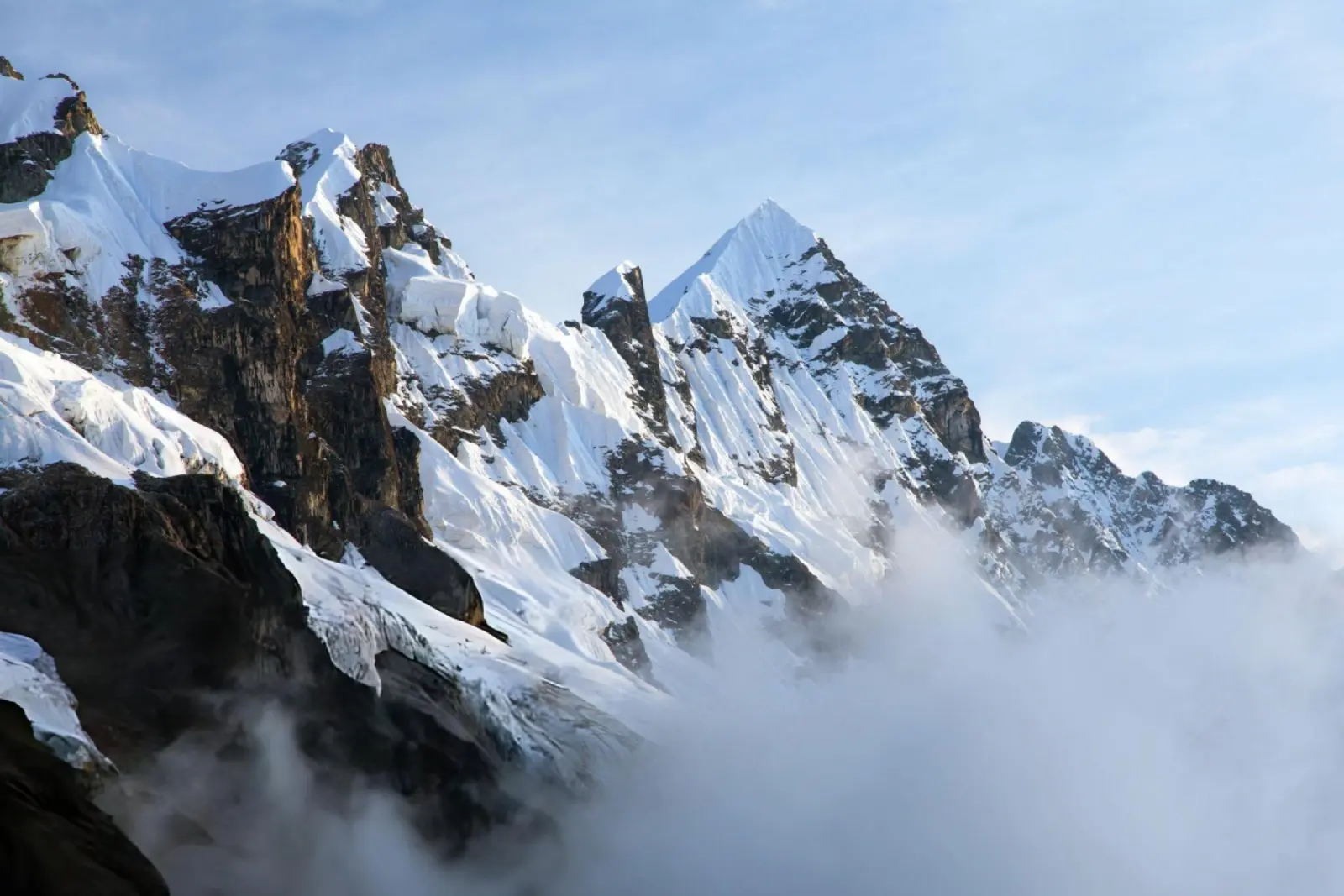
Close-up of Salkantay Mountain’s snow-covered ridges.
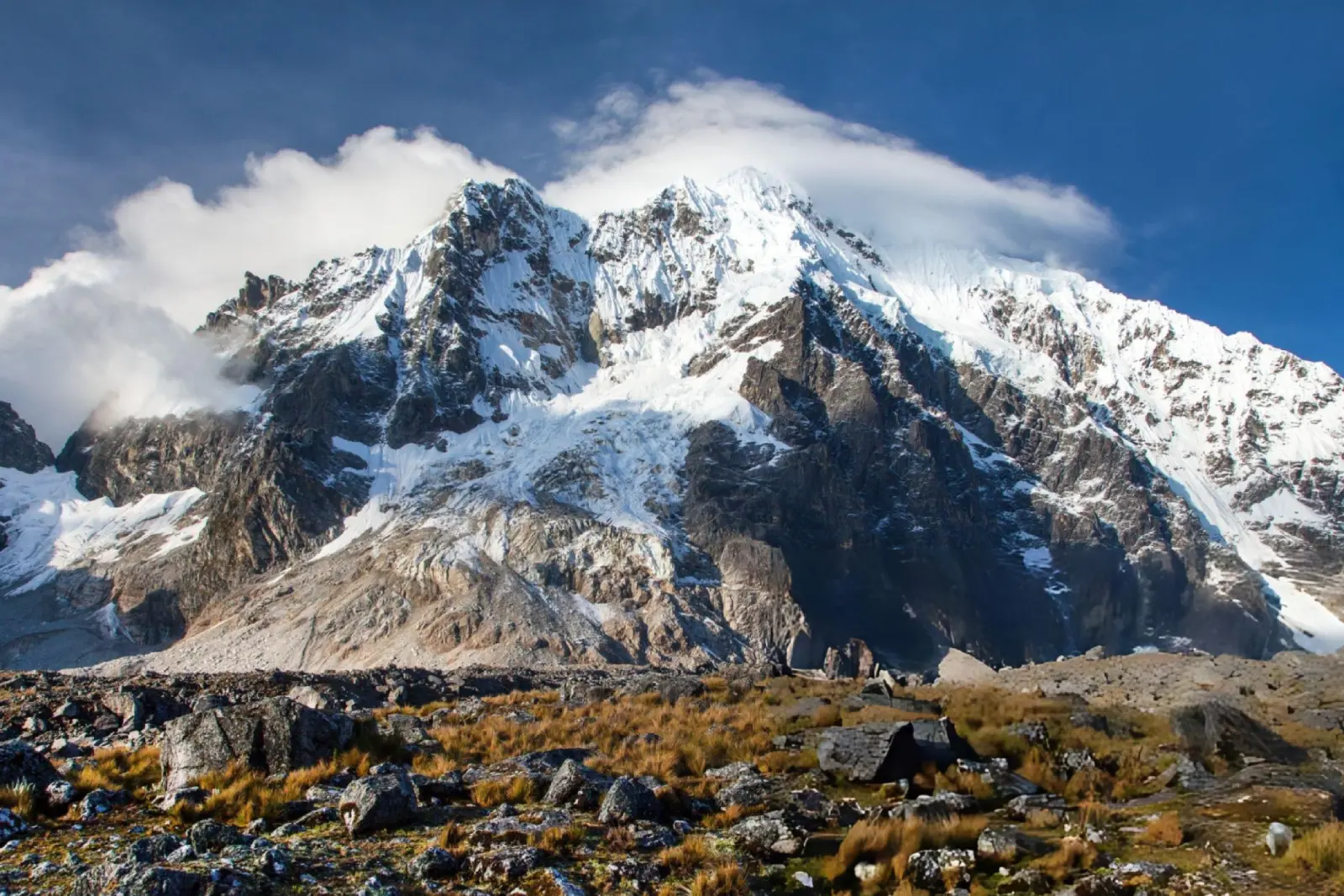
Salkantay Mountain dominating the high-Andean landscape in Salkantay pass.
4 Days or 5 Days: Which Salkantay Duration Makes More Sense?
Choose the 4-day route if four calendar days is a hard limit and you are comfortable concentrating the journey into fewer trekking days. Many 4-day itineraries fall around 32–38 mi (52–61 km); the route used here is about 32.3 mi (52 km) before the Machu Picchu visit.
Choose the 5-day route if you can give the trek another day and want more of the route kept as part of the walking journey. Published 5-day itineraries commonly fall around 43–49 mi (69–79 km); the route used here covers 42.9 mi (69 km) across four main trekking days before the Machu Picchu visit.
For that version specifically, use the 5-day Salkantay Trek guide. The 5-day option is longer in total, so it is not automatically “easier.” Its advantage is that the route has another day in which to distribute the experience.
For the exact camps and transfers, use the dedicated 4-day Salkantay Trek page or the 3-day Salkantay Trek guide if you are considering an even tighter schedule.
Why Do Different Websites Give Different Salkantay Distances?
Because there is no single mandatory Salkantay trailhead-to-finish sequence. Published totals usually diverge at a handful of specific places:
- Starting point: walking from farther back near Challacancha adds mileage compared with being driven closer to Soraypampa.
- Humantay Lake: some totals include the side trip; others list it separately.
- Lower-valley transfers: sections around Chaullay, La Playa or Lucmabamba may be shortened by vehicle.
- Llactapata: routes that climb through Llactapata add a substantial walking section that compressed itineraries may bypass.
- Hydroelectric to Aguas Calientes: this may be walked or replaced by train depending on the itinerary.
- Machu Picchu day: some operators stop the mileage count at Aguas Calientes; others add walking associated with the final visit.
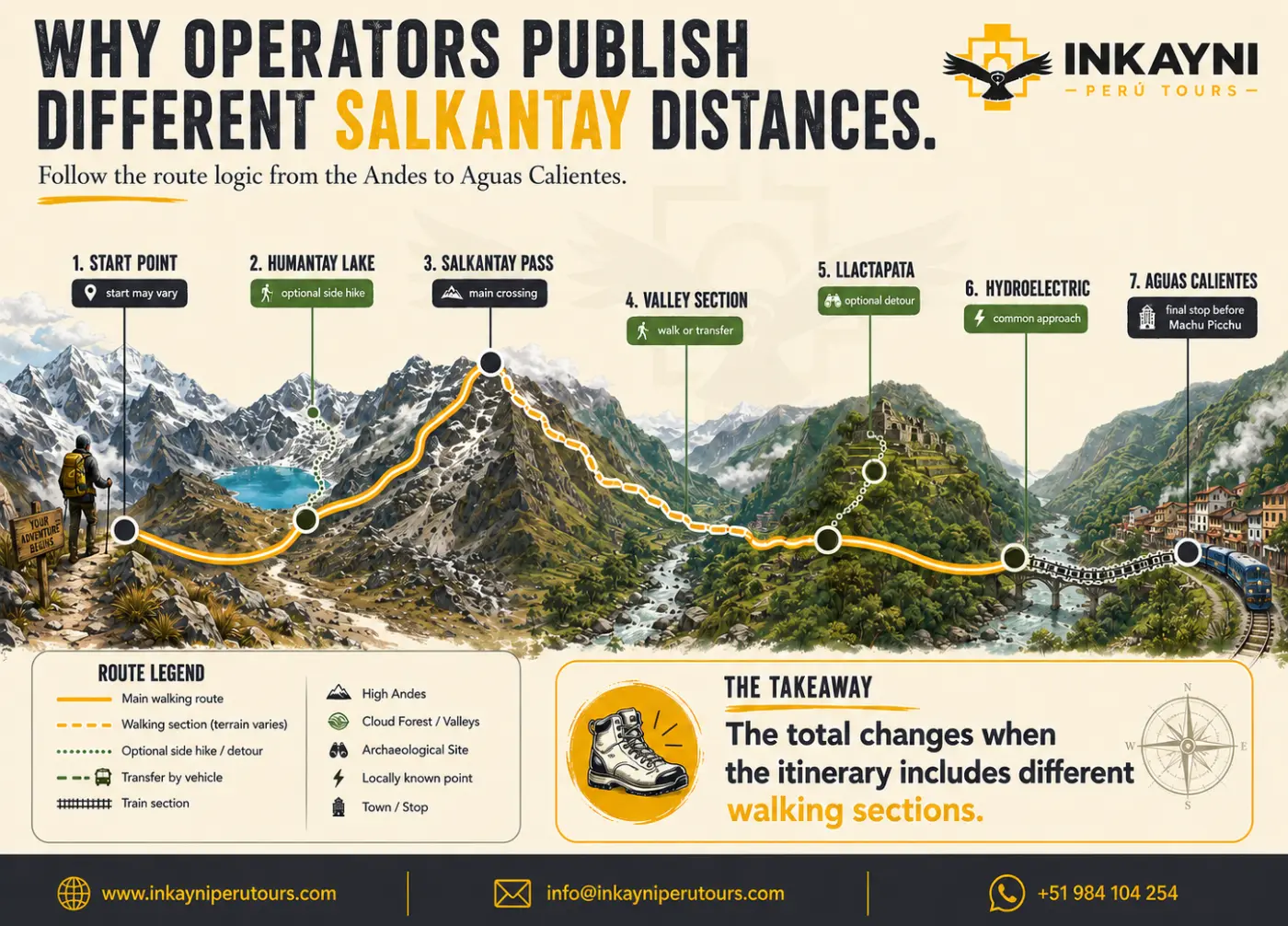
Why Salkantay trekking distances vary between routes and operators.
The 5-day benchmark in this article shows the effect clearly: its Day 4 alone contributes about 10.6 mi (17 km) from Lucmabamba through Llactapata and Hydroelectric to Aguas Calientes. An itinerary that transfers or bypasses part of that lower approach can publish a much smaller total without changing the fact that it is sold as a Salkantay route to Machu Picchu.
That is why a 4-day route may be published in the low-to-upper 30-mile range, while a 5-day route may land anywhere from the low-to-upper 40s. The useful comparison is not the headline mileage by itself; it is where you walk those miles and what the itinerary counts.
Once you know the route you are actually walking, the Salkantay preparation guide is the better place to turn mileage and elevation into a training plan.
Plan the Rest of Your Salkantay Trek
Choose the Salkantay Duration That Matches Your Trip
By this point, the decision should come down to how many days you actually have, how much of the route you want to walk and how much compression you accept. If the real decision is whether Salkantay is the right trek at all, compare the Salkantay Trek vs. Inca Trail before choosing by duration alone.
| If this is your priority | Best fit | What you are accepting |
| Reach Machu Picchu through Salkantay with only three days available | 3-day route | Usually around 24–28 mi (38–45 km) on foot on compressed published routes, with more transfer support than longer versions. |
| Fit a complete route into a shorter Peru itinerary | 4-day route | Commonly about 32–38 mi (52–61 km); the itinerary used here is about 32.3 mi (52 km). |
| Keep more of the mountain-to-cloud-forest journey on foot | 5-day route | Commonly about 43–49 mi (69–79 km); the itinerary used here is 42.9 mi (69 km) before the final Machu Picchu visit. |
| Combine Salkantay with the archaeological approach of the Inca Trail | 7-day combination See the Salkantay + Inca Trail guide |
Usually about 43–55 mi (69–88 km) across published combinations; Inkayni’s current itinerary is about 48.5 mi (78 km), plus Inca Trail permit requirements. |
If your goal is only Humantay Lake and the Salkantay Pass sector rather than reaching Machu Picchu through this route, the 2-day high-mountain option is a different category and avoids committing four or five days to the full journey.
Compare the 5-day Salkantay route with the 4-day option, or talk to a travel specialist if you want the exact walking sections checked against your dates and pace.
Frequently Asked Questions About Salkantay Trek Length and Duration
How long does the Salkantay Trek take?
Most complete organized routes to Machu Picchu take 4 or 5 days. Three-day versions exist but compress the route and normally use more transfers; their walking distance varies enough that it should be checked itinerary by itinerary. Longer combinations can take 7 days when Salkantay is joined with the Inca Trail.
For the routes compared here, 4 days means three main trekking days, while 5 days means four main trekking days plus the Machu Picchu visit on Day 5. The main Salkantay route guide compares the broader itinerary options.
How many miles is the Salkantay Trek?
A 4-day Salkantay route commonly falls around 32–38 mi (52–61 km), while many 5-day routes are around 43–49 mi (69–79 km). The itineraries used as concrete examples in this article are about 32.3 mi (52 km) for 4 days and 42.9 mi (69 km) across the four main trekking days of the 5-day route.
How many kilometers is the Salkantay Trek?
Using miles first for U.S. travelers, expect roughly 32–38 mi (52–61 km) for many 4-day itineraries and 43–49 mi (69–79 km) for many 5-day itineraries. Three-day compressed routes are often closer to 24–28 mi (38–45 km). The exact number only becomes meaningful once you know which sections are actually walked.
How many hours do you walk per day on the Salkantay Trek?
On the 5-day reference used here, the main trekking days are approximately 6, 9, 6 and 7 hours, or about 28 scheduled walking hours in total before the Machu Picchu visit. Day 2 is the longest at about 13.7 mi (22 km) and roughly 9 hours.
What is the longest day on the Salkantay Trek?
On the current 5-day reference, Day 2 is the longest stage at about 13.7 mi (22 km) and roughly 9 hours. It also crosses Salkantay Pass at about 15,190 ft (4,630 m), so it combines the longest distance with the highest point of the route.
Is the 4-day Salkantay Trek easier because it is shorter?
Not automatically. Four-day routes are commonly around 32–38 mi (52–61 km), while 5-day routes often reach roughly 43–49 mi (69–79 km). The 4-day option usually has less total walking but compresses the route into fewer trekking days, so lower mileage does not automatically mean an easier rhythm.
Can the Salkantay Trek be shortened with transport or a train?
Yes. Lower-valley sections around La Playa, Lucmabamba, Hydroelectric and Aguas Calientes are where itineraries often diverge. Some operators use vehicle transfers, and the Hydroelectric–Aguas Calientes section may be replaced by train. Those choices can remove miles and hours from the walking total without changing the trip name.
Does the published Salkantay distance include the Machu Picchu visit day?
Not always. Some operators stop the mileage count at Aguas Calientes, while others add walking associated with the final Machu Picchu day. In the 5-day itinerary used here, the four main trekking days total 42.9 mi (69 km); Day 5 separately lists about 1.25 mi (2 km) of walking, which would bring the published walking total to roughly 44.1 mi (71 km) if both were combined.
That is one reason 5-day totals can legitimately fall at different points within the broader range. Check what the operator includes before comparing two numbers. For the final archaeological visit itself, use the Machu Picchu travel guide rather than treating those steps as part of the trekking-distance question.
Autor
Shared:


If you liked this article and the information you found, give us 5 stars!
 (Ninguna valoración todavía)
 Loading...