


Can You Do the Salkantay Trek on Your Own?
Yes, you can do the Salkantay Trek on your own because the standard route does not require the mandatory guide-and-permit system used on the Classic Inca Trail. The real challenge is logistics: you must arrange transport to the trailhead, lodging or camping, food, water, offline navigation, local access fees, your Machu Picchu ticket and the return to Cusco.
Table of Contents
Doing the Salkantay Trek on your own is no longer limited to hikers willing to carry a tent, stove and several days of food. Independent travelers can now combine shared transport, simple lodges, trail meals and a pre-booked Machu Picchu ticket while still hiking the route without a tour group. The freedom is real, but so is the responsibility. Without an agency, you become your own logistics team.
| DIY allowedno mandatory guide | 15,190 ftSalkantay Pass (4,630 m) | Mollepatamain access hub | Book firstMachu Picchu ticket |
PERU’S LEGENDARY HIKEInca Trail to Machu Picchu
Follow the historic trail through mountain passes, Inca sites, and cloud forest paths to Machu Picchu.
Self-Guided Salkantay
The main difference between Salkantay and the Classic Inca Trail is regulatory. Inca Trail permits are limited and tied to authorized operators; Salkantay gives independent hikers much more freedom. That freedom does not remove local rules. You do not need a special trekking permit for Salkantay, but local access fees may apply around Mollepata, Humantay Lake and the Salkantay route. Carry around US$5–8 (S/18–25) in small cash for these local payments, as the amount and collection point can change.
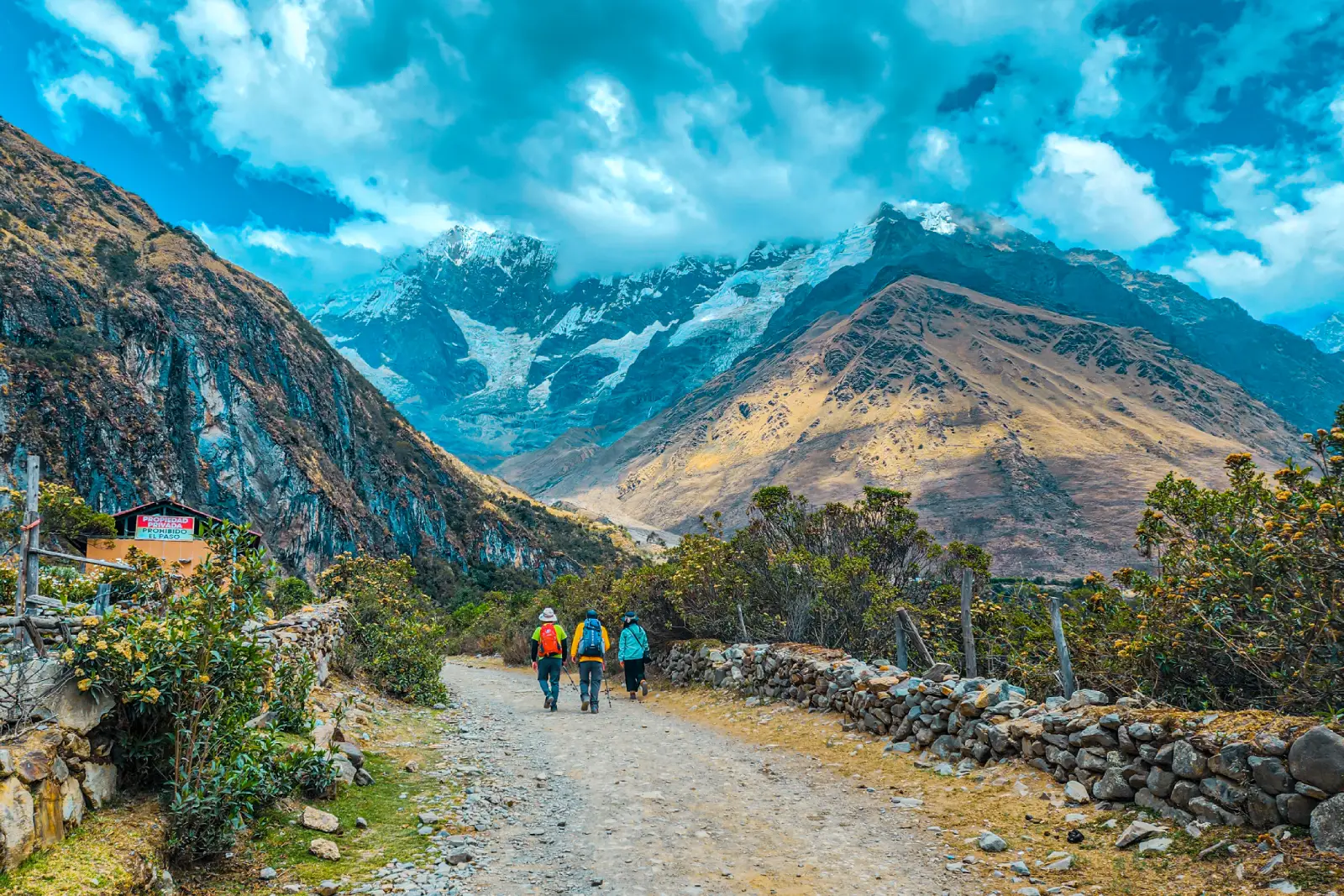
Hiking toward the glacier mountains.
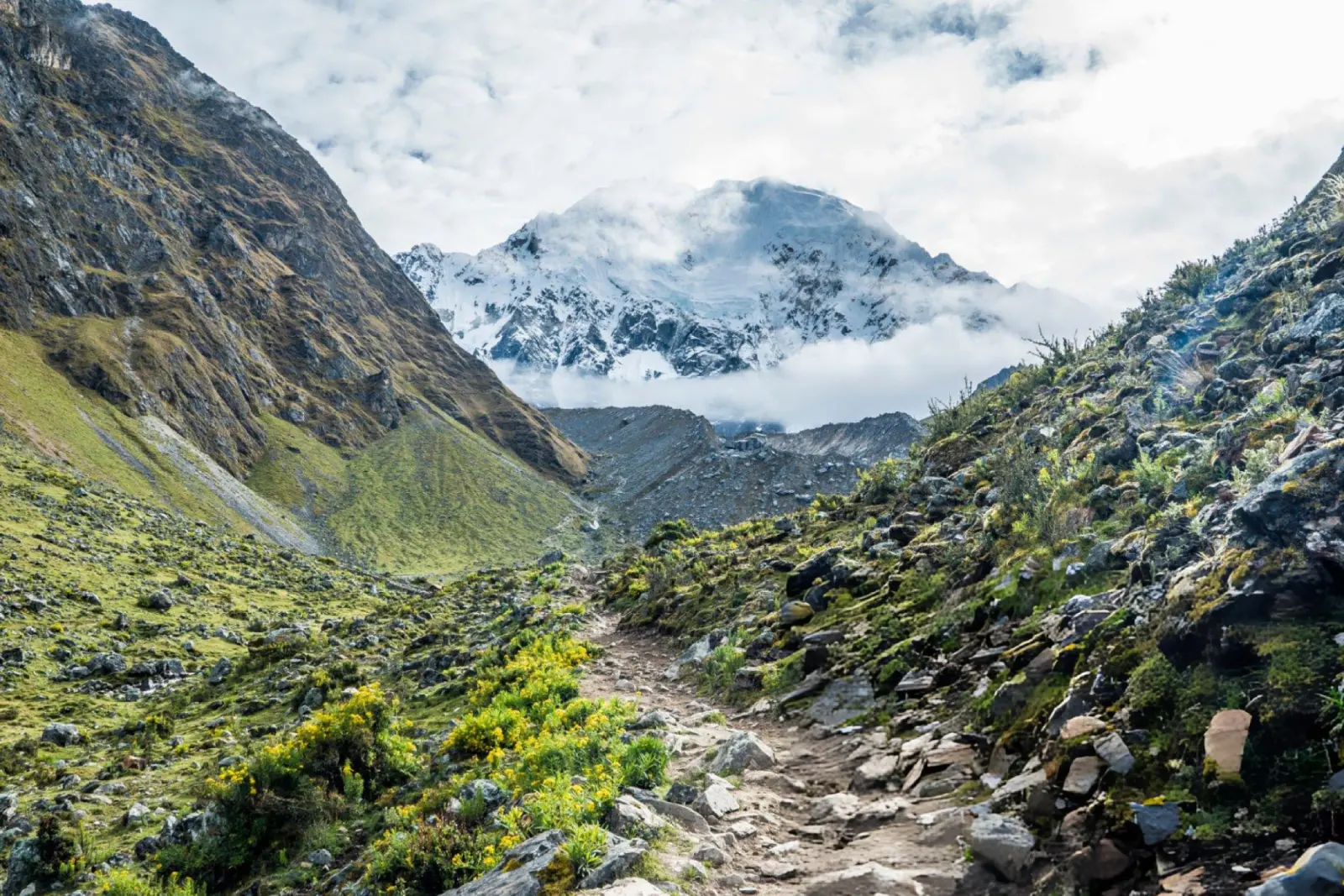
Trail views toward Salkantay Mountain on the route.
Pro tip:
For independent hikers, the challenge is coordination rather than obtaining a trekking permit. You decide where the hike begins, where you sleep, what food and water you carry, how you respond to a trail closure and how your final walking day connects with the fixed time on your Machu Picchu ticket and circuit.
Self-Guided Is Not the Same as Hiking Solo
You can hike independently with a partner or small group and still be completely self-guided. Hiking alone adds a different level of exposure because there is no companion to help with navigation, high-altitude symptoms and trail difficulty, injury, route changes or an unexpected transport problem.
Salkantay is popular enough that you will often see other hikers, lodge staff and local traffic, but that should not be your emergency plan. An independent itinerary works better when someone outside the trek knows your expected overnight stops and when you have enough flexibility to stop early if conditions change.
Who Is a Good Candidate for a DIY Salkantay Trek?
| Self-guided can make sense if… | A guided trek may make more sense if… |
| You already have multi-day hiking experience. | This is your first multi-day mountain trek. |
| You are comfortable using offline navigation and changing plans. | You prefer camps, meals and transport coordinated in advance. |
| You have already acclimatized in Cusco or spent time in the Sacred Valley. | You are unsure how your body responds above 13,000 ft (4,000 m). |
| You want control over pace, lodging and route length. | You want luggage support and help solving operational problems. |
The hiking is demanding even when navigation is straightforward. If your main question is whether your fitness and acclimatization are enough for the pass, use the Salkantay Trek difficulty guide. Going without a guide changes the logistics and pack weight; it does not make the mountain itself easier.
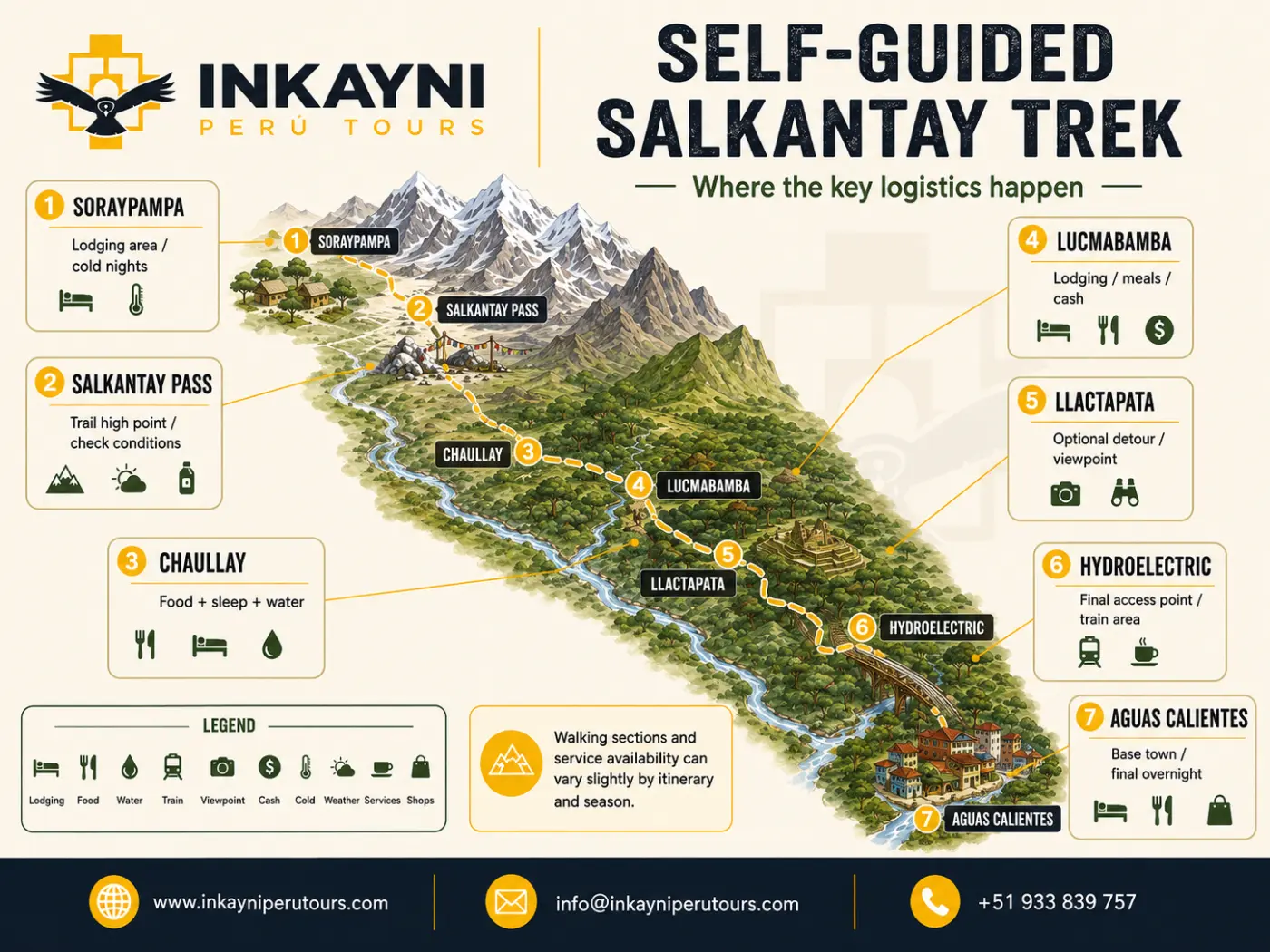
Key logistics and service points on the self-guided Salkantay route.
How to Get From Cusco to the Salkantay Trailhead
This is one of the most important practical parts of a DIY plan. Mollepata is the main access hub, but the actual hiking start on the Salkantay route can be Challacancha, Soraypampa or another point farther along the access road. That difference changes both the morning logistics and how much of the opening route you walk.
Where Does the Salkantay Trek Start?
Mollepata is the transport and service hub. Challacancha is a traditional trailhead for hikers who want to keep more of the opening approach on foot. Soraypampa, at about 12,795 ft (3,900 m), is farther up the road and is the practical first high-altitude base for many independent itineraries. That elevation is also why acclimatization before Salkantay matters, especially if you also plan the Humantay Lake hike.
Starting farther up the road saves time and leg effort but shortens the walking line. If total distance is part of your decision, compare the different route conventions in How Long Is the Salkantay Trek?.
Cusco to Mollepata: Colectivo, Price and Travel Time
Shared colectivos and minivans are the normal budget option from Cusco to Mollepata. A useful current planning range is about US$6–8 (S/20–25) per person, with travel commonly taking around 2–2.5 hours. Vehicles often leave when enough passengers are ready rather than following a rigid public-bus timetable, so an early departure gives you more margin.
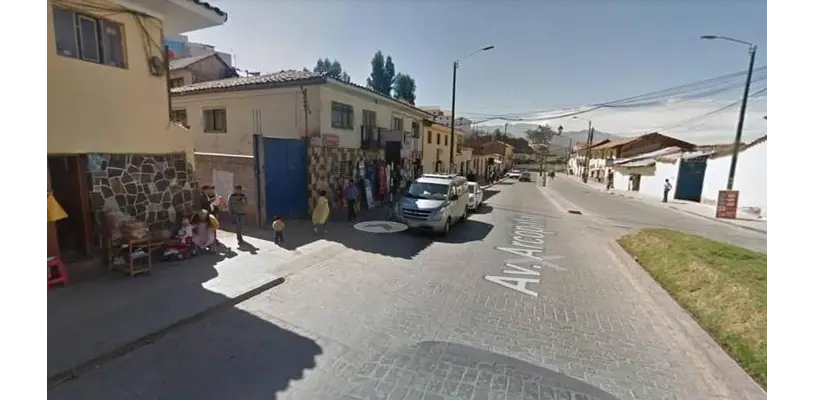
Arcopata and the Av. Mollepata area remain useful references for finding transport, but pickup points can move between operators. Confirm the exact location the day before rather than relying on an old street address or a years-old forum post.
Mollepata to Challacancha
Challacancha preserves more of the traditional opening approach. Independent transport from Mollepata is usually a local taxi, van or shared vehicle rather than one continuous public bus from Cusco.
For budgeting, shared local transport can fall around US$4–6 (S/15–20) per person, while taking most or all of a vehicle yourself can move closer to US$12–18 (S/40–60) per vehicle. The transfer usually takes well under an hour, but road and pickup conditions can change.
Cusco to Soraypampa: Direct or via Mollepata
For a lodge-based DIY trek, reaching Soraypampa on Day 1 is often the most efficient choice. The cheapest logic is usually Cusco → Mollepata → local shared transport toward Soraypampa. Combined shared costs commonly land around US$12–17 (S/40–55) per person when both legs line up well.
Mollepata to Soraypampa: Shared or Private Transfer
For Mollepata to Soraypampa, local shared transport commonly falls around US$6–9 (S/20–30) per person. If you need most or all of the vehicle yourself, a practical whole-vehicle range is closer to US$24–36 (S/80–120). Agree on the price and exact drop-off point before leaving Mollepata.
Direct or semi-direct transfers from Cusco also appear. Shared or accommodation-arranged options can fall around US$15–22 (S/50–70) per person, while a private car from Cusco can move into roughly US$75–105 (S/250–350) per vehicle. Direct service is convenient, but availability is not as standardized as the Cusco–Mollepata colectivo.
Important note:
Road access around Soraypampa can change after heavy rain, landslides or maintenance. A vehicle may stop short of the accommodation zone and leave you with an additional walk. Build daylight and time margin into Day 1.
Which Self-Guided Salkantay Route Makes Sense?
There is no single official DIY itinerary. The broader Salkantay Trek to Machu Picchu route can be shortened by starting farther up the road, skipping a side hike or using a transfer in the lower valley. Treat 3, 4 and 5 days as itinerary formats rather than one fixed trail divided into different calendars.
| Format | DIY reality | Best fit | Detailed route guide |
| 3 days | Compressed; usually needs more transfer support and tight timing. | Experienced hikers with a hard time limit. | 3-day Salkantay Trek |
| 4 days | A practical DIY rhythm from Soraypampa through the pass and lower valleys to Aguas Calientes. | Experienced hikers comfortable with long days and independent decisions. | 4-day Salkantay Trek |
| 5 days | Leaves more room for the lower approach and reduces the need to force later stages. | Travelers who want a fuller hiking line before Machu Picchu. | Salkantay Trek 5 days |
DIY Overnight and Resupply Points at a Glance
Before building a day-by-day plan, identify the places where you can realistically sleep, eat, refill and change your plan. A common independent line is Soraypampa → Salkantay Pass → Chaullay/Collpapampa → Lucmabamba → Llactapata → Hidroeléctrica → Aguas Calientes.
| Location | Why it matters independently | Planning decision |
| Soraypampa | First high-altitude overnight zone and access to Humantay Lake. | Reserve ahead when possible; Humantay visitors add demand. |
| Salkantay Pass | Highest point at about 15,190 ft (4,630 m). | Leave with enough food, water and weather protection; do not treat the pass as a resupply point. |
| Chaullay / Collpapampa | Major lower overnight zone after the pass. | Useful for lodging, meals and checking the next trail section. |
| Lucmabamba | Base for the Llactapata approach. | A strong place to sleep before the final long approach to Aguas Calientes. |
| Hidroeléctrica | Rail and road transport decision point. | Walk to Aguas Calientes, use the short train if available, or coordinate a road return later. |
| Aguas Calientes | Main logistics base below Machu Picchu. | Your arrival, hotel and return plan must work with the time and route on your Machu Picchu ticket. |
Example Self-Guided Salkantay Itinerary: 4 Days
This is not a fixed route you must copy. It is a practical example of how an experienced independent hiker could organize Salkantay in four days, using Soraypampa as the effective starting area and established settlements for overnight stops.
Weather, trail conditions, lodging availability and your Machu Picchu entry route and time can all change the plan. Use the accordion as a framework for understanding what must be solved before each day ends, not as a rigid timetable.
Important note:
Do not copy this itinerary blindly. Before leaving Cusco, confirm your Machu Picchu ticket, first-night accommodation, current trail conditions and return plan. For the route-specific version itself, use the 4-day Salkantay Trek guide.
Day 1: Cusco → Mollepata → Soraypampa → Humantay Lake
Main goal: reach Soraypampa with enough daylight to settle in and decide whether conditions and acclimatization allow a Humantay Lake side hike.
Leave Cusco early and travel first toward Mollepata. For this four-day example, continuing by vehicle toward Soraypampa at about 12,795 ft (3,900 m) preserves time and energy for the high-mountain section.
If you arrive early and feel well, the side hike to Humantay Lake reaches about 13,780 ft (4,200 m). Do not force it simply because it appears on an itinerary; Day 2 is the more important high-altitude commitment.
Before sleeping:
- Ask about conditions toward Salkantay Pass.
- Organize enough food and water for the high section.
- Charge your phone and power bank if electricity is available.
- Recheck your offline route.
Sleep: Soraypampa.
Day 2: Soraypampa → Salkantay Pass → Chaullay or Collpapampa
Main goal: cross the highest point and descend far enough to sleep at a much lower altitude.
Start early. The route climbs to Salkantay Pass at about 15,190 ft (4,630 m) before the long descent toward the warmer valleys. Do not treat the pass as a food or water stop; leave Soraypampa prepared for several hours in exposed terrain.
After the pass, continue through the Huayracmachay sector toward Chaullay / Collpapampa, where lodging, meals, drinks and local information become easier to find.
Before sleeping:
- Refill water and organize the next morning’s food.
- Ask whether the trail toward La Playa and Lucmabamba is open normally.
- Dry wet clothing and footwear whenever possible.
- Reassess your pace before committing to a longer Day 3.
Sleep: Chaullay or Collpapampa, around 9,580 ft (2,920 m) in the Chaullay sector.
Day 3: Chaullay → La Playa → Lucmabamba → Llactapata Area
Main goal: move through the cloud-forest section and position yourself for the final approach to Aguas Calientes.
The route descends through warmer valleys toward La Playa and Lucmabamba at about 6,562 ft (2,000 m), where independent hikers can usually find food, lodging and basic supplies.
From here, choose according to daylight and condition:
- Longer hiking option: continue toward the Llactapata area and sleep closer to the archaeological viewpoint.
- More conservative option: sleep in Lucmabamba and start the Llactapata crossing early the next morning.
If weather, daylight or fatigue are working against you, stopping in Lucmabamba is the better decision. The purpose of a DIY itinerary is flexibility, not proving that you can force the route written on your phone.
Before sleeping:
- Confirm the open route toward Llactapata and Hidroeléctrica.
- Estimate the daylight needed for the final walking day.
- Reconfirm your Aguas Calientes accommodation.
- Keep the Machu Picchu ticket and return booking available offline.
Sleep: Lucmabamba or the Llactapata area.
Day 4: Llactapata → Hidroeléctrica → Aguas Calientes
Main goal: reach Aguas Calientes with enough margin for the Machu Picchu plan you already booked.
If you slept in Lucmabamba, start early and climb toward Llactapata at about 8,860 ft (2,702 m), then descend toward Hidroeléctrica.
From Hidroeléctrica, the normal walking approach to Aguas Calientes is about 6.2 mi (10 km) and usually takes around 2–3 hours on mostly flat terrain beside the railway. For the full access logic, see how to get to Machu Picchu.
At Hidroeléctrica you can normally:
- Walk to Aguas Calientes and keep the final section on foot; or
- Use the short train if you have a ticket and weather, fatigue or timing make walking a poor choice.
Reach Aguas Calientes, check into your accommodation and organize the next morning around the exact route and entry window on your ticket. For most DIY hikers, sleeping in town before the visit gives more margin than trying to combine the final trekking approach and Machu Picchu on the same afternoon.
Sleep: Aguas Calientes, roughly 6,700 ft (2,040 m).
Where to Sleep, Eat and Refill Water on Your Own
Lodge-Based DIY: You Do Not Necessarily Need a Tent
Basic lodges, hostels and refugios make a lodge-based Salkantay Trek realistic. In the main overnight settlements, a simple bed or room generally falls around US$15–20 (S/50–65) per person. Packages that include some combination of dinner, breakfast, hot shower or Wi-Fi commonly move closer to US$18–30 (S/60–100+) per person.
Soraypampa is the stop worth reserving first. Its lodging supply is smaller, and travelers staying for Humantay Lake add demand. Recent independent reports show basic beds around the lower end of those ranges, while fuller room + meal packages can approach the upper end.
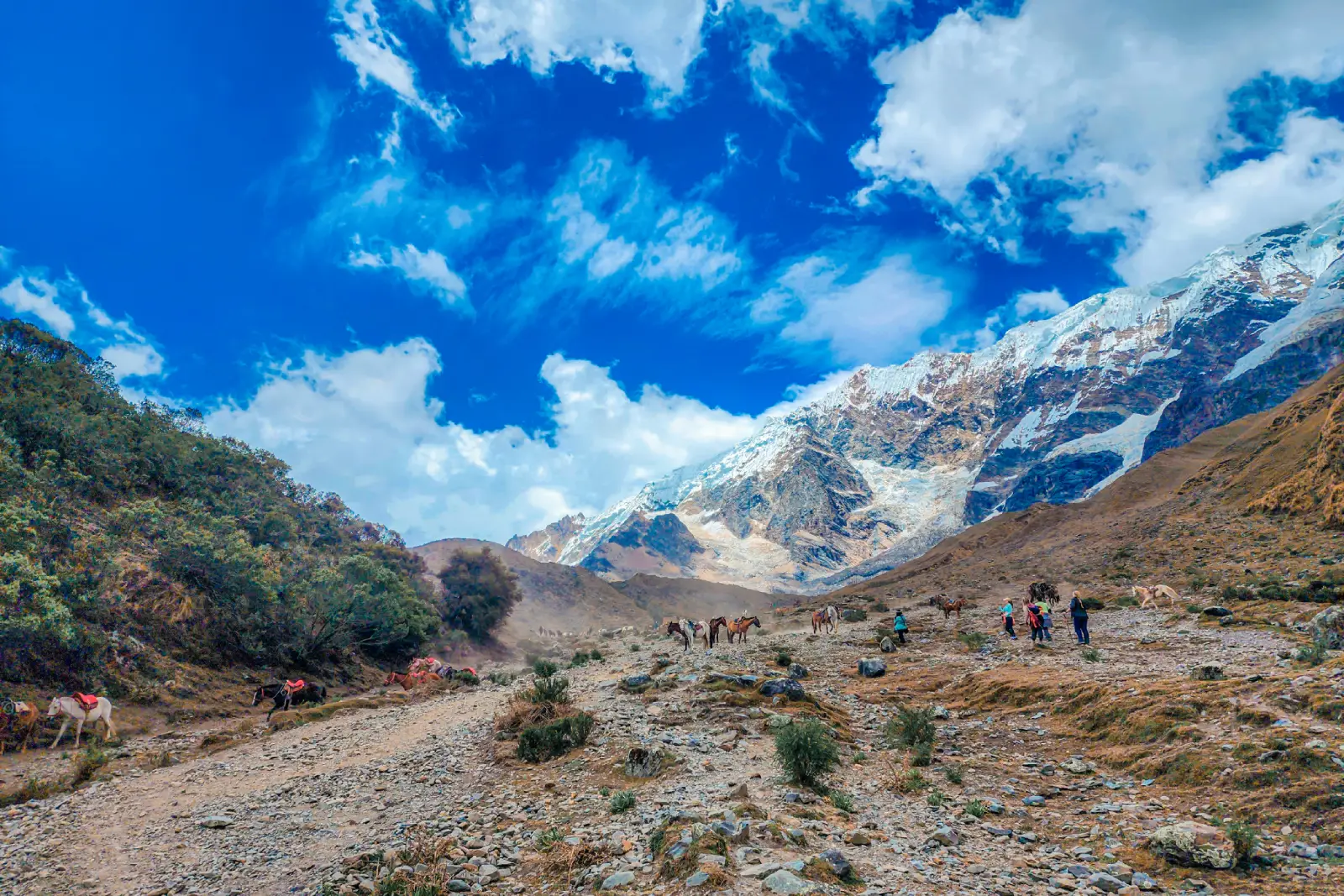
Upper valley with horses and glaciers.
Camping Is Still Possible, but It Changes the Weight Equation
Camping gives you more independence, but it also adds shelter, sleeping equipment, cooking gear and more food. Much of the corridor crosses community or privately managed areas, so do not assume every open patch of land is free wild camping.
Pack weight should follow your accommodation strategy. A lodge-based hiker can keep the load much lighter; a fully self-supported hiker carries every additional kilogram over Salkantay Pass at about 15,190 ft (4,630 m).
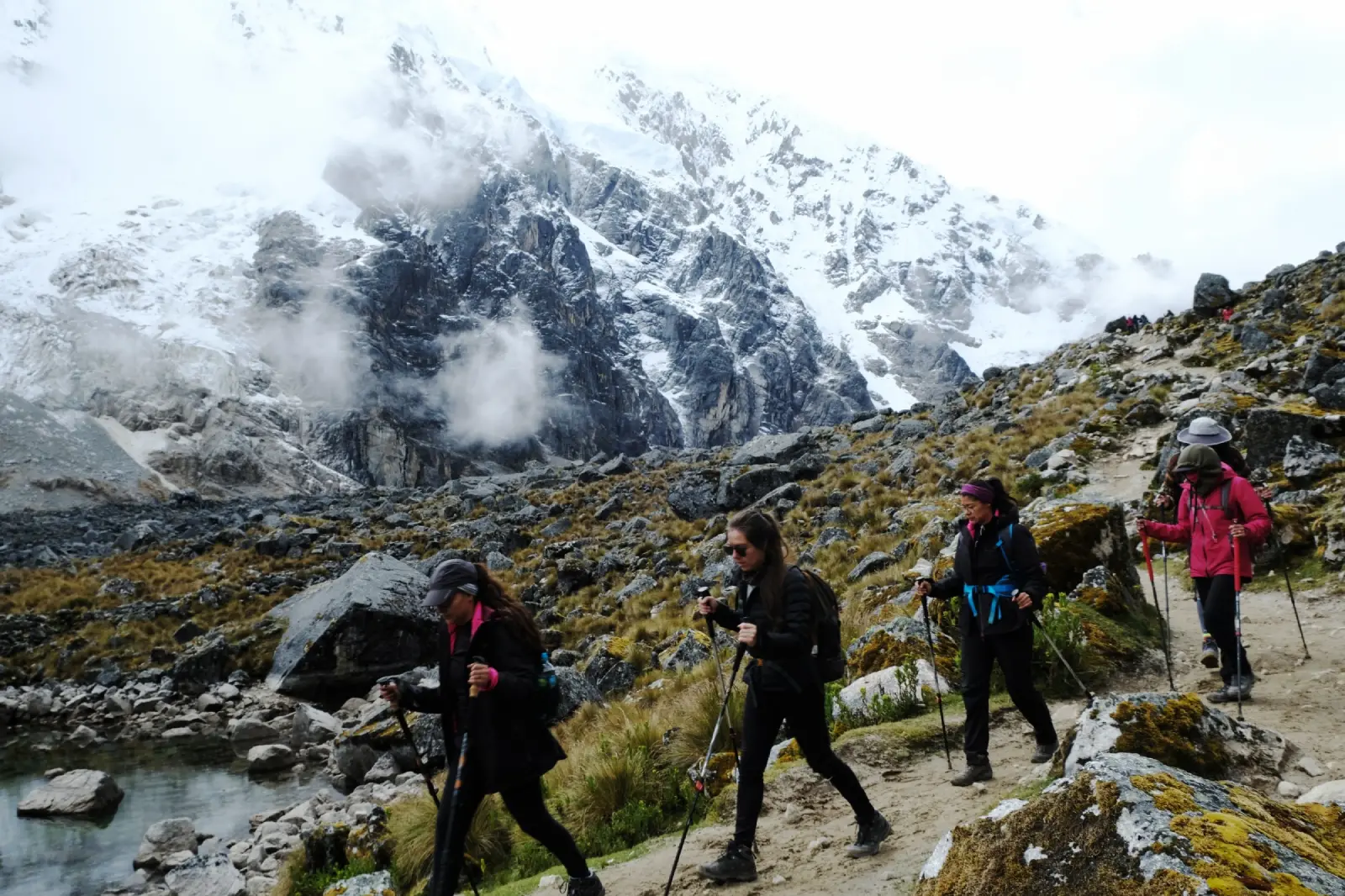
Hiking the alpine trail below Salkantay mountain.
Food and Water Are Available, but Not Continuously
Established overnight areas usually have simple meals, bottled water, snacks and basic supplies. A useful planning range for cooked trail meals is around US$4–8 (S/12–27), while sandwiches and simple snacks can fall around US$1–4 (S/4–13). Prices rise as options become more limited.
The high section is different. Leave Soraypampa with enough water and calories for the full pass stage rather than expecting regular kiosks between established stops. A treatment method is still sensible even if you plan to buy most of your water.
| Zone | What you can usually plan around | DIY rule |
| Mollepata / Soraypampa | Breakfast, basic supplies, lodging and water. | Start the high section stocked. |
| Pass day | Limited and irregular services. | Carry enough for the full high-altitude stage. |
| Chaullay / Collpapampa | Lodging, meals, water and snacks. | Refill and ask locally about the next section. |
| Lucmabamba | Lodging, meals, fruit/coffee areas and water. | Prepare for Llactapata and the final approach. |
| Hidroeléctrica / Aguas Calientes | Many more food and transport options. | Budget more in Aguas Calientes than on the trail. |
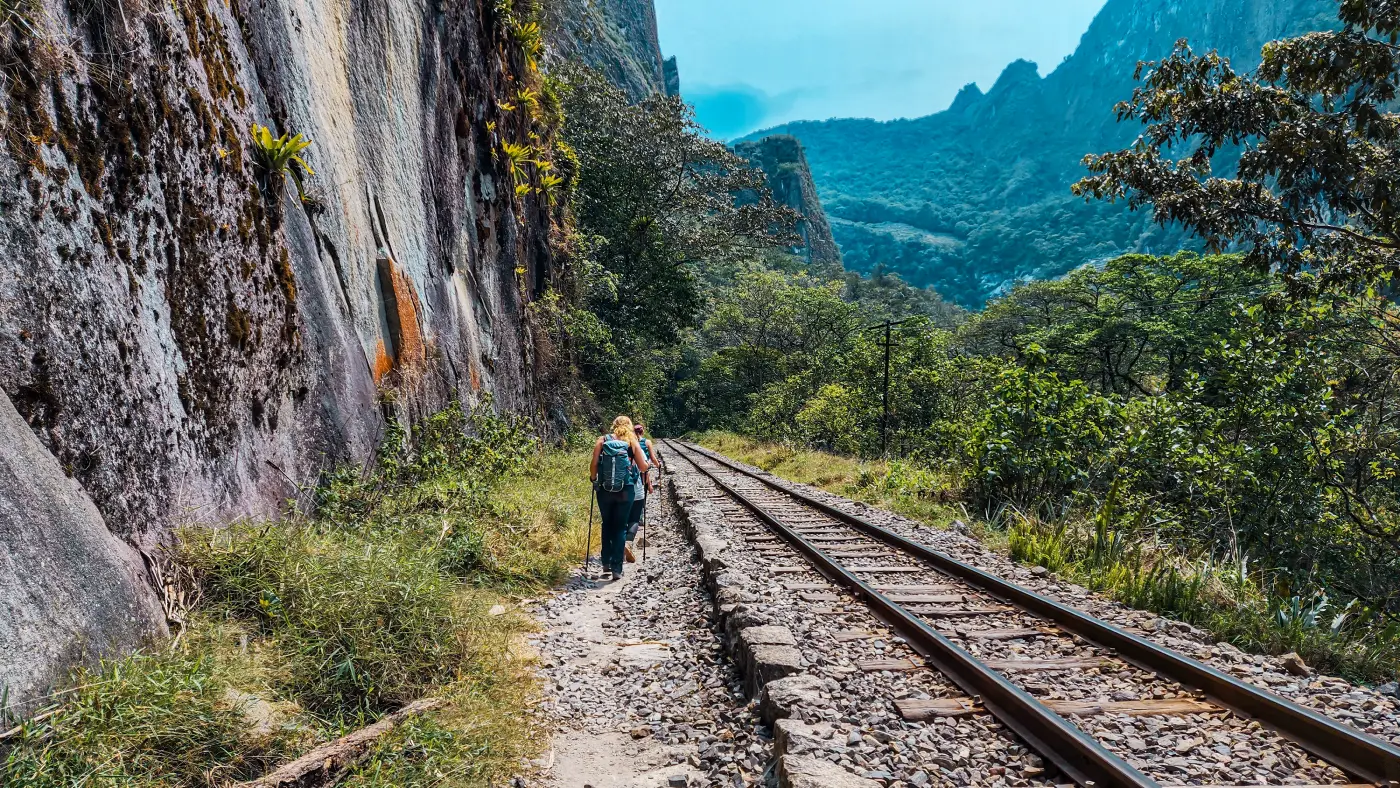
Railway section on the lower Salkantay, Hidroelectrica route.
What You Must Book Before Starting the Trek
Book Machu Picchu First
This is the most important scheduling rule in the DIY plan: book Machu Picchu before building the trek around it. The official system uses a specific date, entry time, circuit and route. For a foreign adult, a sensible planning envelope for the archaeological entrance and related conservation charges is around US$48–65 (S/160–220), depending mainly on the route selected and any tariff changes.
Buy through the official TuBoleto platform and then work backward from the confirmed entry. The Machu Picchu circuits guide explains what the different route options mean for the visit.
Decide How You Will Return to Cusco
The two main DIY strategies have very different costs and timing:
- Standard tourist train return: plan around US$55–90 (S/185–300) per person one way for practical tourist services, before any onward ground transfer. It costs more but removes another long road day after the trek.
- Walk back to Hidroeléctrica + road vehicle: shared return services commonly fall around US$15–25 (S/50–85) per person. The trade-off is a much longer road journey and the need to reach the departure area on time.
If you choose the road return, do not plan around the final departure of the day. Independent transport is much easier when one delayed walking section does not destroy the rest of your schedule.
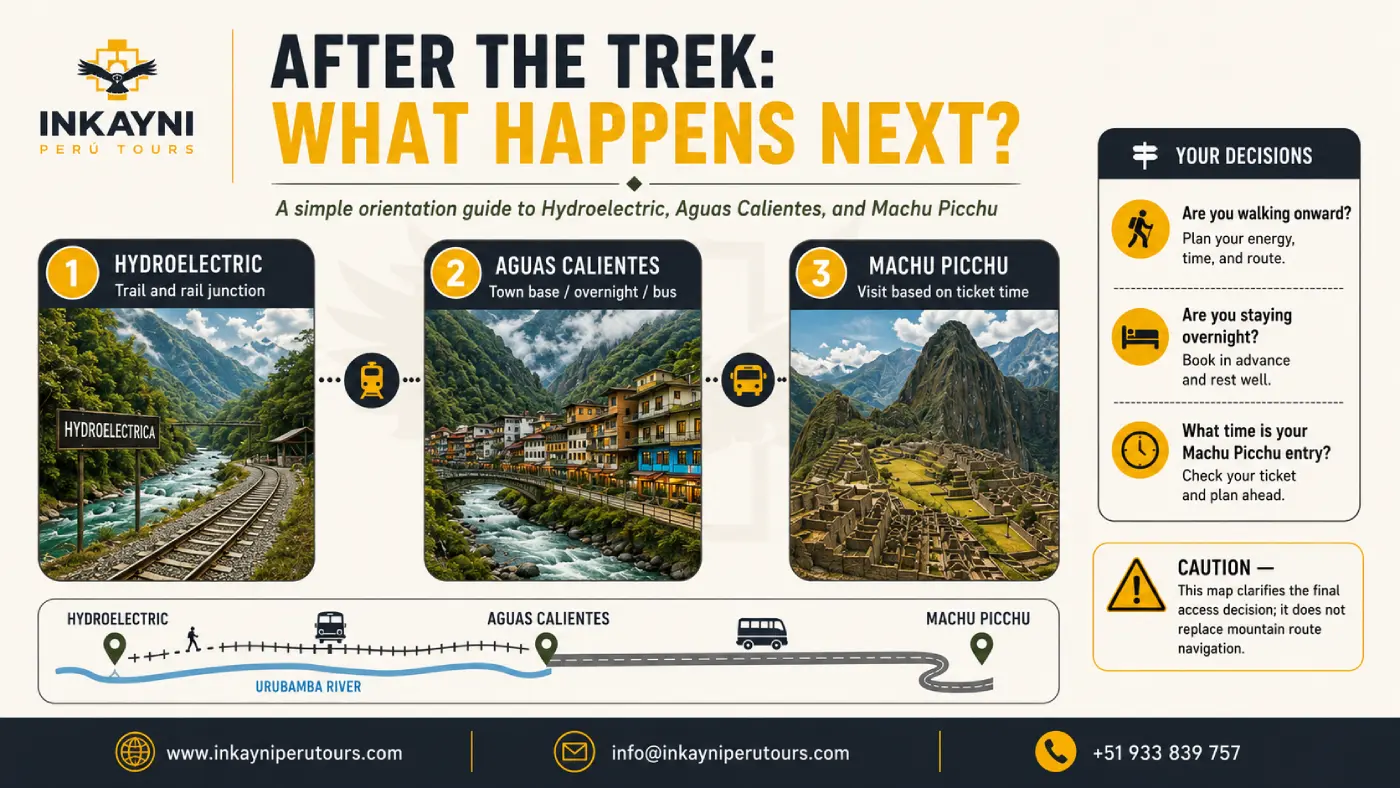
Final access decisions after the Salkantay Trek.
Decide Whether You Will Bus or Walk to Machu Picchu
From Aguas Calientes, allow roughly US$12–25 (S/40–85) per person if you plan to use the shuttle bus in one direction or both. Walking avoids that transport cost but adds a steep climb before the archaeological visit.
After several trekking days, the bus can be less about comfort and more about preserving energy for the visit. The Aguas Calientes travel guide explains how the town, shuttle and entrance timing fit together.
Reserve the First High-Altitude Night
Chaullay, Collpapampa and Lucmabamba usually offer more flexibility, but Soraypampa is the night worth securing first. Recent independent travelers report that accommodation can fill, especially when Humantay Lake demand overlaps with through-hikers.
Keep this in mind:
Keep flexibility where it helps, but remove the expensive uncertainties before you start: Machu Picchu ticket, Soraypampa accommodation and your preferred return transport.
How Much Does It Cost to Do the Salkantay Trek on Your Own?
A DIY Salkantay Trek can be much cheaper than a full-service package, but “cheap” only makes sense after you include the complete chain: trailhead transport, local access, trail lodging, food, Aguas Calientes, Machu Picchu, the bus or walk to the entrance, return transport and a contingency buffer.
All ranges below are shown in US dollars first with Peruvian soles in parentheses. The conversions are deliberately rounded using a planning rate of roughly 3.3–3.4 soles per US dollar. Local trail payments are often made in soles, so the dollar figures are budgeting equivalents rather than local quoted fares.
| DIY expense | Useful planning range | What makes it change |
| Cusco → Mollepata | US$6–8 (S/20–25) pp | Shared colectivo/minivan and pickup point. |
| Mollepata → Challacancha | US$4–6 (S/15–20) pp shared; US$12–18 (S/40–60) per vehicle when private | Passenger count and vehicle type. |
| Mollepata → Soraypampa | US$6–9 (S/20–30) pp shared; US$24–36 (S/80–120) per vehicle when private | Sharing, road access and exact drop-off point. |
| Local access / registration buffer | US$5–8 (S/18–25) | Local rules and collection arrangements can change. |
| Trail lodging | US$15–30 (S/50–100+) pp/night | Basic bed vs. room/package, meals, shower/Wi-Fi and Soraypampa demand. |
| Trail meals + snacks | US$12–25 (S/40–85) pp/day | Cooked meals, packed lunch, snacks and bottled drinks. |
| Basic Aguas Calientes night | US$15–40 (S/50–135) pp/night | Dorm/private room, date, demand and booking platform. |
| Machu Picchu entrance + conservation | US$48–65 (S/160–220) foreign-adult planning range | Route selected and official tariff changes. |
| Aguas Calientes ↔ Machu Picchu bus | US$12–25 (S/40–85) | One-way vs. round-trip; walking removes this cost. |
| Return by road from Hidroeléctrica | US$15–25 (S/50–85) pp | Operator, departure time and service type. |
| Standard tourist train return | US$55–90 (S/185–300) pp one way | Train category, departure time, demand and promotions. |
| Cash / contingency buffer | US$30–60 (S/100–200) | Hot showers, Wi-Fi, extra food, local rides, delays or a forced plan change. |
Realistic Total Budget for a Self-Guided Salkantay Trek
| DIY style | Realistic total range per person | What that assumes |
| Lean lodge-based + road return | US$220–330 (S/740–1,100) | Shared trailhead transport, simple lodging/meals, standard Machu Picchu visit, limited extras and Hidroeléctrica road return. |
| Standard DIY + train return | US$300–450 (S/1,000–1,500) | Lodge-based trek, Aguas Calientes night, Machu Picchu bus, standard tourist train and a reasonable cash buffer. |
| More comfortable / less improvised DIY | US$430–650+ (S/1,440–2,180+) | Private trailhead transport, better rooms, extra night, higher-cost Machu Picchu route, higher train fare or more paid contingencies. |
Warning:
These totals cover the Salkantay trek and its Machu Picchu logistics, not international flights, a pre-trek Cusco hotel, travel insurance or major gear purchases. A DIY route stays inexpensive only when you actually use shared transport, simple lodging and lower-cost return options.
For comparison, established 5-day full-service group treks commonly sit around US$500–750 (S/1,675–2,515) per person. The higher upfront cost usually bundles guide/cook support, trail meals, mule logistics, organized camps, Machu Picchu arrangements and return transport. If you want to see what a fuller service changes on the route, compare the 5-day Salkantay Trek.
What Do You Need to Carry Without Mule Support?
Pack weight depends mainly on where you sleep. A lodge-based trek needs personal layers, water capacity, food for gaps between services and electronics; camping adds shelter, sleeping equipment, cooking gear and extra food.
Hostel- and Lodge-Based Self-Guided
- Daypack or moderate trekking pack.
- Warm and waterproof layers.
- Water capacity and treatment backup.
- Food for gaps between established services.
- Offline navigation and charged phone/power bank.
- Headlamp, personal medication, sun protection and first-aid basics.
- Cash in Peruvian soles.
Fully Self-Supported
Add a tent, sleeping system, cooking setup and more food only if you plan to camp and cook independently. Every extra kilogram still has to cross Salkantay Pass at 15,190 ft (4,630 m).
For clothing, footwear, training and acclimatization, use how to prepare for the Salkantay Trek. This page keeps gear focused on what changes specifically when no guide, cook or mule team is organizing your load.
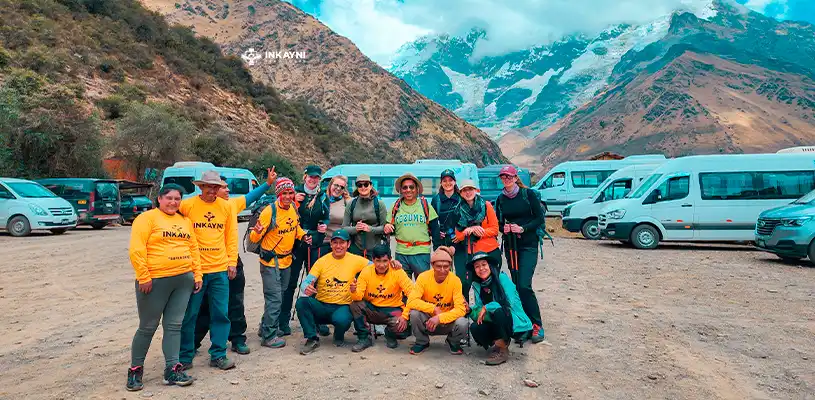
Starting the Salkantay Trek at Soraypampa.
Navigation, Cell Service and Emergency Planning
Use an Offline Route, Not Google Maps Alone
The main corridor is well traveled, but an independent hiker should still carry an offline GPX or mapping app and understand the route before leaving. This matters most when a traditional trail is temporarily closed and walkers are redirected to a road or another side of the valley.
Google Maps is useful for road orientation around Cusco, Mollepata, Soraypampa, Hidroeléctrica and Aguas Calientes. It is not the tool to trust for every mountain junction.
Trail Conditions Can Change During the Wet Season
Rain can turn high sections muddy and trigger landslides or closures lower in the valley. If a trail is marked closed, do not follow an old GPX simply because it shows the historical line.
Ask at your accommodation or local checkpoint about the next day’s conditions and use the open route. A self-guided plan should be flexible enough to take a short local ride or stop earlier when the safe walking line changes.
Do Not Rely on Continuous Electricity or Cell Service
Some lodges offer charging, Wi-Fi or satellite internet; others have limited power or intermittent connections. The useful rule is simple: do not make your safety or reservations depend on continuous connectivity.
- Download maps before leaving Cusco.
- Carry a power bank.
- Keep bookings and emergency contacts available offline.
- Carry cash; card acceptance is inconsistent along the trail.
- Share your expected overnight stops with someone outside the trek.
- Leave daylight margin for reroutes, slow transport or weather delays.
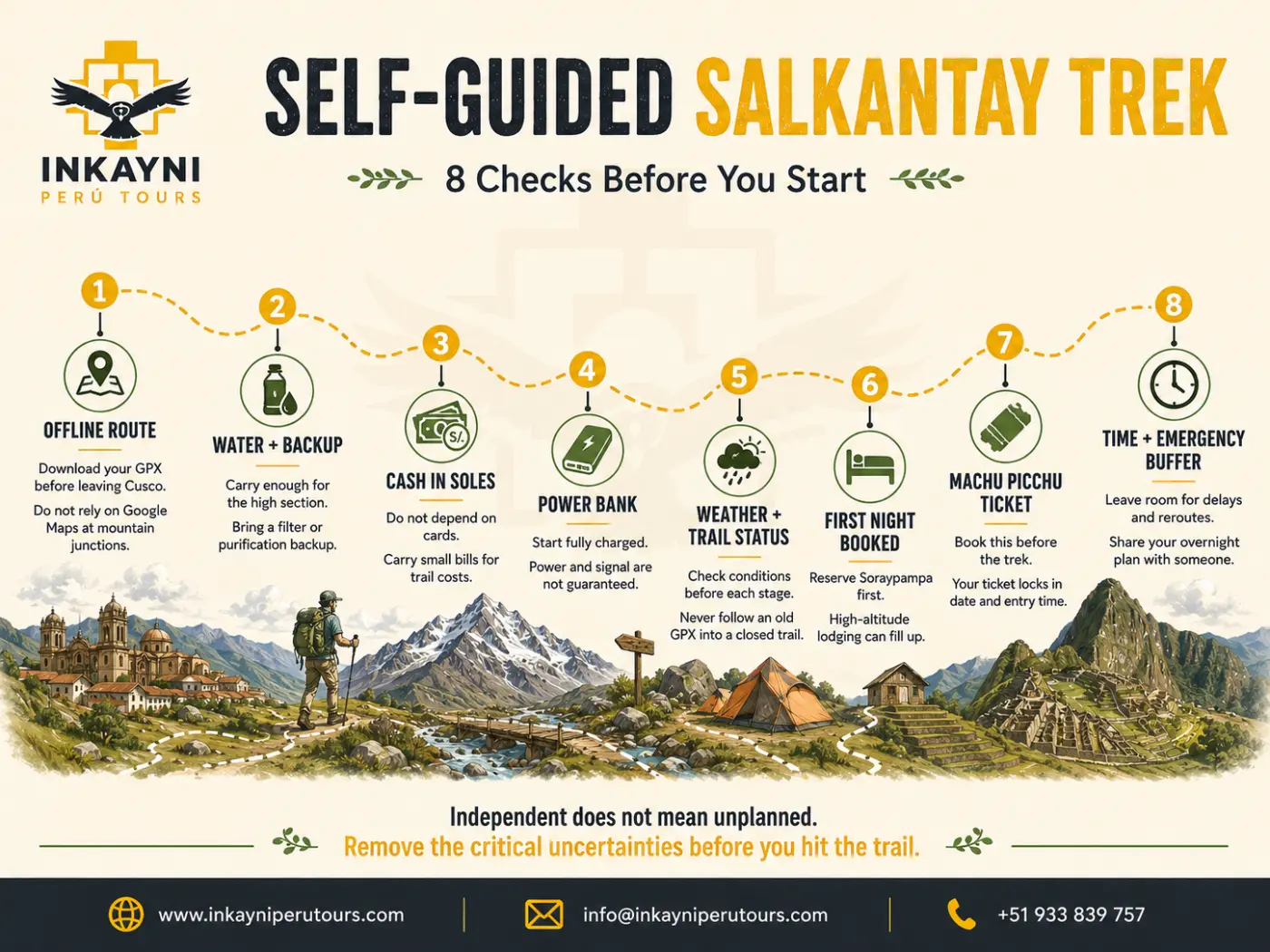
Essential checks before hiking Salkantay without a guide.
Self-Guided vs. Guided Salkantay: The Practical Trade-Off
The decision is not “adventure versus easy tourism.” Both options cross the same high-altitude environment. The real question is which responsibilities you want to keep.
| If this is your priority | Better fit | What you accept |
| Lowest cost + flexible overnight decisions | Self-guided | You manage transport, lodging, food, navigation and route changes. |
| Lighter pack + logistics already coordinated | Guided | Higher upfront cost and less day-to-day route freedom. |
| Ability to change where you sleep as you go | Self-guided | More uncertainty and more decisions when weather or transport changes. |
| Operational support if something goes wrong | Guided | You follow the operator’s logistics rather than solving each change yourself. |
If your real decision is between trekking routes rather than service styles, compare Salkantay Trek vs. Inca Trail. That comparison covers permits, archaeology, route character and trekking experience.
Continue Planning Your Salkantay Trek
Want the Salkantay Route Without Managing Every Moving Part?
A self-guided trek makes sense when the logistics are part of the independence you want. If coordinating transport, meals, accommodation, luggage and route changes sounds more like work than freedom, a guided route lets you keep the mountain crossing while shifting those moving parts to an operating team.
Compare the 5-day Salkantay Trek with the 4-day route. If you are unsure where DIY independence stops being useful for your dates, fitness or Machu Picchu ticket, talk to a travel specialist.
Frequently Asked Questions About Doing Salkantay on Your Own
Can you do the Salkantay Trek without a guide?
Yes. The standard route can be hiked independently and does not require the mandatory operator system used on the Classic Inca Trail. You are still responsible for local access requirements, lodging, food, navigation, transport and your separate Machu Picchu ticket.
Do you need a permit for the Salkantay Trek?
You do not need an Inca Trail-style trekking permit or mandatory licensed guide for the standard Salkantay route. Mollepata regulates tourist use of the Salkantay/Humantay sector, and local access or registration payments may apply. Machu Picchu has a separate official ticket system.
How do you get from Cusco to Mollepata?
Shared colectivos or minivans are the normal budget option. Plan around US$6–8 (S/20–25) per person and roughly 2–2.5 hours. Departure points and waiting time can change, so confirm the pickup locally the day before.
How do you get from Cusco to Soraypampa?
The lowest-cost route is usually Cusco → Mollepata → shared local transport toward Soraypampa, commonly around US$12–17 (S/40–55) per person when both legs are shared. Direct shared transfers can fall around US$15–22 (S/50–70), while a private vehicle from Cusco can reach roughly US$75–105 (S/250–350).
How do you get from Mollepata to Challacancha or Soraypampa?
Local shared or private vehicles connect Mollepata with the upper access road. Challacancha keeps more of the opening trail on foot; continuing toward Soraypampa reduces that initial walking. Shared fares are usually much cheaper than taking most of a vehicle yourself.
Can you hike Salkantay without a tent?
Yes. Basic lodges, hostels and refugios operate in Soraypampa, Chaullay/Collpapampa and Lucmabamba. A practical lodging range is around US$15–30 (S/50–100+) per person per night, depending on room type and whether meals or other services are bundled.
Can you buy food and water along the Salkantay trail?
Yes, especially in overnight settlements and the lower valleys. Do not assume continuous service on the high-altitude pass day. Leave Soraypampa with enough food and water for several hours and carry a treatment backup.
How much does a self-guided Salkantay Trek cost?
A realistic lodge-based DIY trip including Machu Picchu is roughly US$220–330 (S/740–1,100) with a low-cost road return, or about US$300–450 (S/1,000–1,500) when you add a standard train return and more comfortable logistics. Private transfers, better rooms or higher-cost Machu Picchu routes can push the trip above US$430–650+ (S/1,440–2,180+).
Is there cell service or Wi-Fi on the Salkantay Trek?
Coverage is inconsistent. Some lodges offer Wi-Fi or satellite internet and charging, while other sections have little dependable service. Download maps before leaving Cusco, carry a power bank and keep important bookings available offline.
Should I buy my Machu Picchu ticket before hiking Salkantay?
Yes. It is the most important advance booking for a DIY trek. Machu Picchu tickets are tied to a specific date, entry time, circuit and route, so secure the ticket first and build the Salkantay schedule backward from that confirmed entry.
Is it safe to do the Salkantay Trek alone?
Experienced hikers do complete Salkantay solo, but solo travel leaves less margin for altitude symptoms, injury, route changes and transport problems. Carry offline navigation, share your overnight plan, check current trail conditions and do not enter a section marked closed.
Autor
Shared:


If you liked this article and the information you found, give us 5 stars!
 (Ninguna valoración todavía)
 Loading...