


Which Machu Picchu Circuit Is Best
The best Machu Picchu circuit depends on what you want your ticket to do. For most first-time visitors, Circuit 2 is the strongest option because it combines the classic view with a fuller walk through the citadel’s main sectors. Circuit 1 works better if your priority is panoramic viewpoints, the postcard photo, or routes like Machu Picchu Mountain, Intipunku, or the Inca Bridge. Circuit 3 makes more sense if your goal is Huayna Picchu, Huchuy Picchu, or a visit focused on the lower and royal sectors rather than the classic upper terraces. The practical mistake is buying whatever ticket is left and adjusting everything else later, when in reality the circuit should shape your train, bus, entry time, and the whole logic of the visit.
Table of Contents
Choosing the right Machu Picchu circuit is one of the most important decisions you’ll make before buying your ticket. It’s no longer enough to say “I want to visit Machu Picchu.” You now have to choose a specific route, with a set entry time and a path that doesn’t always allow you to backtrack or switch sectors once you’re inside Machu Picchu.
So, which circuit works best for your type of trip, what routes does each one include, which maps to review, which one gives you the classic photo, which routes include a mountain, which options are seasonal, what they cost as a general reference, and what mistakes to avoid before booking.
| 3official circuits | 10visitor routes | 7,972 ftcitadel elevation (2,430 m) | Circuit 2best first visit |

Machu Picchu circuits map displaying Circuit 1, Circuit 2 and Circuit 3.
PERU’S LEGENDARY HIKEInca Trail to Machu Picchu
Follow the historic trail through mountain passes, Inca sites, and cloud forest paths to Machu Picchu.
What Are the Machu Picchu Circuits?
The Machu Picchu circuits are official visitor routes designed to manage the flow of people, protect the Inca citadel, and prevent travelers from crowding the same areas at the same time. Each ticket is linked to a circuit, a route, an entry time, and a direction of travel. In other words, your ticket decides the kind of experience you’ll have. Some routes give you the classic photo, some cover more archaeological sectors, some include mountains, some only operate in high season, and some don’t allow access to the urban area of the citadel at all.

If the full logistics still aren’t clear, first check how to organize your arrival in our guide on how to get to Machu Picchu, especially if you’ll be taking the train, staying overnight in Aguas Calientes, or riding the bus to Machu Picchu.
Full Table of Machu Picchu Circuits and Routes
This table summarizes all 3 circuits and their 10 routes. Use it as a decision map before diving into the details.
| Route | Official Name | What It Offers | Availability |
| Circuit 1: Panoramic | |||
| 1-A | Machu Picchu Mountain Route | High panoramic view, classic photo, and ascent to Machu Picchu Mountain. | Year-round. |
| 1-B | Upper Terrace Route | Panoramic view and classic photo, without a deep walk through the urban sector. | Year-round. |
| 1-C | Intipunku Gateway Route | High view and hike toward Intipunku, the Sun Gate. | High season. |
| 1-D | Inca Bridge Route | High view and hike toward the Inca Bridge. | High season. |
| Circuit 2: Classic Machu Picchu | |||
| 2-A | Designed Route | The most complete first-time visit: classic photo and main archaeological sectors. | Year-round. |
| 2-B | Lower Terrace Route | Similar experience to the classic circuit, with entry from the lower terrace. | Year-round. |
| Circuit 3: Royal | |||
| 3-A | Huayna Picchu / Waynapicchu Mountain Route | Lower citadel sectors and ascent to Huayna Picchu. | Year-round |
| 3-B | Royal Designed Route | Royal sector, Temple of the Sun, House of the Inca, and lower areas. | Year-round. |
| 3-C | Great Cavern Route | Lower sectors and hike toward the Great Cavern or Temple of the Moon. | High season. |
| 3-D | Huchuy Picchu Route | Lower sectors and short ascent to Huchuy Picchu. | High season. |
Circuit 1 at Machu Picchu: Panoramic Views and Upper Viewpoints
The Machu Picchu Circuit 1 is designed for panoramic views from the upper areas. It’s associated with the classic photo from the upper terraces, though its main limitation is clear: it does not cover the urban sector of Machu Picchu in depth.
It’s a good choice if you want photography, viewpoints, and complementary routes like Machu Picchu Mountain, Intipunku, or the Inca Bridge. It’s not the right pick if your priority is walking through the main temples, plazas, and enclosures of the citadel.
Warning:
Machu Picchu routes operate with controlled, one-directional flow. Your ticket defines the circuit, route, entry time, and sectors you can visit. Once inside the sanctuary, do not assume you can freely return to previous areas, switch circuits, or enter sections that belong to a different route.
Route 1-A: Machu Picchu Mountain Year-Round
Route 1-A is designed for travelers who want to add a mountain hike to the panoramic visit. After entering, the path climbs toward the upper sector of Machu Picchu and connects to the trail for Machu Picchu Mountain, one of the longest routes within the sanctuary. From the top, you gain a better sense of the scale of the Urubamba Valley, the layout of the citadel, and the position of the surrounding mountains.
This route has both visual and physical value. It works well for travelers who want to hike, gain elevation, and see Machu Picchu from a wider perspective. Its main limitation is that it’s not designed for a deep walk through the urban sector, main temples, or plazas of the citadel.
- Availability: year-round, with limited spots depending on date and entry time.
- What you’ll see: upper terraces, panoramic viewpoints, access to Machu Picchu Mountain, and broad views of the sanctuary.
- What’s left out: a deep walk through the urban sector, temples, plazas, and main enclosures.
- Best for: travelers with good physical fitness, a taste for long hikes, and enough time before the return train.
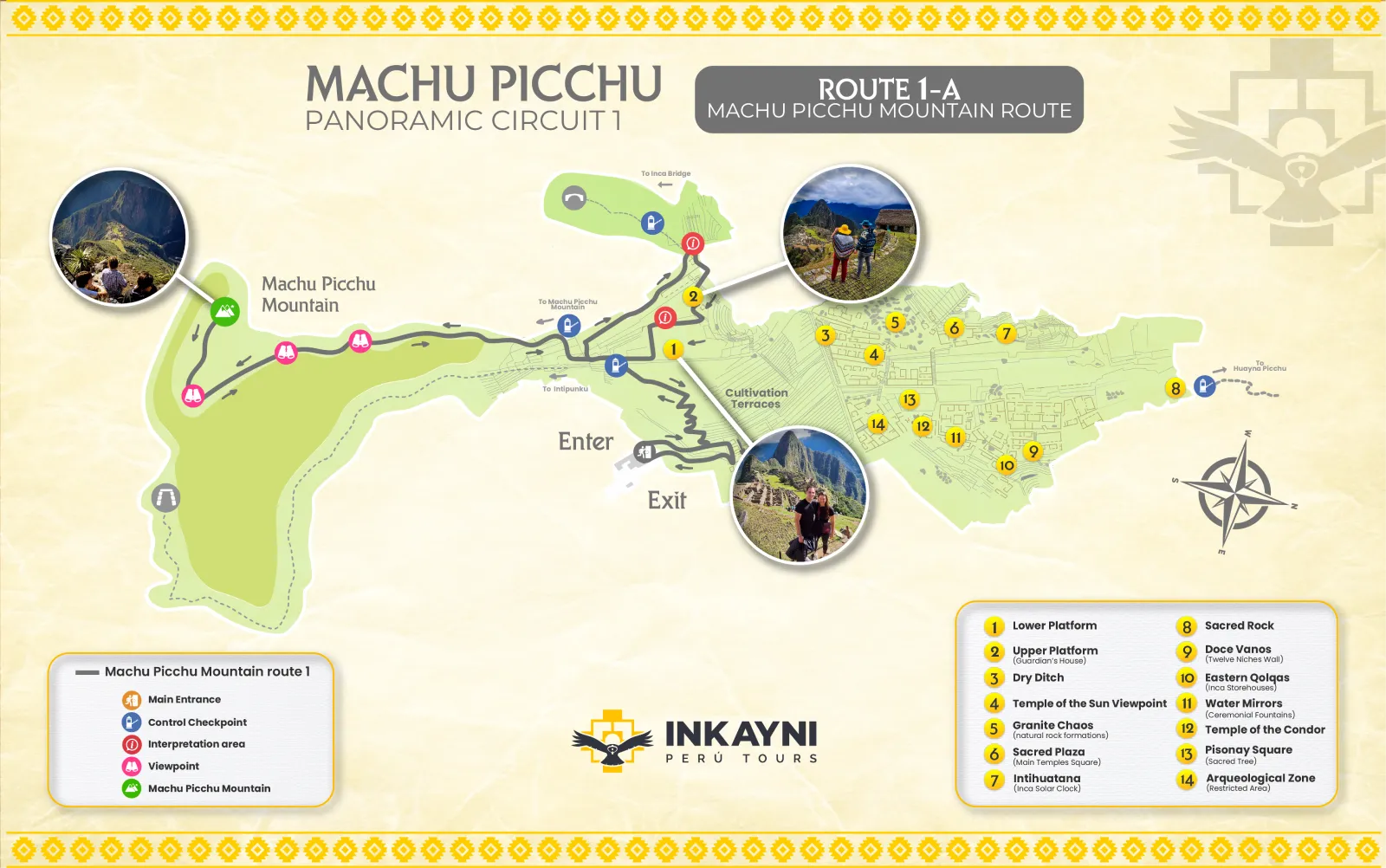
Map of Machu Picchu Circuit 1-A showing the route to Machu Picchu Mountain.
Route 1-B: Upper Terrace Year-Round
Route 1-B is the most direct way to reach the upper terraces and get a panoramic view of Machu Picchu. It’s a short, visual, and straightforward route compared to the mountain options. It works for travelers who are after the classic overhead shot of the archaeological complex, with Huayna Picchu and the surrounding mountains in the background.
Its main weakness is clear: the experience centers on the view. It’s not the right route for anyone who wants to walk through the interior of the citadel, stop at temples, or understand how the site is organized.
- Availability: year-round.
- What you’ll see: upper terraces, high viewpoints, and one of the most recognizable views of Machu Picchu.
- What’s left out: the internal walk through temples, plazas, ceremonial enclosures, and the urban sectors.
- Best for: travelers with limited time, those who prioritize photography, or anyone who has visited Machu Picchu before.
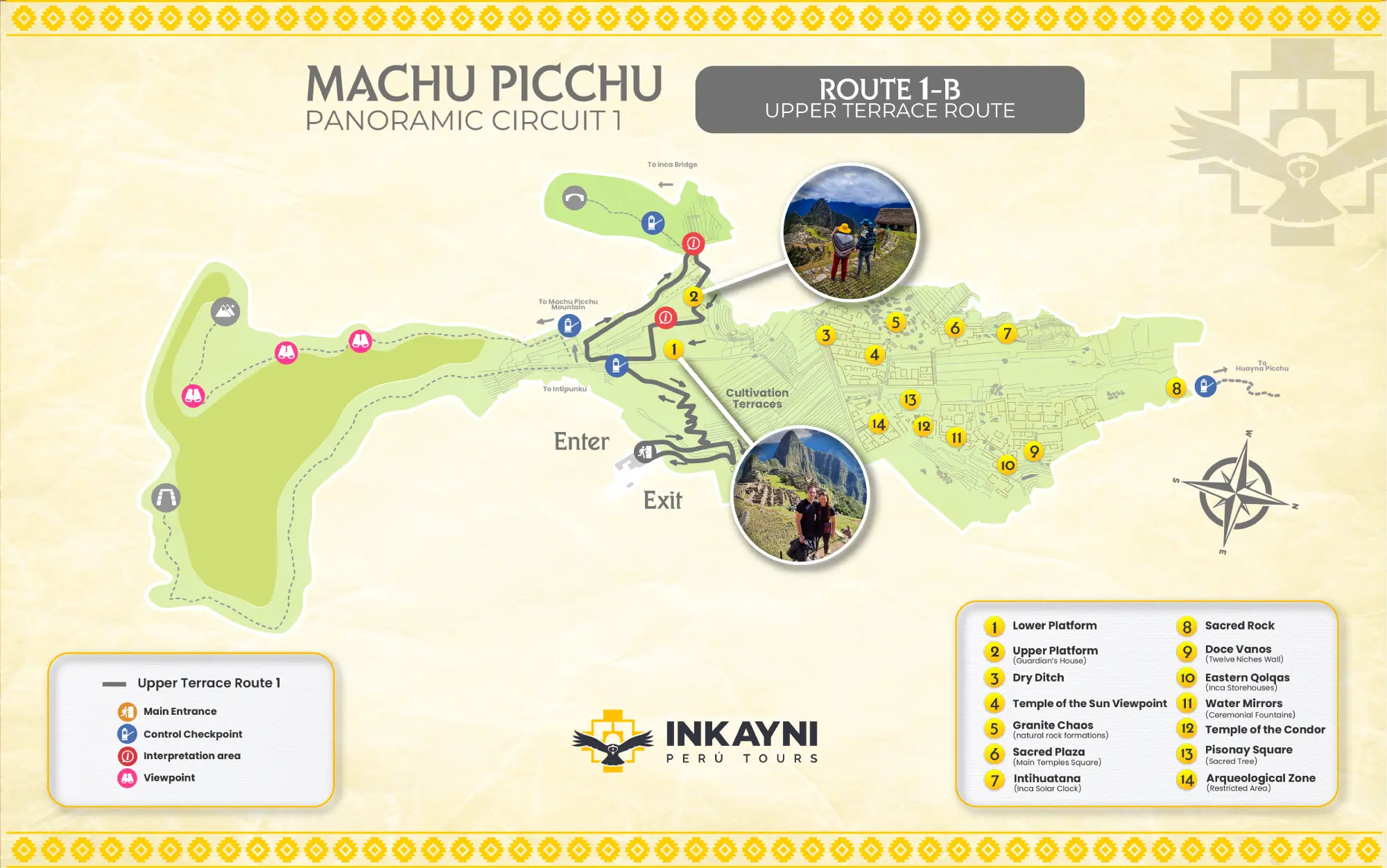
Map of Machu Picchu Circuit 1-B showing the Upper Terrace Route and panoramic viewpoints
Route 1-C: Intipunku Gateway High Season Only
Route 1-C adds a hike toward Intipunku, the Sun Gate. This point carries special significance because it was part of the ancient ceremonial entrance used by those arriving at Machu Picchu from the Inca Trail. The route allows you to look down at the citadel from a high vantage point and better understand the relationship between trail, mountain, and ritual access.
It’s a good choice if you want a hike with historical meaning without doing the full Inca Trail. It takes more time than the Upper Terrace and should be confirmed before arranging trains, buses, and your return schedule, since it doesn’t operate as a permanent year-round route.
- Availability: high season or official enabling only.
- What you’ll see: upper terraces, panoramic view, and hike toward Intipunku or the Sun Gate.
- What’s left out: the full walk through the urban sector of Machu Picchu.
- Best for: travelers who want a moderate hike, elevated views, and a direct connection to the logic of the Inca Trail.
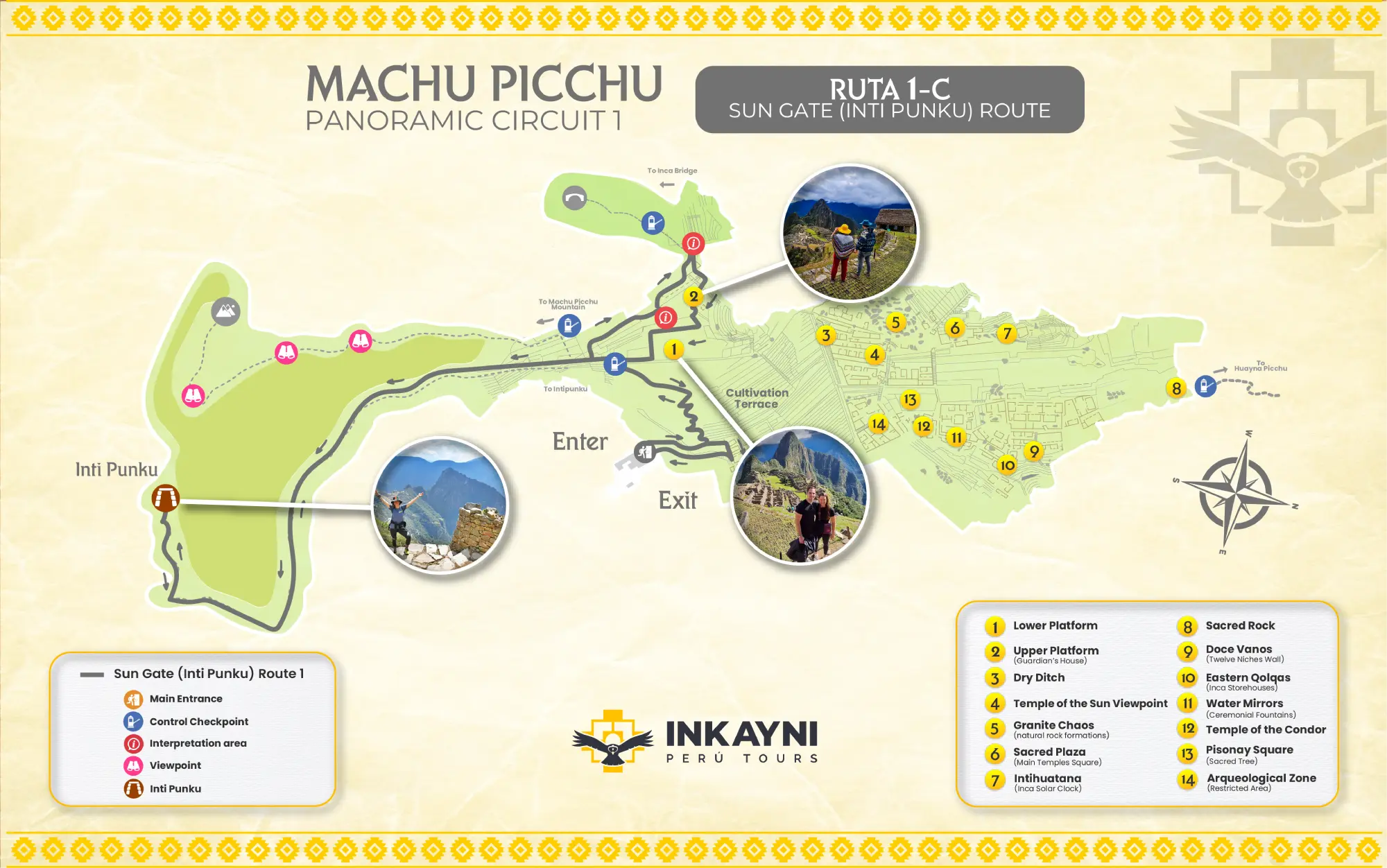
Map of Machu Picchu Circuit 1-C showing the route to Inti Punku (Sun Gate).
Route 1-D: Inca Bridge High Season Only
Route 1-D combines the view from the upper areas with a side hike toward the Inca Bridge. The interest of this route lies at the edge of the mountain: it shows how the Incas used narrow passes, slopes, and defensive structures to control access through a difficult landscape.
It’s a short route, but it shouldn’t be chosen out of mere curiosity. The trail can feel exposed for anyone with vertigo or discomfort on narrow paths. The bridge is viewed from the permitted route; the visit does not involve crossing it.
- Availability: high season or official enabling only.
- What you’ll see: upper terraces, panoramic view, and hike toward the Inca Bridge.
- What’s left out: main temples, internal plazas, and a deep archaeological walk.
- Best for: travelers who want a short, lateral, and less common route with no issues on narrow trails.
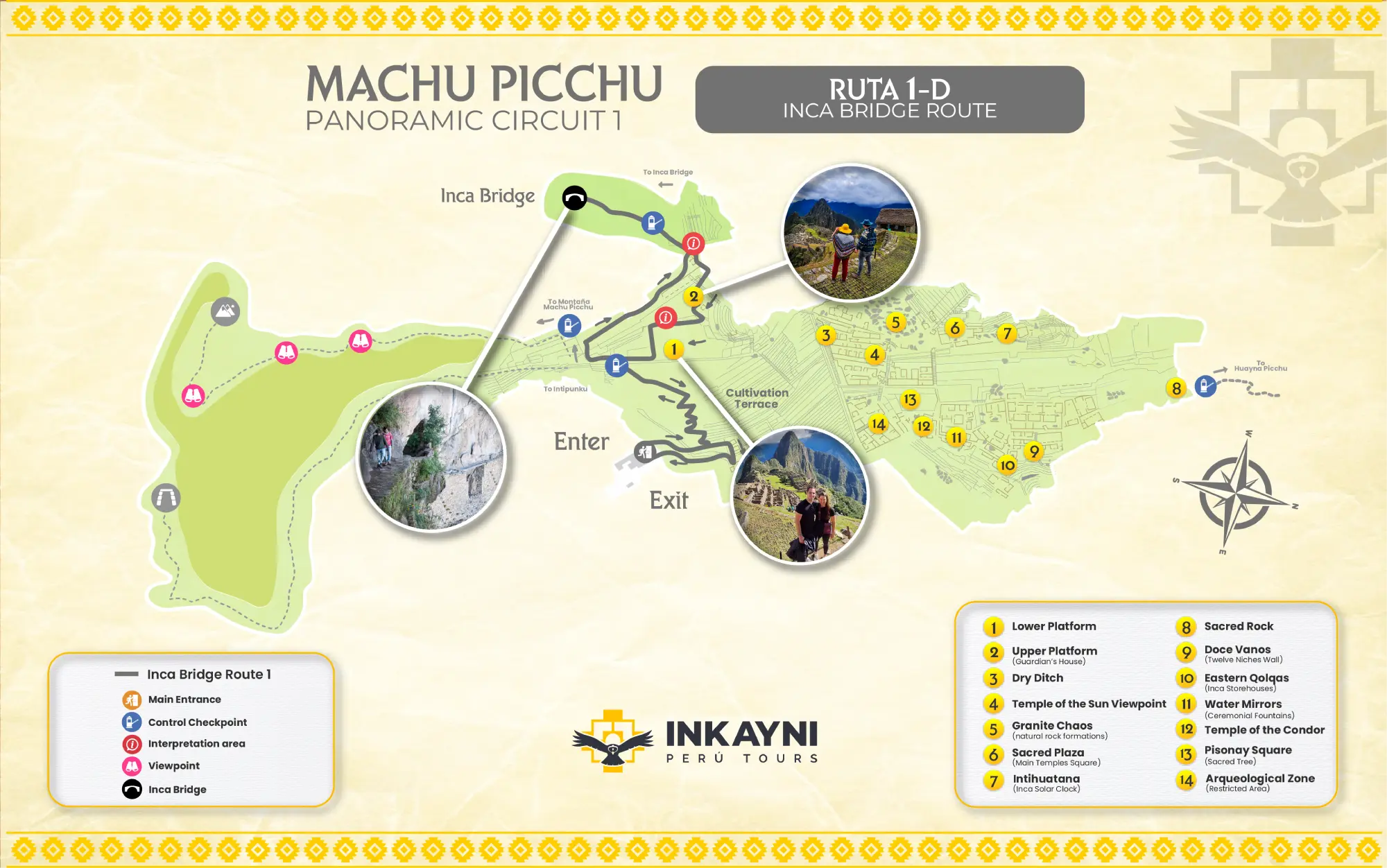
Map of Machu Picchu Circuit 1-D showing the route to the Inca Bridge.
WORLD WONDER IN THE ANDESMachu Picchu
Discover the history, landscapes, and essential tips for visiting this world wonder.
Circuit 2 at Machu Picchu: The Classic and Most Complete Route
The Machu Picchu Circuit 2 is the most balanced option for a first visit. It combines the classic view, agricultural terraces, entry into the urban sector, ceremonial spaces, and a fuller sense of how the citadel was organized.
The value of this circuit is that it doesn’t reduce Machu Picchu to a single photo. It allows you to walk through representative sectors, observe the relationship between terraces, paths, plazas, temples, and enclosures, and better understand why the llaqta was built at that exact point in the landscape.

Route 2-A: Designed Route Year-Round
Route 2-A is the strongest option for first-time visitors to Machu Picchu who want a complete experience. The walk typically integrates agricultural zones, platforms, transition spaces, viewpoints, ceremonial sectors, and urban areas. Depending on current access controls, it may include points such as the Dry Moat, the Temple of the Sun Viewpoint, the Plaza of Temples, the Intihuatana Pyramid, the Sacred Rock, the Water Mirrors, the Temple of the Condor, and the Pisonay Plaza.
This route works best with a guide, because the value isn’t just in covering more ground — it’s in understanding why each zone serves a distinct function within the complex: agriculture, transit, ritual, visual control, and urban organization.
- Availability: year-round.
- What you’ll see: classic view, agricultural terraces, urban sectors, plazas, ceremonial enclosures, and several main archaeological points.
- What’s left out: mountain routes like Huayna Picchu or Machu Picchu Mountain.
- Best for: first-time visits, families, and travelers who want to understand Machu Picchu rather than just photograph it.
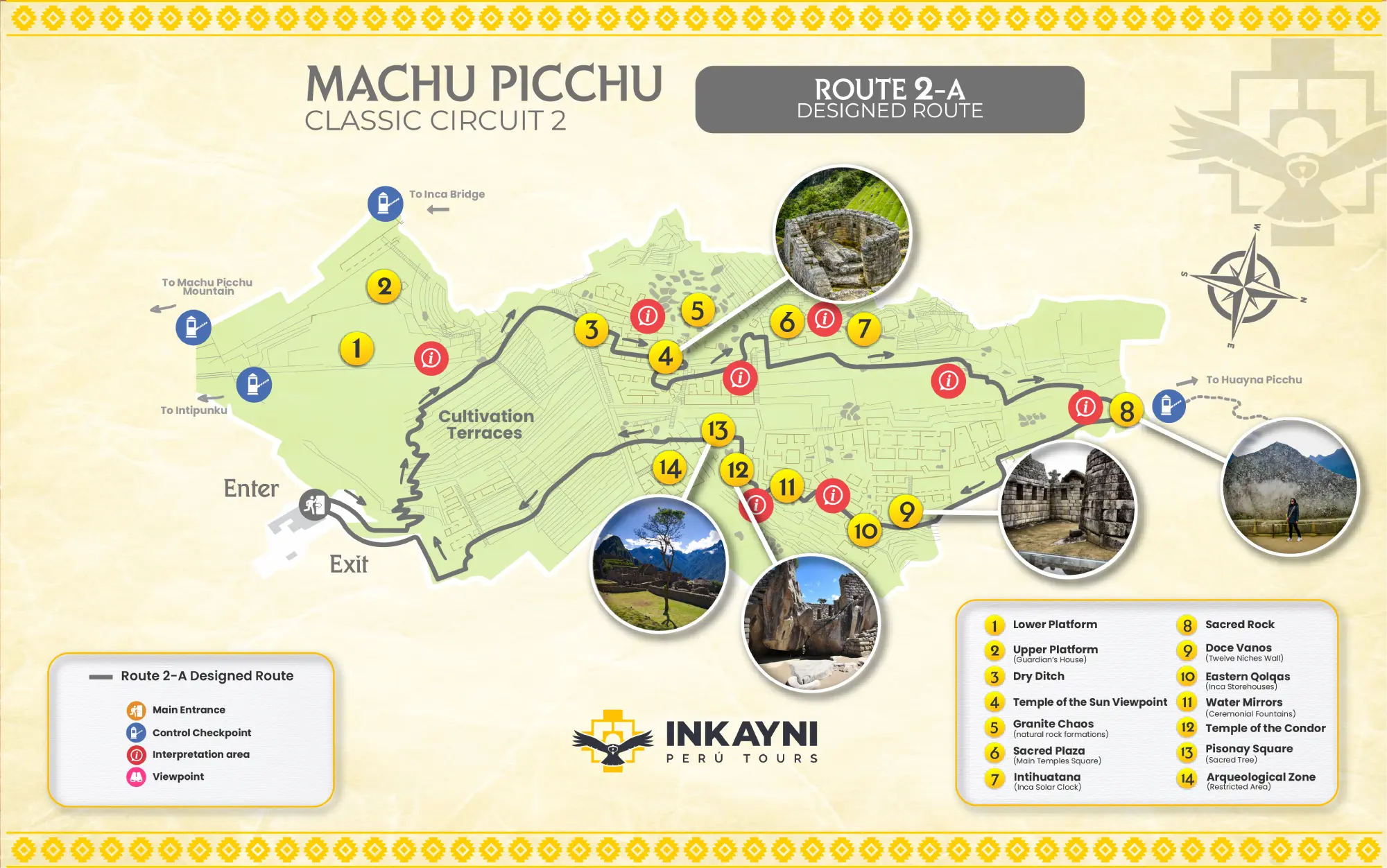
Map of Machu Picchu Circuit 2-A showing the classic route through terraces, temples and ceremonial areas.
Route 2-B: Lower Terrace Year-Round
Route 2-B follows the same logic as Circuit 2 but takes a lower-terrace variation. It’s a useful alternative when Route 2-A is sold out or when you’re looking for a similar experience within the same circuit. It retains the archaeological character of the visit and allows a wider reading of the site than the purely panoramic routes.
Its path feels less focused on climbing toward high viewpoints and more oriented toward moving through the citadel in a continuous flow. For most travelers, the practical difference from 2-A won’t be dramatic; what matters is that both belong to the most complete circuit for a first experience.
- Availability: year-round.
- What you’ll see: representative citadel sectors, terraces, enclosures, and a classic Machu Picchu experience.
- What’s left out: mountain hikes and free movement between routes inside the sanctuary.
- Best for: travelers who want a full visit when Route 2-A isn’t available, or who prefer a variation within Circuit 2.
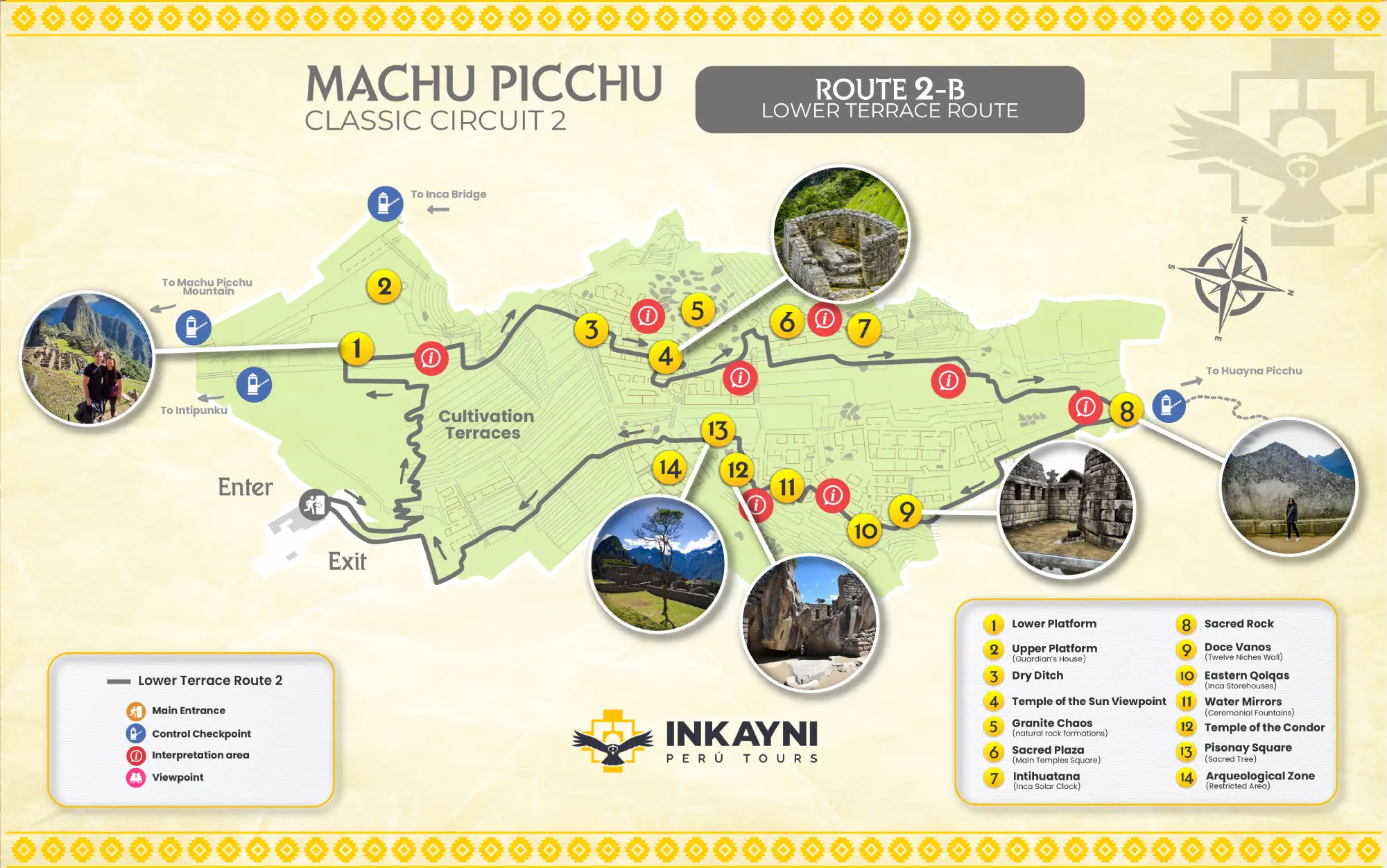
Map of Machu Picchu Circuit 2-B showing the Lower Terrace Route.
Circuit 3 at Machu Picchu: Royal Sector, Lower Areas, and Mountains
The Machu Picchu Circuit 3 focuses on the lower and royal sectors of the citadel. Its path moves through areas of higher architectural hierarchy, such as the surroundings of the Temple of the Sun, the House of the Inca, inner enclosures, storehouses, water mirrors, and ceremonial spaces.
This circuit isn’t designed for the classic postcard shot from the upper terraces. Its value lies in a closer experience of the lower sector of Machu Picchu and in the special routes it can connect to: Huayna Picchu, the Great Cavern, or Huchuy Picchu.
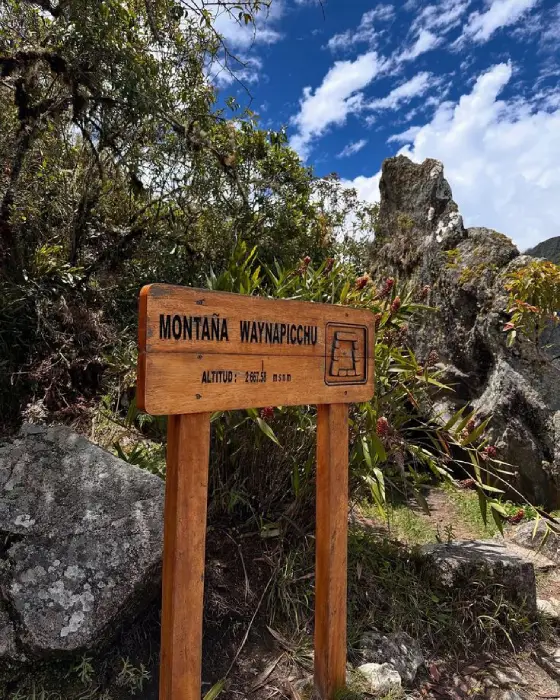

Route 3-A: Huayna Picchu / Waynapicchu Mountain Year-Round
Route 3-A combines the lower sector of Machu Picchu with the ascent to Huayna Picchu, the mountain that appears behind the citadel in many iconic photos. The walk starts through the lower areas and then moves toward a steep, narrow, and highly popular climb. In some sections the trail demands sure footing, comfort with heights, and confidence on stone stairs.
This route isn’t chosen for the classic photo from the Guardian’s House. It’s chosen for the vertical experience, the view from a different angle, and the physical sensation of climbing one of the sanctuary’s most recognizable mountains.
- Availability: year-round, with highly sought-after spots.
- What you’ll see: lower citadel sectors and ascent to Huayna Picchu.
- What’s left out: the classic photo from the upper terraces and a relaxed visit without physical effort.
- Best for: physically fit travelers, those with no severe vertigo, and anyone interested in an intense route.

Map of Machu Picchu Circuit 3-A with Huayna Picchu.
Route 3-B: Royal Designed Route Year-Round
Route 3-B is the base option of Circuit 3. It covers the lower and royal sector of Machu Picchu without adding a mountain. Depending on current controls, it may include areas linked to the Temple of the Sun, the House of the Inca, inner enclosures, water mirrors, storehouses, and ceremonial spaces.
It’s shorter and less panoramic than Circuit 2, but can be a reasonable alternative if the classic routes are sold out or if you’re looking for a more direct walk through the lower internal sectors. It’s also more manageable than the mountain routes.
- Availability: year-round.
- What you’ll see: lower sector, royal area, inner enclosures, and ceremonial spaces of Machu Picchu.
- What’s left out: the classic postcard shot from the upper terraces.
- Best for: travelers who want a shorter route, lower sectors, or an alternative when Circuit 2 is no longer available.
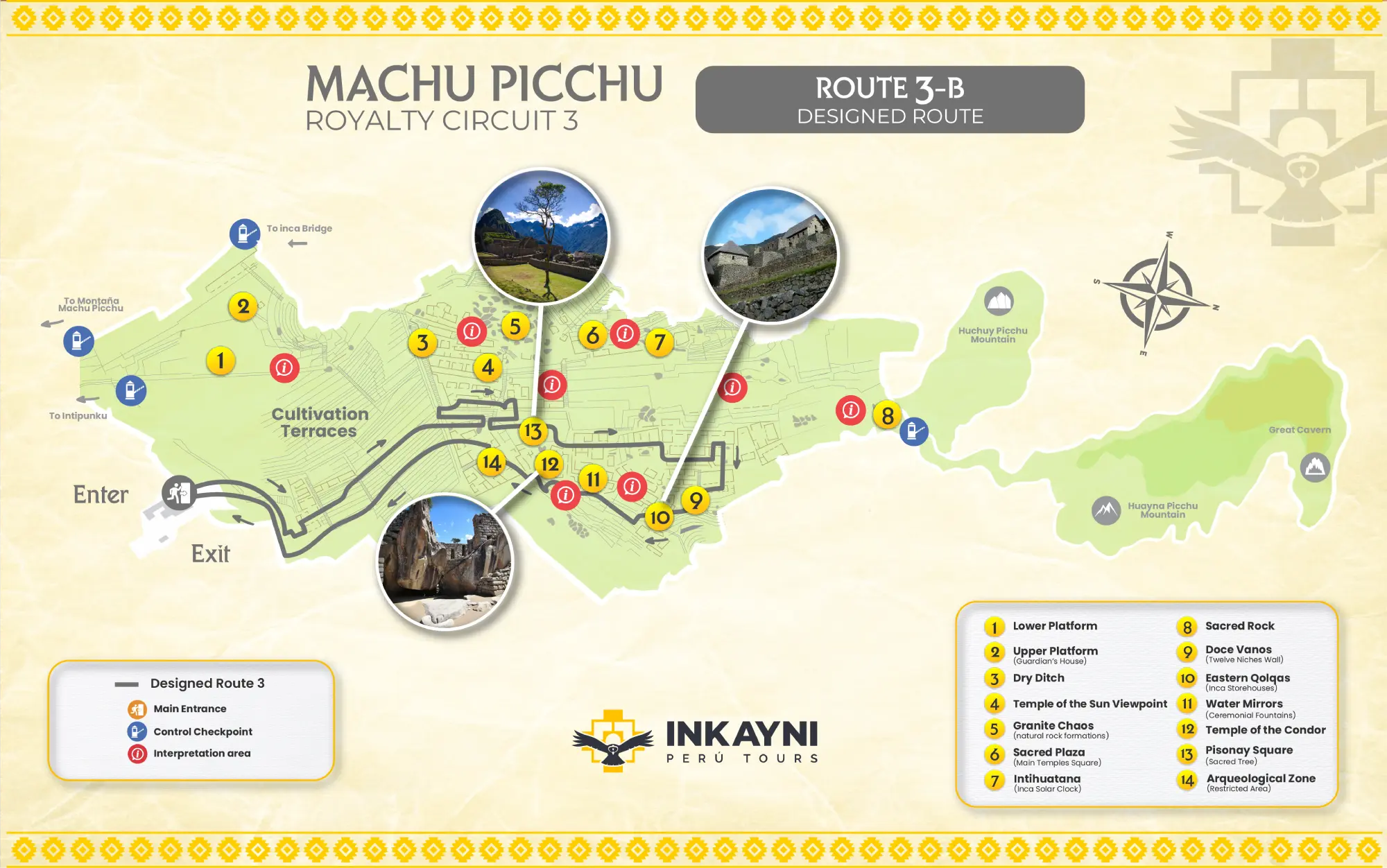
Map of Machu Picchu Circuit 3-B through the lower ceremonial sector.
Route 3-C: Great Cavern or Temple of the Moon High Season Only
Route 3-C combines the lower sector of Machu Picchu with the hike toward the Great Cavern, also known as the Temple of the Moon. The route moves away from the more common path and demands more time, more energy, and better planning. Its appeal lies in reaching a ceremonial space associated with the mountain, rock, and the symbolic depth of caves within the Andean world.
This may be one of the most demanding routes in the current system. It’s best to avoid it if your itinerary is tight, if you depend on an early return train, or if you’re mainly looking for the classic Machu Picchu photo.
- Availability: high season or official enabling only.
- What you’ll see: lower citadel sectors and hike toward the Great Cavern or Temple of the Moon.
- What’s left out: a short, light visit or one centered on the classic photo.
- Best for: physically fit travelers with more time available and an archaeological interest in a less conventional route.
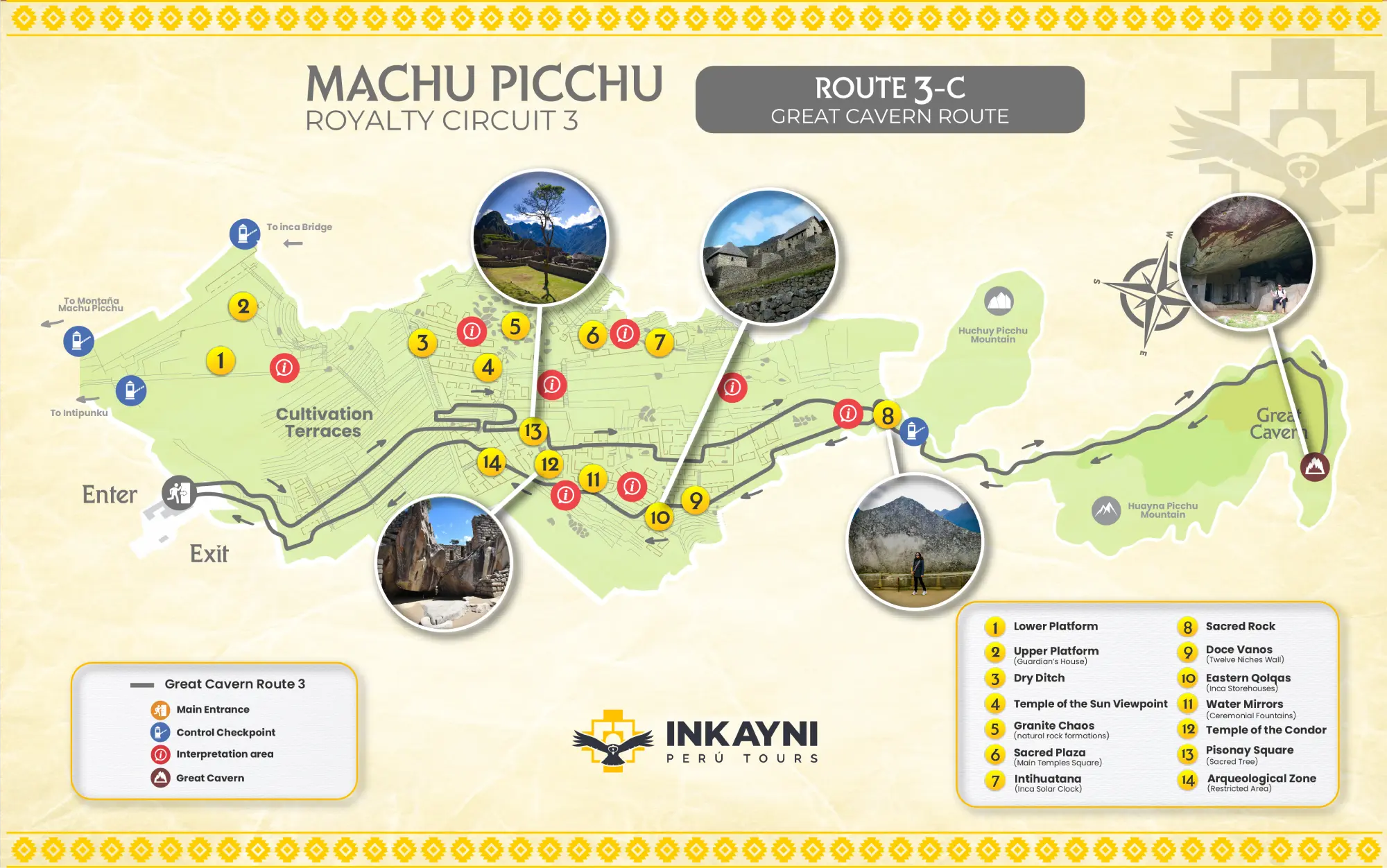
Map of Machu Picchu Circuit 3-C leading to the Great Cavern area.
Route 3-D: Huchuy Picchu High Season Only
Route 3-D adds the ascent to Huchuy Picchu, a smaller and less demanding mountain than Huayna Picchu. The experience keeps the walk through the lower sectors of Circuit 3 and adds a short climb for a different view without taking on as intense a hike.
It can work well for travelers who want a route with some effort but without the exposure and physical demands of Huayna Picchu. Availability depends on the season, so it should be confirmed before organizing the rest of the trip.
- Availability: high season or official enabling only.
- What you’ll see: lower sectors of Machu Picchu and short ascent to Huchuy Picchu.
- What’s left out: an experience as complete as Circuit 2 or as intense as Huayna Picchu.
- Best for: travelers who want a lighter additional hike, provided the route is available during their travel season.
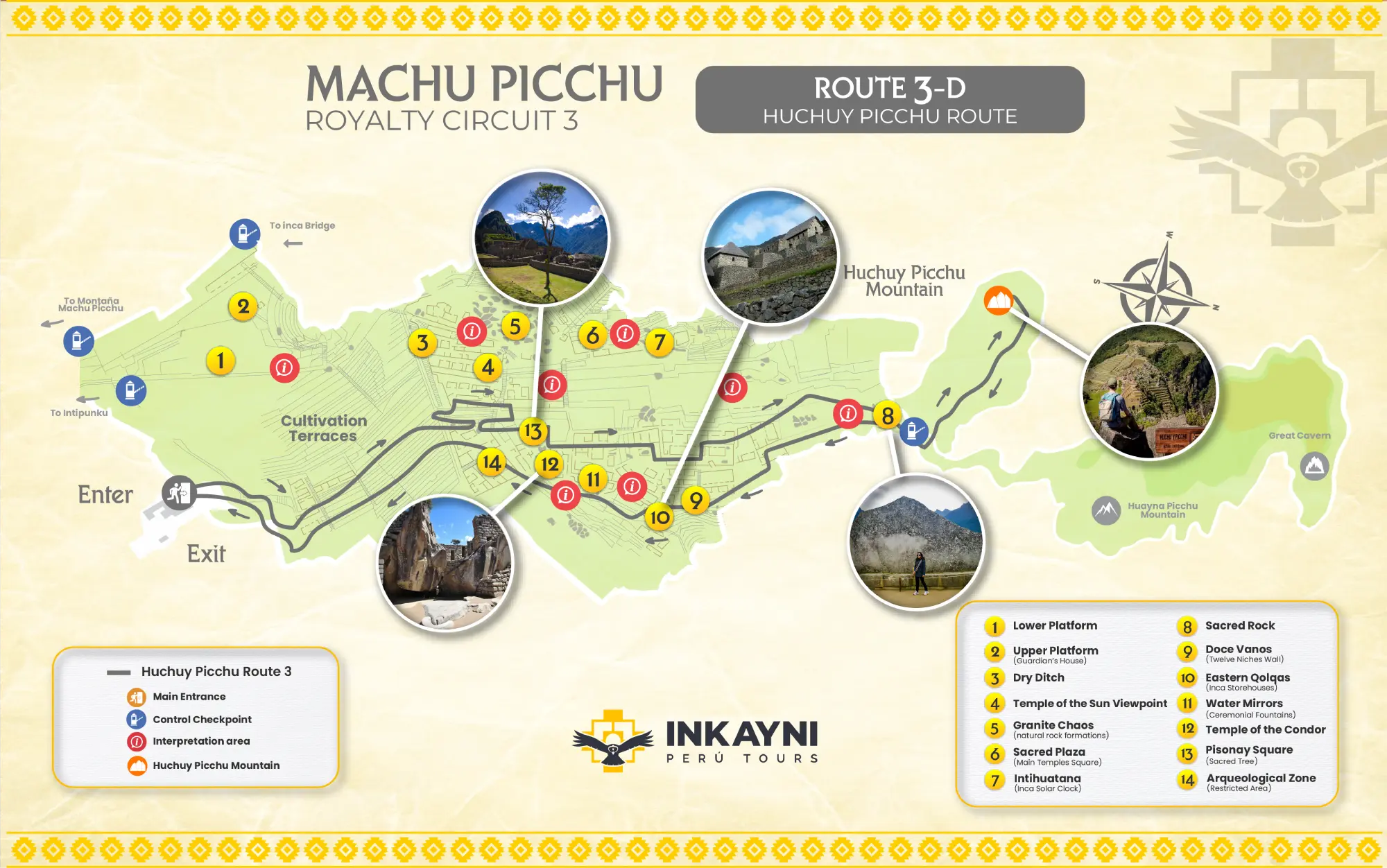
Map of Machu Picchu Circuit 3-D showing the route to Huchuy Picchu Mountain.
Warning:
High-capacity season applies on January 1, April 2–5, June 19 through November 2, and December 30–31. During those dates, routes 1-C Intipunku, 1-D Inca Bridge, 3-C Great Cavern, and 3-D Huchuy Picchu are enabled. These routes only operate during those specific dates.
Machu Picchu Circuit Prices
Official Machu Picchu prices are published in Peruvian soles and can change based on nationality, age, student status, chosen route, season, and official updates. Use this table as a reference to understand what the ticket costs if you buy on your own, but always verify the final amount at tuboleto.cultura.pe before paying.
| Ticket Type or Service | Reference Price | Practical Note |
| General admission, foreign adult | $40–45 USD (S/152) | Common reference for general routes without mountain access, such as 1-B, 2-A, 2-B, or 3-B. |
| Foreign student | $20–23 USD (S/77) | Requires valid documentation. Verify age, student status, and requirements before buying. |
| Foreign minor | $18–21 USD (S/70) | Applies within the official age range and must match the minor’s travel document. |
| Peru / Andean Community adult | $17–20 USD (S/64) | Requires a valid document from Peru, Bolivia, Colombia, or Ecuador, as applicable. |
| Routes with mountain or special access | $53–60 USD (S/200 approx.) | Reference for routes like Machu Picchu Mountain, Huayna Picchu, or the Great Cavern for foreign adults. These are high-demand routes with limited spots. |
| Bus Aguas Calientes to Machu Picchu | From $24 USD round-trip | Not included in the entrance ticket. Must be coordinated with your sanctuary entry time. |
Important note:
The official ticket is only one part of the real cost of visiting Machu Picchu. If you book on your own, you pay for each service separately: entrance, bus, train, guide, transfers, and hotel if needed. If you book through an agency, the total price per person or as a package may be higher because it includes reservation management, availability verification, schedule coordination, operational support, guide, transportation, and other services bundled into the tour package.
Prices are for reference only. Before paying, confirm the date, entry time, circuit, route, ID document, and final amount at tuboleto.cultura.pe. If you’re traveling with an agency, always ask which services are included and which are paid separately.
How to Choose the Best Machu Picchu Circuit
Before looking at each route, answer one simple question: what do you actually want from your visit? Most mistakes happen because travelers buy whatever ticket is available without understanding what it really includes.
| Traveler Goal | Best Option | Why It Works |
| First time at Machu Picchu | Circuit 2, Route 2-A or 2-B | Offers the most balanced experience: classic view, agricultural sectors, and a walk through the main areas of the citadel. |
| Classic photo with limited time | Circuit 1, Route 1-B | Prioritizes the panoramic view from the upper areas. It’s shorter and doesn’t enter the main urban sector. |
| Long hike with panoramic view | Circuit 1, Route 1-A | Includes Machu Picchu Mountain, ideal if you want physical effort and a wide view of the sanctuary. |
| Huayna Picchu | Circuit 3, Route 3-A | The route that combines the ascent to Huayna Picchu with the lower citadel sectors. |
| Internal archaeological visit | Circuit 2 or Circuit 3-B | Circuit 2 is more complete; Circuit 3-B works if you prioritize the lower sectors and a shorter visit. |
| Family trip or moderate pace | Circuit 2 | Usually the most balanced for understanding Machu Picchu without adding a mountain hike. |
Practical Rule:
If it’s your first visit and you want a complete experience, try to get Circuit 2. If you want a mountain, choose between Machu Picchu Mountain, Huayna Picchu, or Huchuy Picchu based on your fitness and comfort with heights. If you’re mainly after the classic photo, Circuit 1 may be enough.
Common Mistakes When Choosing a Circuit
- Booking the train first and then looking for a ticket: the entry time determines the train, not the other way around. Check how to get to Machu Picchu before locking your schedule.
- Choosing Circuit 1 expecting to see the whole citadel: it’s primarily panoramic.
- Buying Huayna Picchu just because it’s famous: it’s steep, narrow, and not right for everyone.
- Not checking the season: Intipunku, the Inca Bridge, the Great Cavern, and Huchuy Picchu may be seasonal.
- Not accounting for the bus: the line in Aguas Calientes can affect your entry time.
- Not planning for rain: stone paths can get slippery, especially on mountain routes. Review Cusco weather by month before choosing your travel dates.
Choosing the Right Circuit Changes the Whole Visit
The Machu Picchu circuits aren’t a technical detail. They define the photo, the time inside, the physical effort, the archaeological sectors, and the entire logistics of the day. For a first visit, Circuit 2 remains the most complete option. For mountains and viewpoints, Circuit 1 or Circuit 3 may make more sense. To avoid mistakes with tickets, trains, buses, schedules, and guides, Inkayni Peru Tours can help you organize the right route for your date, fitness level, and travel style.
Frequently Asked Questions About Machu Picchu Circuits
How Many Circuits Does Machu Picchu Have?
Which Circuit Is Best for a First Visit to Machu Picchu?
Which Circuit Gives You the Classic Machu Picchu Photo?
Which Circuit Includes Huayna Picchu?
Which Circuit Includes Machu Picchu Mountain?
Can I Switch Circuits Once I’m Inside Machu Picchu?
Which Routes Are High Season Only?
Does the Machu Picchu Ticket Include the Bus From Aguas Calientes?
Which Circuit Works Best for Families With Children?
What If Circuit 2 Is Sold Out?
Autor

Shared:



If you liked this article and the information you found, give us 5 stars!
 (1 votos, promedio: 5.00 de 5)
 Loading...