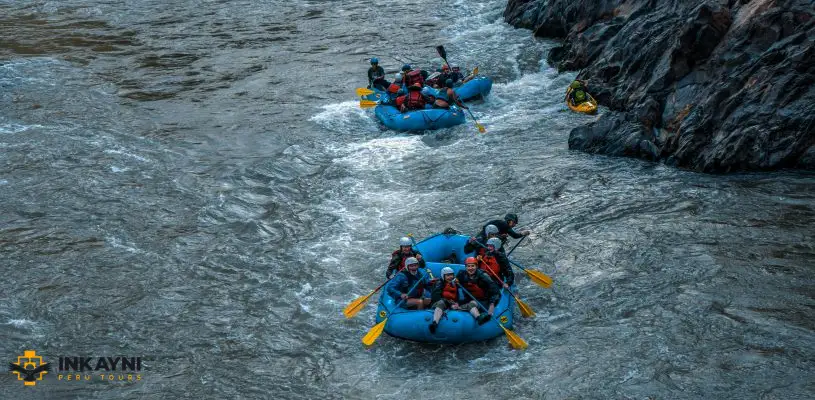
What can make a four-day Salkantay itinerary surprisingly demanding is not the missing fifth day, but where that time is taken from. Some routes spend the first day around Humantay Lake and sleep lower; others keep climbing until the first camp sits close to 15,000 ft (4,570 m)—almost at the altitude of Salkantay Pass itself. Both reach the same iconic crossing, but they can feel like very different first two days.
| 4D / 3N3 trek days + Machu Picchu | 30–36 micommon published range (48–58 km) | 15,190 ftSalkantay Pass (4,630 m) | US$520–680standard group (S/1,740–2,280) |
PERU’S LEGENDARY HIKEInca Trail to Machu Picchu
Follow the historic trail through mountain passes, Inca sites, and cloud forest paths to Machu Picchu.
Salkantay Trek 4 Days at a Glance
The Salkantay Trek 4 days format has a recognizable backbone even though the details are not identical between companies: high-Andean approach → Salkantay Pass → cloud forest → Hidroeléctrica/Aguas Calientes → Machu Picchu. The biggest differences are usually the first-night camp and how much of Day 3 remains on foot. For the broader route before comparing versions, use the complete Salkantay Trek to Machu Picchu guide.
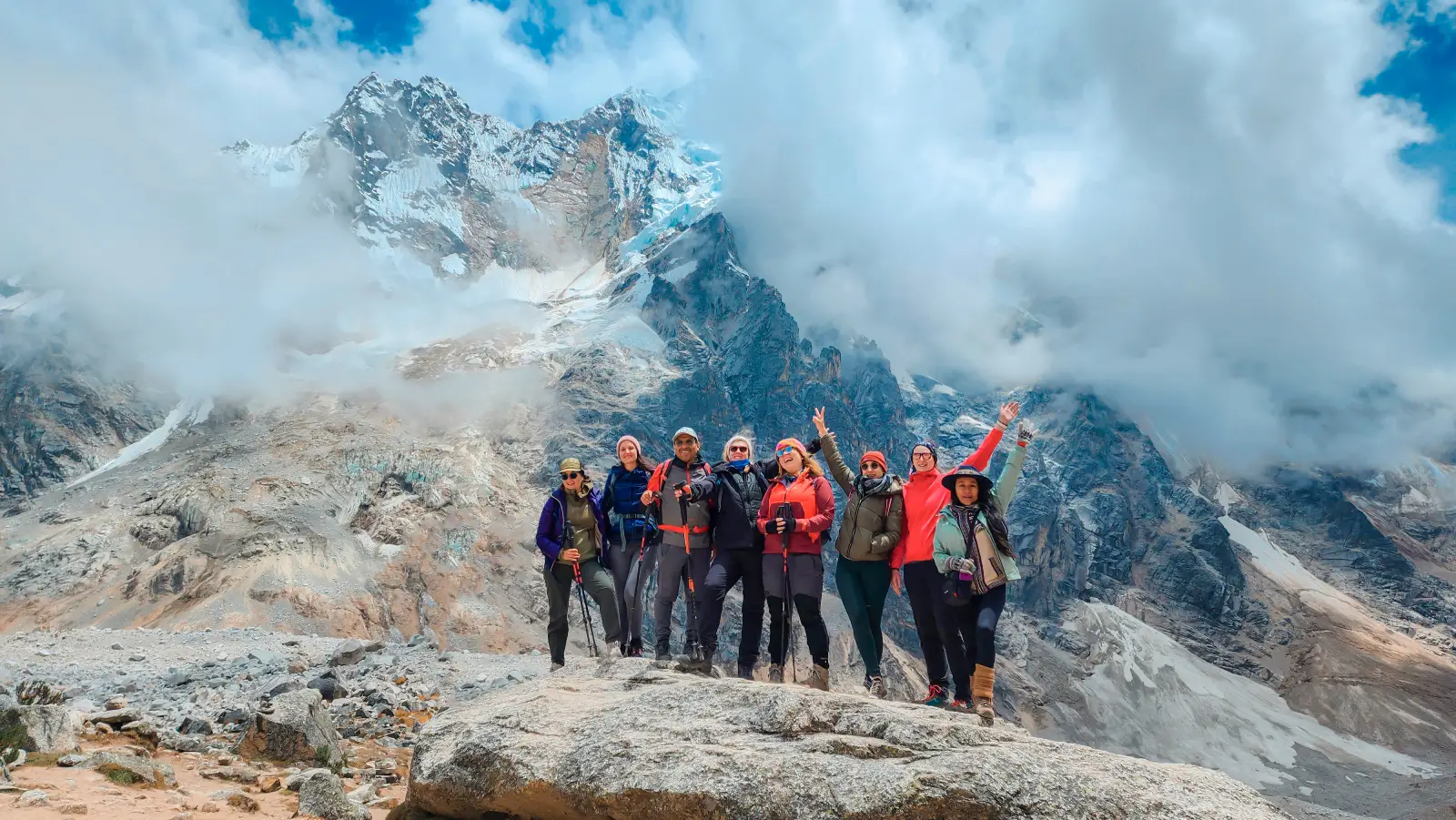
Hikers below Salkantay glacier peaks.
| Planning point | Useful 4-day reference |
| Structure | Three main trekking days + Machu Picchu and return on Day 4. |
| Common route sequence | Soraypampa/Humantay sector → Salkantay Pass → Chaullay or Collpapampa → lower valley → Hidroeléctrica → Aguas Calientes. |
| Published hiking distance | Roughly 30–36 mi (48–58 km) on many current full-service 4-day routes. |
| Highest point | 15,190 ft (4,630 m) at Salkantay Pass as a practical planning reference. |
| Difficulty | Challenging. Day 2 is normally the major mountain day; a very high first camp can make acclimatization more demanding. |
| Humantay Lake | Common on many mainstream 4-day itineraries, but not guaranteed by the duration alone. |
| Final night | Usually a hotel in Aguas Calientes before Machu Picchu. |
For a full comparison of mileage, walking hours and elevation across Salkantay versions, use the Salkantay distance and duration guide.
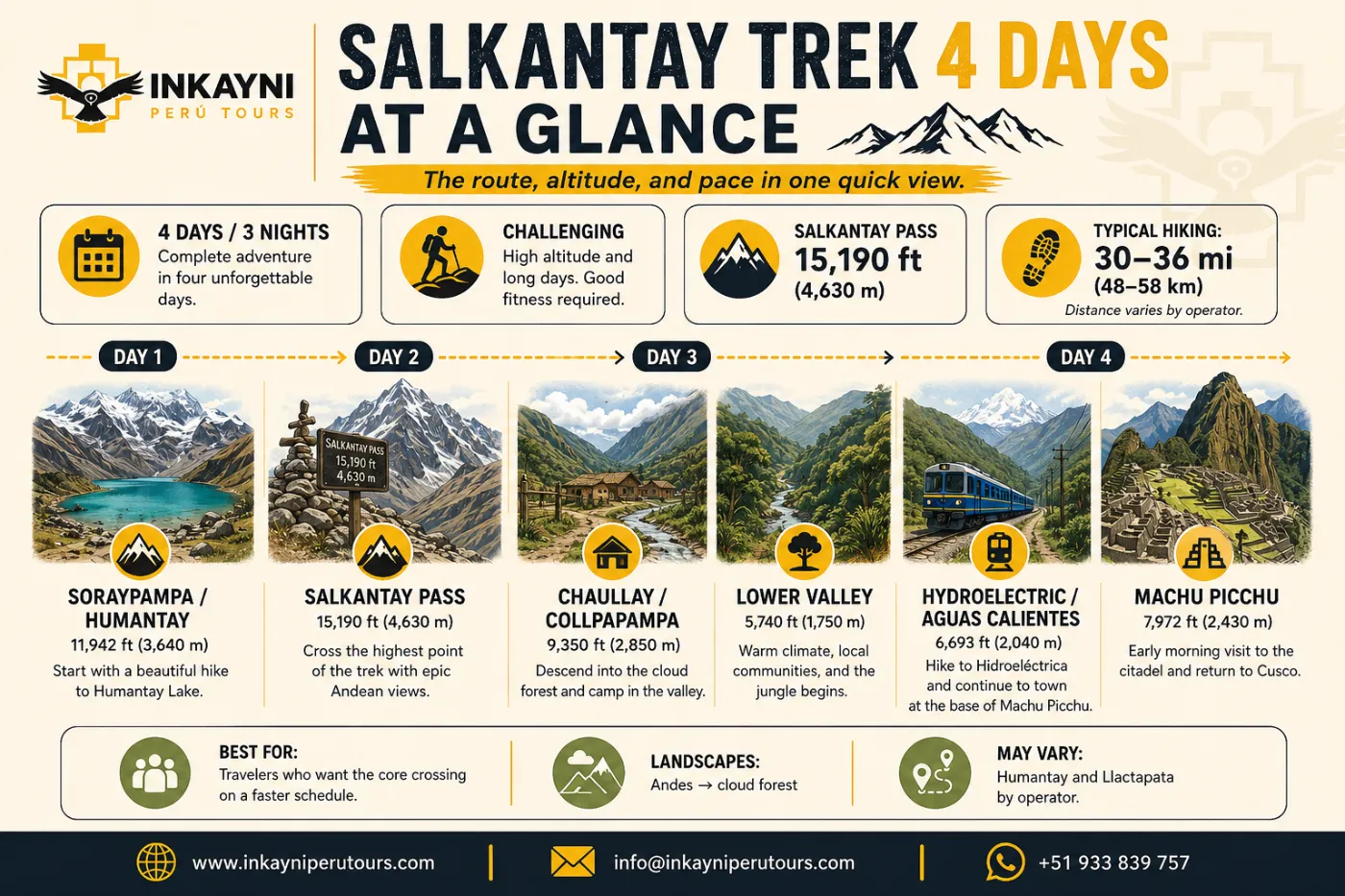
4-day Salkantay Trek itinerary at a glance.
Where 4-Day Salkantay Routes Usually Differ
There is no official 4-day Salkantay Trek itinerary, but most current routes are variations of the same mountain crossing rather than completely different treks. Salkantay Pass and the cloud-forest descent are relatively consistent; the real differences sit around them.
| Route element | Common 4-day pattern | Main variation |
| Day 1 | Soraypampa sector, often with Humantay Lake. | Some routes sleep around Soraypampa/Salkantaypampa; others continue to a much higher camp close to the pass. |
| Day 2 | Cross Salkantay Pass and descend through Huayracmachay toward Chaullay or Collpapampa. | Distance changes with the first camp and overnight point, but this is the most consistent stage across operators. |
| Day 3 | Cloud forest and lower valley toward Hidroeléctrica and Aguas Calientes. | Vehicle transfers can replace part of the valley; some more trekking-focused versions keep Llactapata, while others bypass it. |
| Final approach | Hidroeléctrica → Aguas Calientes. | Usually walked in about 2–3 hours, but some services offer or include a short train instead. |
Keep this in mind:
Before comparing total mileage, compare the first-night camp and the Day 3 transfer points. Those two choices explain much of the difference between current four-day routes.
Does the 4-day Salkantay Trek include Humantay Lake?
Often, but not automatically. Humantay Lake sits around 13,780 ft (4,200 m) and appears on many current 4-day itineraries because Day 1 can be built around the Soraypampa/Humantay sector before the pass crossing on Day 2.
Other routes use those same hours to continue toward a much higher first camp. The Inkayni walking line used below focuses on the climb from Soraypampa through Salkantaypampa toward Suyroccocha. If Humantay is a must-have rather than a bonus, confirm the exact Day 1 route for your departure.
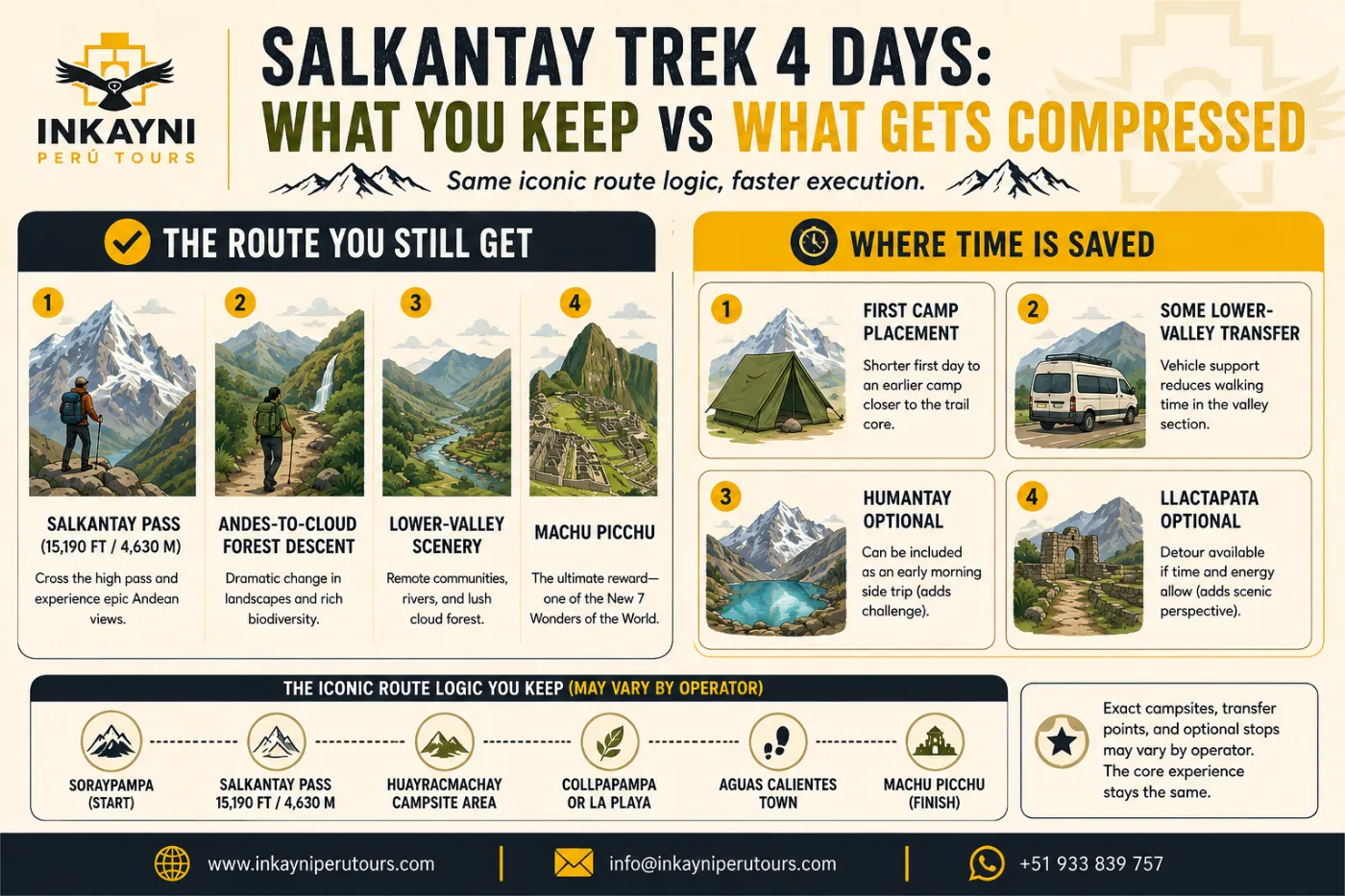
What a 4-day Salkantay Trek keeps and compresses.
4-Day Salkantay Trek Itinerary: A Common Route Pattern
Most four-day routes share the same mountain backbone, so the itinerary below follows a common pattern while showing where Day 1 and Day 3 can change. The detailed walking line comes from Inkayni’s high-first-night version, with the main alternatives noted where they matter.
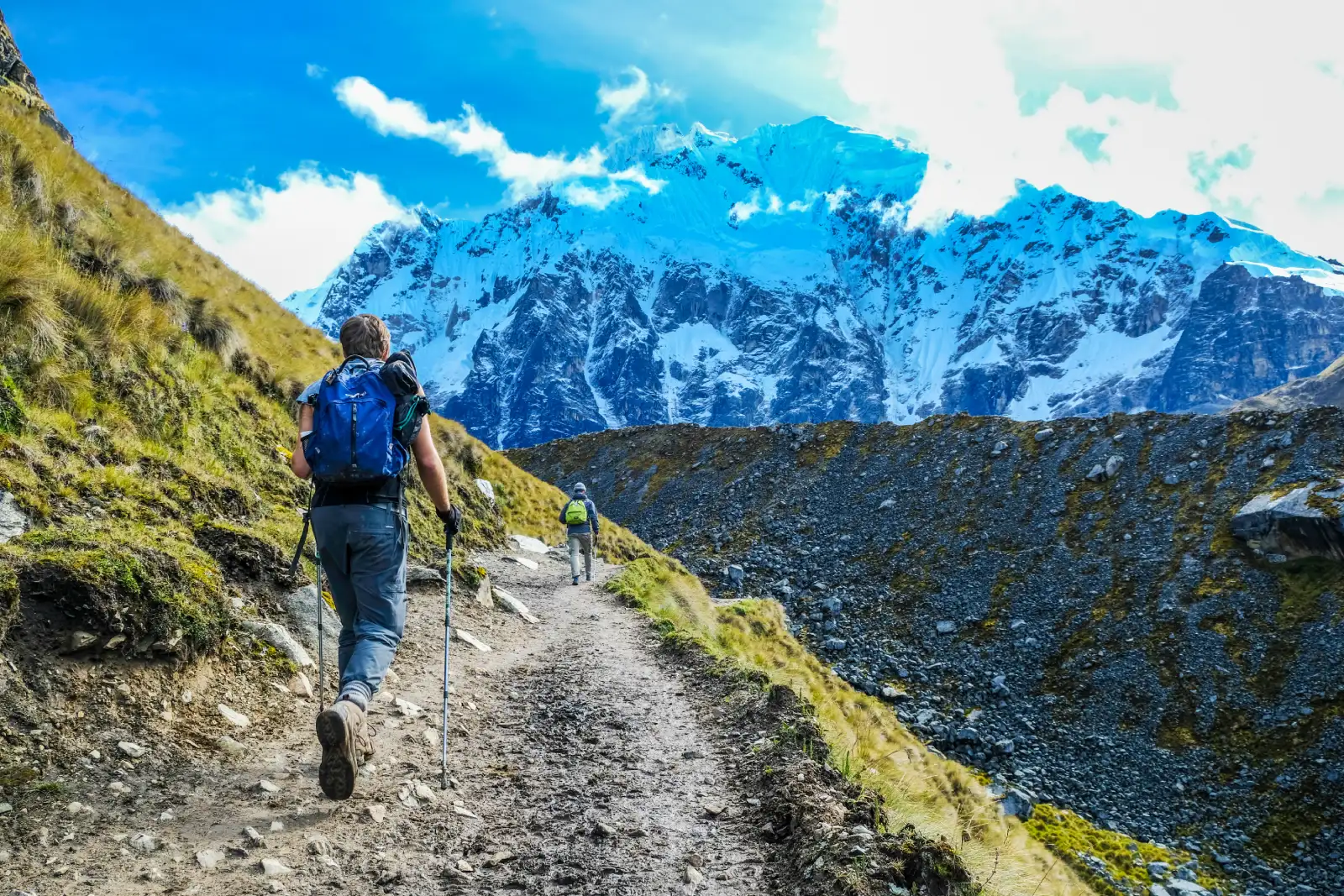
Trail section below Salkantay Mountain.
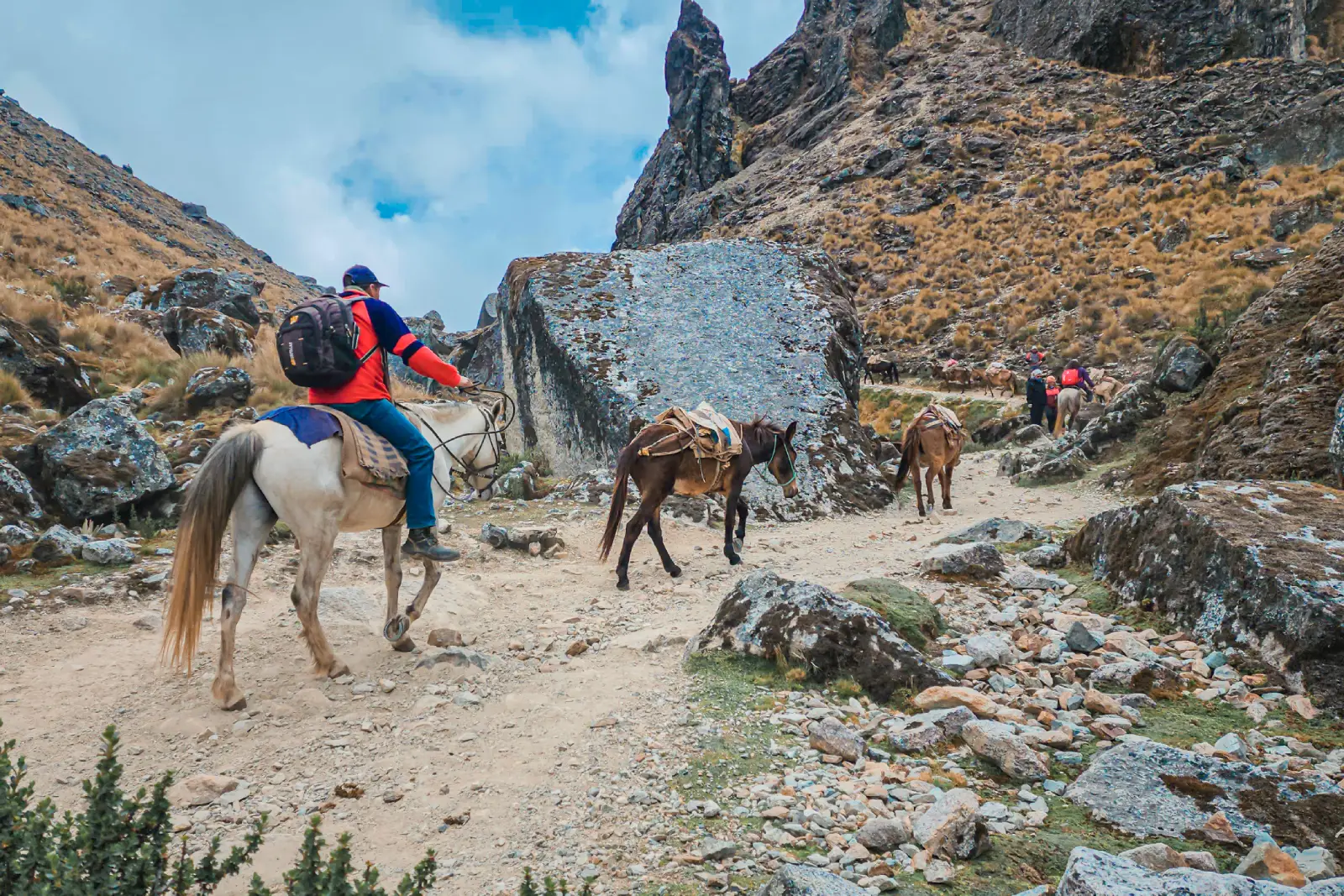
Mules supporting the Salkantay route.
Important note:
Camp names, daily distances and transfer points can change slightly between departures and operators. Use these figures for planning, then confirm the exact route during booking and the pre-trek briefing.
Day 1: Cusco → Soraypampa → Humantay Lake or High Camp
The day begins with an early road transfer from Cusco toward Mollepata and the Soraypampa sector. This is where the main 4-day variations begin.
- Common Humantay-first version: hike to Humantay Lake, return toward the main Salkantay corridor and sleep around Soraypampa, Quiswarniyoc or Salkantaypampa. This preserves the lake and keeps the first night lower.
- High-first-night version: continue beyond Soraypampa and Salkantaypampa toward a camp such as Suyroccocha. Inkayni’s detailed route publishes about 7.5 mi (12 km) of walking and places the camp around 15,092 ft (4,600 m).
That high camp sits only about 100 ft (30 m) below Salkantay Pass. The advantage is less climbing before the pass the next morning; the trade-off is sleeping extremely high on Night 1. If you arrive in Cusco shortly before departure, review the Cusco altitude and acclimatization guide and the Salkantay training and preparation guide before choosing this format.
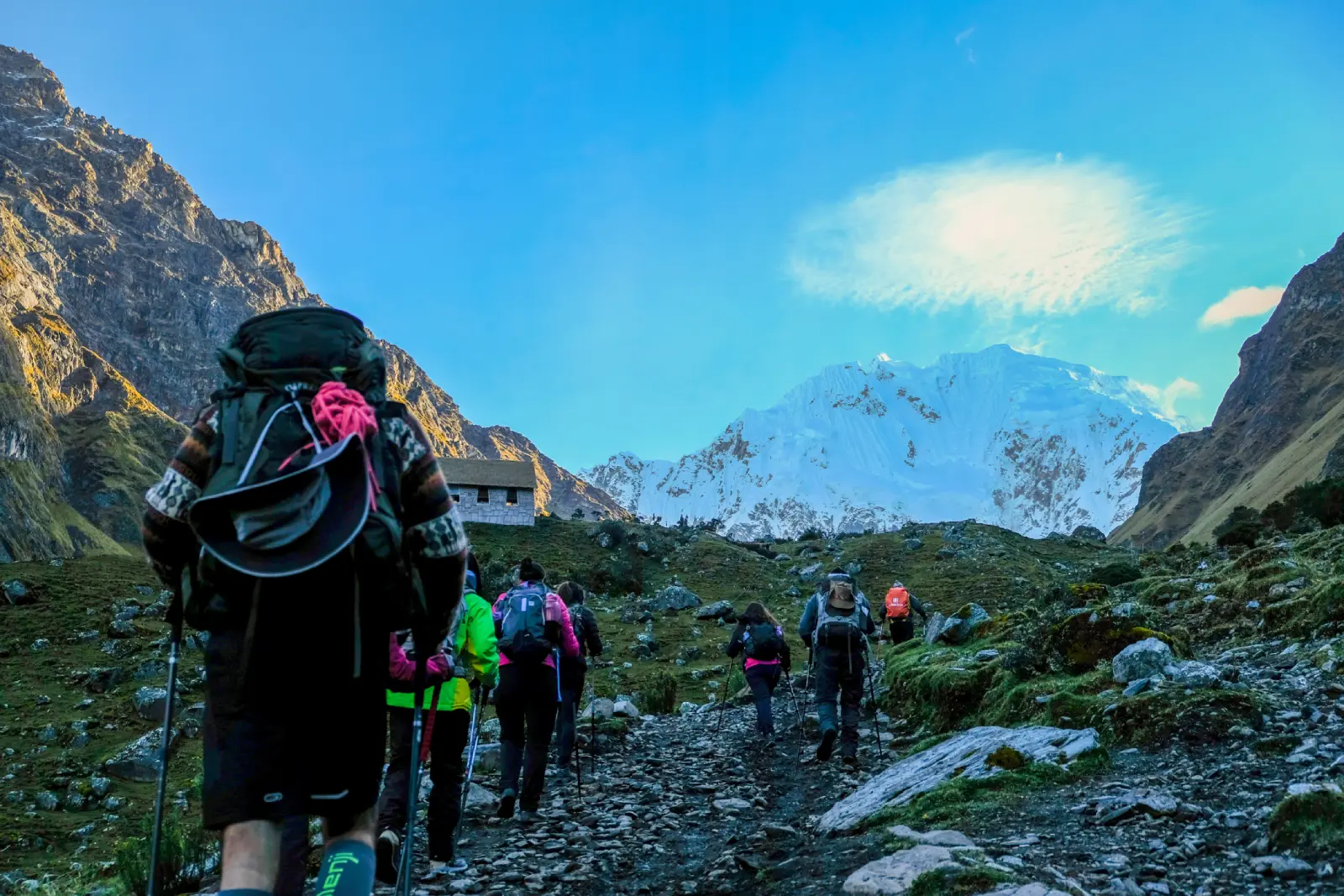
Hikers approaching Salkantay Mountain.
Day 2: High Camp / Soraypampa → Salkantay Pass → Chaullay or Collpapampa
Day 2 is the most recognizable stage of the 4-day Salkantay Trek. Whether the group slept at a lower camp or much closer to the pass, the route climbs to Salkantay Pass at about 15,190 ft (4,630 m), then descends through Huayracmachay into progressively warmer cloud-forest terrain.
- High-camp version: less climbing remains before the pass, but hikers begin after a night close to 15,000 ft.
- Lower-camp version: the morning ascent is longer, but the previous night’s sleeping altitude is usually more forgiving.
- Typical endpoint: Chaullay or Collpapampa, depending on the operator and camp logistics.
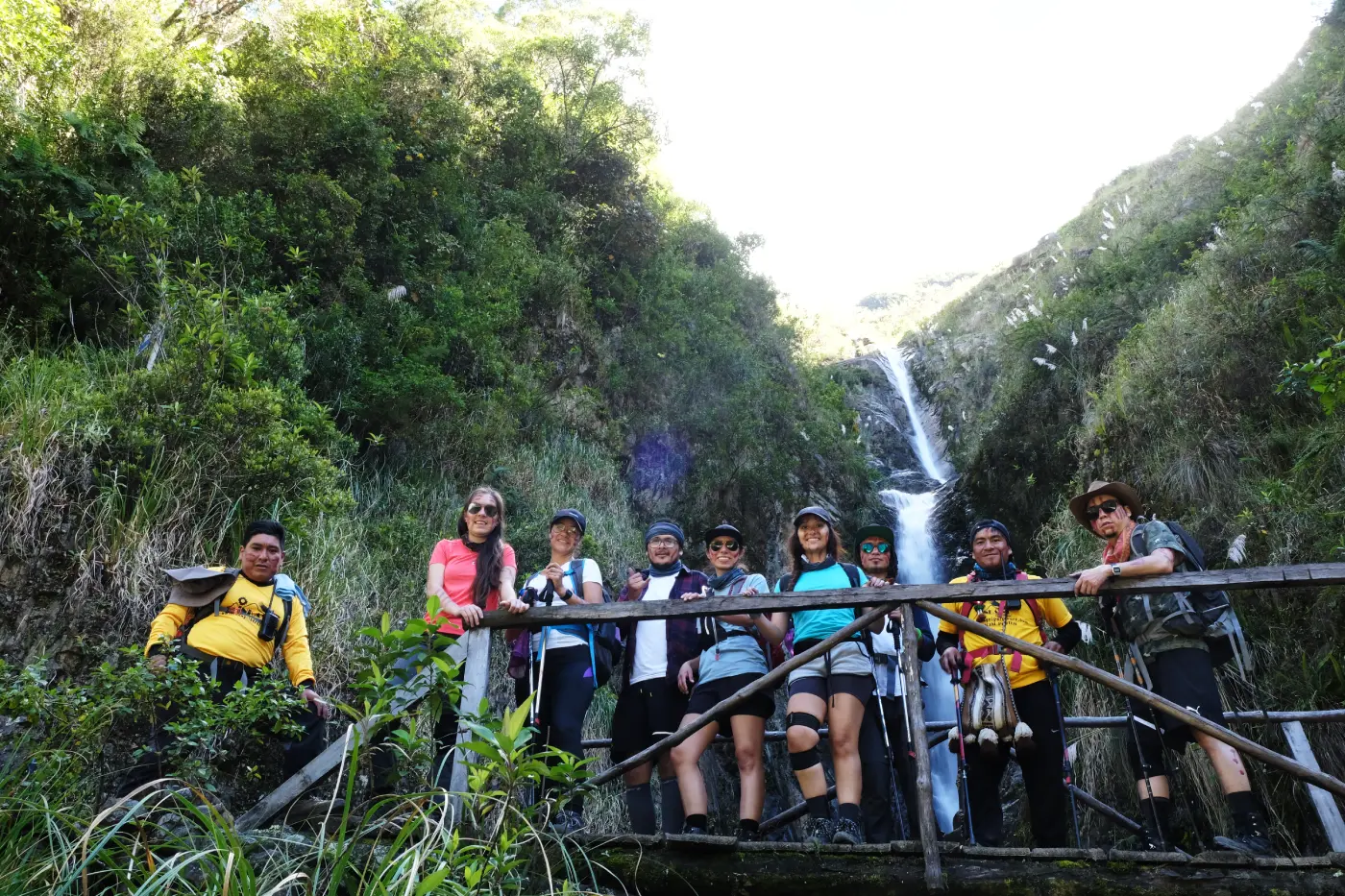
Waterfall stop along the Salkantay mountain route.
Inkayni’s detailed route continues from Suyroccocha through the pass and Huayracmachay to Collpapampa around 9,580 ft (2,920 m), with roughly 12.5 mi (20 km) published for the day. Other current operators commonly publish roughly 11–15 mi (18–24 km) for comparable pass-crossing stages.
The descent matters as much as reaching the pass: from Salkantay Pass to Collpapampa the route loses roughly 5,610 ft (1,710 m). For terrain, altitude load and the hardest sections in more depth, use the Salkantay Trek difficulty guide.
Day 3: Cloud Forest → Lower Valley → Hidroeléctrica → Aguas Calientes
Day 3 leaves the high alpine environment behind. Coffee, cacao, avocado, fruit fields, waterfalls and dense vegetation become more prominent as the route continues through the lower Salkantay valley.
This is the stage where operators make most of their time-saving decisions:
- Common transfer version: walk through part of the Chaullay/Collpapampa–La Playa/Sahuayaco sector, then use a vehicle for part of the lower valley before reaching Hidroeléctrica.
- More trekking-focused version: keep more of the lower route on foot; a smaller number of 4-day itineraries also preserve the climb through Lucmabamba toward Llactapata.
- Final approach: from Hidroeléctrica, many travelers walk about 6.2 mi (10 km) beside the railway to Aguas Calientes, normally around 2–3 hours. Some services instead arrange the short train.
Inkayni’s detailed route walks toward the Sahuayaco sector and then uses a vehicle transfer toward Hidroeléctrica. Its published Day 3 walking line is around 12.5 mi (20 km), depending on the exact transfer point.
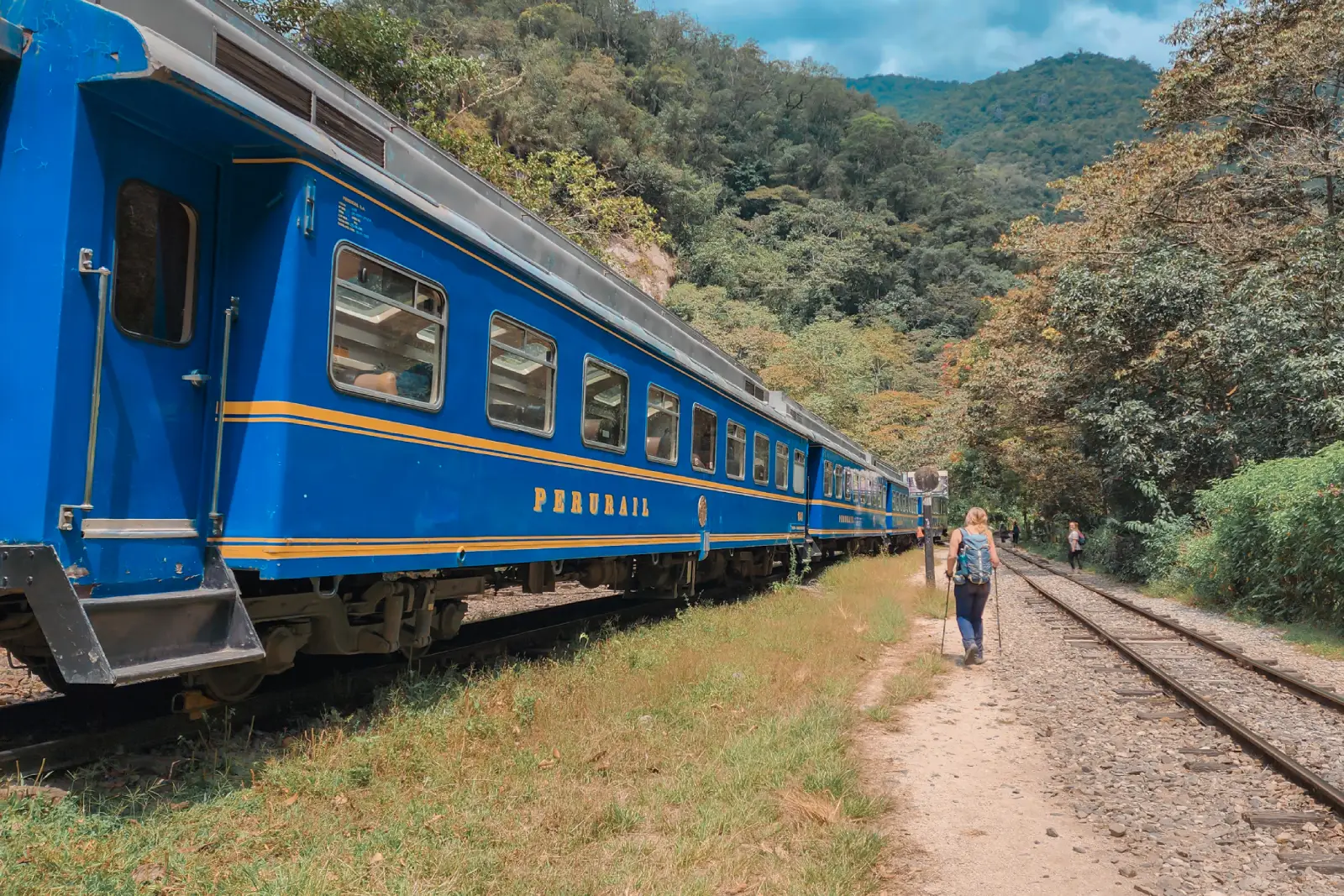
Day 3 is where walking distance and transfer choices vary most.
The short Hidroeléctrica–Aguas Calientes train changes both total hiking distance and cost, so treat it as a route choice rather than a trivial add-on. The train to Machu Picchu guide explains rail options in more detail.
Day 4: Aguas Calientes → Machu Picchu → Ollantaytambo → Cusco
Day 4 is primarily the Machu Picchu visit and return journey rather than another full trekking stage. Machu Picchu sits at about 7,972 ft (2,430 m), far below Salkantay Pass.
Most organized 4-day services use the morning for the archaeological visit, then return to Aguas Calientes for the train toward Ollantaytambo and onward road transfer to Cusco.
Machu Picchu operates through 3 main circuits divided into 10 routes, with the ticket tied to a specific route, date and entry time. Confirm the exact Machu Picchu circuit and route rather than accepting only “entrance included.”
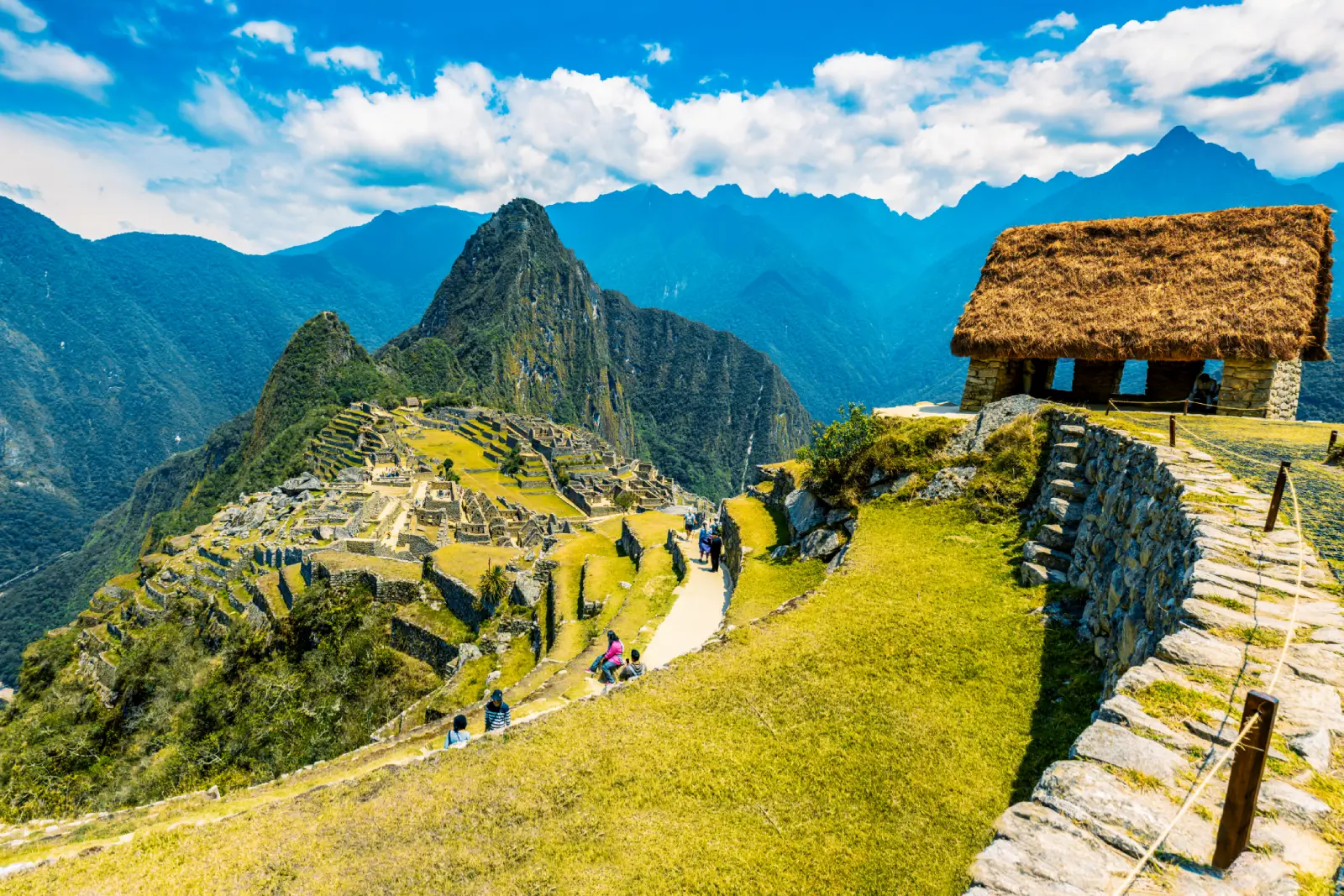
Machu Picchu remains a dedicated final day on most four-day routes.
How Difficult Is the 4-Day Salkantay Trek?
The 4-day Salkantay Trek is challenging. Day 2 normally combines the high pass with a long descent, and a high-first-night route adds another acclimatization demand before that stage even begins. The four-day format is less compressed than the fastest 3-day versions, but it still leaves little recovery time between substantial hiking days.
| Physical factor | What it means on a 4-day route |
| Altitude | The route still reaches roughly 15,190 ft (4,630 m); a high first camp can add a substantial overnight altitude load. |
| Hardest day | Usually Day 2: climb to Salkantay Pass followed by a long descent toward Chaullay or Collpapampa. |
| Recovery | There is less room than on a 5-day route to recover between the high pass and the lower-valley stage. |
Arriving acclimatized and with a solid hiking base matters more than the day count alone. For a full analysis of terrain, altitude, fitness and the hardest sections, use the Salkantay Trek difficulty guide.
Distance and Elevation on the 4-Day Salkantay Trek
Across current full-service itineraries, a practical hiking range is roughly 30–36 mi (48–58 km) before counting incidental walking around Machu Picchu. Inkayni’s detailed published figures total about 32 mi (52 km) across Days 1–3, while other operators move higher or lower depending on the Day 1 camp, Day 3 transfer and final Hidroeléctrica approach.
Elevation explains why mileage alone is a poor difficulty measure. A high-first-night route can move from Soraypampa around 12,795 ft (3,900 m) to a camp near 15,092 ft (4,600 m), reach the pass around 15,190 ft (4,630 m) the next morning, then descend to roughly 9,580 ft (2,920 m) around Collpapampa.
For the complete mileage and walking-time comparison, continue with the Salkantay distance and duration guide. If your question is how altitude and descent affect the effort, use the difficulty guide.
How Much Does a 4-Day Salkantay Trek Cost?
Public 2026 prices vary because “4 days” does not standardize the camp quality, group size, hotel, Machu Picchu ticket, return train, luggage support or how much service is private. Current market pricing supports two useful planning bands rather than one misleading fixed price:
| Service level | Realistic 2026 range | What usually separates it |
| Standard full-service group | US$520–680 (S/1,740–2,280) per person | Shared small-group departure, camping support, meals, guide, luggage support, Machu Picchu logistics and a standard return train when included in the package. |
| Premium / private | US$700–1,300 (S/2,340–4,360) per person | Private or very small groups, upgraded camps or glamping, more personalized logistics, better hotel/rail categories or additional comfort. Very small private groups and true luxury services can exceed this band. |
The lower end of the market can advertise prices below this standard band, but some of those services exclude major components such as the return train, hotel level, transfers or other logistics. Compare the final inclusion list before treating two headline prices as equivalent.
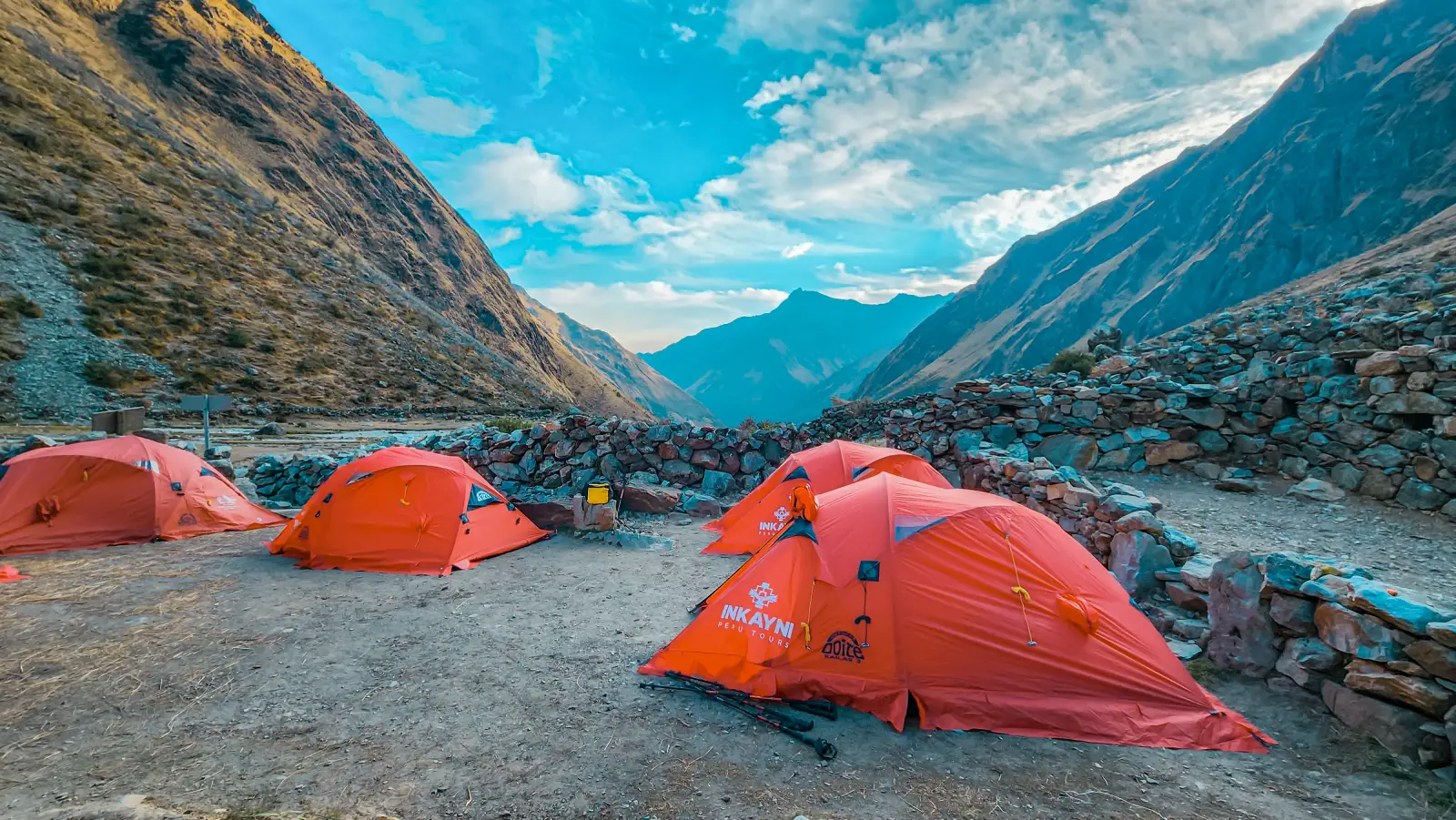
Mountain campsite on the Salkantay Trek.
Common extras, when they are not already included, can add roughly:
- Sleeping bag and trekking poles: about US$30–60 (S/100–200) combined.
- Optional Hidroeléctrica → Aguas Calientes train: about US$30–50 (S/100–170).
- Personal drinks, snacks, tips and small trail expenses: roughly US$30–80 (S/100–270).
- Single-room or hotel upgrade: commonly around US$60–120+ (S/200–400+), depending on hotel category and season.
Budget reality:
After common rentals, trail spending and modest upgrades, a practical total planning range is about US$580–850 (S/1,940–2,850) for a standard group trip and roughly US$780–1,450+ (S/2,610–4,860+) for premium or private service. These ranges cover the trek and its immediate Machu Picchu logistics, not international flights, pre-trek Cusco accommodation, travel insurance or major gear purchases.
What the Current Inkayni 4-Day Service Includes
Price makes more sense once you know what is already bundled. Inkayni’s current 4-day product lists:
- professional trekking staff and guided service;
- mule support for up to 15 lb (7 kg) of personal belongings, with sleeping equipment counted within that allowance;
- two camping nights and one hotel night in Aguas Calientes;
- three breakfasts, three lunches, three afternoon snacks and three dinners;
- camping equipment, first-aid kit and oxygen;
- transport from Cusco toward the trek start;
- Machu Picchu visit logistics according to the ticket booked;
- return train from Aguas Calientes toward Ollantaytambo and onward ground transport to Cusco.
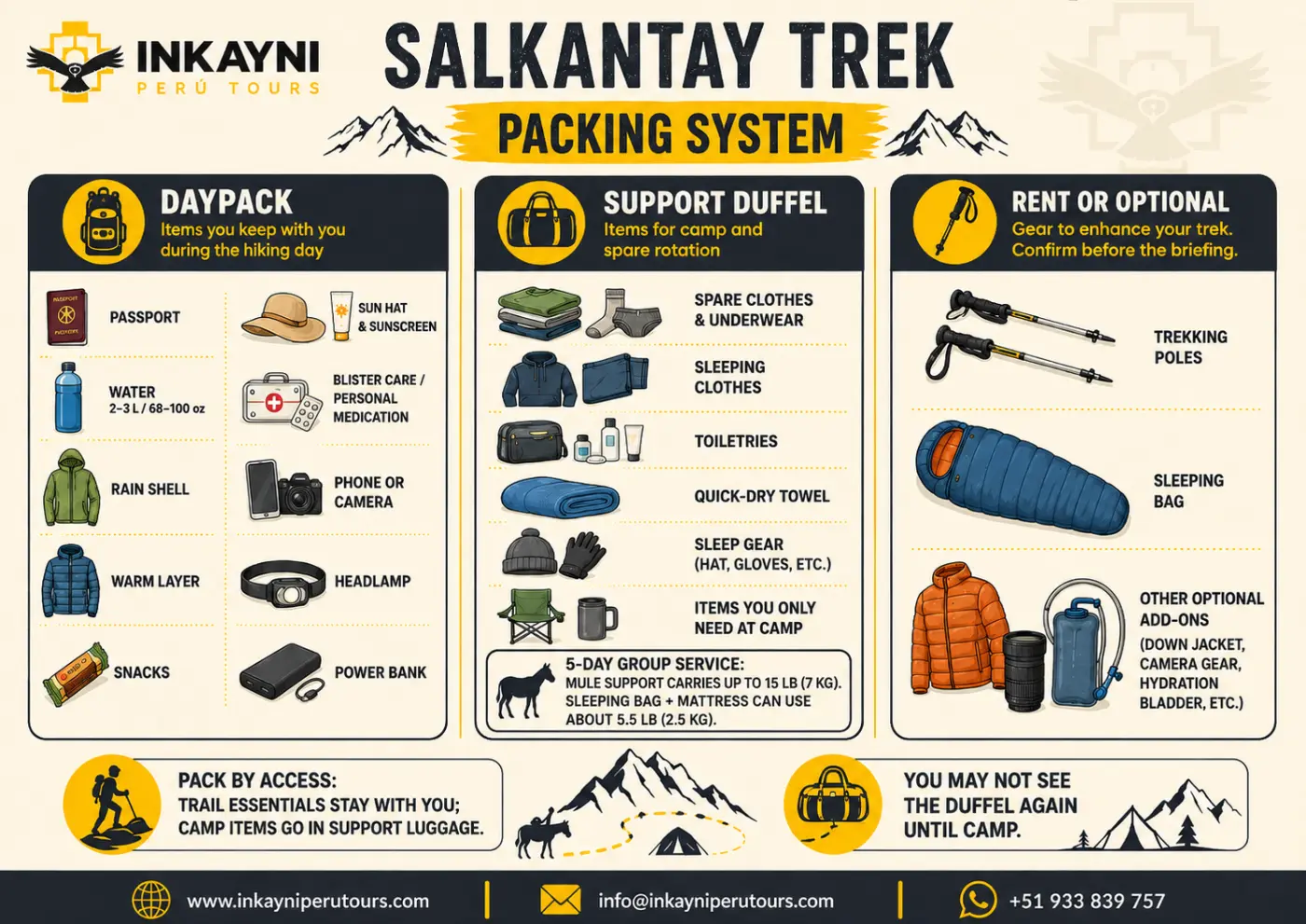
How to organize your gear for the Salkantay Trek.
Sleeping bags and trekking poles are rental equipment rather than standard inclusions, and the return train is listed in a standard Expedition/Voyager-type category. Confirm the exact Machu Picchu circuit, bus segments, hotel room arrangement and any upgrades before payment.
For clothing, training and personal equipment, use the Salkantay training and packing guide.
Who Should Choose the 4-Day Salkantay Trek?
| The 4-day route is a strong fit if… | Consider a longer route if… |
| Four days is a firm limit in your Peru itinerary. | You can spare another day without sacrificing another priority. |
| You are already acclimatized and comfortable with substantial hiking days. | You are reaching Cusco immediately before departure or want a gentler recovery rhythm. |
| You want the core Salkantay Pass-to-Machu-Picchu experience and accept some lower-valley compression. | Keeping more of the lower valley, Lucmabamba or Llactapata on foot is a major priority. |
| You are comfortable with a vehicle transfer being part of a shorter itinerary. | Continuous trekking matters more to you than saving one day. |
If one extra trekking day is available, the dedicated Salkantay Trek 5 days shows what the longer format adds. If you are still choosing between trekking routes rather than Salkantay durations, compare the Salkantay Trek vs. Inca Trail.
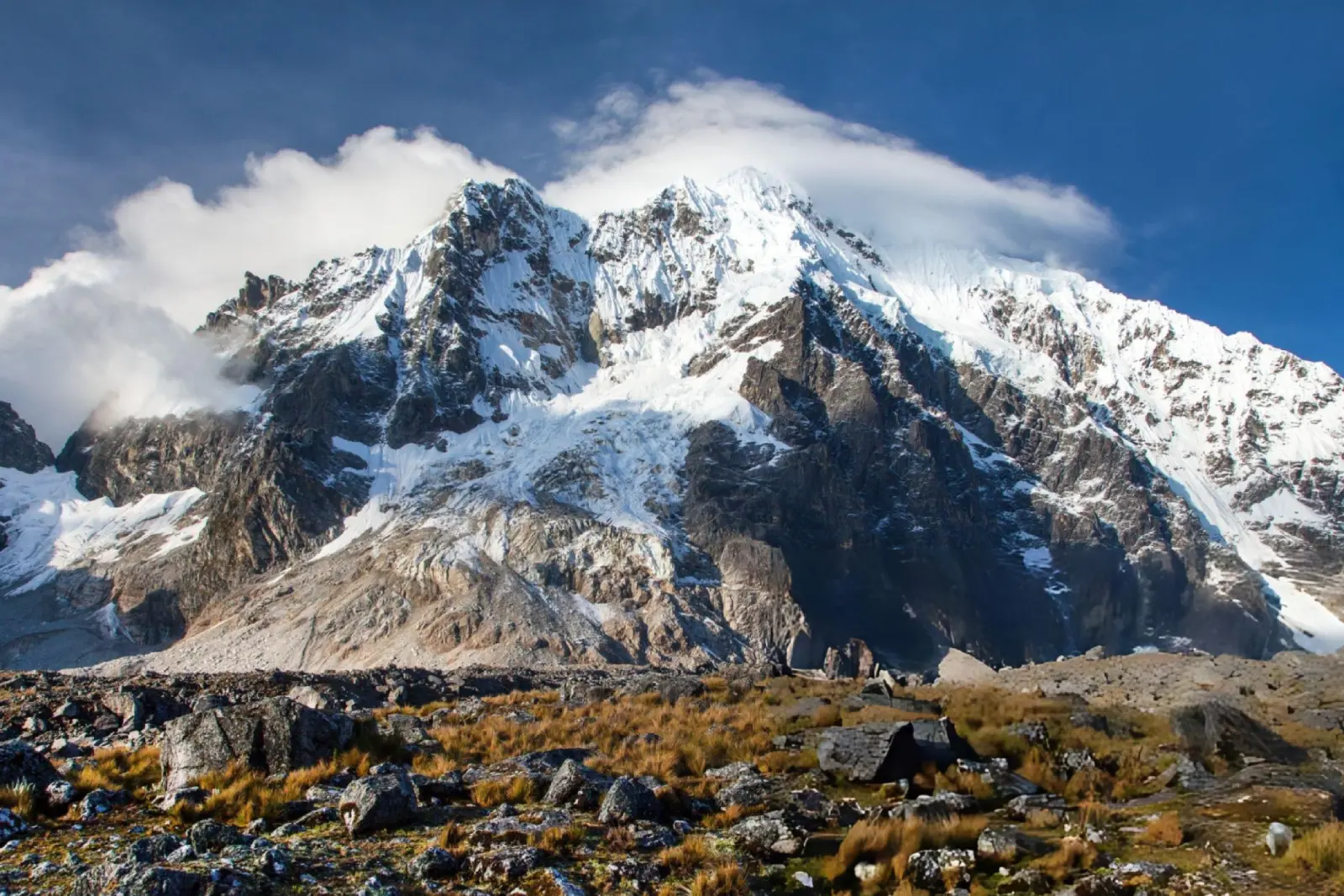
Salkantay Mountain dominating the high-Andean landscape in Salkantay pass.
What to Confirm Before Booking the 4-Day Route
The 4-day market is relatively consistent, but the details still affect difficulty, mileage and value. Before paying, confirm:
- Day 1: Humantay Lake, direct climb to a high camp, or both—and what is the first-night altitude?
- Daily hiking: what distance and approximate walking time is planned on Days 1–3?
- Pass-day endpoint: Chaullay, Collpapampa or another camp?
- Lower valley: where does vehicle transport begin, and is Llactapata included or bypassed?
- Hidroeléctrica → Aguas Calientes: walk, included train or optional train?
- Aguas Calientes: hotel category and room arrangement?
- Machu Picchu: which circuit and route will be issued?
- Return and luggage: train category, ground transfer and personal mule allowance?
- Extras: sleeping bag, trekking poles, single supplement, hotel upgrade or train upgrade?
Machu Picchu currently uses 3 main circuits and 10 routes. You can verify the system on the official Machu Picchu circuits page. If you are building the trek independently, the Salkantay Trek on your own guide covers transport, lodging and navigation.
Continue Planning Your Salkantay Trek
Choose the 4-Day Salkantay Trek When Time Is Tight
The 4-day Salkantay Trek still keeps the high-Andean approach, Salkantay Pass, the cloud-forest transition, Aguas Calientes and Machu Picchu. What you give up is mainly time between those stages and some of the lower-valley walking.
If that trade-off fits your schedule, review Inkayni’s 4-day Salkantay Trek to Machu Picchu. If Humantay Lake, the first-night altitude, the exact walking line or your Machu Picchu ticket could change your decision, talk to a travel specialist before booking.
Frequently Asked Questions About the Salkantay Trek 4 Days
How long is the Salkantay Trek 4 days?
The itinerary lasts 4 days / 3 nights. The first three days contain the main trekking stages, while Day 4 is primarily the Machu Picchu visit and return to Cusco.
How many miles is the 4-day Salkantay Trek?
Many current full-service four-day routes publish roughly 30–36 mi (48–58 km) of hiking. The total changes with the first camp, Day 3 transfer and whether the Hidroeléctrica–Aguas Calientes section is walked.
What is the highest point of the 4-day Salkantay Trek?
Salkantay Pass is the highest point on the common route at about 15,190 ft (4,630 m) as a practical planning reference. Some operators publish slightly different figures because of GPS readings and rounding.
Does the 4-day Salkantay Trek include Humantay Lake?
Humantay Lake is common on many 4-day itineraries, especially routes that use Day 1 around Soraypampa, but it is not guaranteed. High-first-night versions can use that time to continue toward Salkantaypampa or Suyroccocha instead. Confirm the written Day 1 route if Humantay is a priority.
How difficult is the 4-day Salkantay Trek?
It is generally challenging. Day 2 usually combines the climb to Salkantay Pass with a long descent into the cloud forest, while a high-first-night design can add extra acclimatization stress. It is normally less compressed than the hardest 3-day versions but offers less recovery time than many 5-day routes.
How much does the Salkantay Trek 4 days cost?
A realistic current planning range is roughly US$520–680 (S/1,740–2,280) per person for a standard full-service group trek and about US$700–1,300 (S/2,340–4,360) per person for premium or private services. Very small private groups and true luxury itineraries can cost more. Compare inclusions before comparing headline prices.
Where do you sleep on the 4-day Salkantay Trek?
Most four-day formats use two nights on the trekking route followed by one hotel night in Aguas Calientes. The first camp varies significantly: some operators sleep around Soraypampa/Salkantaypampa, while high-first-night versions can continue close to 15,000 ft.
Does the 4-day Salkantay route use a vehicle transfer?
Many current four-day routes use a lower-valley vehicle transfer on Day 3 to save time before Hidroeléctrica. The exact transfer point varies, so ask how much of the Chaullay/Collpapampa-to-Hidroeléctrica line is actually walked.
Does the 4-day Salkantay Trek include Llactapata?
Not always. Some trekking-focused 4-day itineraries preserve the Lucmabamba–Llactapata section, but many mainstream versions bypass it or use lower-valley transport to reach Hidroeléctrica sooner. Check the written Day 3 route if Llactapata matters to you.
Do all 4-day Salkantay tours follow the same itinerary?
No, but they are more standardized than most 3-day versions. Current routes usually preserve Salkantay Pass, the cloud-forest descent, Aguas Calientes and Machu Picchu. The main differences are Humantay Lake, first camp, Day 3 transfers, Llactapata and the final walk or train from Hidroeléctrica.
Should I choose the 4-day or 5-day Salkantay Trek?
Choose four days when time is limited and you accept a faster rhythm with some lower-valley compression. Choose five days when you can spare the extra day and value more trail continuity, route depth and recovery time.