


How Difficult Is the Salkantay Trek?
The Salkantay Trek is challenging but non-technical. The difficulty comes from hiking at high altitude, crossing Salkantay Pass at about 15,190 ft (4,630 m), handling long descents and walking for several days in a row. Active beginners can do it with preparation and acclimatization, but the hardest day can reach about 13.7 mi (22 km) and roughly 9 hours on foot, so it should not be treated as a casual hike.
Table of Contents
Difficulty changes as the trek progresses. The pass is the hardest section for breathing, the long descent shifts the stress to quads and knees, and later days add cumulative fatigue. The route eventually connects with Machu Picchu, but the physical challenge is decided mainly in the mountain stages before the final visit. A shorter itinerary is not automatically easier either: the 4-day reference route sleeps much higher on its first night than the 5-day version.
For route, camps, weather and broader logistics, use the complete Salkantay Trek guide.

Salkantay is challenging because altitude, distance and long descents accumulate over several days.
Salkantay Trek Difficulty at a Glance
The standard route is best understood as a high-altitude endurance trek, not a technical mountain climb. These are the factors that most affect how hard it feels:
| Difficulty factor | Impact | What it means on the trail |
| Altitude | High | Salkantay Pass reaches about 15,190 ft (4,630 m), where a normal hiking pace requires noticeably more effort. |
| Hardest day | High | The 5-day reference route combines 13.7 mi (22 km), about 9 hours and the high pass in one stage. |
| Long descent | High | From the pass to Chaullay, the route loses about 5,610 ft (1,710 m), putting sustained load on quads and knees. |
| Consecutive days | Moderate–high | Fatigue carries forward because the trek asks you to hike again after several long days rather than recover fully between stages. |
| Pack weight | Variable | Walking with a light daypack is very different from carrying your full camping load on the same terrain. |
| Technical skill | Low | The standard trek is hiking, not a summit climb of Salkantay Mountain. |
Keep this in mind:
If you already handle long hilly walks comfortably and can repeat a substantial walk the next day, Salkantay is a realistic challenge with proper acclimatization. If most of your fitness comes from flat walking or indoor cardio, the pass day and the descent are more likely to surprise you than the total mileage.
GLACIER MOUNTAIN TREKSalkantay Trek
Discover one of Peru’s most scenic treks beneath snowy peaks and changing landscapes.
Why the Salkantay Trek Feels Hard
No single obstacle makes Salkantay difficult. The challenge comes from how altitude, climbing, descending and accumulated walking time overlap.
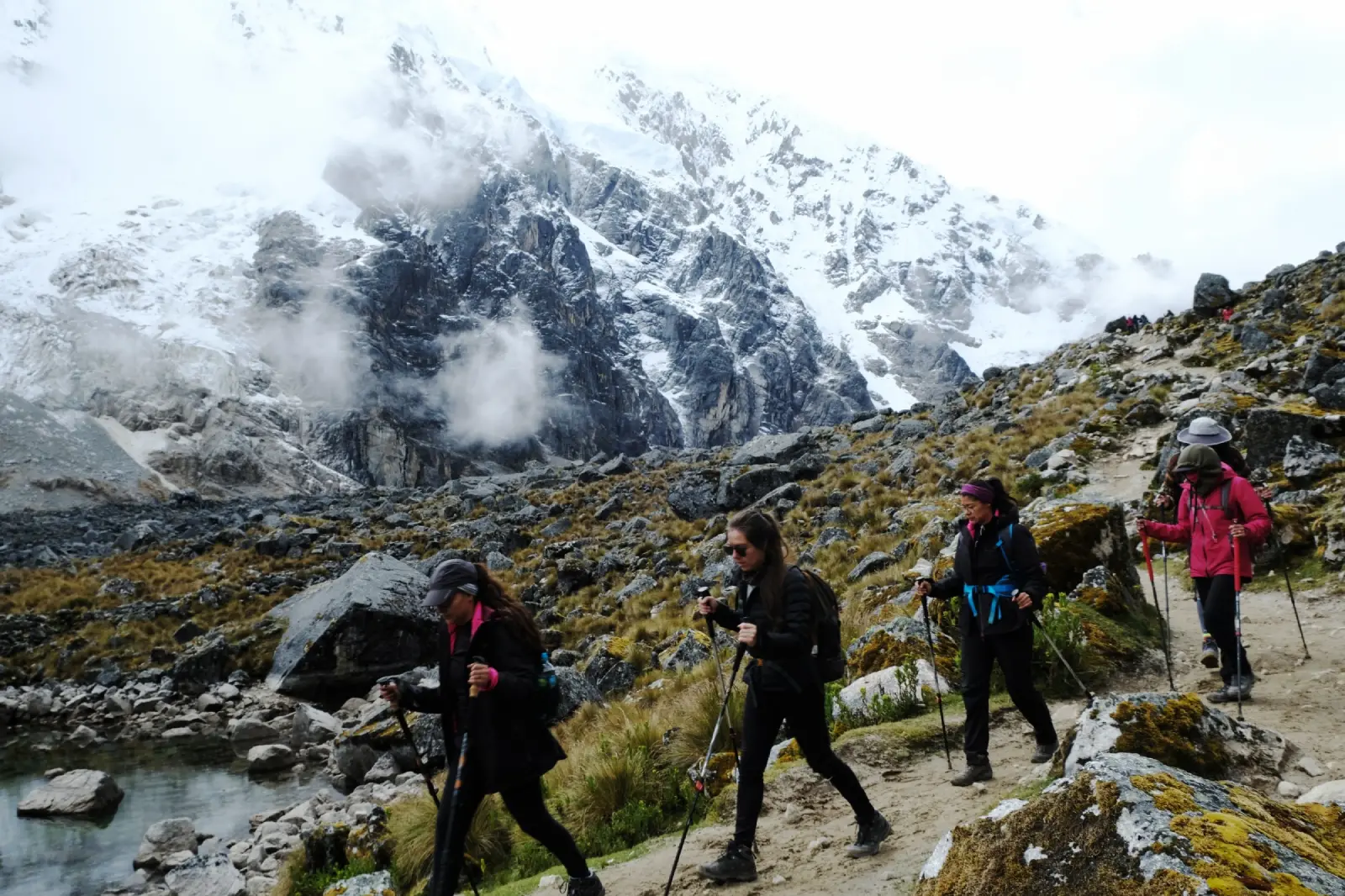
Hiking the alpine trail below Salkantay mountain.
Salkantay Pass and high altitude
Salkantay Pass reaches about 15,190 ft (4,630 m). On the 5-day route used here as a reference, the pass day starts near Soraypampa at about 12,795 ft (3,900 m), gains roughly 2,395 vertical ft (730 m), and then drops toward Chaullay at about 9,580 ft (2,920 m).
That means the hardest day is not simply an uphill. After reaching the high point, the route still loses approximately 5,610 ft (1,710 m) before the next camp.

The CDC identifies the Salkantay Trek at 15,190 ft (4,630 m) as a high-altitude destination and notes that fitness does not protect travelers from altitude illness. Fitness helps with the physical workload; acclimatization in Cusco is a separate issue. See the CDC high-altitude guidance for the medical context and the Salkantay preparation guide for pre-trek planning.
Long hiking days and cumulative fatigue
The hardest 5-day stage is about 13.7 mi (22 km) and roughly 9 hours. Even after the pass is behind you, a later trekking day can still require about 10.6 mi (17 km) and around 7 hours before reaching Aguas Calientes.
Across the four main trekking days of that route, the published schedule adds up to roughly 28 hours on foot. That is why finishing the pass day strongly does not mean the physical challenge is over.
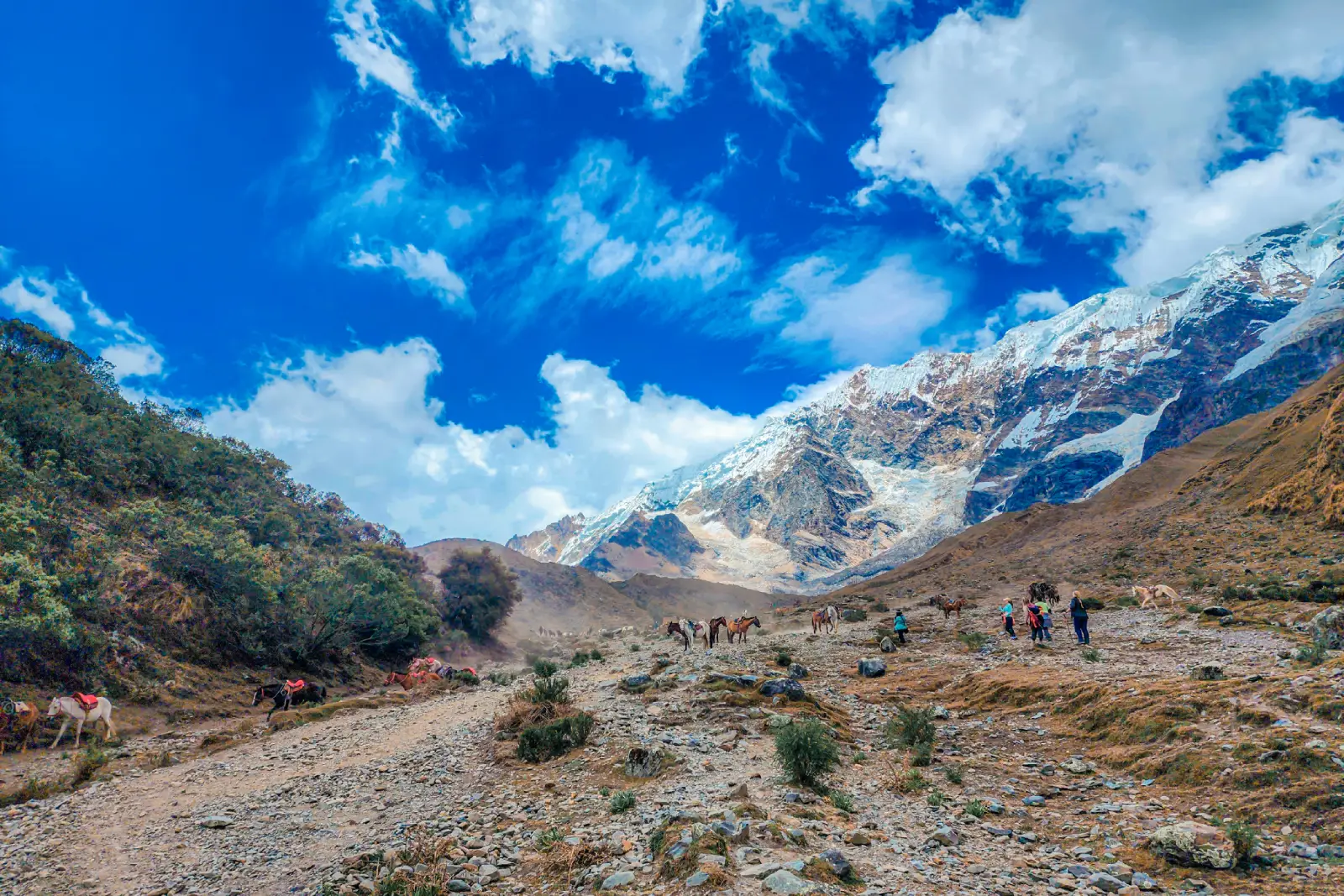
Upper valley with horses and glaciers.
For the complete day-by-day mileage and walking-time comparison, use the Salkantay Trek distance and duration guide.
The long descent after Salkantay Pass
The descent deserves almost as much attention as the climb. Dropping about 5,610 ft (1,710 m) toward Chaullay changes the type of effort: breathing becomes easier as altitude decreases, but quads, knees and balance take more of the load.
Uneven downhill terrain becomes more tiring as the day progresses. Trekking poles are not mandatory, but they can be especially useful for hikers whose knees usually become the limiting factor on long descents.
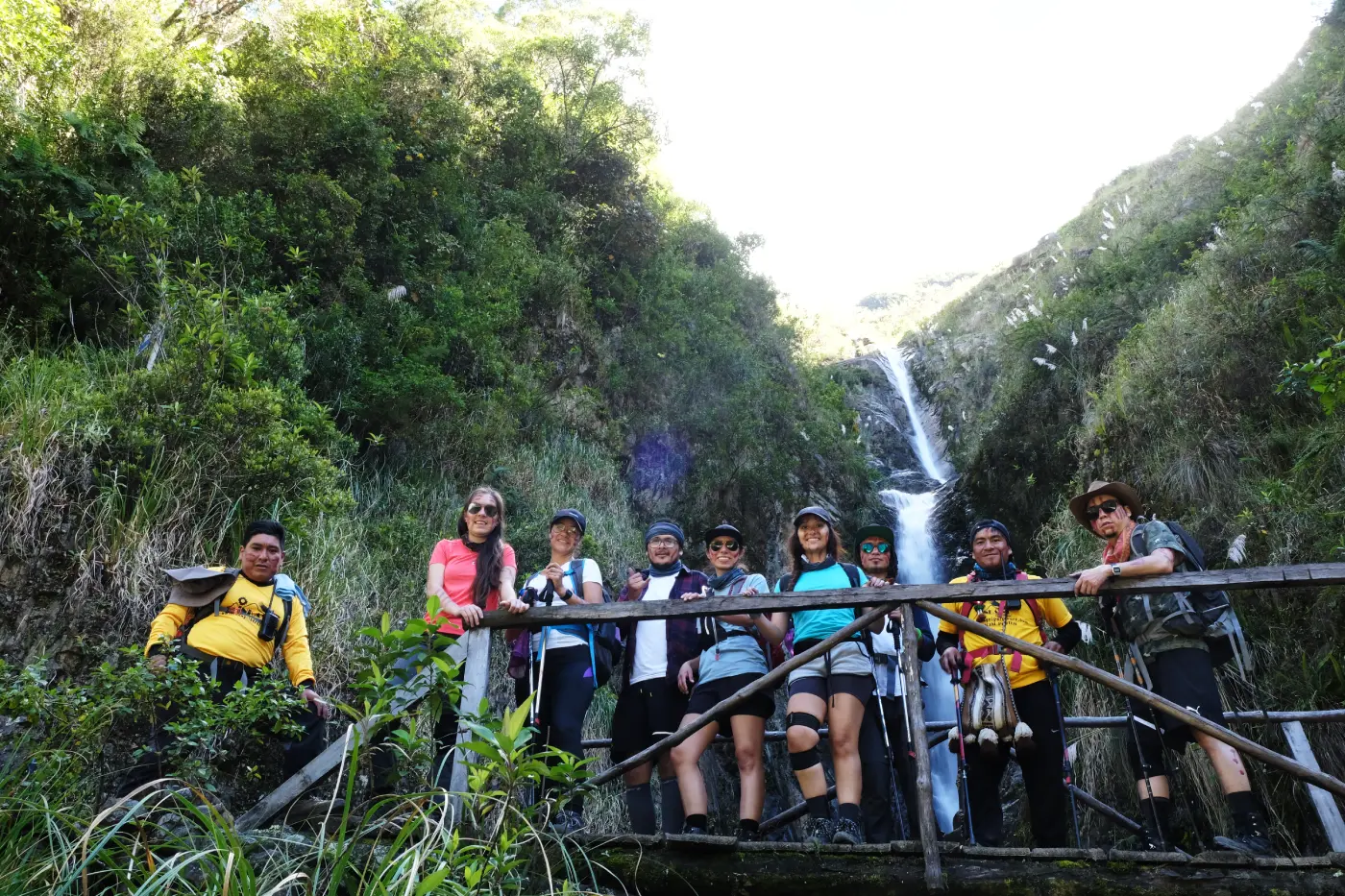
Waterfall stop along the Salkantay mountain route.
Salkantay Trek Altitude and Elevation
Salkantay Trek altitude is one of the main reasons the route feels harder than a similar-distance hike at low elevation. The most useful numbers are the places where you actually hike and sleep.
| Reference point | Elevation | Why it matters |
| Cusco | ~11,000 ft (3,350 m) | Most travelers begin adapting to significant altitude before the trek starts. |
| Soraypampa | ~12,795 ft (3,900 m) | Typical first-night altitude on the 5-day reference route. |
| Suyroccocha | ~15,092 ft (4,600 m) | First-night camp on the 4-day reference route, only about 98 ft (30 m) below the pass. |
| Salkantay Pass | ~15,190 ft (4,630 m) | Highest point on the standard trekking corridor. |
| Chaullay | ~9,580 ft (2,920 m) | The major descent shifts the workload from breathing to legs and knees. |
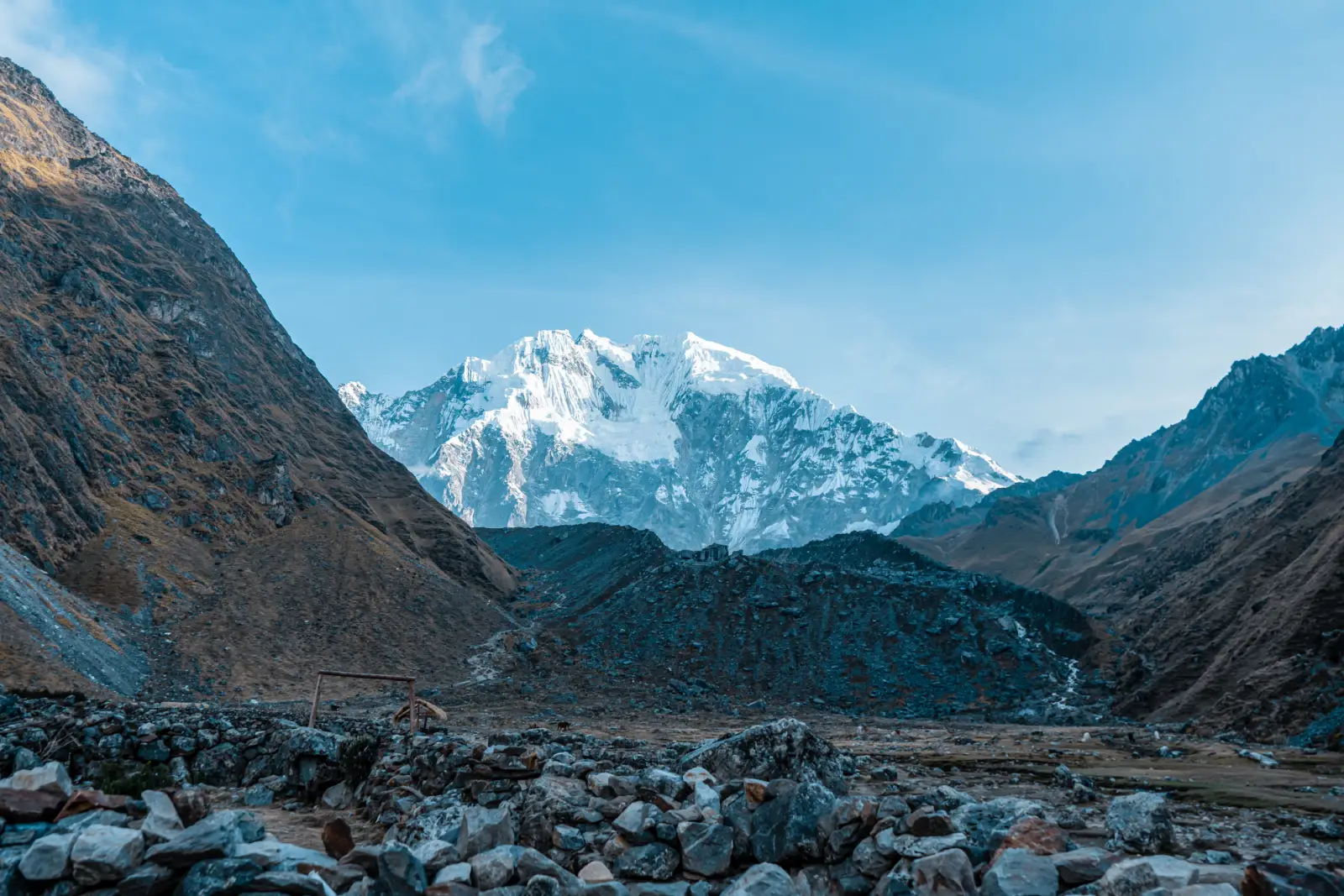
Glaciated scenery along the Salkantay route.
Salkantay Trek elevation gain is route-specific
There is no single universal Salkantay Trek elevation gain because 4-day, 5-day and other versions do not follow exactly the same walking line. A whole-route gain figure only makes sense when it comes from a specific itinerary or GPX track.
For difficulty, the more useful numbers are what happens within a day. On the 5-day pass stage, that means roughly 2,395 ft (730 m) of climbing followed by about 5,610 ft (1,710 m) of descent.
Continue Planning the Salkantay Trek
The Hardest Day on the Salkantay Trek
On the 5-day reference route, Day 2 is the clearest hardest-day benchmark:
| Distance | Walking time | Highest point | Main challenge |
| 13.7 mi (22 km) | About 9 hours | 15,190 ft (4,630 m) | High-altitude climb + long descent |
The final approach to the pass is where a normal low-altitude hiking pace becomes a poor expectation. Reaching the top is also not the end of the workload: the descent continues for thousands of vertical feet toward much warmer terrain.
That is why being comfortable with a 13-mile hike at home is useful but not a complete readiness test. Salkantay asks you to cover similar mileage at altitude, on uneven ground and as part of a multi-day trek.
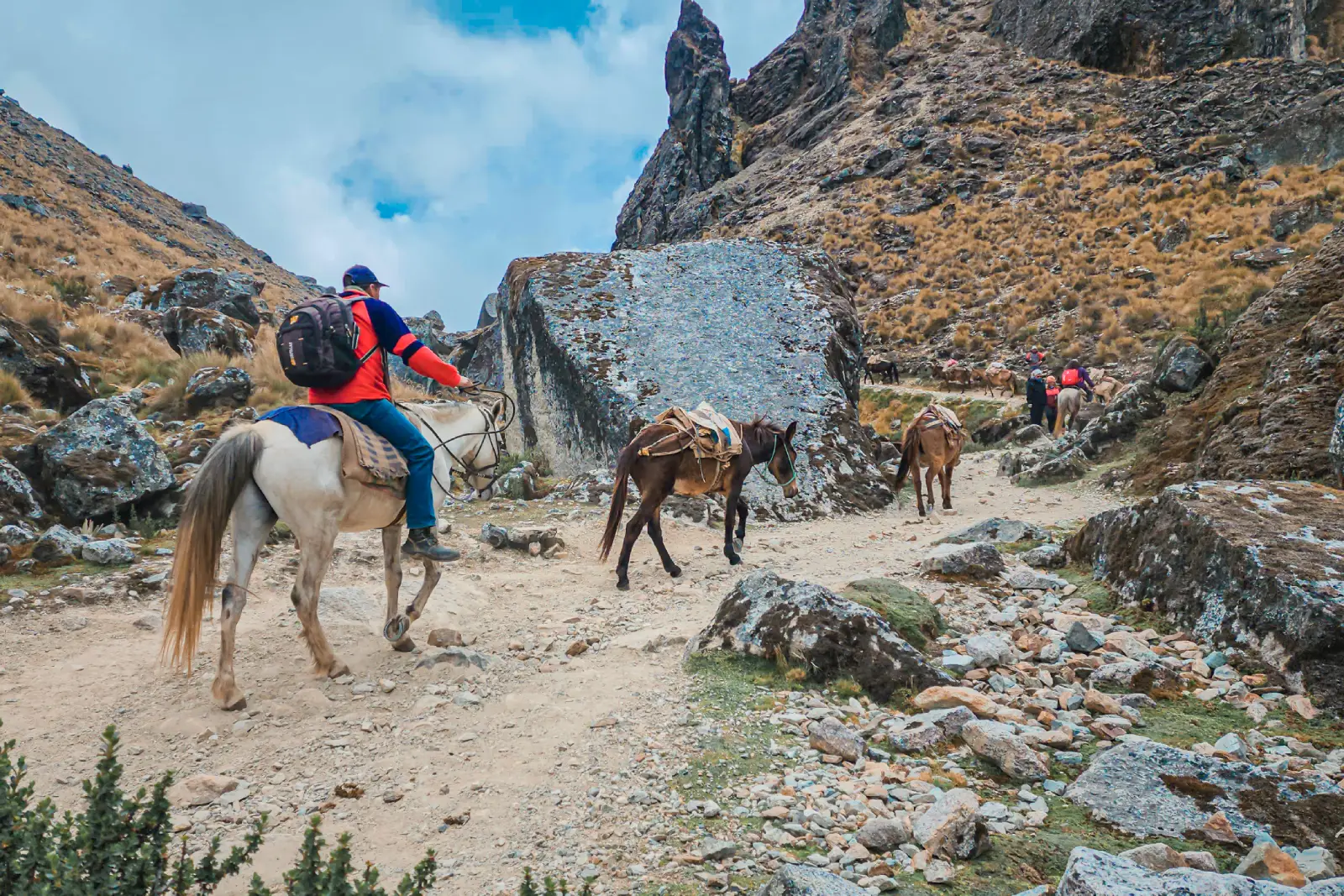
Mules supporting the Salkantay route.
4-Day vs. 5-Day Salkantay Difficulty
Neither version is automatically easier. They stress the body in different ways.
| Factor | 4-Day Salkantay | 5-Day Salkantay |
| Reference trekking distance | About 32.3 mi (52 km) | About 42.9 mi (69 km) |
| Main trekking days | 3 | 4 |
| Highest point | ~15,190 ft (4,630 m) | ~15,190 ft (4,630 m) |
| First-night altitude | ~15,092 ft (4,600 m) | ~12,795 ft (3,900 m) |
| Main trade-off | Less total mileage, but a more compressed high-altitude profile. | More total mileage and cumulative fatigue, but a lower first night. |
The first-night difference is about 2,300 ft (700 m). On the 4-day reference route, Suyroccocha sits only around 98 ft (30 m) below Salkantay Pass itself. That is why choosing four days simply because the route is shorter can be misleading from a difficulty standpoint.


For the full itineraries, compare the 4-day Salkantay Trek with the 5-day Salkantay Trek. If the decision is instead between Salkantay and the Inca Trail, difficulty is only one part of the choice; permits, archaeology and route style differ just as much.
Can Beginners Do the Salkantay Trek?
Yes, but a first-time trekker should already be physically active before arriving in Cusco. Previous multi-day trekking experience is helpful, not mandatory. The better question is whether your current fitness matches the workload.
A useful readiness check is whether you can:
- walk 8–10 mi (13–16 km) on hilly terrain and still function normally afterward;
- repeat another substantial walk the next day;
- climb continuously for one to two hours without frequent long stops;
- descend uneven or rocky ground without your knees becoming the limiting factor;
- carry a small daypack comfortably for several hours.
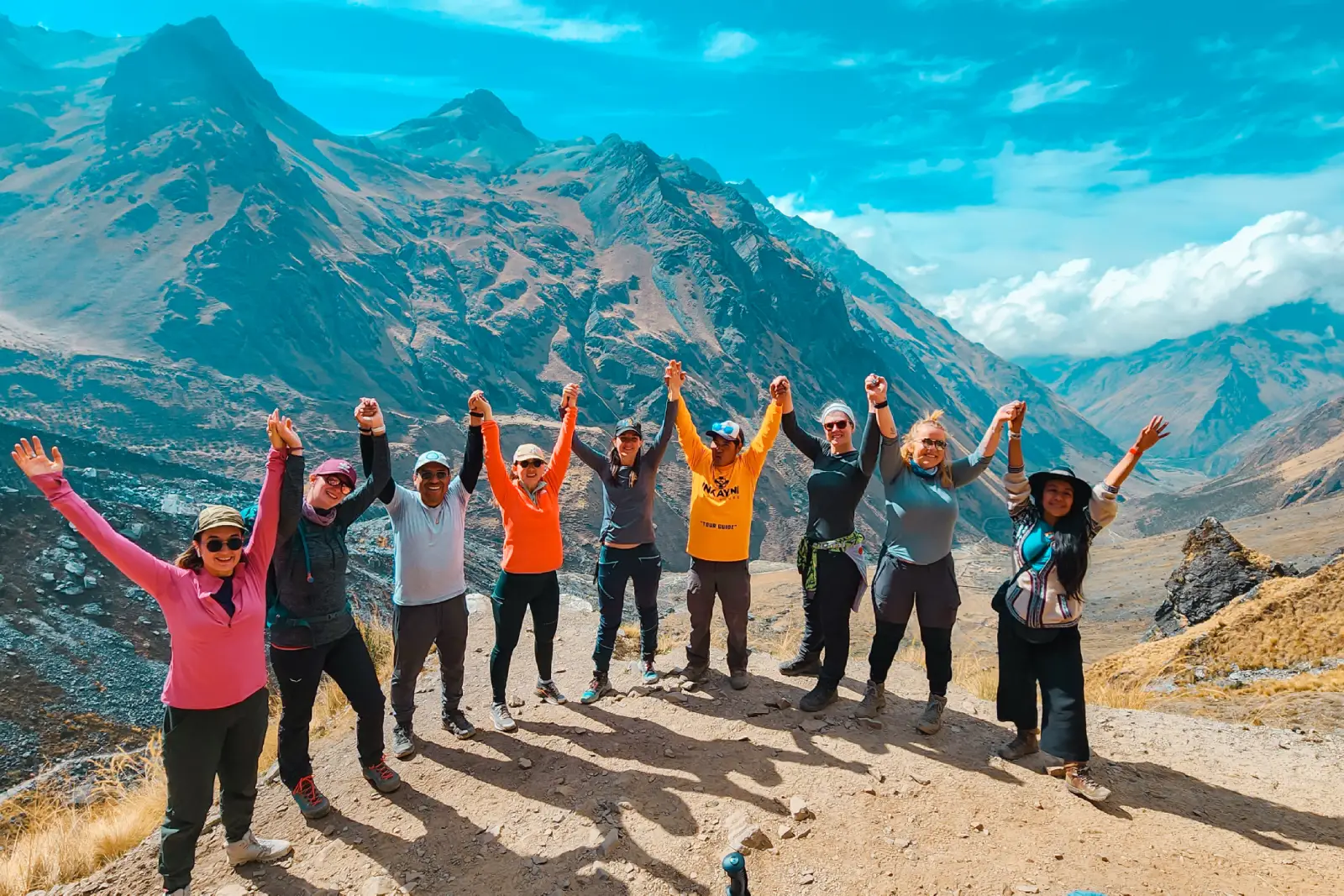
Hikers before Salkantay Pass.
If several of those are new to you, the trek may still be possible, but preparation becomes the next step. The Salkantay training and preparation guide covers how to build that endurance.
Important:
Being very fit at low altitude does not guarantee that you will feel strong at Salkantay Pass. Acclimatization and fitness solve different problems.
A supported trek is also physically different from carrying all of your own equipment. If you are considering the independent route, the Salkantay Trek on your own guide explains the extra load and logistics involved.
Common Difficulty Traps on the Salkantay Trek
Three parts of the trek are easy to underestimate when you only look at the total mileage:
- The final approach to the pass: the 5-day reference stage gains about 2,395 ft (730 m) before reaching 15,190 ft (4,630 m), so pace naturally slows near the top.
- The downhill after the pass: the route then loses about 5,610 ft (1,710 m) toward Chaullay; that is not a recovery section for tired legs.
- The later mileage: Day 4 can still require about 10.6 mi (17 km) and roughly 7 hours before Aguas Calientes.
This is a trek where steady pacing matters more than proving how fast you can reach the pass.
Salkantay Readiness: A Practical Decision Guide
| Your current situation | Practical read |
| Regular hiker / active traveler | A realistic challenge if long hills and consecutive hiking days are already familiar and you arrive acclimatized. |
| Good cardio, little trail experience | Cardio helps, but practice hills and descents because trail-specific leg fatigue is different from gym fitness. |
| Occasionally active | Possible with preparation, but choosing the 4-day version only because it is shorter is a poor shortcut. |
| Mostly sedentary | Build endurance before the trip rather than treating Salkantay as a casual sightseeing walk. |
| Knees struggle on descents | The 5,610 ft (1,710 m) pass-to-Chaullay descent deserves as much attention as the climb; poles are worth considering. |
Choose a Salkantay Route That Matches Your Fitness
The right itinerary is the one whose sleeping altitude, hardest-day workload and recovery pattern match you. Four days saves time but compresses the high-altitude profile; five days adds total mileage but begins with a lower first night.
Compare the 4-day Salkantay route with the 5-day Salkantay route, or talk to a travel specialist if you want the route matched to your hiking experience.
Frequently Asked Questions About Salkantay Trek Difficulty
What is the Salkantay Trek difficulty level?
The standard Salkantay Trek is challenging but non-technical. On the 5-day reference route, the hardest stage is about 13.7 mi (22 km), roughly 9 hours and reaches 15,190 ft (4,630 m). The difficulty comes from altitude, long descents and consecutive hiking days rather than climbing skills.
What is the highest altitude on the Salkantay Trek?
Salkantay Pass reaches about 15,190 ft (4,630 m) on the standard trekking corridor. That elevation is one of the main reasons Salkantay feels harder than a similar-distance hike at low altitude.
Is the Salkantay Trek suitable for first-time trekkers?
Yes, if you are already reasonably active, prepare for consecutive hiking days and acclimatize before the trek. It is a poor first hike for someone moving directly from a sedentary routine to several long days in the Andes.
Is Salkantay harder because of altitude or distance?
Altitude dominates the difficulty around Salkantay Pass, while mileage and descent become more important as the trek continues. The hardest 5-day stage combines both: about 13.7 mi (22 km), roughly 9 hours and a high point of 15,190 ft (4,630 m).
Is the 4-day Salkantay Trek harder than the 5-day route?
Neither is automatically harder. The 4-day reference route is shorter but places its first camp at about 15,092 ft (4,600 m), roughly 2,300 ft (700 m) higher than the first camp on the 5-day route. The 5-day version adds more total mileage and cumulative fatigue.
Do I need trekking poles for the Salkantay Trek?
They are not mandatory, but they can be useful on the long descents and uneven sections, especially if your knees usually become tired downhill.
Is the Salkantay Trek dangerous?
The standard route is non-technical, but altitude illness, changing mountain weather, uneven terrain and long descents are real risks. Proper acclimatization, suitable equipment, conservative pacing and knowing when to stop or descend matter more than treating the trek as technically dangerous.
Autor
Shared:


If you liked this article and the information you found, give us 5 stars!
 (1 votos, promedio: 5.00 de 5)
 Loading...