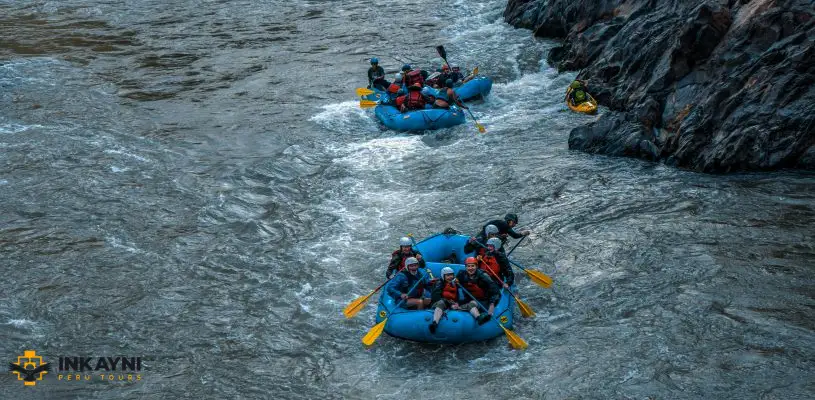

The Salkantay + Inca Trail 7-day trek to Machu Picchu is for travelers who do not want to choose between Salkantay’s glacier country and the archaeological experience of the Classic Inca Trail. It combines both in one continuous expedition—but not by placing a standard 5-day Salkantay Trek and a 4-day Inca Trail back to back.
| 7D / 6Ncombined expedition | 48.5 miInkayni route (~78 km) | 17,060 ftIncachiriaska (5,200 m) | Very challenginghigh altitude + 7 days |
The route changes direction in the high mountains. After Humantay Lake and the upper Salkantay valley, it climbs toward Incachiriaska Pass at about 17,060 ft (5,200 m), then descends toward Paucarcancha and Wayllabamba to join the regulated Inca Trail. That detour is the reason this expedition feels different from either standard trek: the hardest altitude comes before several days of stone paths, archaeological sites and the final approach to Machu Picchu through Intipunku.
GLACIER MOUNTAIN TREKSalkantay Trek
Discover one of Peru’s most scenic treks beneath snowy peaks and changing landscapes.
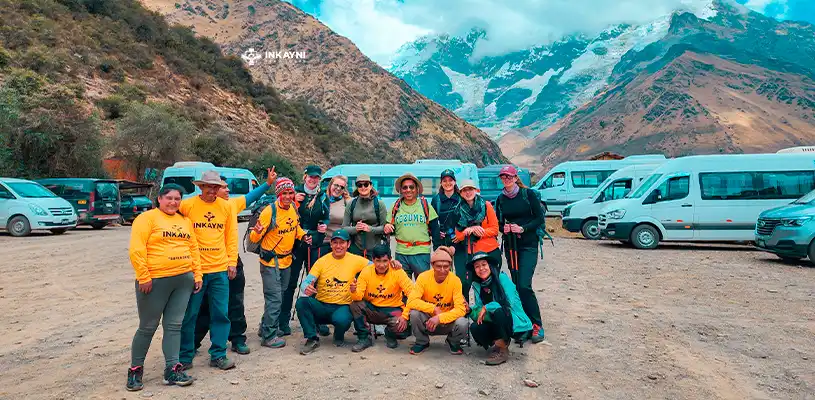
Salkantay begins with glacier scenery and remote mountain camps.

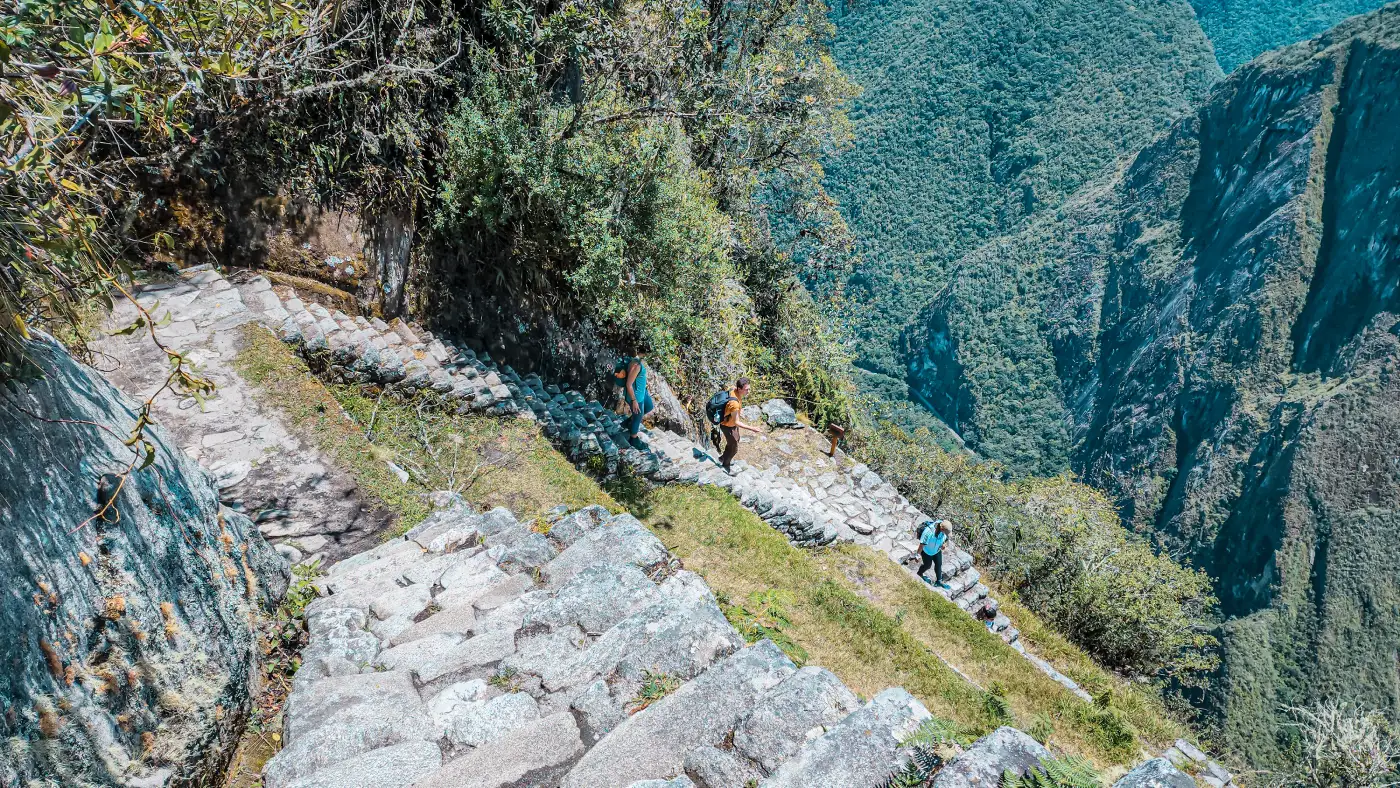
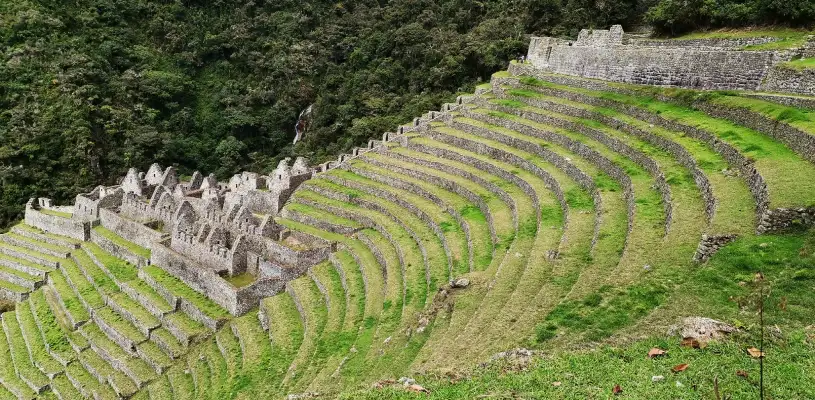
The Inca Trail adds archaeology and the Intipunku approach.
Salkantay + Inca Trail 7 Days at a Glance
| Planning factor | Current Inkayni reference | Why it matters |
| Duration | 7 days / 6 nights | Several hard days arrive before the Classic Inca Trail section is finished. |
| Published distance | About 48.5 mi (78 km) | Accumulated fatigue matters as much as any single climb. |
| Highest point | 17,060 ft (5,200 m) at Incachiriaska Pass | Higher than both the standard Salkantay Pass and Warmiwañusqa. |
| Support system | Horses/muleteers first; porters inside the protected Inca Trail | The logistics change when the route enters the regulated trail network. |
| Permits | Required for the Inca Trail section | Dates depend on official availability and cannot be improvised at the last minute. |
| Arrival | Intipunku → Machu Picchu | You keep the historical Inca Trail arrival instead of approaching only by train or road. |
| Inkayni private price reference | US$1,050–1,400 (S/3,520–4,690) p/p | The per-person rate falls as more travelers share the private operating costs. |
How the Combined Salkantay and Inca Trail Route Actually Works
The most important route detail is that this Salkantay and Inca Trail combined trek does not follow the regular Salkantay trail all the way toward Chaullay, Lucmabamba and Hidroeléctrica. Instead, it turns toward Incachiriaska and connects with the Inca Trail corridor.
- This connection is not merely a commercial invention. Peru’s official Camino Inka network lists Route 03 as Soraypampa → Salkantaypampa → Inkachiriaska → Pampacahuana → Paukarcancha → Wayllabamba → Wiñaywayna → Machupicchu. That official alignment explains why the seven-day combined trek has its own route logic instead of simply adding the standard Salkantay and Classic Inca Trail itineraries together.
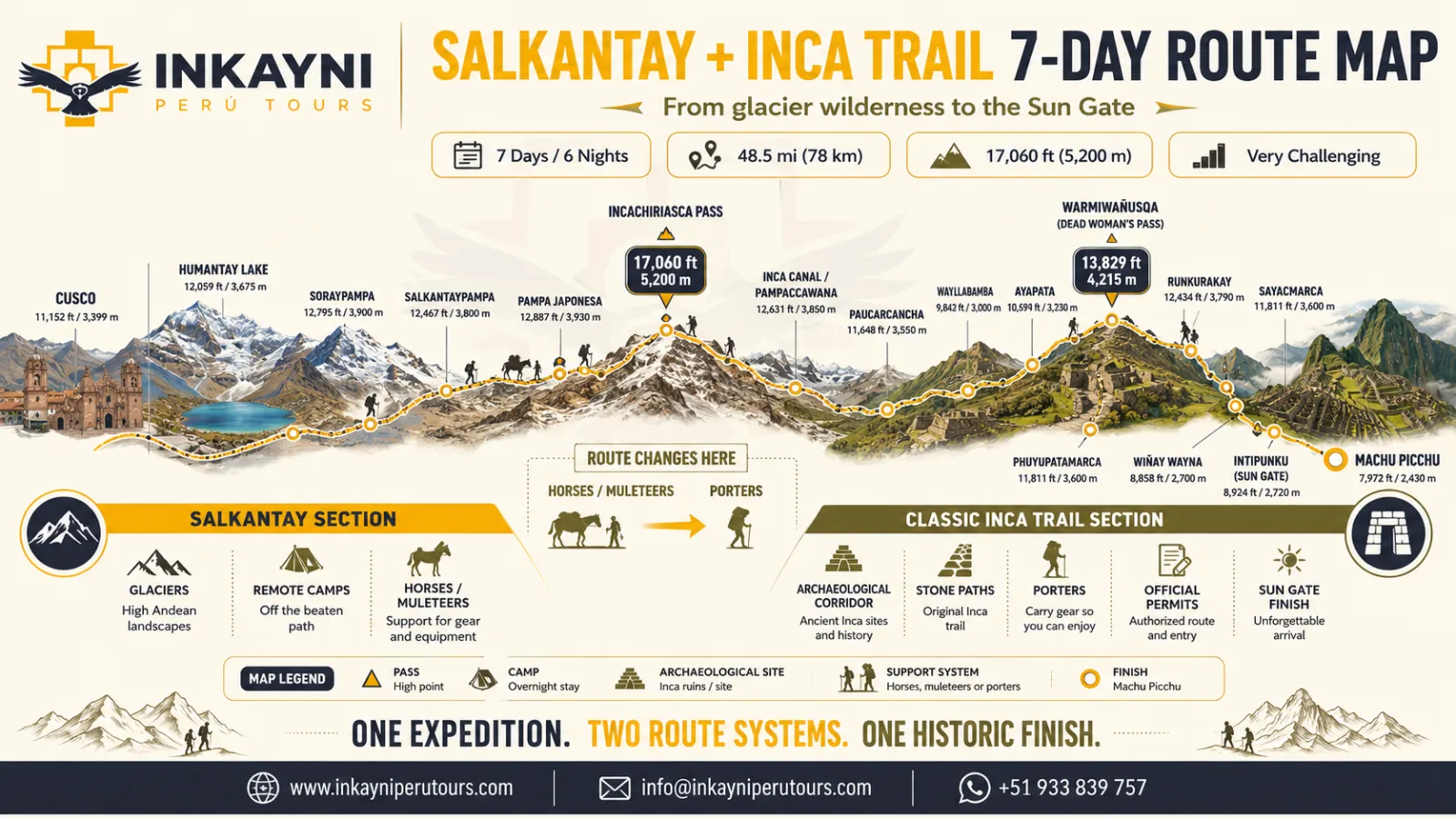
Salkantay and Inca Trail 7-day route map.
The Salkantay Section: Glacier Terrain and Remote Camps
The first days move through the Soraypampa and Salkantaypampa sectors, with Humantay Lake, high camps and close views of Salkantay Mountain. This section is supported by horses and muleteers and is primarily about altitude, glacial landscapes and remote Andean terrain.
If you want the standard route that continues toward the cloud forest and Hidroeléctrica instead, use the complete Salkantay Trek guide or the current 5-day Salkantay Trek.
Incachiriaska: The Connection That Changes the Route
From the upper Salkantay sector, the combined itinerary climbs to Incachiriaska Pass at about 17,060 ft (5,200 m). On the current Inkayni route, this is the highest point and the clearest physical difference from the standard Salkantay itinerary, whose usual pass is around 15,190 ft (4,630 m).
After Incachiriaska, the route descends through the Inca Canal/Pampaccawana area toward Paucarcancha and Wayllabamba. That is where the expedition shifts from the Salkantay system into the Inca Trail corridor.
The Inca Trail Section: Stone Paths, Archaeology and Porters
Once the route connects with the protected Inca Trail, the experience changes. Pack animals are no longer used; porters handle trail logistics, official controls apply, and the route follows original Inca road sections past sites such as Runkurakay, Sayacmarca, Phuyupatamarca and Wiñay Wayna.
The final approach is through Intipunku, the Sun Gate, which is one of the main reasons to choose the combined trek instead of completing only a standard Salkantay route. For the regulated route itself, see the Inca Trail to Machu Picchu guide.
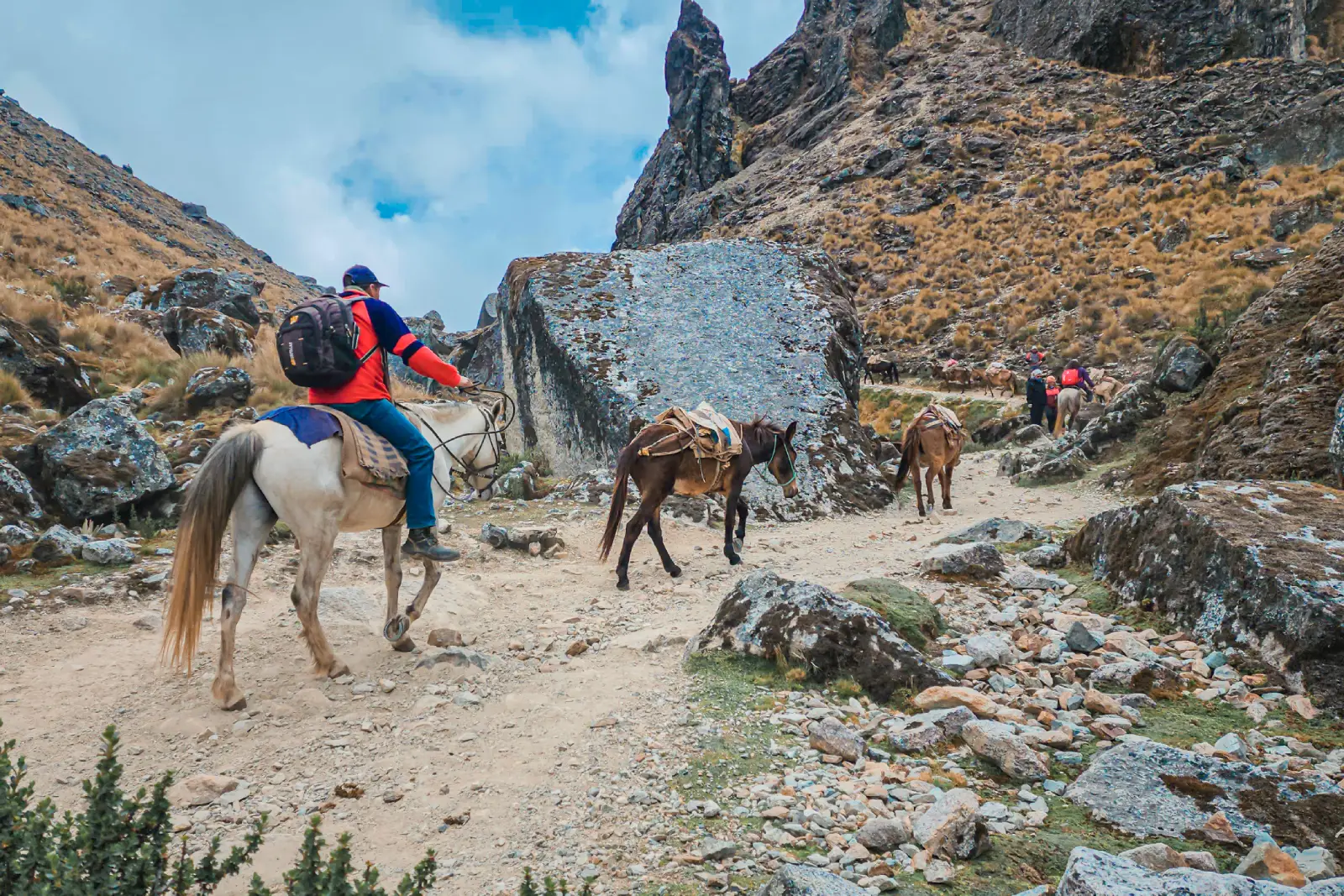
Horse-supported Salkantay terrain before the Inca Trail connection.
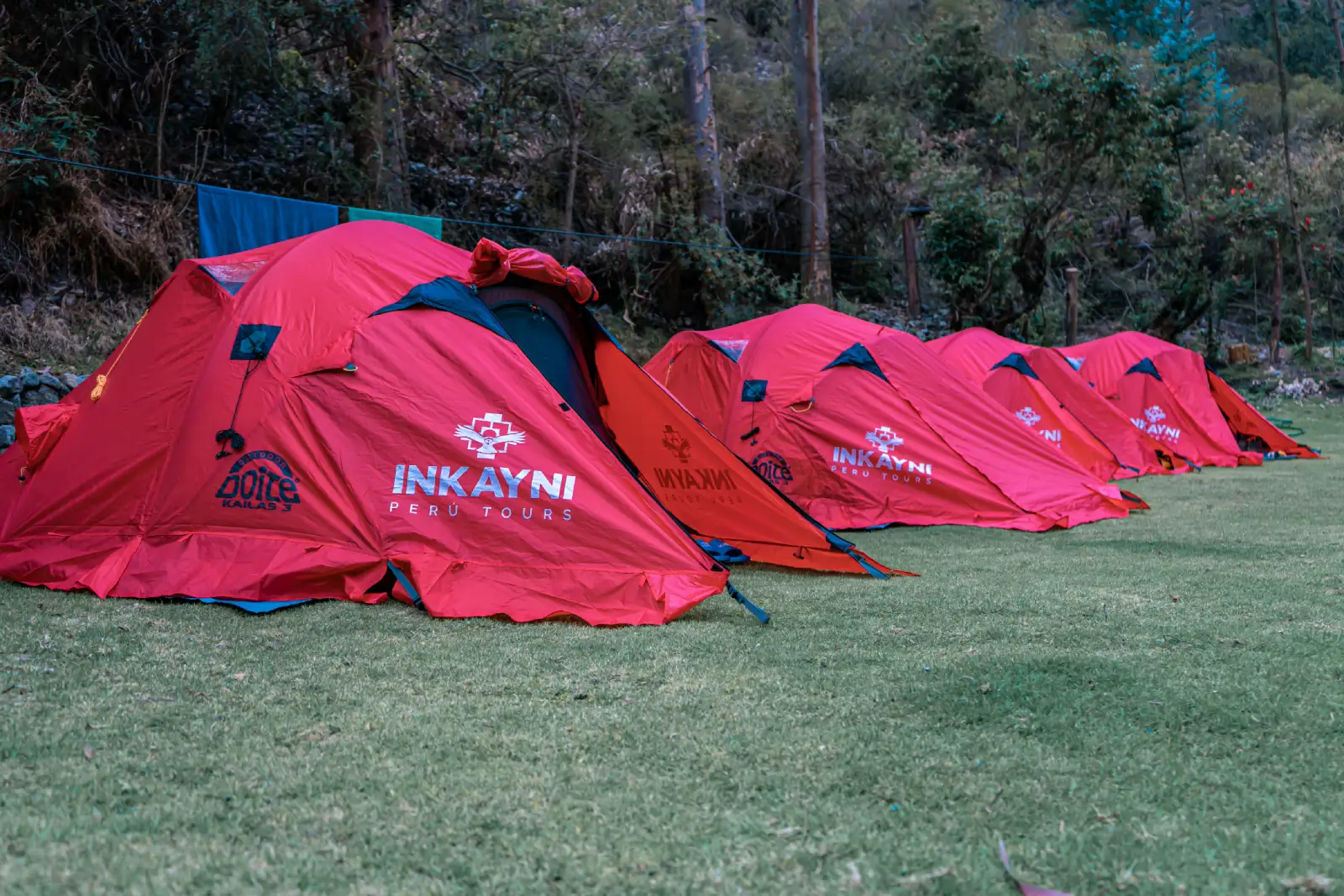
Ayapata marks the regulated Inca Trail camping rhythm.
PERU’S LEGENDARY HIKEInca Trail to Machu Picchu
Follow the historic trail through mountain passes, Inca sites, and cloud forest paths to Machu Picchu.
Salkantay + Inca Trail 7-Day Itinerary
The itinerary below follows Inkayni’s current published 7-day route. Other operators may vary some camps, timings or measurements, so use the daily figures as practical planning references rather than exact GPS guarantees.
Day 1: Cusco → Humantay Lake → Soraypampa
| Distance: 7.5 mi (12 km) | Highest point: ~13,780 ft (4,200 m) |
| Night: Soraypampa ~12,795 ft (3,900 m) | Published walking time: ~6 h |
The expedition leaves Cusco early and moves toward the Salkantay region. The first hiking day includes Humantay Lake, whose glacial basin sits around 13,780 ft (4,200 m), before returning toward the Soraypampa camp.
The mileage is not the main challenge yet; altitude is. Starting a seven-day route without prior acclimatization makes the first three days unnecessarily difficult.
Day 2: Soraypampa → Salkantaypampa → Pampa Japonesa
| Distance: 5.6 mi (9 km) | Night: Pampa Japonesa ~15,092 ft (4,600 m) |
| Environment: glacier / high alpine terrain | Published walking time: ~7 h |
The route climbs deeper into the upper Salkantay valley and camps at Pampa Japonesa around 15,092 ft (4,600 m). It is a short day by mileage but not by effort: you sleep only about 1,970 ft (600 m) below the next day’s high point.
Salkantay Mountain, at about 20,574 ft (6,271 m), dominates the landscape. The trek approaches the massif; it does not climb the summit.
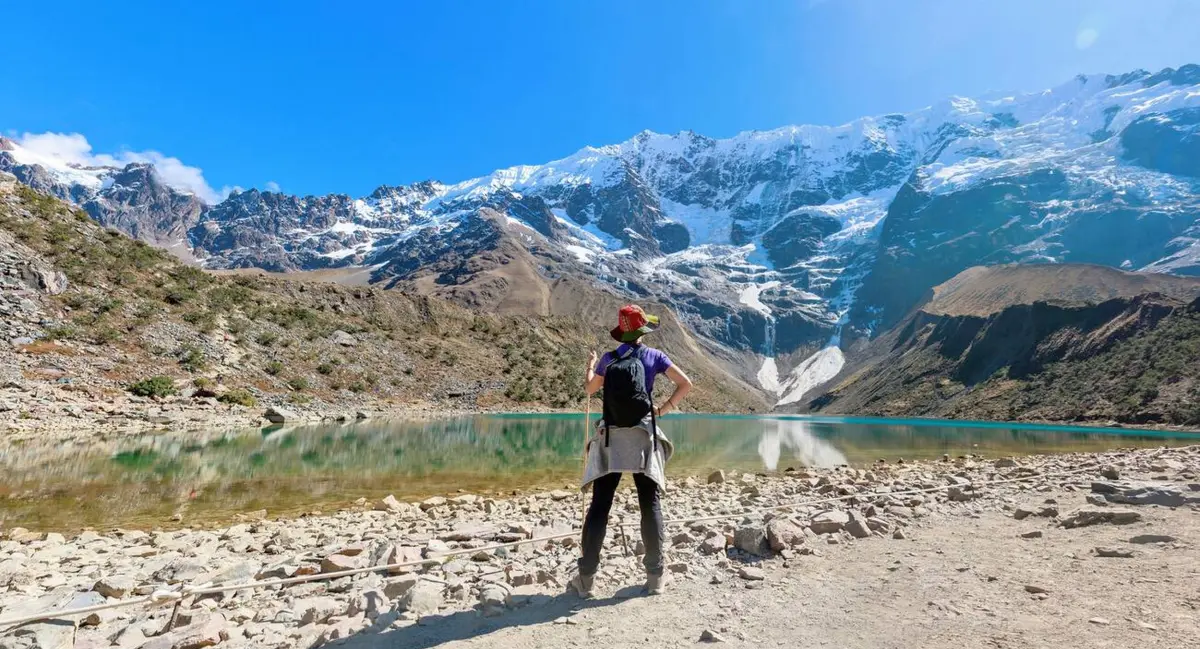
Humantay Lake opens the trek in glacial terrain.
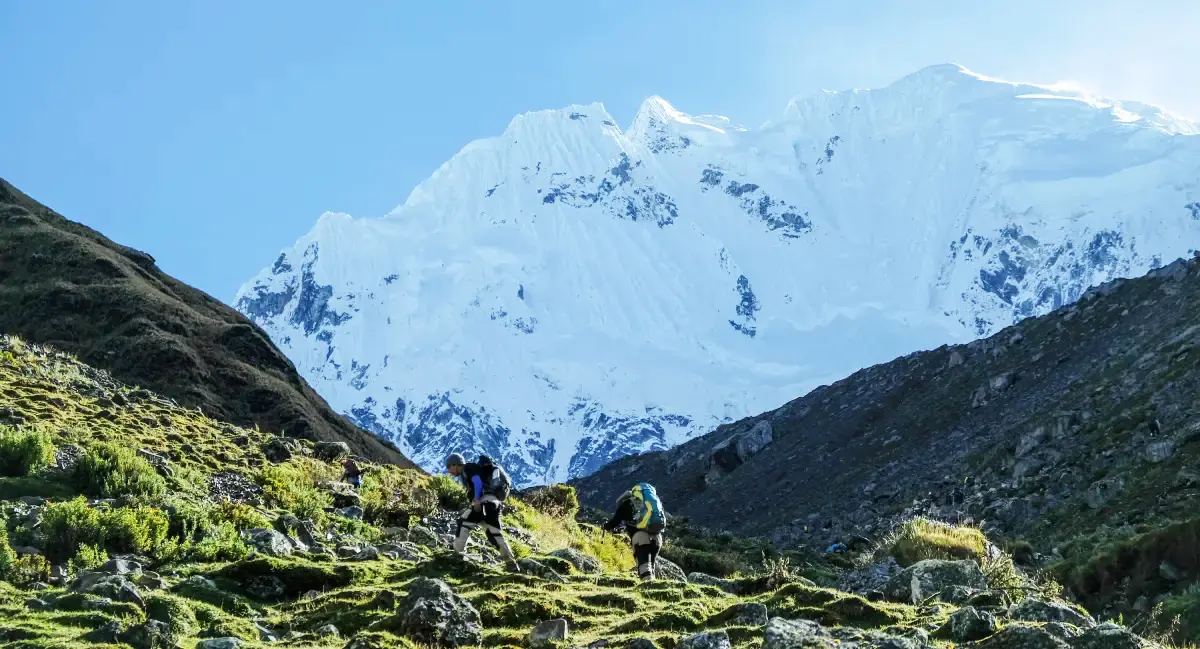
Salkantay dominates the early high-mountain stages.
Day 3: Pampa Japonesa → Incachiriaska Pass → Inca Canal
| Distance: 7.5 mi (12 km) | Highest point: 17,060 ft (5,200 m) |
| Night: Inca Canal area ~12,467 ft (3,800 m) | Published walking time: ~6 h |
Day 3 is the key high-altitude stage. The climb reaches Incachiriaska Pass at about 17,060 ft (5,200 m), where the air is noticeably thinner than at either the standard Salkantay Pass or Dead Woman’s Pass on the Inca Trail.
After the pass, the trail descends strongly toward the Inca Canal/Pampaccawana side of the range. Weather, wind and snow can change how this stage feels.
Warning:
Strong fitness does not eliminate altitude risk. Arrive acclimatized and tell your guide about symptoms rather than treating severe headache, poor coordination, confusion or worsening breathlessness as something to “push through.”
Day 4: Inca Canal → Paucarcancha → Wayllabamba → Ayapata
| Distance: 8.7 mi (14 km) | Main transition: Salkantay → regulated Inca Trail |
| Night: Ayapata ~10,827 ft (3,300 m) | Published walking time: ~7 h |
The route descends through Paucarcancha and toward Wayllabamba, where it connects with the Classic Inca Trail system. The landscape changes, but so do the operating rules.
Pack animals used in the Salkantay section do not continue through the protected Inca Trail. Porters take over the support logistics, official controls apply and the remaining camps operate within the regulated trail network.
Day 5: Ayapata → Warmiwañusqa → Chaquicocha
| Distance: 9.9 mi (16 km) | Key pass: Warmiwañusqa ~13,829 ft (4,215 m) |
| Night: Chaquicocha ~11,810 ft (3,600 m) | Published walking time: ~9 h |
Warmiwañusqa, or Dead Woman’s Pass, is the highest point of the Classic Inca Trail. On this combined expedition, you reach it after already spending four days on the trail and after crossing the much higher Incachiriaska Pass.
If you want the detailed terrain and effort analysis of this section, use How Difficult Is the Inca Trail?.
Day 6: Chaquicocha → Phuyupatamarca → Wiñay Wayna
| Distance: 6.2 mi (10 km) | Night: Wiñay Wayna ~8,793 ft (2,680 m) |
| Key sites: Runkurakay, Sayacmarca, Phuyupatamarca, Wiñay Wayna | Published walking time: ~5 h |
The sixth day shifts the emphasis from high-pass endurance to archaeology and long stone descents. The trail enters greener cloud-forest environments and passes a sequence of Inca sites before reaching Wiñay Wayna.
Day 7: Wiñay Wayna → Intipunku → Machu Picchu → Cusco
| Distance: 3.1 mi (5 km) | Intipunku: ~8,957 ft (2,730 m) |
| Machu Picchu: ~7,972 ft (2,430 m) | Return: bus + train + ground transfer |
The final morning follows the Inca Trail to Intipunku, where Machu Picchu appears from the historic trail approach. For 2026, the Ministry of Culture links visitors arriving through the Red de Caminos Inka with Machu Picchu Circuit 3B. Because circuit rules can change between seasons, confirm the entry attached to your permit and use the Machu Picchu circuits guide for the current visitor layout.

Why Incachiriaska Makes This Trek Different
Incachiriaska is not simply another altitude number. It explains why this route should not be described as “Salkantay plus a few Inca Trail days.” The combined trek leaves the normal Salkantay corridor and crosses a higher, more remote pass to reach the Inca Trail connection.
| High point | Altitude | Route context |
| Incachiriaska Pass | 17,060 ft (5,200 m) | Highest point of Inkayni’s current combined route. |
| Standard Salkantay Pass | 15,190 ft (4,630 m) | High point used by Inkayni’s standard 4D/5D Salkantay routes. |
| Warmiwañusqa | 13,829 ft (4,215 m) | Highest pass on the Classic Inca Trail section. |
This altitude hierarchy is also why acclimatization matters more here than in a normal itinerary comparison. If you are planning your arrival in Cusco, use the acclimatization in Cusco guide.
How Difficult Is the Salkantay + Inca Trail?
Very challenging is the most useful overall rating. The route does not require technical climbing, but it does combine seven consecutive trekking days, a high camp around 15,092 ft (4,600 m), Incachiriaska at 17,060 ft (5,200 m), long descents, original Inca stone steps and limited recovery time before the next demanding stage.
This is not the best route for finding out whether you enjoy multi-day camping at altitude. Previous hiking experience is strongly preferable. For route-specific context, compare the Salkantay difficulty guide with Inca Trail difficulty; for preparation, use the Salkantay training and packing guide and Inca Trail training guide.
Important note:
A traveler can be strong enough for the Classic Inca Trail and still find the combined route substantially harder because the Inca Trail section begins after several days of high-altitude Salkantay trekking.
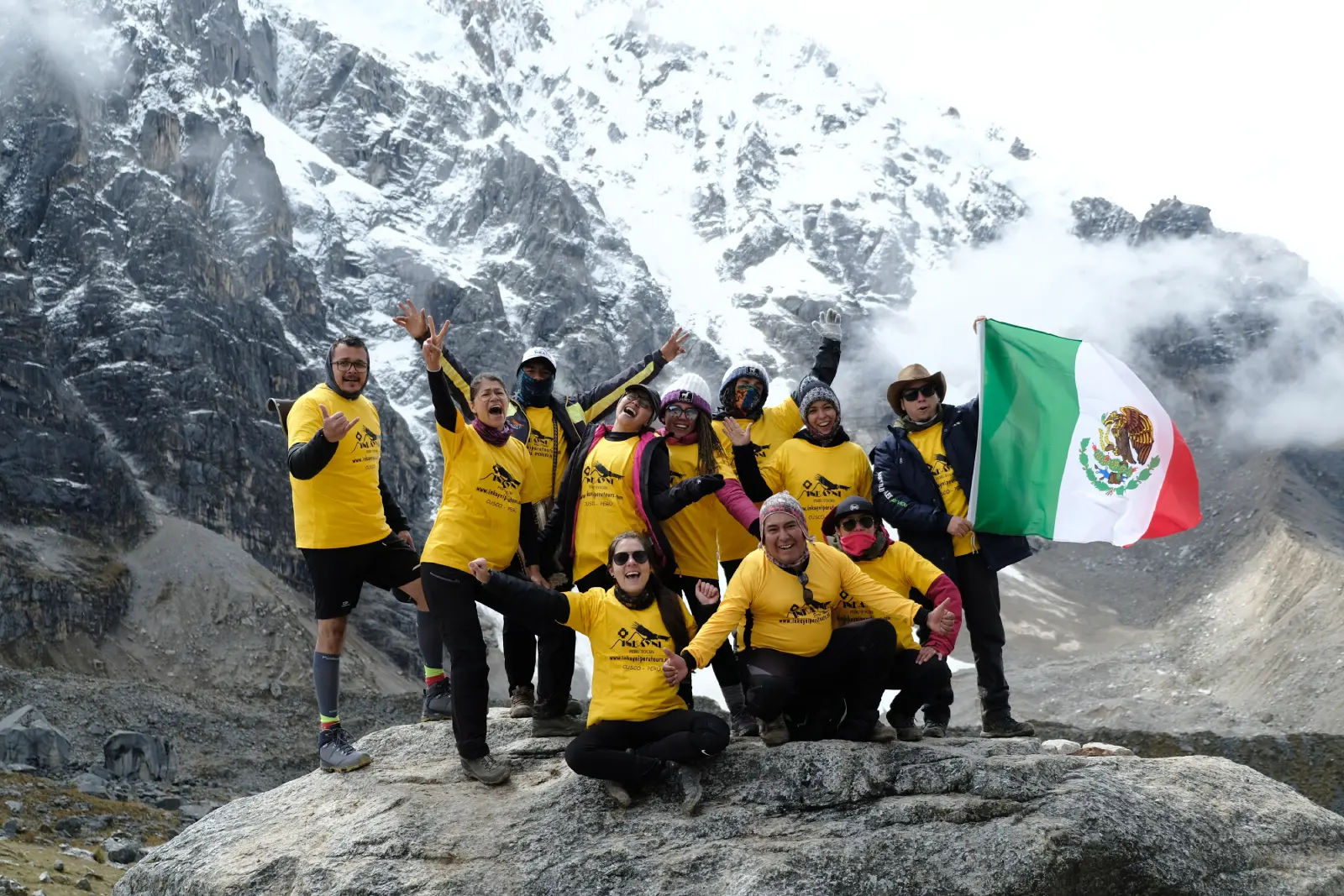
High-altitude Salkantay effort starts well before the Inca Trail.
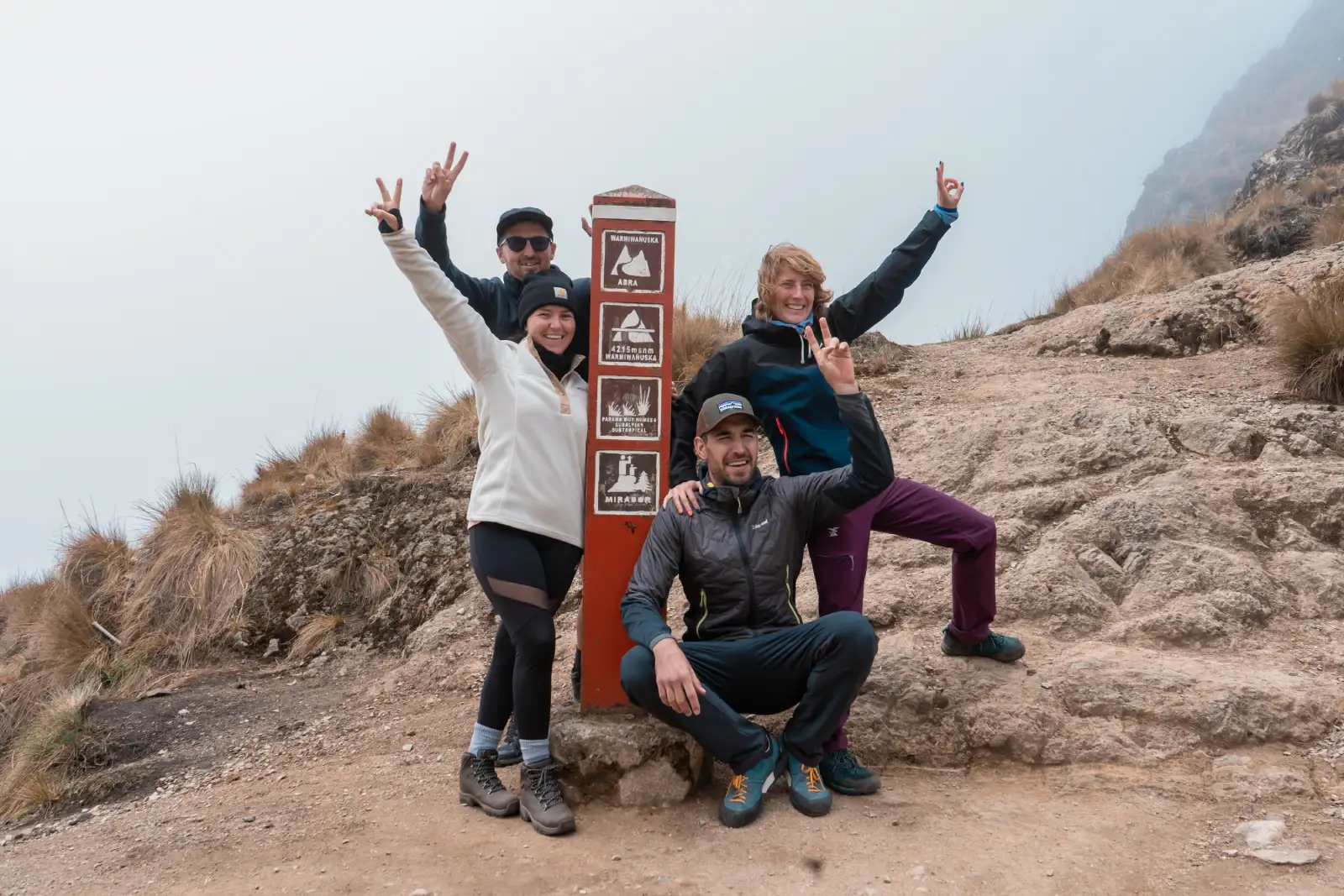
Warmiwañusqa remains demanding after several previous trekking days.
Permits, Porters and the Logistics Transition
Inca Trail Permits Are Mandatory
You cannot complete this combined route independently because it enters the official Inca Trail network. Access requires an authorized operator and official Inca Trail availability. The Inca Trail permits guide covers the system in depth.
The regulated section requires authorized tourism operation, and the Red de Caminos Inka closes during February for annual conservation and maintenance. The 2026 SERNANP reopening notice confirms the March reopening after the February maintenance period. For permit mechanics and availability, use the Inca Trail permits guide.
Horses First, Porters Later
The current Inkayni service uses horse and muleteer support in the Salkantay sector, then shifts to porters once the route enters the Inca Trail system. The personal allowance is up to 15 lb (7 kg), including the weight of the sleeping bag and mattress when applicable.
Book the Permit Before Building the Rest of the Trip
For this route, permit availability decides your trekking date. During high-demand months, secure the Inca Trail entry first and only then finalize flights, hotels and the rest of the Peru itinerary around that confirmed start date.

Horses support supplies through the early Salkantay section.

Porters take over inside the protected Inca Trail network.
How Far Is the Salkantay + Inca Trail?
Inkayni’s current published daily distances add up to about 48.5 mi (78 km).
| Day | Distance | Route focus |
| 1 | 7.5 mi (12 km) | Humantay / Soraypampa |
| 2 | 5.6 mi (9 km) | Pampa Japonesa |
| 3 | 7.5 mi (12 km) | Incachiriaska |
| 4 | 8.7 mi (14 km) | Paucarcancha / Wayllabamba |
| 5 | 9.9 mi (16 km) | Warmiwañusqa / Chaquicocha |
| 6 | 6.2 mi (10 km) | Phuyupatamarca / Wiñay Wayna |
| 7 | 3.1 mi (5 km) | Intipunku / Machu Picchu |
Other operators publish different totals because their first days, camps and route measurements vary. Treat distance as an itinerary-specific figure, not a universal Salkantay + Inca Trail number.
How Much Does the Salkantay + Inca Trail 7-Day Trek Cost?
A seven-day combined route costs more than a normal Salkantay or Classic Inca Trail because one itinerary has to coordinate high-mountain camps, mule support, Inca Trail permits, porters, meals, Machu Picchu entry and return transportation. Group size and service level create a much wider price spread than the walking distance alone.
| Service level | Useful 2026 planning range | What usually changes |
| Full-service group / small group | US$1,100–1,300 (S/3,685–4,355) p/p | Shared guide and camp logistics, permits, meals, support staff and standard return services. |
| Private standard | US$1,050–1,900+ (S/3,520–6,365+) p/p | Fixed staffing and logistics are divided among fewer travelers, so small parties usually pay more per person. |
| Premium / upgraded | US$2,700–3,200+ (S/9,045–10,720+) p/p | Higher-end camp equipment, more staff, upgraded transport or other comfort additions; custom or solo departures can exceed this band. |
Inkayni currently operates the route as a private service, with a live planning range of approximately US$1,050–1,400 (S/3,520–4,690) per person depending on group size. Use the current 7-day Salkantay + Inca Trail product to confirm the quote for your departure instead of treating any blog price as permanent.
Pro tip:
Private and premium are not the same thing. A private trek can cost more simply because the same guide, cook, permits and logistics are shared by fewer travelers. Premium service adds a separate layer of comfort or upgrades. Compare permit handling, personal porter allowance, camp equipment, meals, train category and group privacy before comparing the headline price.
What the Current Inkayni Service Includes
| Current inclusion | Why it matters on this route |
| Guide, cook, horsemen and porters | The support team changes between the Salkantay and protected Inca Trail sections. |
| Inca Trail permit + Salkantay entrance | Both operating systems must be coordinated in one itinerary. |
| Machu Picchu entry | The current product lists Circuit 3; for 2026 official Inca Trail access is linked to Circuit 3B. |
| 6 camping nights | There is no hotel break before Machu Picchu in the current standard itinerary. |
| 6 breakfasts, 6 lunches, 6 afternoon snacks/teas and 6 dinners | Most on-trail food is organized; Day 1 breakfast and Day 7 lunch/dinner are excluded. |
| Up to 15 lb (7 kg) personal support luggage | Sleeping bag and mattress weight count inside this allowance. |
| Return train + Machu Picchu bus + ground transport | Completes the return logistics after seven days on foot. |
Sleeping bags, trekking poles and additional porter capacity can be added separately when needed. Because rental and add-on prices can change faster than the route itself, confirm the current amounts on the live product before booking.
When Does the Combined Trek Make More Sense Than Choosing Only One Route?
Here it helps to compare the combined trek carefully without turning this page into another Salkantay vs Inca Trail article.
| Route | Choose it mainly for… | Main tradeoff |
| Salkantay 5 days | Glacier landscapes, high-mountain scenery and a more flexible route to Machu Picchu. | Does not enter the protected Classic Inca Trail or reach Machu Picchu through Intipunku. |
| Classic Inca Trail 4 days | Original Inca roads, archaeological sites and the iconic Sun Gate arrival in fewer days. | Less time in Salkantay’s remote glacial landscape. |
| Salkantay + Inca Trail 7 days | Both environments in one expedition, including Incachiriaska and the historic Inca Trail finish. | Highest cost, most permit pressure and strongest accumulated physical demand. |
If you are still deciding between the two routes rather than trying to combine them, use the Salkantay Trek vs Inca Trail comparison. The seven-day expedition only makes sense once doing both experiences is part of the goal.
What to Pack Without Repeating Two Separate Packing Guides
The combined route crosses cold high camps, exposed passes, original stone trail and humid cloud forest. Pack for range rather than volume. Keep anything needed during the walking day in your daypack and use the supported duffel for camp items.
| Keep in your daypack | Usually in the supported duffel |
| Original passport, water, snacks, rain shell, warm layer, gloves, sun protection, medication, headlamp, power bank. | Spare clothing, sleeping clothes, toiletries and camp-only items. |
| Trekking poles when needed on steep descents. | Sleeping bag/mattress weight when included in your allowance. |
For a complete gear system, use the Salkantay training and packing guide, plus the Inca Trail backpack guide and Inca Trail footwear guide.
TURQUOISE LAKE HIKEHumantay Lake
Discover bright turquoise waters beneath the snowy peaks of the Andes.
Best Time for the Salkantay + Inca Trail
April through October is the most practical overall window, with May through September usually offering the most stable dry-season conditions. The tradeoff is permit pressure: the months with better weather also attract the strongest demand for the Inca Trail.
| Period | Practical read |
| April–October | Best overall balance for the high-mountain and Inca Trail sections. |
| May–September | Drier and more stable, but permits can disappear far in advance. |
| November–March | More rain, cloud and mud; high passes can become less predictable. |
| February | The Red de Caminos Inka closes for annual conservation and maintenance, so the combined route cannot operate normally through the Inca Trail section. |
Who Should Choose the 7-Day Combined Trek?
| A strong fit if… | Choose another route if… |
| You specifically want both Salkantay’s glacier environment and the Inca Trail’s archaeological finish. | You are mainly looking for the easiest or cheapest way to trek to Machu Picchu. |
| You have previous multi-day hiking experience and arrive properly acclimatized. | This would be your first serious camping trek at altitude. |
| Incachiriaska and the remote connection between the routes are part of what excites you. | You only care about seeing Machu Picchu and do not value the seven-day build-up. |
| You can commit to the permit date months in advance. | You need last-minute flexibility during peak Inca Trail season. |
Plan Each Part of the Combined Trek
Seven Days Only Makes Sense If You Want Both Routes
The combined trek asks for more money, more preparation and more advance planning than either route by itself. Its value is therefore very specific: you get the remote Salkantay highlands, Incachiriaska Pass and the Classic Inca Trail arrival to Machu Picchu in one continuous expedition.
If that is exactly the experience you want, review the current 7-day Salkantay + Inca Trail private service. Because permits control the available dates, confirm Inca Trail space before building the rest of your itinerary around a specific departure. If you want help matching your dates, group size and preparation level to the route, talk to a travel specialist.
Frequently Asked Questions About the Salkantay + Inca Trail 7-Day Trek
Is the Salkantay + Inca Trail one continuous combined trek?
Yes. On Inkayni’s current route, the trek starts in the Salkantay highlands, crosses Incachiriaska, descends toward Paucarcancha and Wayllabamba, and then joins the regulated Inca Trail before reaching Machu Picchu through Intipunku.
Does the combined trek cross the standard Salkantay Pass?
Not on Inkayni’s current seven-day route. Instead of continuing through the standard Salkantay Pass toward Chaullay, the combined itinerary turns toward Incachiriaska Pass at about 17,060 ft (5,200 m) to connect with the Inca Trail.
Can I do the Salkantay + Inca Trail without an agency?
No. Parts of the broader Salkantay region can be organized independently, but this combined route enters the regulated Inca Trail network. Official access must be arranged through an authorized operator with the required trail permits and registered support staff.
Do horses carry luggage for all seven days?
No. Horses and muleteers support the Salkantay section, while porters take over inside the protected Inca Trail system. Inkayni currently allows up to 15 lb (7 kg) of supported personal luggage, with sleeping bag and mattress weight counted within that allowance when applicable.
How many days should I acclimatize before starting?
Plan at least 2–3 days in Cusco or the Sacred Valley when your itinerary allows it. This trek sleeps around 15,000 ft and climbs above 17,000 ft before the Inca Trail section, so starting immediately after arriving from sea level leaves very little altitude margin.
Is the combined trek better than choosing only Salkantay or the Inca Trail?
Only if doing both is genuinely important to you. The 5-day Salkantay Trek is shorter and more flexible, while the Classic Inca Trail delivers the archaeological route in fewer days. The seven-day combination is for travelers who specifically want the remote Salkantay approach, Incachiriaska and the historic Inca Trail finish in one expedition.