


The Ideal Backpack for the Inca Trail
The ideal backpack for the Inca Trail is a small trekking daypack, ranging from 20 to 30 liters (1,220 to 1,830 cubic inches). It should fit snugly against your body, with a hip belt to transfer weight off your shoulders, and a comfortable back panel for walking several hours. The lighter it is when empty, the better. Use a rain cover and protect your passport, phone, and camera in a dry bag; in your backpack, carry only what you’ll use while hiking: water, sunscreen, sunglasses, hat, a lightweight jacket, snacks, and personal items.
On the Inca Trail, the rest of your gear typically goes separately (in a duffel bag) and is carried by porters, which is why your daypack should hold only the essentials. The simple rule is this: what you might need during the hike goes with you, and everything else is better off in the duffel bag that you won’t be carrying all day.
Table of Contents
Choosing the right backpack for Inca Trail backpacking isn’t a minor detail. It must be comfortable, durable, and capable of protecting essentials against rain, intense sun, and demanding terrain. A bad choice is felt with every step; a good one makes the difference between enjoying the route or suffering through it. Let’s get straight to the point, this is what you need to know to bring the ideal trekking backpack for the Inca Trail to Machu Picchu.
| 20–30LUseful range | < 4.4 lbsEmpty weight (<2 kg) | 11–15 lbsLoaded pack (5–7 kg) | Rain coverEssential protection |

Start your adventure with the ideal backpack for the Inca Trail
Did you know…?
The Inca Trail is Peru’s most famous trekking route and the most special way to reach Machu Picchu. Over several days, you traverse ancient stone paths, cross mountains, visit Inca archaeological sites, and finally enter the citadel through the Sun Gate (Intipunku), after nearly 27 miles (43 km) of hiking.
Quick Facts about the Inca Trail
- Altitude: approx. 9,840 feet (3,000 m); highest point 13,828 feet (4,215 m) at Warmiwañuska.
- Duration: classic route 4D/3N; there are also 5-day and 2-day versions.
- Difficulty: moderate to challenging (altitude + ascents + stone steps + weather).

PERU’S LEGENDARY HIKEInca Trail to Machu Picchu
Follow the historic trail through mountain passes, Inca sites, and cloud forest paths to Machu Picchu.
What Backpack Do I Need for the Inca Trail?
A 20 to 30-liter backpack (preferably 25 liters or about 1,525 cubic inches) will be your perfect companion during the 4-day trek. On the Inca Trail, you’ll face steep stone staircases, the challenging Warmiwañuska Pass at 13,828 feet (4,215 m), possible intense rains (during the rainy season), and rocky, highly varied terrain. Your inca trail backpack must be lightweight, comfortable, durable, and intelligently organized.
Ideal Features of Your Backpack
Summary Table: Ideal Backpack Features
| Ideal Specification | Why It Matters | |
| Capacity | 25L (20–30L) | Sufficient space for daily essentials |
| Weight (empty) | < 4.4 lbs (2 kg) | At altitude, weight feels heavier |
| Waterproofing | Rain cover included | It can rain between December and March |
| Support | Adjustment + hip belt | Better weight distribution |
| Ventilation | Mesh panel | Cooler back while hiking |
| Hydration | Bottles or 2L reservoir | Makes frequent drinking easier |
| Access | External pockets | Quick access to necessities |
| Material | Durable fabric (ripstop) | Withstands trail abrasion |
Expert tip:
If you have to choose between two similar backpacks, always prioritize the one with the better suspension system and hip belt. Comfort on your shoulders and back will be your best investment for enjoying the trek.
Important Features of a Backpack for Inca Trail
Comfort and Fit:
Imagine walking up steep Inca staircases or crossing the dreaded Warmiwañuska Pass at over 13,780 feet (4,200 m). In those moments, the last thing you want is a backpack that’s uncomfortable or throws you off balance.
A trekking backpack should feel like an extension of your body. To achieve this, it needs an adjustable suspension system that adapts to your torso, padded straps that distribute weight properly, a hip belt that offloads effort from your shoulders, and a chest strap that provides stability on the trail. Without these elements, any long hike, especially at high altitudes, becomes punishment.
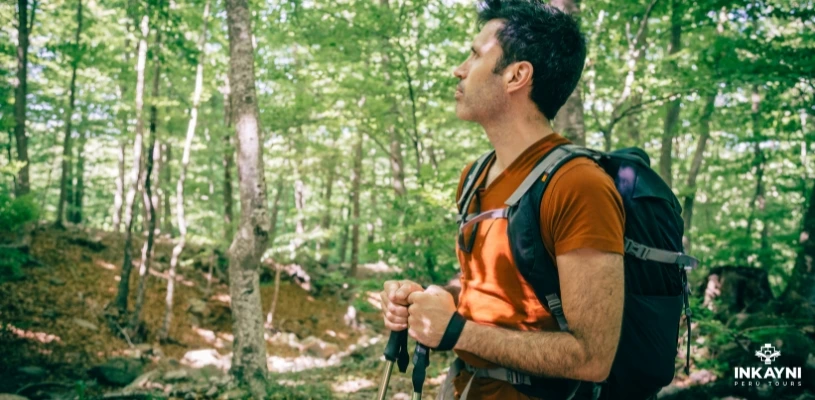
Comfort and ease should always be your priority
Ventilation
Because you’ll be hiking for several hours on the Inca Trail, it’s inevitable that your body will produce sweat, especially in areas like the armpits and back, where the backpack rests. This is why it’s essential that your backpack has a good ventilation system.
A well-ventilated backpack makes all the difference. Make sure it has a breathable back panel that allows air to flow and reduces sweating, along with integrated air channels in the back panel that prevent heat buildup during long hikes. This way, your back stays cool and dry as you move through mountains, fog, and sun.
Accessibility and Organization
For more efficient and quick use during trekking activities, a good backpack should have different access points that allow you to grab the items you need at any moment, such as external pockets, side pockets, and hip belt pockets, where you can store small objects like snacks, phone, sunglasses, and more.
It’s also important to note that having different external and internal compartments allows the backpack to provide better organization, maximizing the use of separations between each area of the pack.
Remember that:
Many travelers believe it’s not worth investing in a good backpack if they’ll only use it once. It might sound reasonable. But on the Inca Trail, where you’ll cross rocky terrain, mud, intense rains, and even slippery streams, a durable backpack with waterproof fabrics and anti-tear technology isn’t a luxury: it’s a necessity.
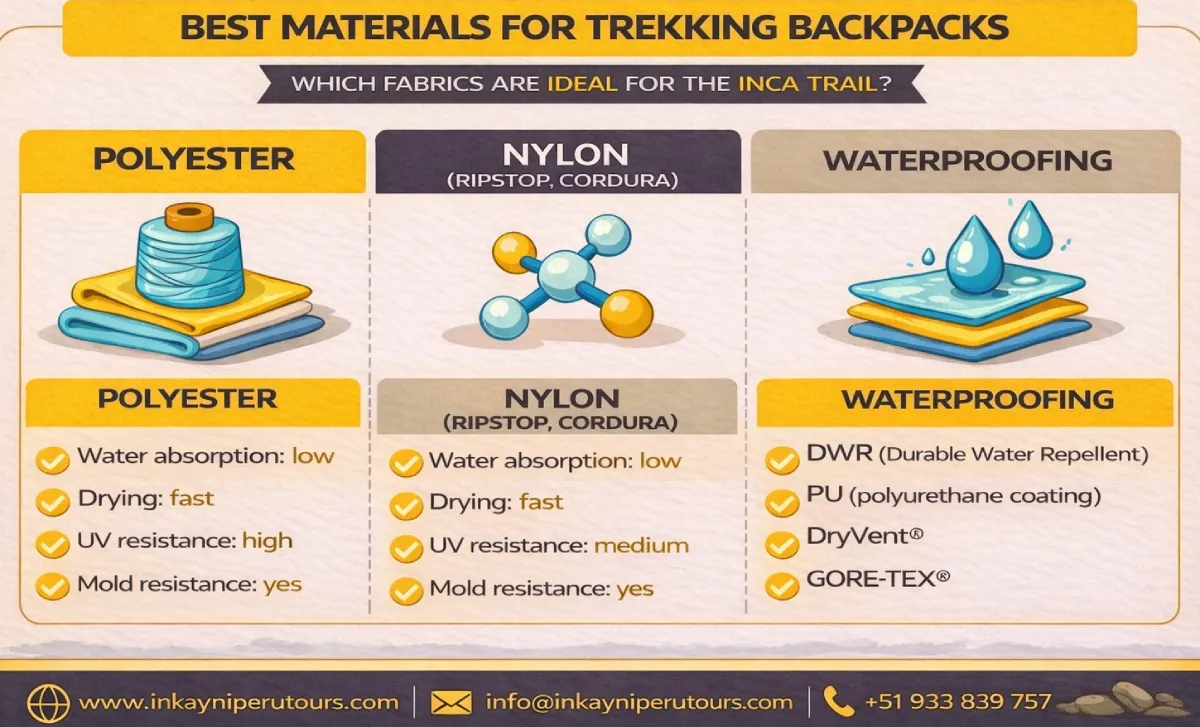
Waterproofing and Rain Protection
Between November and March is rainy season on the Inca Trail. There can be drizzles or short downpours that can soak all your gear in minutes if you’re not prepared.
Your backpack should ideally include or have:
- Rain cover: that completely covers the backpack.
- Good exterior resistance: a fabric that doesn’t absorb water immediately.
- Internal protective bags: to keep documents, clothes, and electronic devices dry.
- Firm base: to set it on wet ground without it getting soaked.
Expert tip:
Even if your backpack is “waterproof,” always carry an internal waterproof bag (dry bag) for your camera, documents, and electronics. It’s your second line of defense against Andean humidity.
Ideal Weight of a Trekking Backpack
If an empty backpack exceeds 4.4 pounds (2 kg) with nothing inside, that’s a bad sign. You’re about to hike for several days at altitude; every ounce counts. A lightweight backpack from the start is your best ally to avoid ending up exhausted before reaching Machu Picchu.
Your backpack should have just enough space for what you’ll carry with you during the hike. The rest goes in the duffel bag carried by porters. You only need to carry the essentials at hand: water, snacks, lightweight jacket, sunscreen, camera, and personal items.
- Ideal capacity: 25 liters (1,525 cubic inches).
- Men: 25–30 L (1,525–1,830 cubic inches).
- Women: 20–25 L (1,220–1,525 cubic inches).

Pockets will allow you to access your tools easily
So, What Should I Carry in My Backpack During the Hike?
Your backpack is for what you’ll use during the day, while hiking. It’s not made to carry “just in case” items. Bring the essentials for the weather, your hydration, something to snack on, and your personal items.

Warning:
What you might need while hiking goes with you; everything else goes in separate luggage (duffel bag) that you won’t carry all day.
- Water: bottle or hydration reservoir.
- Rain protection: waterproof jacket or poncho.
- Sun: hat or cap, sunglasses, and sunscreen.
- Insects: repellent.
- Something to eat: lightweight snacks.
- Documents and money: passport and cash (soles recommended), stored in internal pocket.
- Health: personal medications.
- Trail basics: toilet paper.
- Photos: camera (if you bring one).
- Trekking poles: if you use them, carry them by hand or securely attached outside.
Gender Considerations
| Feature | Women’s Backpack | Men’s Backpack |
| Torso size | Shorter and narrower | Longer and wider |
| Shoulder width | Narrower straps | Wider straps |
| Strap shape | Contoured to fit around bust | Straight or slightly curved |
| Hip belt | More conical, adapted to wider hips | Straight, adapted to narrower pelvis |
Other Guides That Help Before Packing for the Inca Trail
Best Brands and Models of Backpacks for the Inca Trail
After years of seeing which backpacks work best on Inca terrain, these are the brands that consistently deliver quality, durability, and comfort. You don’t need the most expensive one, but you do need one that meets essential technical features.
Osprey, the Guides’ Favorite
Founded in 1974, Osprey has earned a reputation for creating virtually indestructible backpacks with the best suspension system on the market. Their “All Mighty” warranty covers any damage, regardless of cause, for the lifetime of the product.
Why it works on the Inca Trail: Its Anti-Gravity system distributes weight exceptionally well, critical when climbing Warmiwañuska Pass. Ventilated back panel that reduces sweating by up to 30%.
Recommended models:
- Osprey Talon 22 – Ideal for men, ultralight (1.5 lbs/680g), perfect for minimalists
- Osprey Tempest 20 – Women’s version of the Talon, specific fit for female torso
- Osprey Stratos 24 – More capacity, excellent ventilation, premium padded belt
Price range: $100-150 USD | Weight: 1.5-2.4 lbs (680g-1.1kg) | Available for rent in Cusco: Yes

Osprey: the most reliable option according to professional guides
Deuter, Proven German Ergonomics
With over 125 years of experience (founded in 1898), Deuter is synonymous with precision engineering. Their backpacks stand out for the Aircomfort system that literally creates an air space between your back and the pack.
Why it works on the Inca Trail: Ventilation system superior to the competition. Ideal if you sweat a lot or hike during warm season (October-April). Robust construction that lasts years of intensive use.
Recommended models:
- Deuter Speed Lite 21 – The lightest (1 lb/470g), for those prioritizing minimal weight
- Deuter AC Lite 23 – Complete Aircomfort system, perfect comfort/weight ratio
- Deuter AC Lite 25 EL – Extra-long for taller torsos (over 5’9″/1.75m)
Price range: $90-140 USD | Weight: 1-2.1 lbs (470g-950g) | Available for rent in Cusco: Limited

Deuter: superior ventilation for warm climates
Gregory, Comfort Without Compromise
Since 1977, Gregory has obsessively focused on one thing: perfect fit. Their FreeFloat technology allows the backpack to move naturally with your body, reducing pressure points.
Why it works on the Inca Trail: If you have back problems or have never done trekking, Gregory forgives fitting mistakes. Its hip belt is the most comfortable on the market for 6+ hour hikes.
Recommended models:
- Gregory Nano 20 – Ultralight and compact, for experienced travelers
- Gregory Maya 22 – Women’s specific, exceptional anatomical fit
- Gregory Jade 28 – Maximum capacity without sacrificing comfort
Price range: $110-160 USD | Weight: 1.5-2.6 lbs (700g-1.2kg) | Available for rent in Cusco: Occasional

Gregory: anatomical fit for maximum comfort
The North Face, Extreme Durability
Pioneer since 1966 in outdoor equipment, TNF manufactures backpacks designed to survive extreme expeditions. If you plan to reuse your backpack on multiple trips, this is your brand.
Why it works on the Inca Trail: Ultra-resistant fabrics that withstand rock abrasion. Superior waterproofing. Perfect if you’re traveling during rainy season (November-March).
Recommended models:
- TNF Trail Lite Speed 20 – Lightweight version, without sacrificing durability
- The North Face Recon – Multi-use: trekking + urban use post-trip
Price range: $85-130 USD | Weight: 1.8-2.9 lbs (800g-1.3kg) | Available for rent in Cusco: Yes, common
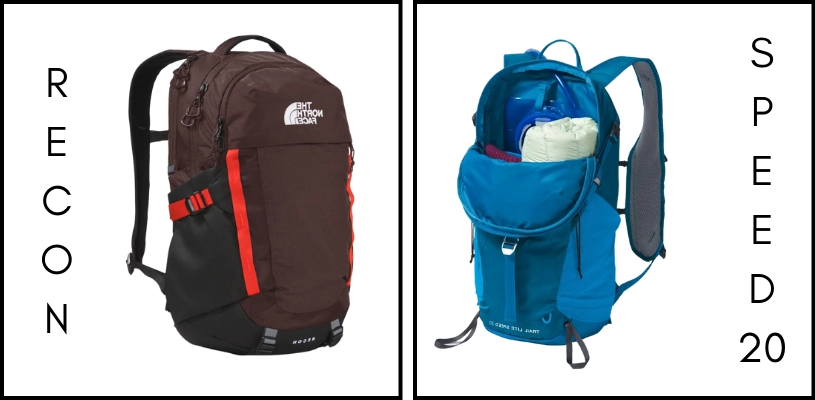
The North Face: when durability is priority
REI Co-op, Best Value
American cooperative brand that offers almost premium quality at accessible prices. Perfect for travelers who don’t want to spend $150+ but don’t want to settle for basic options either.
Why it works on the Inca Trail: Includes all essential technical features (padded belt, hydration system, rain cover) at half the price of premium brands.
Recommended models:
- REI Flash 22 – Ultralight (1.2 lbs/560g), favorite of experienced backpackers
- REI Trail 25 – Perfect price/performance balance for beginners
- REI Ruckpack 30 – Maximum capacity without being excessive
Price range: $60-100 USD | Weight: 1.2-2.4 lbs (560g-1.1kg) | Available for rent in Cusco: No
Salomon, French Competition Design
Specialist in trail running and mountain sports since 1947. Their backpacks are designed for fast, dynamic movements, ideal if you plan to do the Inca Trail at a sporty pace.
Why it works on the Inca Trail: Industry-leading integrated hydration systems. Vest-style fit that eliminates bounce. Perfect for photographers who need quick access to equipment.
Recommended models:
- Salomon Trailblazer 20 – Ergonomic design, excellent weight distribution
- Salomon ADV Skin 12 – Vest style, for fast hikers
- Salomon Aerotrek 30 – Traditional spacious version
Price range: $75-120 USD | Weight: 0.9-2 lbs (400g-900g) | Available for rent in Cusco: Rare
Patagonia, Sustainability + Performance
California brand committed to the environment. All their backpacks use recycled materials without sacrificing durability. If your trip includes ecological values, this is your option.
Why it works on the Inca Trail: Impeccable construction, free lifetime repairs, functional minimalist design. Fewer pockets = less weight = more efficiency.
Recommended models:
- Patagonia Nine Trails 20L – Lightweight (1.4 lbs/650g), 100% recycled materials
- Patagonia Altvia 22L – Versatile design for multiple uses
- Patagonia Refugio Day Pack 26L – Classic, also works as urban backpack
Price range: $100-150 USD | Weight: 1.4-2.2 lbs (650g-1kg) | Available for rent in Cusco: No
Arc’teryx, Premium for Perfectionists
Canadian luxury brand in absolute outdoor equipment. If budget is no limitation and you’re looking for the best of the best in technology, materials, and construction, Arc’teryx is your reference.
Why it works on the Inca Trail: Every detail is optimized to the millimeter. Seam-sealed construction, waterproof YKK zippers, Gore-Tex fabrics. Designed for professional alpinists.
Recommended models:
- Arc’teryx Granville 25 Backpack – Perfect balance between weight and features
- Arc’teryx Alpha AR 20 – Total waterproofing, for serious expeditions
- Arc’teryx Mantis 26 – Versatile, works post-trek as urban daypack
Price range: $180-280 USD | Weight: 1.3-2.2 lbs (580g-980g) | Available for rent in Cusco: Never
Where to Buy in Peru?
- Lima: Outdoor Gear (Miraflores), Tatoo Adventure Gear (San Isidro), Doite (San Borja)
- Cusco: Tatoo (Plaza de Armas), several shops on Av. El Sol offer rentals
Quick Comparison Table: Which to Choose?
| If You’re Looking For… | Choose Brand | Featured Model |
| Best value | REI Co-op | Trail 25 ($70) |
| Maximum comfort | Gregory / Osprey | Jade 28 / Stratos 24 |
| Ultralight weight | Deuter / Salomon | Speed Lite 21 (1 lb/470g) |
| Extreme durability | The North Face | Banchee 28 |
| Superior ventilation | Deuter | AC Lite 23 |
| Total waterproofing | Arc’teryx | Alpha AR 20 |
| Available for rent | Osprey / TNF | Talon 22 / Recon |
| Sustainability | Patagonia | Nine Trails 20L |
Important note:
There is no “best backpack.” There is the best backpack for you. Prioritize based on your budget, previous experience, and whether you plan to reuse it. For a traveler doing the Inca Trail once in a lifetime, renting an Osprey Talon in Cusco ($20 USD/4 days) is smarter than buying a $250 Arc’teryx.

Trek the Inca Trail worry-free
What to Bring in Your Inca Trail Daypack
Your Inca Trail daypack should carry only what you need while walking. The heavier camp items (extra clothes, sleeping bag, toiletries, and night gear) go in the duffel bag handled by the porters. During the day, keep your backpack light, organized, and easy to access.
- Water: bottle or hydration reservoir.
- Rain protection: waterproof jacket or poncho.
- Sun: hat or cap, sunglasses, and sunscreen.
- Insects: repellent.
- Something to eat: lightweight snacks.
- Documents and money: passport and cash, stored in an internal pocket.
- Health: personal medications.
- Trail basics: toilet paper.
- Photos: camera or phone.
- Trekking poles: if you use them, carry them by hand or securely attached outside.
Your Backpack vs the Porters’ Bags
On the Inca Trail, porters carry camping equipment (tents, kitchen, food) and, additionally, can carry up to 15 pounds (7 kg) of your personal belongings in a duffel bag: sleeping clothes, toiletries, sleeping bag, and extra clothing. That bag doesn’t go with you during the day; you typically see it again at camp in the afternoon because porters move ahead to have everything ready when you arrive. That’s why you need to carry only the day’s essentials in your backpack.
Did you know…?
Since 2002, porters have been protected by law: the load limit is 44 pounds (20 kg), and 33 pounds (15 kg) for women. As a gesture of appreciation, it’s customary to leave a tip toward the end of the trek.

Inca Trail porters make the adventure move forward.
Test It Before You Leave
You now know what backpack you need. Now comes the most important part: load it with everything and walk 2-3 hours before the trek. If something bothers you at home, it’ll be worse in the mountains. Don’t settle for trying it on empty. Fill it with everything you plan to carry (water, jacket, snacks, camera), adjust the straps correctly, and go for a walk for at least 2-3 hours. Climb stairs, walk uphill if you can. If something bothers you, rubs, or hurts during a short walk, imagine what it’ll be like after 6 hours climbing to Warmiwañuska.
Remember, book your Inca Trail with Inkayni Peru Tours and arrive prepared with the best equipment to enjoy every step of this adventure.
Frequently Asked Questions about Backpacks for the Inca Trail
What type of backpack do I need for the Inca Trail?
What should I bring on the Inca Trail?
What should I bring on the Inca Trail in my daypack?
What goes in the porter duffel on the Inca Trail?
What is the ideal backpack capacity for this route?
Can I use my regular travel backpack or school backpack?
Do I need to buy a new backpack or can I rent in Cusco?
How much should my loaded backpack weigh for the Inca Trail?
Are women’s backpacks really different or is it marketing?
Does my backpack need to be waterproof for the Inca Trail?
What backpack brand do you recommend for the Inca Trail?
Where can I get or rent a good backpack in Cusco?
Autor

Shared:


If you liked this article and the information you found, give us 5 stars!
 (1 votos, promedio: 5.00 de 5)
 Loading...