Classic 4-Day Inca Trail, What to Know Before Choosing Your Dates
The Classic Inca Trail is the only trekking route that reaches Machu Picchu through the Sun Gate (Intipunku), the original Inca entrance. It covers about 26.7 miles (43 km) in 4 days and reaches 13,828 ft at Dead Woman’s Pass. It is generally considered a moderate to challenging hike, with Day 2 usually being the hardest.
Permits are required and daily spaces are limited, so it is best to book at least 5 to 6 months in advance. The trail closes completely in February. The dry season runs from April to October; the most stable window is usually May to September, while April and October often mean fewer crowds. Try to arrive in Cusco 2 to 3 days early to acclimatize properly.
Table of Contents
The classic 4 day Inca Trail is a mountain route with changing altitude, cold campsites, stone steps, cloud forest sections, and a final arrival at Machu Picchu through Inti Punku. Planning it well means understanding the route before choosing your dates, packing your gear, or confirming your permit.
This guide explains how the 4 day Inca Trail works in real travel terms: where it starts, what each day feels like, how difficult the route is, when to go, what to pack, how permits and availability affect your plans, and why spending time acclimatizing in Cusco matters before the trek.

Explore Machu Picchu with your favorite person and let the view do the talking.
| 4 daysClassic route duration | 27 miTotal distance (43 km) | 13,828 ftHighest point (4,200 m) | 4–6 mo.Permit booking window |
Did you know…?
The Inca Trail to Machu Picchu is a walkable section of what was the great imperial road network of the Inca Empire. It was built to connect Cusco with strategic regions through mountain routes, with staircases, stone pavements, drainage systems, retaining walls and control points.
The classic Inca Trail is the route most travelers use as the benchmark, but it is not the only way to structure the journey. The Short Inca Trail fits tighter itineraries, while alternatives such as the Salkantay Trek or the Lares Trek change the balance between altitude, logistics, and route style before reaching Machu Picchu.


The Classic 4 Day Inca Trail to Machu Picchu
In practice, the 4 day Inca Trail hike is experienced as a mountain route with camping, early mornings and daily hiking on irregular terrain. You’ll alternate between high, cold sections and more humid areas as you descend toward the cloud forest. This variation defines everything: how you dress in layers, how you manage rest and how you conserve your energy.

Final Stretch to Machu Picchu through Inca Trail.
The challenge is concentrated on day 2, when the ascent is sustained and the altitude weighs heaviest. The typical mistake is “burning out” on the first day due to excitement and arriving at the second day without reserves. A steady pace, short breaks, organized hydration and prior acclimatization (2–3 days in Cusco or Sacred Valley) completely change the experience.
Where is the Classic Inca Trail and where does it pass through?
The Classic Inca Trail is in Peru, in the Cusco region (southern part of the country), within the Urubamba River basin (also called Vilcanota in the upper sections). The route crosses the eastern slope of the Peruvian Andes, passing from high Andean zones to the cloud forest (jungle eyebrow). The climate changes rapidly as you ascend or descend in altitude.
In most 4-day programs from various tour operators, the trekking starts at Km 82 (Piscacucho sector), which is located in the Urubamba province. From there the hike advances through ravines and stone slopes, gaining altitude as you progress toward the Andean passes and then descends toward the jungle environment of Machu Picchu.
- Country: Peru.
- Region: Cusco (southern Peru).
- Province: Urubamba.
- Usual starting point (4 days): Km 82, Piscacucho sector (Sacred Valley corridor, Ollantaytambo area).
- Highest point of the route: Warmiwañusca (Dead Woman’s Pass), 4,200 m / 13,828 ft.
- Trek endpoint: Machu Picchu area, with connection to Aguas Calientes (Machupicchu Pueblo), Machupicchu district, Urubamba province.
How do you get to the Inca Trail?
Generally, you travel by road from Cusco city toward the Sacred Valley (Ollantaytambo area) and continue to Km 82 (Piscacucho), which is the starting point of the Classic Inca Trail in most itineraries. Upon completing the hike you connect with Machu Picchu and then with Aguas Calientes, according to the tour logistics (schedules and tickets).
When to Do the Trek: Understanding Cusco’s Climate
The Inca Trail experiences two distinct seasons, each offering different conditions for hikers. Your date choice will largely determine your experience.
Warning:
The Inca Trail closes completely in February for annual maintenance and restoration work.
Dry Season (April to October)
This is the ideal season to complete the 4 day inca trail. Between May and September, rainfall is minimal or nonexistent, skies are clearer and trail conditions are more reliable. Daytime temperatures range from 15°C to 20°C (59°F to 68°F), while nights drop to 0°C to 5°C (32°F to 41°F). Expect below-freezing temperatures at the higher-altitude campsites.
May to August represents the busiest period. If you hike during these months, you’ll share the trail with groups at maximum capacity, but you’ll also enjoy the most stable weather. June offers the opportunity to experience Inti Raymi in Cusco city.

Rainy Season (November to March)
Between November and March, afternoon rains are common and can vary from light drizzles to heavy downpours. Temperatures are slightly warmer during the day (17°C to 20°C / 63°F to 68°F) but nights remain cold. The trail can become muddy and slippery, making the inca trail 4 days more challenging.
However, this season has its advantages. The abundant clouds create mystical atmospheres, the landscape is lush and green. If you don’t mind getting wet and have rain gear, the rainy season offers a different perspective of the 4 day inca trail hike.

Expert tip:
Even during dry season, temperatures vary dramatically throughout the day. You might start the morning with freezing cold, hike with warm sun at midday and then face icy winds at high passes, so it’s wise to pack smartly and dress in layers.
PERU’S LEGENDARY HIKEInca Trail to Machu Picchu
Follow the historic trail through mountain passes, Inca sites, and cloud forest paths to Machu Picchu.
Itinerary of the 4 day Classic Inca Trail: What Each Day is Really Like
Seeing the day-by-day progression helps you prepare your body and mind for the effort, especially regarding altitude, stone steps and climate changes. This is the real overview of the classic 4 day Inca Trail, with the most important details and no filler.
Day 1: Km 82 to Wayllabamba, the warm-up
| Distance 12 km / 7.45 miles | Altitude 2,720 m (8,924 ft) → 3,000 m (9,843 ft) |
| Difficulty ⭐⭐☆☆☆ Moderate | Hiking time 5 to 6 hours |
| Meals Lunch, Dinner | |
The day starts with early pickup in Cusco and transfer to the village of Piscacucho, Km 82, where you do permit control with your passport. Generally it’s a friendly day to get into rhythm, with flat sections along the Urubamba River and gentle climbs that feel more due to altitude than steepness. You’ll walk between fields, slopes and small communities, with strong sun if the sky is clear, so it’s wise to start with layers and water at hand.

The first major stop is usually Llactapata, an Inca complex with terraces and wide valley views, ideal for a short guide explanation and photos. In the afternoon you reach Wayllabamba, a valley campsite at about 3,000 m (9,843 ft), where you notice the temperature drop when the sun goes down, so light jacket for the night usually makes the difference.
Key moments Permit control at Km 82 • Patallacta • First campsite in the valley

Your first day on the Classic Inca Trail.
Day 2: Wayllabamba to Pacaymayu, the hardest day
| Distance 11 km / 6.83 miles | Altitude 3,000 m (9,843 ft) → 4,200 m (13,829 ft) → 3,580 m (11,745 ft) |
| Difficulty ⭐⭐⭐⭐⭐ Challenging | Hiking time 7 to 8 hours |
| Meals Breakfast, Lunch, Dinner | |
This is the day that defines the trek. You leave early and begin a long ascent on stone trail and steep sections to the Abra Warmiwañusca, Dead Woman’s Pass, at about 4,200 m (13,829 ft), the highest point of the entire route. The real difficulty isn’t technical, it’s physiological; the air feels thin, your pace slows, and your body is still finishing adapting. The smart approach here is maintaining a steady pace, controlled breathing and short rests, without competing.

At the top, if weather cooperates, you have open views of mountain ranges and high valleys, a brief stop for photos and to catch your breath. Then comes a steep descent toward Pacaymayu, a campsite at about 3,580 m (11,745 ft), where knees work harder, trekking poles help considerably, and the night is usually cold.
Key moments Long ascent and stone steps • Summit at Warmiwañusca • Demanding descent to Pacaymayu
Warning:
For Dead Woman’s Pass, what works best is maintaining a steady rhythm with short steps and deep breathing, without burning out at the start, because altitude hits you hard if you leave accelerated. If you carry poles, really use them; they help you sustain the ascent and, above all, protect your knees on the descent.

Day 2 is the challenge day, higher passes, longer effort, and the kind of views that make every step worth it.
Day 3: Pacaymayu to Wiñaywayna, the archaeological day
| Distance 16 km / 9.94 miles | Altitude 3,580 m (11,745 ft) → 3,950 m (12,959 ft) → 2,680 m (8,793 ft) |
| Difficulty ⭐⭐⭐⭐☆ Challenging due to duration | Hiking time 8 to 9 hours |
| Meals Breakfast, Lunch, Dinner | |
It’s the longest day and richest in Inca sites. You start with a climb toward Runkurakay and its high pass, around 3,950 m (12,959 ft), then alternate sections of very well-preserved stone road with descents toward strategic complexes like Sayacmarca, and later Phuyupatamarca, known for its water channels and its view over the valley when the sky is clear. You also cross the only Inca tunnel on this route, a detail that surprises because it’s part of the original trail.

The finale is a long descent with many stone steps to Wiñaywayna, at about 2,680 m (8,793 ft). Here the climate already feels more humid and temperate, with denser vegetation, and excitement builds because the next day you enter Machu Picchu through the Sun Gate.
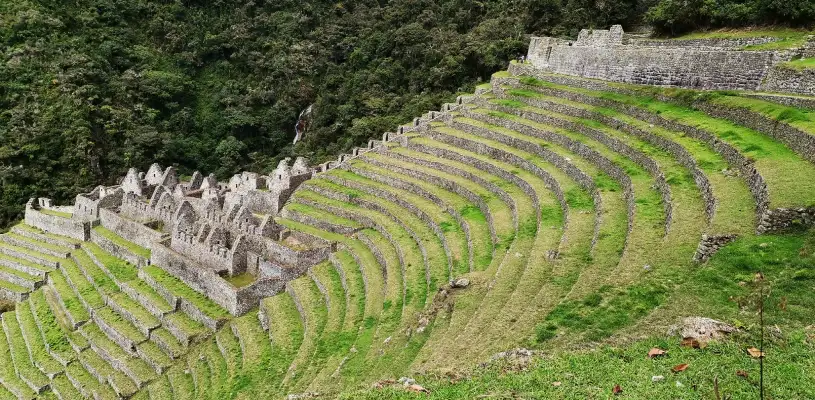
Wiñay Wayna, “Forever young”.
Key moments Day’s high pass • Sayacmarca • Inca tunnel • Phuyupatamarca • Descent to Wiñaywayna

Day 3 is where rhythm meets reward, more ruins and smoother miles.
Day 4: Wiñaywayna to Machu Picchu, the finale
| Distance 5 km / 3.10 miles | Altitude 2,680 m (8,793 ft) → 2,720 m (8,924 ft) → 2,430 m (7,972 ft) |
| Difficulty ⭐⭐☆☆☆ Easy | Hiking time 2 to 3 hours |
| Meals Breakfast, Lunch | |
You wake up early to reach the final checkpoint and advance in darkness through cloud forest. The objective is Inti Punku, the Sun Gate, at about 2,720 m (8,924 ft), from where the first classic view of Machu Picchu opens. If there are clouds, the moment is still powerful; they move quickly and the landscape changes in minutes. Then you descend toward the citadel, located around 2,430 m (7,972 ft), and do the guided visit through the main sectors. Afterward comes the return to Aguas Calientes, train to Ollantaytambo and transfer to Cusco.

Key moments Pre-dawn hike • First view from Inti Punku • Entrance to Machu Picchu • Guided visit
Did you know…?
The Inca Trail is the only trek that reaches Machu Picchu through Inti Punku, the original ceremonial entrance.

Day 4 is the payoff, an early start, a final push.
The Elevation Profile of the Inca Trail
Altitude plays a crucial role in the Inca Trail experience. This is what you’ll encounter:
- Start Km 82 (Piskacucho): 2,720 m.a.s.l. / 8,923 feet
- Wayllabamba Campsite: 3,000 m.a.s.l. / 9,843 feet
- Abra Warmiwañusca: 4,200 m.a.s.l. / 13,828 feet (highest point)
- Pacaymayu Campsite: 3,580 m.a.s.l. / 11,745 feet
- Abra Runkurakay: 4,000 m.a.s.l. / 13,123 feet
- Phuyupatamarca: 3,680 m.a.s.l. / 12,073 feet
- Wiñaywayna Campsite: 2,680 m.a.s.l. / 8,792 feet
- Sun Gate: 2,730 m.a.s.l. / 8,956 feet
- Machu Picchu: 2,400 m.a.s.l. / 7,874 feet
- Aguas Calientes: 2,050 m.a.s.l. / 6,725 feet (lowest point)

Altitudinal profile of the Inca Trail to Machu Picchu.
Notice the pattern: you’ll climb high, descend to camp, climb again. This “climb high, sleep low” approach actually helps with acclimatization, although it doesn’t make Day 2 easier in the moment.
Permits for the Inca Trail
Getting an Inca Trail permit (entrance) is possibly more difficult than the hike itself. Peru’s Ministry of Culture limits daily entries to 500 people total: 200 hikers and 300 support staff (guides, porters, cooks). This creates intense demand, especially during dry season.
What is an Inca Trail permit?
The permit is an entry in the traveler’s name, with a fixed date, managed by an authorized agency. It’s issued with a valid passport, is non-transferable and at checkpoints they ask for the same document. If you renew or change your passport, it’s wise to notify in advance so the operator can update the data.

What does an Inca Trail permit look like?
How the Permit System Works
Permits are released at the beginning of each year and sell out in days for high season (May-September). You cannot buy permits individually. They must be purchased through authorized operating agencies that process entries with your personal information before the corresponding Peruvian organizations.
Once issued, permits are non-transferable and name-specific. You must present the same passport used for booking when accessing the Inca Trail. Lost or expired passports can ruin your trek, so verify expiration dates when booking.
Remember this:
Permits to enter the Inca Trail are limited and, in high season (especially June to August), can sell out quickly, so if you have fixed dates the responsible thing is to book as soon as there’s availability; if there’s no space left, the practical thing is to switch to a realistic plan B like the Short Inca Trail (Km 104), Salkantay trek, Lares trek or some other trek.
Age Restrictions and Physical Requirements
The Ministry of Culture establishes minimum and recommended age limits:
- Recommended age: 14 years (always accompanied by their parents).
- Recommended maximum: 55 years, although this is flexible for those in excellent physical condition.
- Physical condition: You must be able to walk uphill continuously for 1-2 hours and walk 6-8 hours daily for consecutive days
That said, age is less important than physical condition and acclimatization. We’ve seen 60-year-old hikers outperform 25-year-olds because they trained adequately and respected the altitude. If you’re over 55 or have health concerns, consult with your doctor and be honest with your tour operator about your fitness level.
What to Pack (and What to Leave Behind)
Your packing strategy makes or breaks your comfort on the trail. Remember, porters carry your main bag (up to 6kg including sleeping bag), but you carry your day pack on every step of the trail.
The Essential Packing List
| Documents and Money | Clothing | Gear and Accessories |
|
|
|

The right trekking shoes change everything on the Inca Trail, comfort, grip, and support from the first step
PERU’S LEGENDARY HIKEInca Trail to Machu Picchu
Follow the historic trail through mountain passes, Inca sites, and cloud forest paths to Machu Picchu.
What’s Provided vs. What You Need to Rent
Included in your tour: In most authorized operators, the standard package usually includes camping tent (often for 4, used by 2 people), sleeping pad, dining tent, guide and cooking equipment, meals from Day 1 lunch to Day 4 breakfast, boiled water for refills and transport of a duffel bag with a weight limit that usually moves between 5 and 7 kg, depending on agency policy. Before paying, ask for inclusion details to compare rates with criteria.
Optional (available to rent or pay separately): Sleeping bag, trekking poles with rubber tips and extra porter if you exceed allowed weight; also, depending on the operator, some logistical items may come included or be charged separately (for example, trains and the descent bus between Machu Picchu Pueblo and the Inca site), so it’s wise to confirm before booking.
Packing Tricks from Experienced Hikers
- The 48-hour boot test: Wear your trekking boots around Cusco for two full days before the trek. Blisters on Day 1 = misery for four days. Also test your rain gear: Cusco’s afternoon rains are perfect for this.
- Layering secret: Three layers work better than one thick jacket. Base layer (thermal) + mid layer (fleece) + outer layer (waterproof) lets you adjust to temperature changes during the day.
- Daypack essentials: Keep these accessible: rain poncho, extra layer, snacks, water, sunscreen, camera, toilet paper, hand sanitizer. Everything else can go in your duffel.
- Battery killer: Cold nights drain phone/camera batteries 40% faster. Keep devices in your sleeping bag at night to preserve charge.
- Blister prevention: Apply vaseline or Body Glide to friction points (heels, toes) every morning before putting on socks. This simple step prevents 80% of blisters.
- The luxury item: Wet wipes.
What NOT to Bring
These items are restricted on the Inca Trail:
- Walking sticks with metal tips (only rubber tips allowed)
- Single-use plastics (bring refillable bottles)
- Drones or professional filming equipment
- Speakers or sound equipment
- Firearms or hunting equipment
- Drugs or excessive alcohol
- Pets
Acclimatization Before the Inca Trail
- If you don’t come from a high-altitude place, arriving in Cusco and leaving the next day for the trek is usually a bad idea. The most reasonable approach is to give yourself 2 to 3 days: day 1 rest and hydrate (light walking is fine), day 2 move around without overdoing it (Sacred Valley works well because you sleep in Cusco), and day 3 go a bit higher only if you feel stable. With that, most people arrive at the inca trail machu picchu 4 days with their body “already in altitude mode”.
- Stay hydrated, avoid alcohol in the days before, eat lightly and walk at a steady pace. Those details usually weigh more than any “trick”.
Warning:
Stop and notify your guide if you notice shortness of breath at rest, confusion, persistent vomiting or loss of coordination. If symptoms intensify, the wisest thing is to descend. And if you have a medical history or take medication, it’s wise to consult with your doctor before the trip.
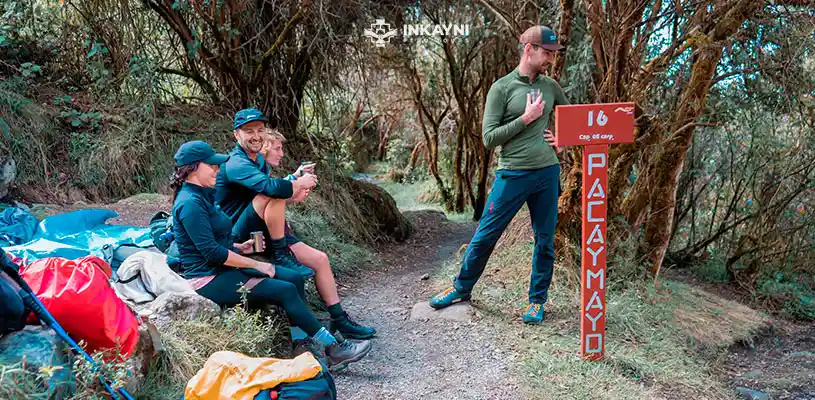
Pacaymayo camp, a well earned stop that turns fatigue into motivation for tomorrow’s push.
What’s Included in Your Trek (and What Costs Extra)
On the Inca Trail, each agency assembles their package with their own inclusions and extras. This list is a sample of how Inkayni Peru Tours handles the Classic 4-Day Inca Trail. Use it as reference and, before booking, ask for inclusion details.
Included in Standard 4-Day Inca Trail Tours (Classic Inca Trail version)
| Concept | Detail |
| ✅ Professional Services | Professional guide (language depending on operator), assistant guide in large groups (depending on group size), professional cook, porters for equipment and duffel transport with weight limit (common 5–7 kg, depending on operator) |
| ✅ Transportation | Hotel pickup in Cusco, transport to Km 82, return train (Aguas Calientes to Ollantaytambo) and bus/transfer to Cusco (schedules and category depending on operator) |
| ✅ Meals | 3 breakfasts, 3 lunches, snacks/afternoon snack and 3 dinners (vegetarian/vegan/gluten-free available with advance notice) |
| ✅ Camping Equipment | Shared tent (normally 2 people per tent), sleeping pad, dining tent with tables/chairs and bathroom tent (depending on operator) |
| ✅ Safety and Support | First aid kit and oxygen for emergencies (standard in serious operators; confirm), and communication system depending on route/operator |
| ✅ Permits and Entries | Inca Trail permit, Machu Picchu entrance ticket (circuit/schedule depending on availability) and, in many cases, Consettur descent bus from Machu Picchu to Aguas Calientes (depending on operator) |
| ✅ Water | Boiled water for refills at campsites (common from Day 2, depending on operator). For Day 1, bring your own water. |
Not Included (Additional Costs)
| Concept | Detail |
| ❌ Sleeping Bag | Rental available (reference price, varies by operator and season) |
| ❌ Trekking Poles | Rental available (with rubber tips; price varies by operator) |
| ❌ Non-Covered Meals | Day 1 breakfast and, often, Day 4 lunch/dinner (depends on operator) |
| ❌ Huayna Picchu Entry | Separate entry (subject to availability and separate purchase, according to current regulations) |
| ❌ Tips | Optional but customary (suggested amount varies by operator and group size) |
| ❌ Travel Insurance | Recommended; varies by provider |
| ❌ Extra Porter | If you exceed allowed weight or want additional service (cost varies by operator) |
Important note:
Inclusions and limits (guide language, duffel weight, Consettur bus, train category, water and equipment) may vary by operator and season. Before booking, ask for details to compare rates with criteria.
Remember to budget an additional $200-300 per person beyond the tour price for these additional expenses.
Tipping Guide: How to Handle It Without Feeling Awkward
- Tips are not mandatory: in practice, many groups leave a tip as thanks to the team (porters, cook and guide). The idea is for it to be voluntary and according to your budget, not a hidden “fee”.
- Practical reference per hiker (4-day trek): a common range for the group pool is usually between S/ 150 and S/ 300 per person, depending on group size, service level and how many people make up the staff. If your agency gives you suggested amounts, use it as a guide, not a rule.
Recommended amounts per hiker (4-day trek):
- Porters: 60-80 soles ($15-20 USD) per porter. For a typical group, there are 2-3 porters per hiker.
- Guide: 150-200 soles ($40-50 USD) for excellent service
- Cook: 100-150 soles ($30-40 USD)
- Assistant guide: 80-100 soles ($20-25 USD) if applicable
Normally the group pools the amount at the end of the trek (sometimes the last night) and distributes it in envelopes. If you prefer to give individually or separate by role, that’s also valid. It’s recommended to bring soles and small bills. If the service was correct, show appreciation within your means; if it was excellent, you can adjust a bit more. But don’t feel pressured. The priority is your safety and your trip.
The People Who Make It Possible: Understanding the Porters
On the Inca Trail, porters are a key part of the experience. While you walk with a light backpack, they transport tents, food and camping equipment (and the group’s duffel) on the same route, at a strong pace and with well-coordinated logistics.
Who are they?
Most come from rural Quechua communities around Cusco and work seasonally (approximately April to October). Therefore, in addition to choosing by price, it’s worth looking at how each operator treats their team. There are specific regulations to protect porters (Porter Law), which contemplates load limits, insurance and basic working conditions. A serious operator should be able to explain their policies without beating around the bush.
Why are they essential?
In much of the route, motorized vehicles or pack animals are not used, so the campsite moves “by hand”. Porters usually arrive first to set up the dining area, organize the campsite and leave everything ready when the group arrives. That coordination is what makes a comfortable trek possible in a remote environment.

Inca Trail porters keep the adventure moving, carrying the essentials so you can focus on the path to Machu Picchu.
Other Guides That Help Before Booking the 4 Day Inca Trail
Final Advice Before Booking the 4-Day Inca Trail
The 4 day Inca Trail is demanding because it combines altitude, stone steps, cold campsites, changing weather, and several days of hiking. With 2–3 days of acclimatization, the right equipment, realistic pacing, and a confirmed permit, the route becomes manageable for most prepared travelers.

Go all in on the Classic Inca Trail, four days of pure adventure that lead you straight to Machu Picchu.
If you want the full experience of reaching Machu Picchu through Inti Punku, the Classic Inca Trail is still one of the strongest ways to do it. Check availability with Inkayni Peru Tours, confirm what is included, and start planning early so your dates, permit, and logistics are secured before they sell out.
Frequently Asked Questions about the Classic 4-Day Inca Trail
What is the minimum age to do the classic Inca Trail?
What documents do I need for the Inca Trail permit?
Can I change the date if I already booked the Inca Trail?
How much weight can I carry and how does the duffel bag work?
What daypack size is recommended?
Can I use trekking poles on the Inca Trail?
What about my Machu Picchu entry: is it included or purchased separately?
Is the return train to Cusco included?
Where do you sleep on the Inca Trail and what are the campsites like?
Do I need a sleeping bag and what temperature is advisable?
What medications or prevention is recommended for altitude?
Is there signal or internet during the Inca Trail?
Do you tip guides and porters?
What happens if I lose my passport or it gets stolen before the trek?
Can I bring drones or professional photo/video equipment?
Autor

Shared: