


When Huayna Picchu Is the Right Ticket
Huayna Picchu is the right choice if you want a short but demanding climb with a higher view over Machu Picchu and you are comfortable with steep stone steps, narrow sections, and a tighter schedule. In practice, the key is to book Route 3-A early, match it carefully with your train and bus, and avoid it if strong vertigo, bad knees, or rushed logistics are already part of the day.
Table of Contents
Huayna Picchu draws travelers because it looks unreachable from below. Its silhouette rises behind the Inca citadel of Machu Picchu: narrow, tall, green, and nearly vertical, as if it closes off the entire landscape. Climbing Huayna Picchu does not require technical mountain experience, but it does demand patience and a well-informed decision before you purchase your ticket.
| 8,835 ftHuayna Picchu elevation (2,693 m) | Route 3-ACircuit 3 | 400Daily spots in 2026 | 6 hrsMaximum stay |
This guide covers the practical information that matters most before booking: the correct ticket, schedules, available spots, difficulty, minimum age, what you will see on Circuit 3, and more. The goal is to book with confidence and arrive at the Huayna Picchu checkpoint without improvising, so you can get the most out of your visit.

Machu Picchu with Huayna Picchu in the background, one of the most recognizable views of the sanctuary.
WORLD WONDER IN THE ANDESMachu Picchu
Discover the history, landscapes, and essential tips for visiting this world wonder.
What is Huayna Picchu and why travelers want to climb it
Huayna Picchu is the mountain located to the north of the Machu Picchu citadel. Its name comes from the Quechua Wayna Picchu, commonly translated as “young mountain.” In the classic photograph of the sanctuary, this mountain appears behind the Inca structures and gives the landscape its depth.
The route to the summit combines a cloud forest trail, stone staircases, narrow sections, and natural viewpoints. From the upper portion you look down at Machu Picchu from an elevated angle, with the Urubamba River wrapping around the mountain and green slopes closing the valley. The experience tends to be more physical and vertical, with a contemplative perspective from the top.

Close view of Huayna Picchu, the steep mountain behind Machu Picchu.
For some travelers, Huayna Picchu is not the main route but the final extra effort that crowns the visit to Machu Picchu. The most natural fit is usually the Short Inca Trail, because it reaches Machu Picchu on foot. Longer routes such as the Salkantay Trek, the Lares Trek, and the Inca Jungle Trek can also work well when the itinerary leaves enough margin for the train, the bus, and the Route 3-A entry window. In that sense, Huayna Picchu works best as the final mountain chapter of a well-coordinated Machu Picchu trip.
PERU’S LEGENDARY HIKEInca Trail to Machu Picchu
Follow the historic trail through mountain passes, Inca sites, and cloud forest paths to Machu Picchu.
Which ticket do you need to climb Huayna Picchu?
To climb Huayna Picchu you need to purchase the Route 3-A: Montaña Waynapicchu ticket. This route belongs to Circuit 3, also known as the Royal Circuit. The name may appear as Huayna Picchu or Waynapicchu, but both refer to the same mountain.
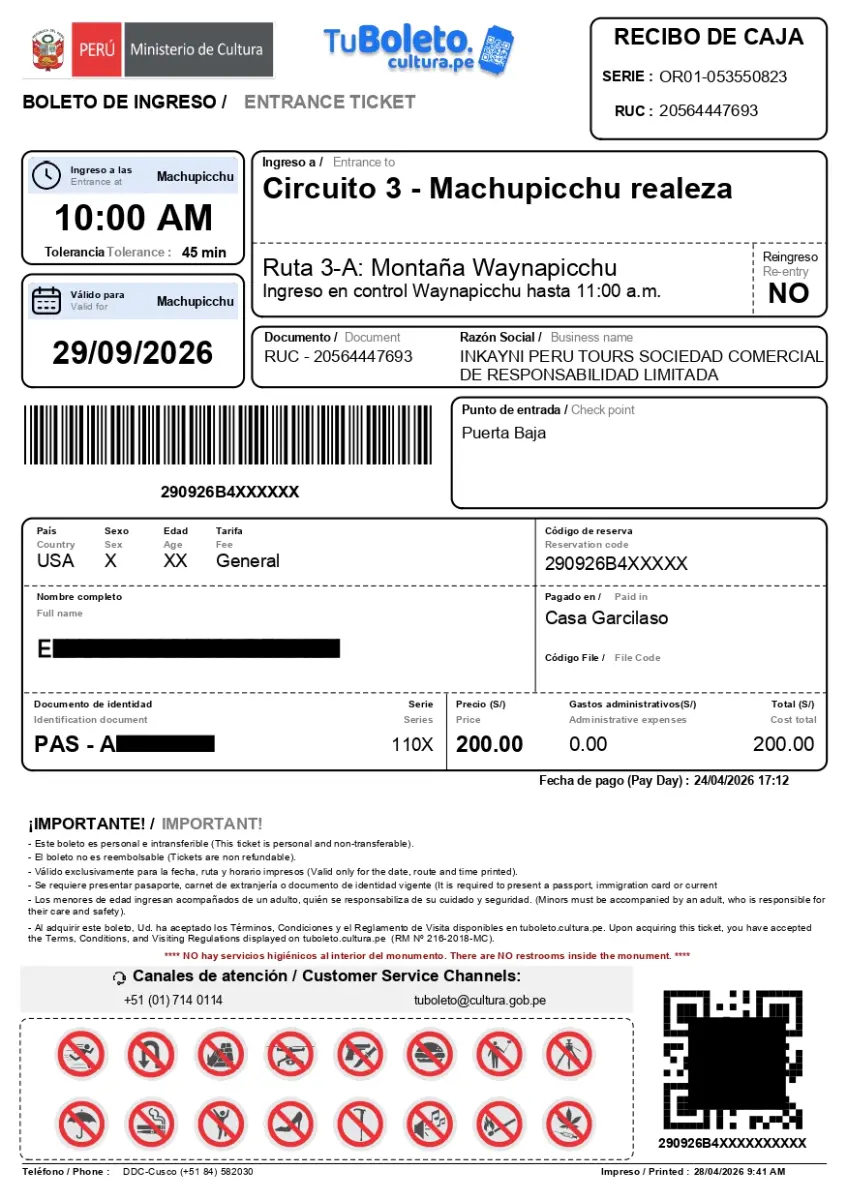
Official Machu Picchu ticket for the Waynapicchu Mountain route.
This point is decisive: the general Machu Picchu entrance ticket does not allow access to Huayna Picchu. A Circuit 1 or Circuit 2 ticket is not sufficient either. If you want to do this hike, your ticket must specifically state Route 3-A.
Keep this in mind:
Check that your ticket says Route 3-A: Montaña Waynapicchu. If you purchase a different circuit, you will be able to visit another part of Machu Picchu but will not have access to the Huayna Picchu checkpoint.
Other Guides That Help Before Booking Huayna Picchu
What Route 3-A of Huayna Picchu includes
Route 3-A combines two experiences: a walk through the lower sectors of Machu Picchu and the hike up Waynapicchu mountain. The official Circuit 3 map includes points such as the Lower Platform, Upper Platform, Dry Moat, Temple of the Sun Viewpoint, Granite Chaos, Temple Plaza, Intiwatana Pyramid, Sacred Rock, Twelve Niches, Eastern Storehouses, Water Mirror Complex, Temple of the Condor, Pisonay Plaza, and the Archaeological Reserve.

Map of Machu Picchu Circuit 3-A with Huayna Picchu.
The visit is designed to move through the lower portion of the llaqta (the Inca settlement) and then connect to the mountain access. This means Route 3-A does not work the same way as Circuit 2, which tends to be the first choice for travelers seeking a more classic experience inside the archaeological site.
Quick summary:
The Huayna Picchu hike delivers an elevated view and an intense climb. If your absolute priority is the classic photograph from the upper terraces, check the Circuit 1 or Circuit 2 routes before purchasing.
Schedules and available spots for Huayna Picchu in 2026
Huayna Picchu has 400 daily spots in 2026, split between two time windows of 200 slots each. In practice, you need to watch two moments: your entry into Machu Picchu’s Circuit 3 and the specific window to reach the mountain checkpoint. Do not arrive at the main Machu Picchu gate at the same time your hiking window begins; you first need to pass the general control and walk to the Huayna Picchu booth.
| Group | Machu Picchu entry | Huayna Picchu entry | Official spots |
| First group | 7:00 to 8:00 a.m. | 8:00 to 9:00 a.m. | 200 spots |
| Second group | 9:00 to 10:00 a.m. | 10:00 to 11:00 a.m. | 200 spots |
Note: The official capacity distinguishes online spots from a smaller number of in-person spots. For a traveler with a fixed date, the safest approach is to book online or through an agency, without depending on last-minute purchases.
Expert tip:
If you are traveling with an agency, confirm that your train schedule, bus ride up, and Machu Picchu entry time are aligned with your Huayna Picchu window. On this route, arriving late to the mountain checkpoint can cost you the hike even if you are already inside Machu Picchu.
When to book your Huayna Picchu tickets
Huayna Picchu tends to sell out before other routes because it combines a famous hike, an elevated view, and a more intense experience within Machu Picchu.
| Season | Reference months | When to book |
| Low season | January to March and part of November | Book 2 to 3 months in advance. For New Year or Easter week, book even earlier since demand rises despite the rainy season. |
| High season | April to October, long public holidays, and late December | Book 4 to 5 months in advance. If you are traveling between June and August, in a group, or with a fixed date, look for availability even earlier. |
Expert tip:
The simple practical rule: buy the Huayna Picchu ticket first and then adjust the train, bus, hotel, and guide around that time slot. If you are traveling with an agency, confirm from the start that the package includes Route 3-A: Montaña Waynapicchu, because switching circuits after spots sell out can be very difficult.
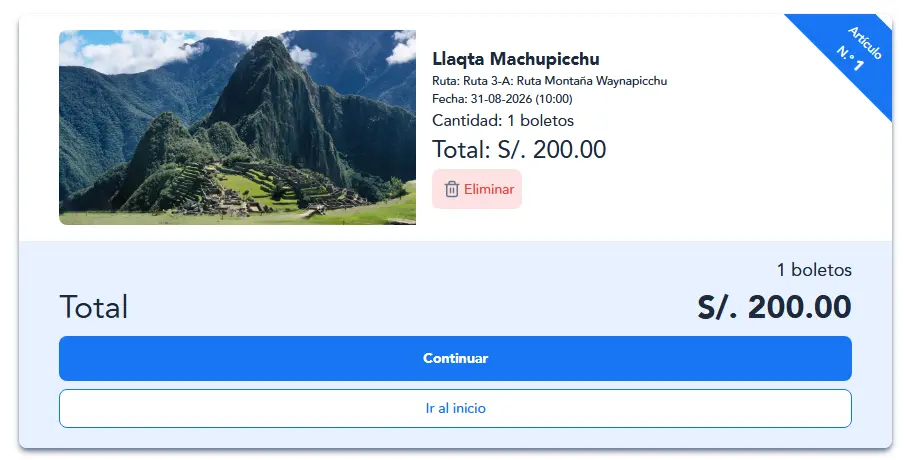
Example of the Huayna Picchu ticket purchase process.
Huayna Picchu ticket prices
The price varies by nationality, age, and student status. For Peruvian travelers, residents, or citizens of the Andean Community, the official promotional rates for Route 3-A are lower than the rates applied to non-resident foreign tourists.
| Visitor type | Reference fare | What to verify |
| Foreign adult | S/ 200 approx. (~$54 USD) | ID, date, and Route 3-A. |
| Foreign student or minor | S/ 118 approx. (~$32 USD) | Valid student card or document. |
| Peruvian adult or Andean Community | S/ 112 approx. (~$30 USD) | National ID, residency, or applicable document. |
| Peruvian student or minor | S/ 80 approx. (~$22 USD) | Age or student status validation. |
Note: Foreign amounts are reference figures and must be confirmed at the time of purchase. National and Andean Community promotional rates may vary depending on current regulations and document validation.
Keep this in mind
Although the official fare is useful as a reference, many agencies offer Huayna Picchu as an optional route add-on within the package. This add-on may be higher than the official ticket price because the agency handles the booking, checks available spots, matches it with your Machu Picchu entry time, and applies its own booking, change, or cancellation conditions. Before paying, confirm whether the amount refers only to the official ticket or to the add-on for including the Route 3-A Huayna Picchu, with the correct date and entry time.
How to get to Huayna Picchu from Cusco
To reach Huayna Picchu you first need to reach Machu Picchu. The most common route starts in Cusco, continues by road to Ollantaytambo, continues by train to Aguas Calientes, and ends with the bus that climbs to the citadel gate. From there you enter through Circuit 3 and make your way to the mountain checkpoint.
| Leg | Mode | Approx. duration | What to watch |
| Cusco to Ollantaytambo | Transfer or tourist transport | 1 hr 30 to 2 hrs | Depart with margin. |
| Ollantaytambo to Aguas Calientes | Train | 1 hr 40 to 2 hrs | Arrival time. |
| Aguas Calientes to Machu Picchu | Bus | 25 to 30 min | Line and ticket. |
| Machu Picchu to Huayna Picchu | Circuit 3 on foot | Depends on pace and control | Arrive within the mountain window. |
On an independent trip, each leg is purchased and calculated separately. In an organized package, an agency can coordinate the full sequence: pickup, train, bus, entrance ticket, guide, mountain time slot, and return. That coordination is especially valuable for climbing Huayna Picchu because a scheduling or ticketing error can leave you locked out of the hike.

The train to Aguas Calientes is a key part of the logistics before climbing Huayna Picchu.

The main Machu Picchu entrance is the first checkpoint before advancing to the Huayna Picchu route.
Real difficulty of the Huayna Picchu hike
The difficulty of climbing Huayna Picchu lies less in the distance than in the gradient, the height of the steps, the humidity of the stone, and the feeling of exposure on certain sections. The hike can feel intense even for seasoned walkers, because elevation is gained quickly and there are stretches where it pays to slow down and use your hands or the support cables.
On a practical scale, the Huayna Picchu mountain hike can be considered moderate to hard in difficulty. It is not a technical route, but it is not an easy stroll either. If you have severe vertigo, serious knee problems, low tolerance for stairs, or fear of narrow passages, it is better to choose another route within Machu Picchu.
| Factor | Level or recommendation |
| Physical effort | Moderate to hard due to the gradient. |
| Feeling of exposure | High on narrow sections and viewpoints. |
| Risk in rain | Greater due to wet stairs and slippery stone. |
| Recommended profile | Active travelers with good balance and no strong fear of heights. |
Expert tip:
If you have severe vertigo, avoid this route. Huayna Picchu can be safe when the trail is respected, but some sections are narrow, steep, and visually exposed.
What the Huayna Picchu hike is like
1.- The start of the route
After moving through Circuit 3, you will reach the Huayna Picchu checkpoint near the Sacred Rock sector. There your ticket, identity document, and entry window are validated. At some checkpoints hikers are registered on the way in and out to track progress along the route.

The checkpoint area before beginning the climb toward Huayna Picchu.

The entrance to the Huayna Picchu trail, where the most physical part of the experience begins.
2.- The ascent through vegetation and stairs
At the beginning the trail moves through the humid cloud forest. Then the gradient increases and more stone staircases appear. On certain sections there are cables or fixed supports that help with both the ascent and descent. Keeping a steady pace, letting faster hikers pass, and not stopping in narrow sections are the most useful habits here.

The Huayna Picchu hike combines dense vegetation, wet stone, and steep gradients.
3.- The Stairs of Death
One of the most well-known sections of the climb is what travelers call the Huayna Picchu Stairs of Death. The name is more dramatic than explanatory, but the spot does demand attention. These are narrow, steep stone steps with a genuine sense of exposure at certain points. The key is to move without rushing, step firmly, and keep your hands free.

The Huayna Picchu death stairs are one of the most well-known sections of the hike.
4.- The summit and the views
When you reach the upper portion, the landscape opens. Machu Picchu appears below, smaller and more complete, surrounded by mountains and the Urubamba River. On clear days the view lets you understand the relationship between the citadel, the valley, and the roads that connect them. On misty days the experience shifts: the mountain feels more enclosed, humid, and quiet.
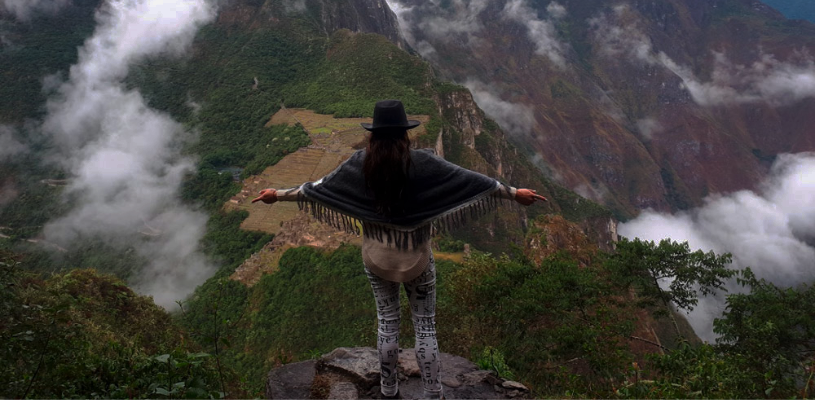
The Huayna Picchu summit offers an aerial view of Machu Picchu and its mountain surroundings.
5.- The descent
The descent requires more patience than strength. Knees work harder, the stone can be wet, and some steps require going slowly. Keep distance from other hikers, use the supports where they exist, and avoid stopping for photographs on narrow sections. The hike ends when you return to the checkpoint and continue along the exit circuit.

Trail signage along the Huayna Picchu route.
PERU’S LEGENDARY HIKEInca Trail to Machu Picchu
Follow the historic trail through mountain passes, Inca sites, and cloud forest paths to Machu Picchu.
The Temple of the Moon and the Great Cavern
The Temple of the Moon, also known as the Great Cavern, was associated for years with the Huayna Picchu experience. Under the current route system, this visit has its own ticket: Route 3-C: Great Cavern, available only in high season. This clears up a common confusion: buying Huayna Picchu tickets and expecting access to the Temple of the Moon as well.
If the Great Cavern is your main interest, check the specific availability of Route 3-C before purchasing. If you choose Route 3-A, your experience focuses on Circuit 3 and climbing Waynapicchu mountain.

The Temple of the Moon or Great Cavern requires a specific route under the current system.
Huayna Picchu, Machu Picchu Mountain, or Huchuy Picchu
The mountains of Machu Picchu do not offer the same experience. Huayna Picchu is the most vertical and the most famous. Machu Picchu Mountain tends to be longer and more panoramic. Huchuy Picchu is shorter and lighter, available only in high season under the current system. The best choice depends on your available time, physical condition, and the type of view you are looking for.
| Route | Best for | Demand level | Key detail |
| Huayna Picchu | Adventure, elevation, and intense view. | Moderate to hard. | Route 3-A, 400 daily spots. |
| Machu Picchu Mountain | Wide panorama and a longer hike. | Hard due to duration. | Route 1-A, panoramic view. |
| Huchuy Picchu | Short hike with less physical effort. | Low to moderate. | Route 3-D, high season only. |

The main mountains linked to a Machu Picchu visit each offer a different experience.
| Alternative hiking routes at Machu Picchu | ||||
| Ticket | Experience | Circuit included | Availability | Restrictions |
| Huayna Picchu Mountain Route 3A |
One of the most sought-after short hikes at Machu Picchu, with steep trails and panoramic views very close to the archaeological site.
See detailBest suited for travelers in good physical condition, with little vertigo, and a desire for an intense experience within the citadel circuit. |
Circuit 3 – Royal Route | Year-round | Ages 12 and up |
| Huchuy Picchu Mountain Route 3D |
A brief hike to the smallest summit at Machu Picchu. A simple, scenic, and less demanding option than climbing Huayna Picchu.
See detailWorks well for travelers who want to add a short hike without spending too much energy during the visit. |
Circuit 3 – Royal Route | High season June 19 – November 2 |
Ages 12 and up |
| Temple of the Moon / Great Cavern Route 3C |
A long route to one of the most enigmatic constructions in the area. Covers a less visited sector with forest, stone, and a sense of isolation.
See detailBetter suited for travelers with time, endurance, and a specific interest in less crowded archaeological zones. |
Circuit 3 – Royal Route | High season June 19 – November 2 |
Ages 12 and up |
| Sun Gate Route (Inti Punku) 1C |
The path toward the ancient entry gate to Machu Picchu from the Inca Trail. Offers one of the broadest views of the Inca city.
See detailA good alternative for those seeking a historical, open, and photography-friendly hike with less enclosed feeling than other routes. |
Circuit 1 – Panoramic Route | High season June 19 – November 2 |
All ages |
| Inca Bridge Route 1D |
A short route to a structure suspended above ravines. A scenic, brief option useful for complementing the panoramic visit.
See detailWorks well for travelers who want to walk a short distance, add historical context, and observe a defensive stretch of the ancient Inca road system. |
Circuit 1 – Panoramic Route | High season June 19 – November 2 |
Ages 12 and up |
What to bring for the Huayna Picchu hike
Keep your pack light. On this climb you need your hands free, solid footwear, and a small bag.
- Passport or ID: must match the document used when purchasing the ticket.
- Route 3-A ticket: printed or digital, as indicated by the platform.
- Hiking shoes or trail sneakers: with solid grip for wet stone.
- Light waterproof layer: useful even outside the rainy season.
- Water: bring at least a small or medium bottle.
- Insect repellent and sunscreen: the environment combines humidity, insects, and strong sun.
- Small daypack: avoid carrying unnecessary weight.
- Camera or phone: with enough battery and kept safely stowed during stair sections.
Rules and recommendations for the route
Huayna Picchu is visited within an archaeological sanctuary, not on a free mountain trail. Respect the schedule, follow the direction of the circuit, and stay within the marked path. The trails are narrow, so a poor individual decision affects other hikers as well.
- Enter only within the time window stated on your ticket.
- Carry your original document or the one used for purchase.
- Do not backtrack through sections not authorized for the circuit.
- Do not use trekking poles unless permitted for physical reasons and fitted with rubber tips.
- Do not bring a tripod, drone, or bulky objects.
- Do not stop on narrow staircases to take photographs.
- Walk at your own pace but allow others to pass safely when the trail permits.
Flora, fauna, and natural environment
Huayna Picchu forms part of the Machu Picchu Historical Sanctuary, a space where the Andean world meets the Amazonian cloud forest. Humidity, orchids, bromeliads, birds, and dense vegetation are part of the ecosystem that sustains this landscape.
During the hike you can encounter butterflies, small birds, mosses, ferns, and vegetation that changes with elevation and sun exposure. The biodiversity does not always appear in spectacular form, but it is present in the humid air, in the shade of the trail, and in the way the mountain envelops the Inca structures.

Flora and fauna of the Machu Picchu and Huayna Picchu environment.
Traveling with an agency when you choose Huayna Picchu
Huayna Picchu leaves little room for error. A wrong ticket, a poorly timed train, a long bus line, or a late arrival to the circuit can affect the entire visit. In an organized package, the agency coordinates the ticket, train, bus, guide, entry time, and return in one sequence. That coordination saves time, avoids duplicate purchases, and reduces decisions made under pressure.
At Inkayni Peru Tours, we can help you integrate Huayna Picchu into a complete Machu Picchu itinerary, coordinating the entrance ticket, train, bus, guide, and real connection times. If this mountain is on your list, booking early and building the day around Route 3-A is the best approach.

Structures and views from the Waynapicchu mountain environment.
Frequently asked questions about Huayna Picchu
What is Huayna Picchu?
Huayna Picchu, also called Waynapicchu, is the mountain that appears behind Machu Picchu in many classic photographs. It is visited with a specific ticket that includes Circuit 3 and Route 3-A to the mountain.
What ticket do I need to climb Huayna Picchu?
You need the Route 3-A: Montaña Waynapicchu ticket, within Circuit 3, also known as the Royal Circuit. Any other type of entrance does not allow access to the Huayna Picchu checkpoint.
Is Huayna Picchu part of Circuit 3?
Yes. Under the current Machu Picchu system, Huayna Picchu corresponds to Route 3-A of Circuit 3. This circuit covers the lower sectors of the llaqta and connects to the checkpoint leading to the mountain.
How high is Huayna Picchu?
The Huayna Picchu peak sits at approximately 8,835 ft (2,693 m) above sea level, around 985 ft (300 m) above the Machu Picchu citadel.
How long does the Huayna Picchu hike take?
The mountain hike typically takes between 2 and 3 hours round trip, depending on pace, weather, and trail congestion. The ticket allows a maximum stay of 6 hours within the corresponding route.
Is the Huayna Picchu hike difficult?
Yes, the difficulty is moderate to hard. The distance is not very long, but the gradient, the stone steps, the humidity, and certain narrow sections make it a demanding hike.
Is Huayna Picchu dangerous?
It is a safe route when hiked carefully, with the trail respected and instructions followed. It can be uncomfortable for people with vertigo, fear of heights, or balance issues.
Can I climb Huayna Picchu if I am afraid of heights?
It is not recommended if the fear is significant. The route has narrow staircases, steep sections, and views with a strong sense of exposure. In that case, Machu Picchu Mountain, Huchuy Picchu, or a circuit without a mountain climb are better alternatives.
What is the minimum age to climb Huayna Picchu?
The reference minimum age is 12 years. Minors must be accompanied by a responsible adult and must hold the corresponding ticket.
How many spots are available per day?
Huayna Picchu has 400 daily spots in 2026, split between two time windows of 200 spots each. Due to demand, booking online or through an agency in advance is strongly recommended.
How far in advance should I book Huayna Picchu?
The recommended minimum is 2 to 3 months ahead if you have a fixed date. If you are traveling between June and August or during high-demand dates, look for availability even earlier.
Does Huayna Picchu include the classic Machu Picchu photo?
Huayna Picchu offers an elevated and different view of Machu Picchu. If you are looking for the classic photograph from the upper terraces, check the Circuit 1 or Circuit 2 routes before purchasing.
Can I visit the Temple of the Moon with the Huayna Picchu ticket?
Not under the current system. The Temple of the Moon or Great Cavern has its own route: Circuit 3, Route 3-C, available only in high season.
Do I need a guide to climb Huayna Picchu?
A guide is generally not mandatory for the mountain hike. Even so, traveling with a guide or agency helps coordinate the circuit, schedule, entry, and return without logistical errors.
What should I bring for Huayna Picchu?
Bring your ID, ticket, water, a light rain layer, insect repellent, sunscreen, a small daypack, and footwear with solid grip. Avoid carrying large or unnecessary items.
What happens if I arrive late to the Huayna Picchu checkpoint?
You could lose access to the mountain. The entry window matters, so calculate the train, bus, general control, and Circuit 3 walk with enough margin.
Is Huayna Picchu or Machu Picchu Mountain better?
Huayna Picchu is steeper, more famous, and more exposed. Machu Picchu Mountain tends to be longer, higher, and more panoramic. The better choice depends on your fitness, tolerance for heights, and the type of view you are looking for.
Can Huayna Picchu be done on a day trip from Cusco?
Yes, but it requires precise coordination of pickup, train, bus, entrance ticket, mountain time window, and return. For that reason, doing it with an agency reduces logistical risk considerably.
Autor

Shared:


TE PUEDE INTERESAR



If you liked this article and the information you found, give us 5 stars!
 (Ninguna valoración todavía)
 Loading...