


Quick Answer
The Inca Trail starts at two official points depending on which route you choose:
- Classic Inca Trail (4 days): Kilometer 82 at Piscacucho, Ollantaytambo
- Short Inca Trail (2 days): Kilometer 104 at Chachabamba
Both starting points are located along the railway line connecting Ollantaytambo with Machu Picchu in Cusco’s Sacred Valley.
Table of Contents
The Inca Trail is considered one of the five best hiking routes in the world. This legendary trek allows you to reach Machu Picchu following the same footsteps that the ancient Incas traveled more than 500 years ago. However, before embarking on this epic adventure, it’s essential to know exactly where does the Inca Trail start according to the route you choose.
| Km 82Classic Trail start | Km 104Short Trail start | PermitRequired for both | Feb.Annual closure |
In this article, we’ll explain clearly and practically the starting points for each route, how to reach them, what you’ll find at each location, and all the essential information you need to plan your journey.
PERU’S LEGENDARY HIKEInca Trail to Machu Picchu
Follow the historic trail through mountain passes, Inca sites, and cloud forest paths to Machu Picchu.
Where Does the Inca Trail Start (Classic Version of 4 days)?
The Classic Inca Trail is the complete trekking experience that takes you through 42 kilometers of living history, spectacular Andean landscapes, and impressive archaeological sites. This route officially starts at Kilometer 82 of the Cusco-Machu Picchu railway, in the community of Piscacucho, Ollantaytambo district.

Piscacucho (Km 82): The Gateway to the Inca Trail
Piscacucho, also known simply as “Km 82,” is a small community located at 2,709 meters above sea level (8,891 feet). This point marks the official start of the legendary Qhapaq Ñan (Quechua name for the Inca Trail) and sits at the boundary of Machu Picchu National Park.
Piscacucho Characteristics:
- Location: Ollantaytambo District, Urubamba Province, Cusco Region
- Altitude: 2,709 masl (8,891 feet)
- Distance from Cusco: Approximately 82 km (2.5-3 hours by ground transportation)
- Climate: Temperate, with daytime temperatures between 15-20°C (59-68°F) and nighttime temperatures of 6-10°C (43-50°F)
- Access: Only by ground transportation from Cusco or Ollantaytambo
Important note:
The name “Kilometer 82” refers to the distance along the railway line from Cusco, not to the trekking trail kilometers. It’s simply a geographic marker on the train route.
What Will You Find Upon Arriving at Piscacucho?
Upon arriving at Km 82, you’ll encounter:
- Official checkpoint: Here you must register with your original passport and Inca Trail permit
- Bridge over the Urubamba River: You’ll cross the mighty Vilcanota River (also called Urubamba) to officially enter the trail
- Visitor center: Inaugurated in 2013, it offers information about the Historic Sanctuary and its biodiversity
- Spectacular view: From here you can already appreciate the majestic Nevado Verónica (5,682 masl) and the canyon valley
- First archaeological sites: Within a few kilometers you’ll find Patallacta and Llactapata

How to Get to Km 82 (Piscacucho)
Access to the Classic Inca Trail starting point is only possible via ground transportation, as trains do not make stops at this location. The typical process is:
- Hotel pickup in Cusco: Between 4:30-5:30 a.m.
- Road journey: Approximately 2.5-3 hours to Piscacucho
- Route: Cusco → Chinchero → Urubamba → Ollantaytambo → Km 82
- Checkpoint registration: Document presentation and permit verification
- Trek begins: Usually between 8:00-9:00 a.m.
Important note:
Transportation to Km 82 is included in all authorized Inca Trail tours. You cannot arrive on your own, as only authorized agencies have permission to start the trek.
The first day of the Classic Inca Trail is relatively moderate and perfect for acclimatization:
- Distance: Approximately 12 km (7.5 miles)
- Hiking time: 5-6 hours
- Difficulty: Easy to moderate (mostly flat terrain)
- Starting altitude: 2,709 masl
- Camp altitude: 3,000 masl at Wayllabamba
- Archaeological sites: Patallacta (Llactapata), Willkaraqay
During this first day, you’ll walk alongside the Urubamba River, traverse Andean farming zones and subtropical forest, with constant views of Nevado Verónica. The trail is wide and well-defined, allowing you to enjoy the scenery without excessive physical effort.
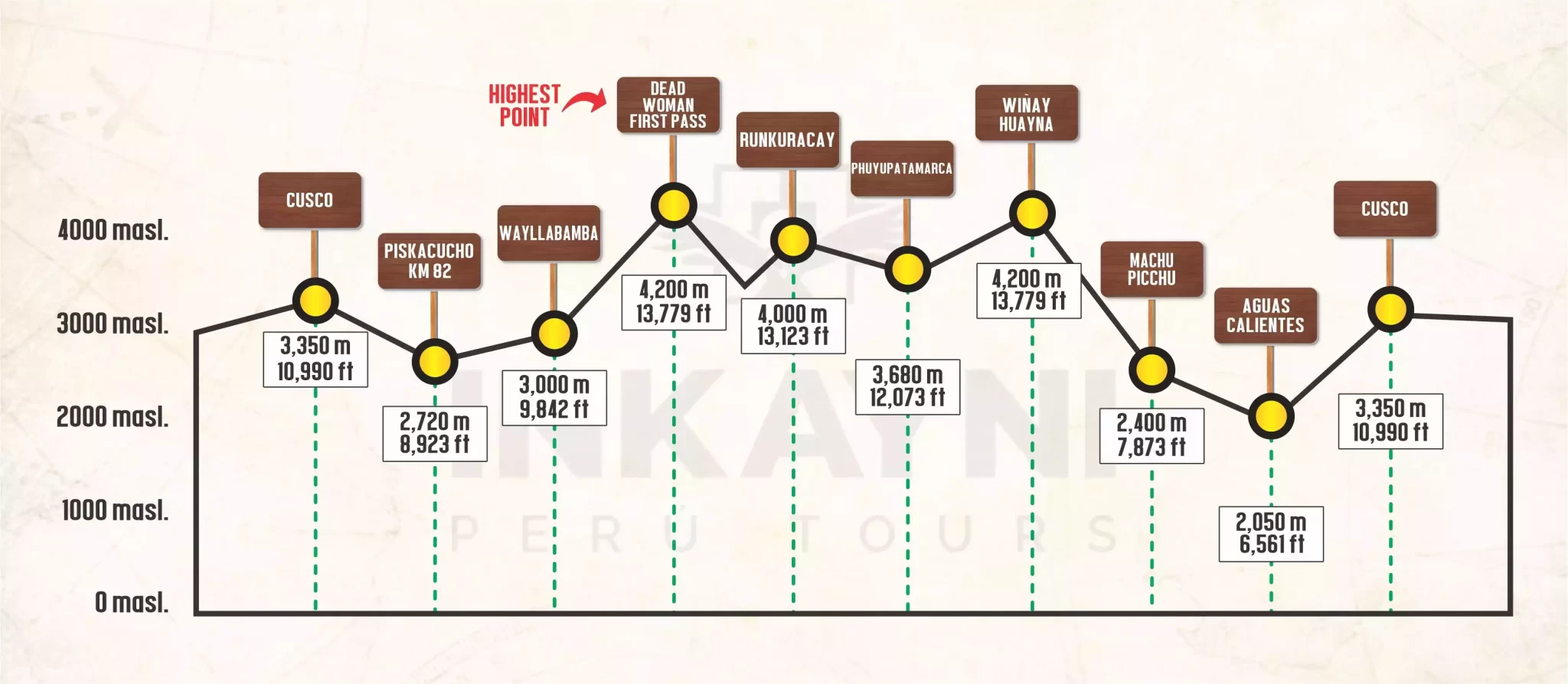
Altitude map of the Classic Inca Trail
Keep this in mind:
Choose Km 82 if you want the full 4-day Inca Trail experience with camping, high mountain passes, and the complete historic route. Choose Km 104 if you want the shorter 2-day version, a train approach, Wiñay Huayna, Intipunku, and one night in Aguas Calientes.
Key Facts About the Classic Inca Trail (4 Days/3 Nights)
| Feature | Detail |
| Starting point | Km 82 – Piscacucho |
| Total distance | 42-43 km (26 miles) |
| Duration | 4 days / 3 nights |
| Maximum altitude | 4,200 masl – Warmihuañusca Pass |
| Difficulty | Moderate to challenging |
| Advance booking | 6-8 months (high season) |
| Best season | April to October (dry season) |
PERU’S LEGENDARY HIKEInca Trail to Machu Picchu
Follow the historic trail through mountain passes, Inca sites, and cloud forest paths to Machu Picchu.
Where Does the 2-Day Short Inca Trail Start?
The Short Inca Trail is the perfect alternative for those with limited time or who prefer a less demanding trek. This route starts at Kilometer 104 of the railway, at the archaeological site of Chachabamba, and covers the last 16 kilometers of the Classic Inca Trail.
Chachabamba (Km 104): The Quick Gateway to Machu Picchu
Chachabamba is a small Inca archaeological complex located beside the train tracks at 2,150 meters above sea level. This point marks the start of the Short Inca Trail and is accessible only by train from Ollantaytambo.
Chachabamba Characteristics:
- Location: Km 104 of the Ollantaytambo-Aguas Calientes railway
- Altitude: 2,150 masl (7,054 feet)
- Distance from Ollantaytambo: 1.5 hours by train
- Climate: Humid subtropical, warmer than Piscacucho
- Access: Only by train (Peru Rail or Inca Rail)
What is Chachabamba?

Chachabamba was an Inca ceremonial center of considerable importance. Its main features include:
- Historical function: Purification and ritual center for pilgrims heading to Machu Picchu
- Architecture: Ceremonial baths, water fountains, and ritual platforms
- Current condition: Well-preserved, first stop on the tour with guide explanation (30-45 minutes)
- Strategic location: Beside the Urubamba River, surrounded by subtropical vegetation
Expert tip:
Starting at lower altitude and covering less distance, the Short Inca Trail is ideal for families with children over 8 years old, people with limited time, or those who prefer a less physically demanding experience.
How to Get to Km 104 (Chachabamba)
Access to the Short Inca Trail is completely different from the Classic route, as you can only reach it by train:
- Early pickup: Between 4:00-5:00 a.m. from your hotel in Cusco or Sacred Valley
- Transfer to Ollantaytambo: 1.5-2 hours in private transportation
- Train boarding: Usually between 6:00-7:00 a.m.
- Train journey: 1.5 hours of scenic travel along the Urubamba River
- Km 104 descent: The train makes a special stop (this is the only way to disembark here)
- Checkpoint: Document and permit registration
- Trek begins: Approximately at 8:30-9:00 a.m.
Important note:
Regular trains DO NOT stop at Km 104. Only trains hired by authorized agencies make this special stop. Therefore, it’s impossible to do this route independently.
Day 1 Itinerary: From Km 104 to Aguas Calientes
The first (and only full day) of the Short Inca Trail includes:
- Distance: 16 km (10 miles)
- Hiking time: 6-7 hours
- Difficulty: Moderate (mostly uphill)
- Starting altitude: 2,150 masl (Chachabamba)
- Maximum altitude: 2,680 masl (Wiñay Huayna)
- Ending altitude: 2,040 masl (Aguas Calientes)
- Archaeological sites: Chachabamba, Choquesuysuy, Wiñay Huayna, Intipunku
The route ascends steadily through the morning via Andean cloud forest, with abundant orchids, bromeliads, and waterfalls. After lunch at Wiñay Huayna, you continue along the authentic Inca stone-paved trail until reaching Intipunku (Sun Gate), where you’ll get your first panoramic view of Machu Picchu.
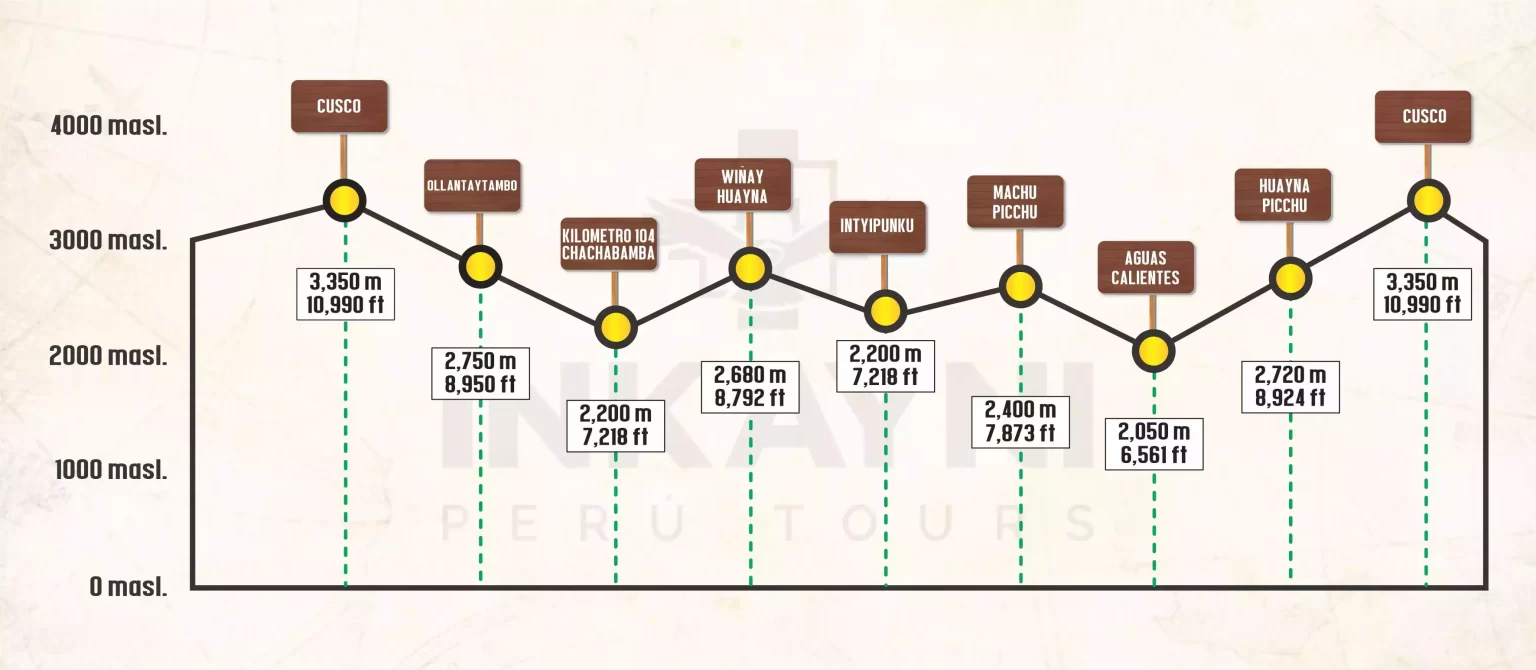
Altitude profile of the 2-day Short Inca Trail
Key Facts About the Short Inca Trail (2 Days/1 Night)
| Feature | Detail |
| Starting point | Km 104 – Chachabamba |
| Total distance | 16 km (10 miles) |
| Duration | 2 days / 1 night |
| Maximum altitude | 2,680 masl – Wiñay Huayna |
| Difficulty | Moderate |
| Advance booking | 2-4 weeks |
| Best season | April to October (dry season) |
COMPACT INCA TRAIL EXPERIENCEShort Inca Trail to Machu Picchu
Enjoy part of the famous Inca Trail on a shorter hike to Machu Picchu.
Other Guides That Help Before Choosing an Inca Trail Starting Point
Comparison: Classic Inca Trail vs. Short Inca Trail
To help you decide which route best suits your needs, here’s the complete comparison:
| Aspect | Classic Inca Trail | Short Inca Trail |
| Starting point | Km 82 (Piscacucho) | Km 104 (Chachabamba) |
| Access to start | Ground transportation | Tourist train |
| Duration | 4 days / 3 nights | 2 days / 1 night |
| Distance | 42-43 km | 16 km |
| Maximum altitude | 4,200 masl | 2,680 masl |
| Difficulty | Moderate to challenging | Moderate |
| Camping | 3 nights in tents | 1 night in hotel |
| Advance booking | 6-8 months | 2-4 weeks |
| Daily permits | 200 tourists | 250 tourists |
| Ideal for | Adventurers with time | Travelers with limited time |
Permits and Reservations
Regardless of where does the Inca Trail start for your chosen route, you need an official permit that can only be obtained through authorized agencies. Here’s everything you need to know:
Permits and Availability
- Total daily limit: 500 people (including tourists, guides, porters, and cooks)
- Classic permits for tourists: ~200 spaces per day
- Short permits for tourists: ~250 spaces per day
Best Time to Visit
The dry season (April to October) is ideal for hiking the Inca Trail, with clear skies and less rain. May through August are the most popular months, while April, September, and October offer good weather with fewer tourists.
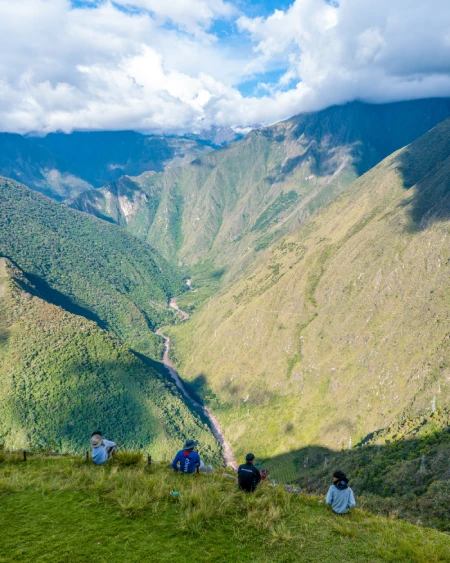
What to Bring Based on Your Starting Point
Regardless of where your Inca Trail starts, these items are essential:
- Original passport
- Waterproof trekking boots
- Layered clothing (mornings are cold)
- Rain poncho
- SPF 50+ sunscreen
- Insect repellent
- Trekking poles
- Water bottle (minimum 2 liters)
- Headlamp with extra batteries
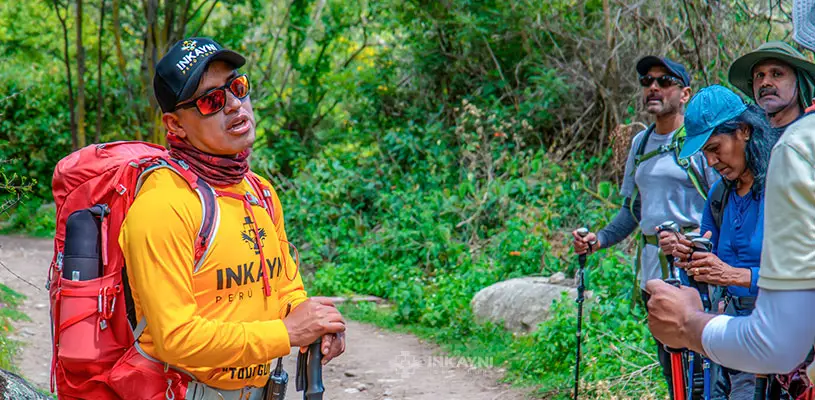
Inkayni Peru Tours – Authorized Inca Trail Agency
Plan Your Adventure from the Right Starting Point
Now that you know where does the Inca Trail start, you can make an informed decision about which route best fits your travel style. If you’re seeking the complete experience with total Andean immersion, Km 82 at Piscacucho is your ideal starting point. If you prefer a more accessible and faster adventure, Km 104 at Chachabamba takes you directly to the trail’s most spectacular sections.
Both routes culminate at the same magical destination: Machu Picchu, the wonder of the world that has captivated millions of travelers. The difference lies in the journey, in the landscapes you traverse, and in how you connect with the Inca legacy.
Frequently Asked Questions
The Inca Trail has two official starting and ending points, depending on the route you choose: Both points are located along the railway line that connects Ollantaytambo with Aguas Calientes, making it easy to understand where the Inca Trail starts and ends before you book your trek. No. Only agencies authorized by Peru’s Ministry of Culture have access to the starting points. Transportation to Km 82 is included in all Classic Inca Trail tours, and Km 104 is only accessible via train contracted by authorized operators. The Inca Trail cannot be done independently. Pickup is from your hotel in Cusco very early (4:30-5:30 a.m.). The journey takes approximately 2.5-3 hours by ground transportation via the route: Cusco → Chinchero → Urubamba → Ollantaytambo → Km 82. This transportation is included in all authorized Inca Trail tours. Access is by train only. The tour includes early pickup (4:00-5:00 a.m.), transfer to Ollantaytambo (1.5-2 hours), and train journey to Km 104 (1.5 hours). Regular trains DO NOT stop at this point; only those hired by authorized agencies make this special stop. The choice depends on your available time, fitness level, and the type of experience you’re seeking. Permits are limited and sell out quickly, especially for the Classic Inca Trail. Although the starting points have manageable altitudes, the Classic Inca Trail reaches 4,200 masl on the second day. It’s recommended to acclimatize in Cusco (3,400 masl) for at least 2 days before starting either route. At both starting points (Km 82 and Km 104) you must present: Permits are nominal and strictly verified at checkpoints. At Km 82 (Piscacucho): At Km 104 (Chachabamba): The Short Inca Trail from Km 104 is ideal for beginners because: Yes. The Inca Trail (both starting points) closes the entire month of February for maintenance, conservation, and cleaning work. It reopens on March 1st. Plan your trip avoiding this month. All Inca Trail tours include pickup from your hotel in Cusco or the Sacred Valley very early in the morning (between 4:00-5:30 a.m.). You don’t need to go to any meeting point on your own; the agency organizes all transportation. Yes. Both starting points have basic restroom facilities: These are the last modern facilities before starting the trek. Afterward, you’ll only find bathrooms at campsites or specific trail points.Where does the Inca Trail start and end?
Can I reach the Inca Trail starting point on my own?
How do I get to Km 82 (Piscacucho) to start the Classic Inca Trail?
How do I get to Km 104 (Chachabamba) to start the Short Inca Trail?
What’s the main difference between the Inca Trail starting points?
How far in advance should I book based on the starting point?
What altitude does each starting point have and how does it affect me?
What documents do I need to present at the starting point?
What will I find upon arriving at each starting point?
Which route is better for beginners based on the starting point?
Does the Inca Trail close during any time of year?
Where do tours depart from to reach the starting points?
Are there bathrooms at the Inca Trail starting points?
Autor

Shared:


If you liked this article and the information you found, give us 5 stars!
 (2 votos, promedio: 5.00 de 5)
 Loading...