


How the Bus to Machu Picchu Really Affects the Day
The bus from Aguas Calientes to Machu Picchu is only a 25 to 30 minute ride, but the real issue is not the road itself. It is the line, the timing, and the fact that this is a separate ticket from both the train and the official Machu Picchu entrance. For most travelers, especially with early entry slots, the bus is the most sensible choice because it protects time and energy for the circuit inside the citadel. Walking up only starts to make sense if you have strong legs, extra time, and a tighter budget.
Table of Contents
If this is your first time visiting Machu Picchu, it helps to understand something before you arrive: the journey does not end when you step off the train in Aguas Calientes. There is still one short, heavily trafficked, and easy-to-underestimate stretch left: the bus that climbs the Hiram Bingham Highway to the entrance gate.
The service looks straightforward, but it concentrates a few small decisions: where to board, how early to arrive, whether to buy tickets online or at the booth, how much it costs, what to do during high season, and how to coordinate it with your official Machu Picchu entrance ticket. This guide organizes everything in a practical sequence so you do not have to improvise in the line.
| 25–30 minBus ride duration | 5:30 a.m.First bus | 3:30 p.m.Last uphill bus | $24 USDRound trip, foreign visitor |
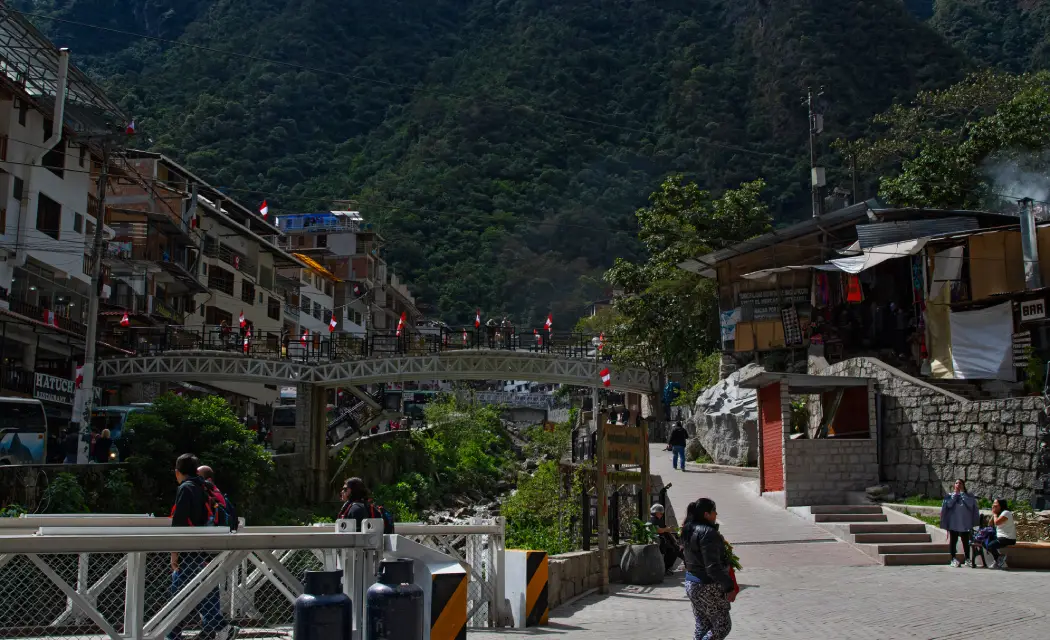
Aguas Calientes: the town where all buses to Machu Picchu depart from.

WORLD WONDER IN THE ANDESMachu Picchu
Discover the history, landscapes, and essential tips for visiting this world wonder.
How the bus to Machu Picchu works
The bus forms the final leg of the journey to Machu Picchu. You first reach Aguas Calientes by train or on foot, depending on your route. Then you walk to the stop on Av. Hermanos Ayar, join the line to buy your bus ticket, and ride up the Hiram Bingham Highway to the entrance gate. Only there do you present your official Machu Picchu ticket, the ID document used when you purchased it, and continue along your assigned circuit.
The real travel sequence
Train to Aguas Calientes → short walk to the bus stop → bus up the Hiram Bingham Highway → entrance control → circuit and route inside Machu Picchu.
Important note:
If you are booking a Machu Picchu tour package with a travel agency, check first which services are included. Many organized tours already include the bus ticket between Aguas Calientes and the Machu Picchu entrance gate and back.
The bus is not only used by travelers arriving on a standard train from Ollantaytambo or Cusco. It also becomes the last practical link for visitors who sleep in Aguas Calientes after routes such as the Short Inca Trail, the Salkantay Trek, Inca Jungle Trek, or the Lares Trek. In other words, this short ascent only makes sense when read together with the train, the overnight stay in Aguas Calientes, and the final timing of your Machu Picchu visit.
PERU’S LEGENDARY HIKEInca Trail to Machu Picchu
Follow the historic trail through mountain passes, Inca sites, and cloud forest paths to Machu Picchu.
Where to board the bus to Machu Picchu
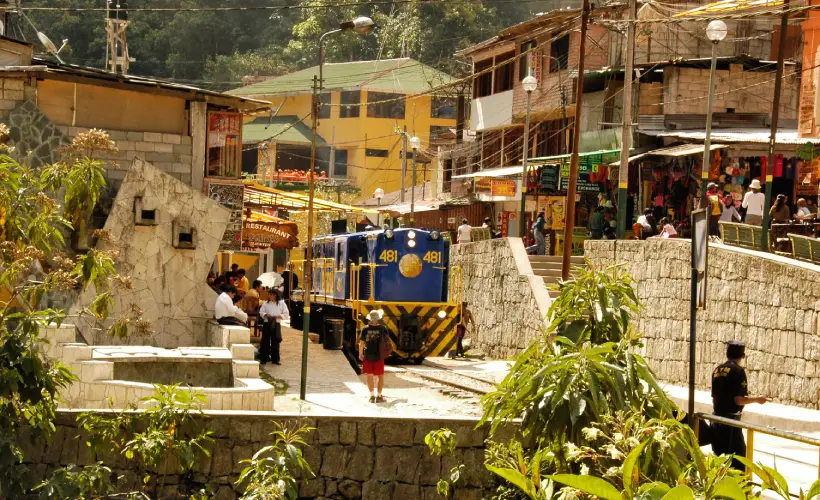
The official bus stop is at Av. Hermanos Ayar S/N, near Puente Ruinas. From the Aguas Calientes train station, cross the craft market and walk toward Av. Hermanos Ayar. Under normal conditions you will get there in under 5 minutes. The area is easy to recognize because the visitor line forms there and buses can be seen waiting for departure.
Aguas Calientes is a small town and everything is walkable. The distances between the train station, the bus stop, hotels, restaurants, and shops are all short. What takes time is not getting to the stop but buying at the ticket booth or moving through the line during the first hours of the morning.
Important note:
You do not need a taxi or mototaxi to reach the bus stop. From the train station, the simplest reference is to walk along the river until you see the line of buses on Av. Hermanos Ayar.
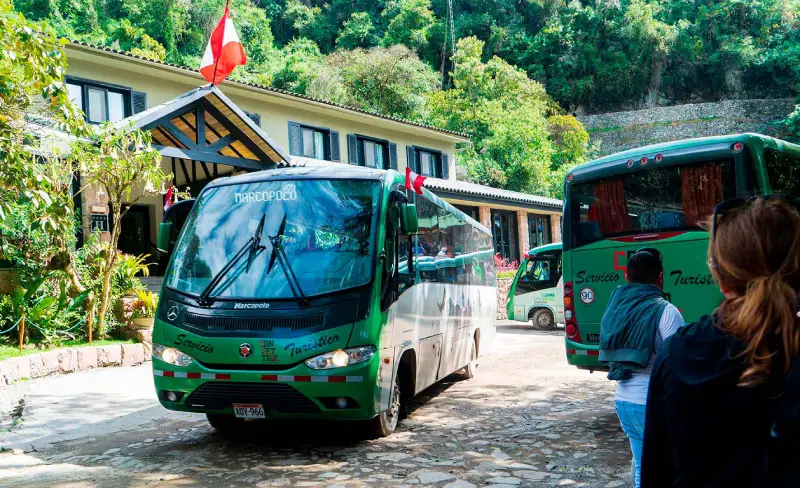

What the bus ride from Aguas Calientes is like
The bus crosses the Vilcanota River and climbs the Hiram Bingham Highway, a narrow road of tight switchbacks that winds through cloud forest, green slopes, and humid vegetation. The ride up typically takes 25 to 30 minutes. The return to Aguas Calientes can take around 20 to 25 minutes, depending on demand, rain, and dispatch pace.
The experience is brief, but the landscape shifts quickly. As the bus gains elevation, the town falls away below, the valley opens up momentarily, and the humidity of the forest registers on the windows. If you can choose your seat, the left side on the way up tends to offer better views of the river and the slopes.
Expert tip:
The bus does not reserve seats. If you board early and can choose, the left side on the ascent usually gives a better read of the valley. In high season, focus on moving up the line rather than finding the perfect seat.
Bus to Machu Picchu schedule
The service runs every day with continuous departures throughout operating hours. The exact frequency depends on demand: during normal hours it can run every 10 to 15 minutes; during peak hours, units are dispatched more quickly to keep the line moving.
| Service | Reference schedule | Frequency |
| First uphill bus | 5:30 a.m. | Depending on initial demand |
| Regular uphill service | 5:30 a.m. to 3:30 p.m. | Every 5 to 15 min approx. |
| Last uphill bus | 3:30 p.m. | Subject to daily operational closing |
| Downhill service to Aguas Calientes | 6:30 a.m. to 6:00 p.m. approx. | Every 5 to 15 min approx. |
| Last downhill buses | 5:30 to 6:00 p.m. approx. | May vary depending on visitor flow |
Note: Reference schedules only. Verify the current timetable close to your travel date, especially if you are visiting Machu Picchu during public holidays, high season, or days with operational changes.
What time to arrive at the bus stop based on your Machu Picchu entry slot
The most common mistake is calculating only the 25 to 30 minutes of the ride itself. In practice you need to add three times: the bus line wait, the road ascent, and a short buffer before the entrance control. For the earliest entry slots, especially between June and August, the line can be the factor that most disrupts your planning.
| Machu Picchu entry time | Low season | High season | Useful note |
| 6:00 a.m. | 5:00 a.m. | 4:45 to 5:00 a.m. | First slot, line can be significant. |
| 7:00 a.m. | 6:00 a.m. | 5:30 to 5:45 a.m. | Good margin to board without rushing. |
| 8:00 a.m. | 7:00 a.m. | 6:30 to 6:45 a.m. | Line can still be heavy at this hour. |
| 9:00 a.m. or later | 45 min before | 60 min before | Adjust depending on rain and visitor flow. |
Warning:
Your Machu Picchu entry time takes priority over everything else. The bus has no reserved seat or fixed hour, but your assigned circuit does have an entry window. Plan your line time conservatively and leave margin for the access control.
Other Guides That Help Before Taking the Bus to Machu Picchu
Who operates the buses to Machu Picchu in 2026
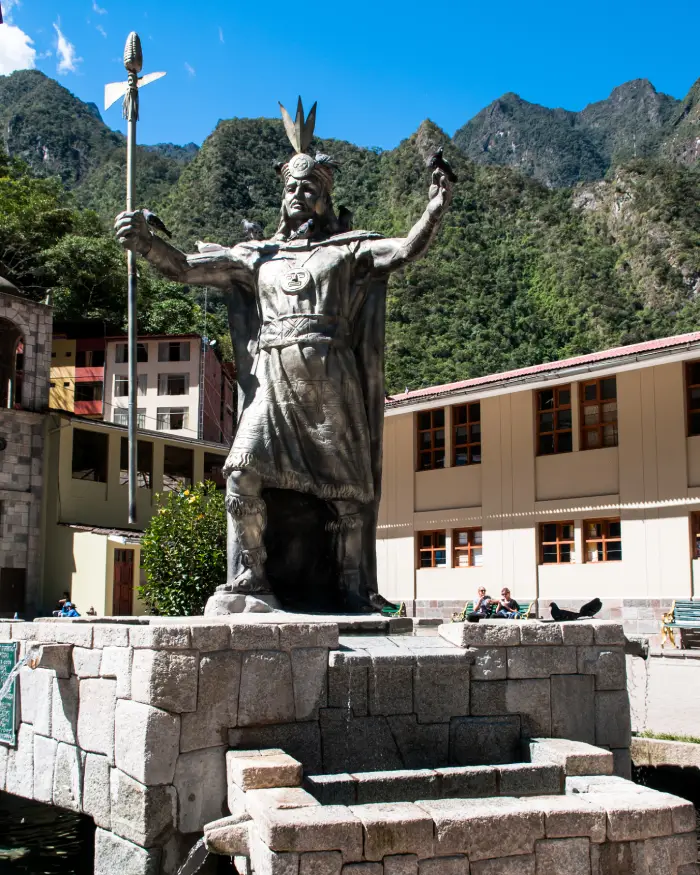
For nearly three decades, Consettur was the main operator of the bus service between Machu Picchu Pueblo and the entrance gate of the citadel. That changed after their contract expired on September 4, 2025. Since then, the Hiram Bingham route has been in a transition period marked by legal disputes, local protests, and temporary changes to operations.
San Antonio de Torontoy was introduced as the new temporary operator. From February 2026, the population of Machu Picchu agreed that both Consettur and San Antonio de Torontoy would continue operating temporarily while a new concession process is defined.
Machu Picchu bus ticket prices
Prices vary by nationality, residency, and passenger type. For foreign tourists, the reference fare remains $12 USD per leg and $24 USD round trip. Special rates apply for Peruvian nationals, students, children, Cusco residents, Machu Picchu Pueblo residents, and guides.
Foreign tourists
| Passenger | One way | Round trip |
| Adult | $12 USD | $24 USD |
| Child | $7 USD | $12 USD |
Peruvian nationals
| Passenger | One way | Round trip |
| Peruvian adult | $8 USD | $15 USD |
| Peruvian student | $6 USD | $10 USD |
| Peruvian child | $5 USD | $8 USD |
Cusco residents, local residents, and guides
| Passenger | One way | Round trip |
| Cusco resident | S/ 9.50 (~$2.57 USD) | S/ 19.00 (~$5.14 USD) |
| Machu Picchu Pueblo resident | S/ 4.00 (~$1.08 USD) | S/ 8.00 (~$2.16 USD) |
| Licensed guide | S/ 6.00 (~$1.62 USD) | S/ 12.00 (~$3.24 USD) |
Note: Reference exchange rate used for equivalencies: $1 USD = S/ 3.70. Fares subject to update by the current operator. Before paying, verify that the document details match your Machu Picchu entrance ticket and your passport or ID.
Warning:
Do not confuse the tickets. The train takes you to Aguas Calientes, the bus takes you up to the Machu Picchu entrance gate, and the official entrance ticket admits you to a specific circuit and route. These are separate reservations and tickets, and they must match in date and time.

Aguas Calientes tucked between mountains and the Vilcanota River, a 5-minute walk from the bus stop.

Where to buy Machu Picchu bus tickets
You can buy the ticket online, in Aguas Calientes, or at designated offices in Cusco. For most travelers, buying online before arriving is the most convenient option, especially if your Machu Picchu entry is early. Buying at the booth also works, but it adds another line to a day that already has tight schedules.
| Channel | Address / platform | Reference hours |
| Online | comprar.consettur.com or torontoy.com | Available online |
| Aguas Calientes | Av. Hermanos Ayar, before Puente Ruinas | Every day, extended hours |
| Cusco, Av. Pardo | Av. Pardo 827 | Mon to Sat, office hours |
| Cusco, Av. El Sol | Av. El Sol 380, Banco Interbank | Mon to Sat, business hours |
If you only bought a one-way ticket up and later decide to take the bus back down, you can normally buy the return ticket near the Machu Picchu entrance gate. Even so, if your itinerary has very little margin, buying round trip from the start avoids an extra transaction at the end of your visit.
Bus or on foot: when each option makes sense
The alternative to the bus is walking up from Aguas Calientes along the pedestrian trail that begins near Puente Ruinas. The ascent can take between 1 hour 30 minutes and 2 hours, depending on pace, weather, and fitness. It is a steep climb with many steps and forest humidity. The descent tends to be more manageable and can take between 1 hour and 1 hour 30 minutes.
| Situation | Best option | Practical reason |
| Early entry slot | Bus | Reduces the risk of arriving tired or late to the entrance control. |
| Single-day trip | Bus | Saves time and energy for the circuit inside the citadel. |
| Children, older adults, or limited mobility | Bus | The uphill walk can be too demanding. |
| Good fitness and tight budget | On foot | Free of charge, but requires time and sustained effort. |
| Looking for a balanced approach | Bus up + walk down | Arrive with energy and decide to walk back if the weather holds. |

High season, visitor limits, and lines
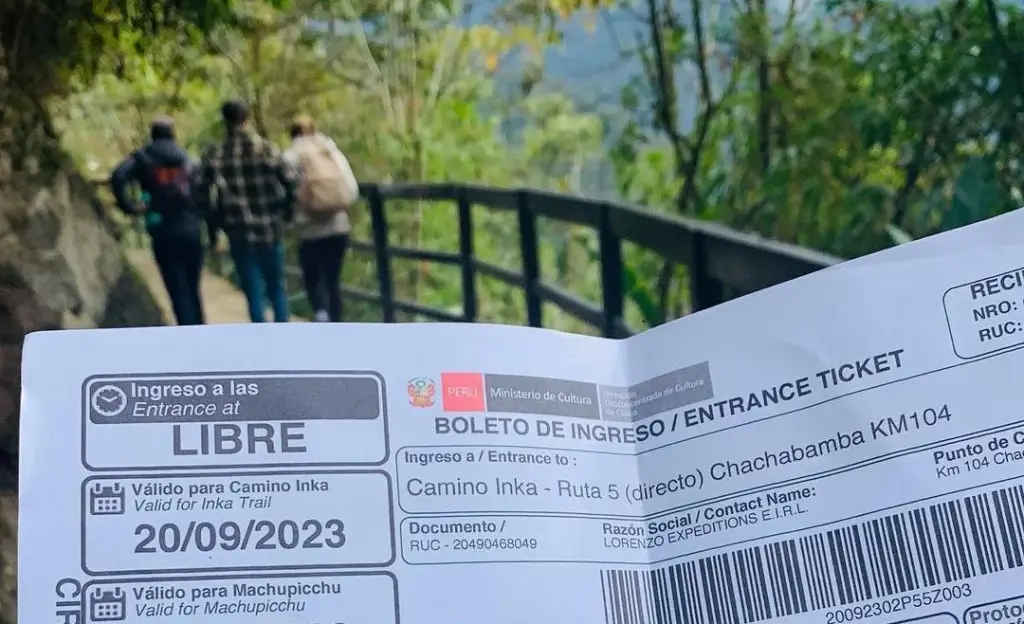
In 2026, Machu Picchu maintains a visitor capacity management system by date and circuit. On high-demand days, the maximum number of visitors can reach 5,600 people per day; the rest of the year operates with a lower regular capacity. This does not mean the bus stops running, but it does increase pressure on lines, early time slots, ticket booths, and access points.
The dates with the highest sensitivity typically include New Year, Easter week, high season from June to November, long public holidays, and the final days of December. If you are traveling during those periods, buy your official entrance ticket in advance, avoid last-minute bus ticket purchases, and arrive at the stop with more buffer than you would during low season.

Panoramic view of Machu Picchu
What to bring on the day of the bus
Before leaving your hotel or accommodation in Aguas Calientes, have your documents ready and avoid carrying large bags. Inside Machu Picchu the entire visit is on foot, with no internal services such as restrooms or food vendors, so going up light and prepared makes a real difference.
- Valid passport or ID: must match the document used to purchase the entrance ticket.
- Official Machu Picchu entrance ticket: digital or printed, with circuit, route, and time slot.
- Bus ticket: digital or printed, depending on the purchase channel.
- Small daypack: water, a light rain layer, sunscreen, insect repellent, and essentials.
- Cash: useful for restrooms, minor purchases, or payment contingencies.
- Layered clothing: Aguas Calientes can be humid at dawn and Machu Picchu can alternate between mist, sun, and light rain.
Expert tip:
Use the restrooms before the entrance control. There are no bathrooms inside the citadel, and leaving the circuit can complicate your visit depending on your assigned route and time slot.
The bus within an organized visit from Cusco
If you are visiting Machu Picchu from Cusco in a single day, the bus has to fit within the hotel pickup, the transfer to the station, the train schedule, the arrival in Aguas Calientes, the uphill bus line, the circuit entry, and the return train. In a well-organized package, a travel agency coordinates the full sequence and normally includes or manages the bus ticket, so the traveler does not have to resolve each leg under pressure.
| Leg | Mode | Approx. duration | What the agency coordinates |
| Cusco to train station | Pickup + transfer | ~1 hr 30 to 2 hrs | Pickup, departure margin, and on-time train arrival |
| Ollantaytambo to Aguas Calientes | Tourist train | ~1 hr 40 to 2 hrs | Train schedule, documents, and bus connection |
| Aguas Calientes to Machu Picchu | Bus | 25 to 30 min | Bus ticket, line management, and arrival before entry time |
| Machu Picchu | Guided circuit | 2 hrs 30 to 4 hrs approx. | Circuit, group pace, entry, and return to train |
The advantage of traveling with an agency shows most clearly in the scheduling details. In many complete Machu Picchu packages, the bus is already included or managed within the itinerary, alongside the train, the entrance ticket, the guide, and the transfers.
Keep this in mind:
For a single-day visit, coordinating with a travel agency is worth it. The traveler does not spend energy and time resolving logistics and can focus on arriving, entering, and walking through Machu Picchu with genuine margin.
The last stretch before entering Machu Picchu
The bus to Machu Picchu tends to look like a minor detail compared to the train, the entrance ticket, or the circuit, but in practice it orders your arrival at the citadel gate. With the ticket purchased, the schedule clear, and enough margin at the stop, the climb up the Hiram Bingham Highway becomes a natural part of the journey.
At Inkayni Peru Tours, we coordinate this leg together with the train, the official entrance ticket, the transfers, and the full rhythm of the visit. If you want to experience Machu Picchu without managing each connection separately, we can help you build a clear, realistic itinerary well aligned with your travel date.
Frequently asked questions about the bus to Machu Picchu
Can you take a bus to Machu Picchu?
Yes. The bus departs from Aguas Calientes and is the standard motorized way to reach the Machu Picchu entrance gate. It operates from early morning with continuous departures and must be coordinated with your circuit and route entry time.
How much does the bus from Aguas Calientes to Machu Picchu cost?
For foreign tourists the reference fare is $12 USD one way and $24 USD round trip. Special rates apply for Peruvian nationals, students, children, Cusco residents, Machu Picchu Pueblo residents, and guides. Verify the current price before purchasing.
Where do you board the bus to Machu Picchu in Aguas Calientes?
At Av. Hermanos Ayar S/N, near Puente Ruinas. From the train station it is a few minutes’ walk along the Vilcanota River. You will see the visitor line, the control point, and buses waiting for departure.
What time does the first bus to Machu Picchu leave?
The first uphill bus typically departs at 5:30 a.m. from Aguas Calientes. If your Machu Picchu entry is at 6:00 a.m., arrive at the stop before that time because the line starts forming early.
What time does the last uphill bus leave?
The last uphill bus typically departs around 3:30 p.m. from Aguas Calientes. This schedule should be verified before your trip as it may be adjusted due to operations, visitor flow, or daily conditions.
What time does the last bus come down from Machu Picchu?
The last downhill buses typically run between 5:30 and 6:00 p.m., depending on demand and the day’s operational closing. If you have a return train, do not wait until the last moment to head back down.
How early should I arrive at the bus stop?
In low season, 30 to 45 minutes before your entry time may be enough. In high season, public holidays, or first entry slots, allow 45 to 60 minutes. Add to that the 25 to 30 minutes of the bus ride itself.
Where can I buy the bus ticket to Machu Picchu?
Online at comprar.consettur.com or the current operator’s platform, at the Aguas Calientes ticket booth, or at designated offices in Cusco. In high season, buying online helps avoid an extra line.
Do bus tickets sell out?
Availability is generally broad because the service runs continuous departures. The most common problem is not running out of tickets but losing time buying at the booth or waiting in line during peak hours.
Does the bus ticket include the Machu Picchu entrance?
No. The bus ticket only covers transport between Aguas Calientes and the entrance gate. The Machu Picchu entrance ticket is purchased separately at tuboleto.cultura.pe and has an assigned circuit, route, date, and time slot.
How long is the bus ride from Aguas Calientes?
Between 25 and 30 minutes under normal conditions. During heavy rain, thick mist, or high demand it may take a few minutes longer because driving slows on the switchbacks.
Is it better to take the bus or walk up?
For most travelers the bus is the better option, especially with an early entry, limited time, children, older adults, or a mountain route added to the visit. Walking up is free but requires 1 hour 30 minutes to 2 hours of sustained effort.
Can I walk up without buying a bus ticket?
Yes. The pedestrian trail is free and signposted. You still need your official Machu Picchu entrance ticket and a valid ID to enter the citadel at your assigned time.
Can I take the bus up and walk back down?
Yes. This is a very common approach. Many travelers take the bus up to save energy and walk back down to Aguas Calientes at the end of the visit. Allow between 1 hour and 1 hour 30 minutes for the descent, depending on pace and weather.
Does the bus ticket have an assigned time?
No. The bus operates on a first-come, first-served basis with continuous departures. The ticket does not reserve a seat or a specific time. What does have a fixed time is your Machu Picchu entrance ticket.
Can I buy the downhill ticket at Machu Picchu?
Yes. You can normally buy the return ticket near the Machu Picchu entrance gate. If your itinerary has little margin, buying round trip from the start saves you an extra transaction.
Do I need my passport to board the bus?
Yes. Carry your valid passport or ID. It may be requested when purchasing, when boarding, and at the Machu Picchu entrance control. The document must match the one used when buying your entrance ticket.
Is the bus ride to Machu Picchu safe?
Yes. It is a regulated tourist route operated every day. The road has tight switchbacks, so remain seated during the journey and follow the instructions of the staff.
How does the rainy season affect the service?
Between November and March there can be rain, mist, and heavy humidity. Buses generally continue operating, but the pace may slow. Bring a light rain layer for the wait in line and keep your documents protected.
Are there direct buses from Cusco or Ollantaytambo to Machu Picchu?
No. From Cusco or Ollantaytambo you must first reach Aguas Calientes, normally by train. From there you take the bus up to the Machu Picchu entrance gate.
Is there a direct bus from Lima to Machu Picchu?
No. From Lima you must first travel to Cusco, then continue to Ollantaytambo or the corresponding station, take the train to Aguas Calientes, and finally board the bus to Machu Picchu.
Is the bus accessible for people with reduced mobility?
Boarding takes place at street level but may require assistance. If you use a wheelchair or need extra time to board, arrive earlier and ask the stop staff for support.
Are there restrooms near the bus stop and at Machu Picchu?
In Aguas Calientes there are restrooms in cafes and facilities near the stop. At the Machu Picchu entrance gate there are pay restrooms before the control checkpoint. There are no restrooms inside the citadel.
What happens if I arrive late to the stop and miss my entry window?
The main risk is the line itself. If you are close to missing your time slot, let the stop staff know. In some cases they can point travelers with an immediate entry in the right direction, but it is not something to rely on. Plan with margin from the start.
Can I bring a large bag on the bus?
The recommendation is to go up with a small daypack only. Large pieces of luggage are inconvenient on the bus and are not practical for entry into Machu Picchu. Leave bulky bags at your accommodation or in a luggage storage facility.
Is card payment accepted for the bus ticket?
Online purchases typically accept card. At in-person booths POS availability may vary, so carry cash as a backup in soles or US dollars.
What documents do I need on the day of the visit?
Carry your valid passport or ID, official Machu Picchu entrance ticket, and bus ticket. Keep everything accessible throughout the day to speed up boarding and the entrance control.
Escrito por


Shared:



If you liked this article and the information you found, give us 5 stars!
 (Ninguna valoración todavía)
 Loading...