


When Machu Picchu Mountain Is the Better Choice
Machu Picchu Mountain is the better choice if you want a longer, more panoramic hike that still gives you access to the classic wide view over the citadel. It suits travelers with good stamina who prefer a steadier uphill effort over a more exposed, narrower climb like Huayna Picchu. It makes less sense if your day is already tight, your legs are not in good shape, or you want a shorter mountain add-on. In practice, the key is to book Route 1-A early enough and make sure your train, bus, and return timing leave real room for a 3 to 4 hour hike.
Table of Contents
Machu Picchu Mountain is often confused with the citadel because both share the same name. The “Inca citadel” is the archaeological site most travelers visit; Machu Picchu Mountain is the peak located to the south and southwest of the complex, above the panoramic sector. In the classic photograph, Huayna Picchu appears behind the Inca structures; Machu Picchu Mountain is on the side from which that same image is so often taken and admired.
| 10,111 ftMachu Picchu Mountain elevation (3,082 m) | Route 1-ACircuit 1 | 350Daily spots in 2026 | 7 hrsMaximum stay |
The Machu Picchu Mountain hike demands legs, time, and patience, but it delivers one of the widest views in the entire sanctuary. This guide will help you decide whether it is the right choice for your trip, which ticket to buy, how much time to allow, and how to organize the route with current information.
WORLD WONDER IN THE ANDESMachu Picchu
Discover the history, landscapes, and essential tips for visiting this world wonder.
What is Machu Picchu Mountain
Machu Picchu Mountain is one of the official hiking routes within the Machu Picchu Historical Sanctuary. Its name is commonly translated as “old mountain” or “old peak.” It sits to the south of the citadel and reaches an altitude of approximately 10,111 ft (3,082 m), well above the llaqta (the Machu Picchu archaeological site), which sits at around 7,972 ft (2,430 m).
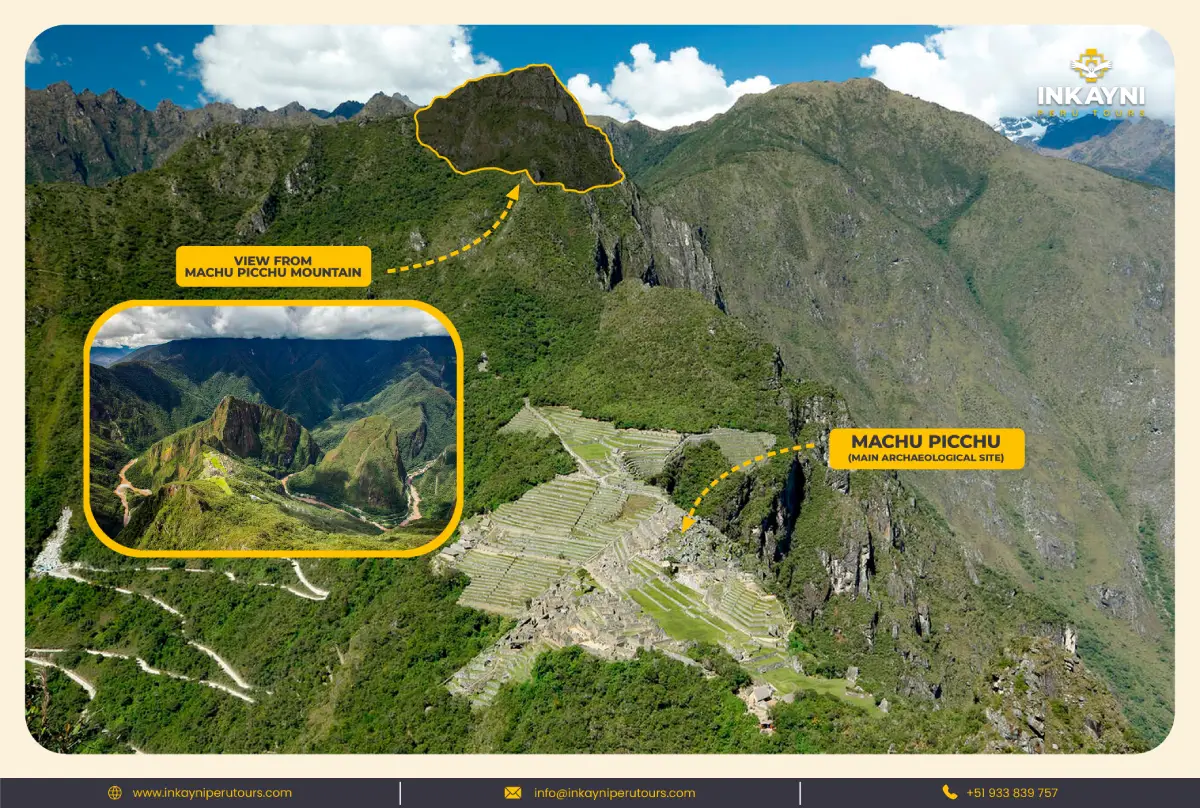
Machu Picchu Mountain and the archaeological site location.
Its main draw is the panoramic view. From the summit, Machu Picchu is seen from a higher and more distant angle than from Huayna Picchu. The Urubamba Valley, the green mountains around Machu Picchu, and the complete profile of the citadel come together in a much wider composition. The hike has less of a sense of exposure than Huayna Picchu, though it demands more time and stamina due to the number of steps and the sustained ascent.
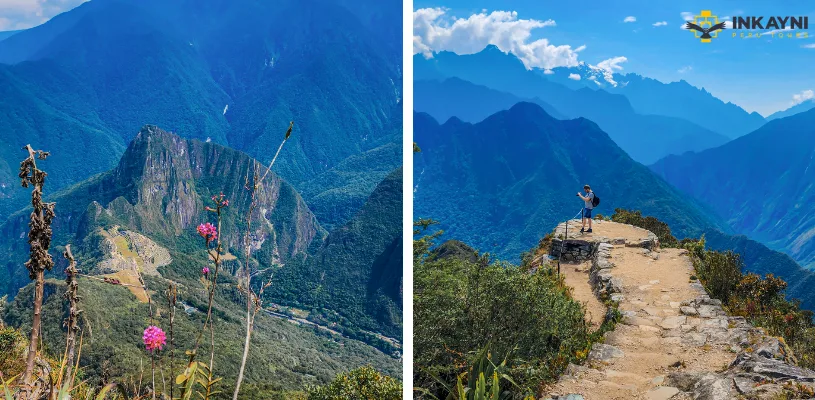
View from Machu Picchu Mountain from the upper section of the route.
Machu Picchu Mountain often works best as the final panoramic climb within a broader Machu Picchu visit. It fits most cleanly after the Short Inca Trail, but it can also crown a trip built around the 4 Day Inca Trail, the Salkantay Trek, the Lares Trek, or the Inca Jungle Trek, as long as the final train-and-bus sequence leaves enough margin for a long Route 1-A day.
PERU’S LEGENDARY HIKEInca Trail to Machu Picchu
Follow the historic trail through mountain passes, Inca sites, and cloud forest paths to Machu Picchu.

Machu Picchu Mountain and Machu Picchu archeological site.
Which ticket do you need for the Machu Picchu Mountain hike
To climb this mountain you need to purchase the Circuit 1, Route 1-A: Machu Picchu Mountain Route ticket. This is the central piece of information in this guide, because many older pages still refer to Circuit 3 or earlier circuit systems. Under the current organization, Machu Picchu Mountain belongs to Circuit 1, also known as the Panoramic Circuit.
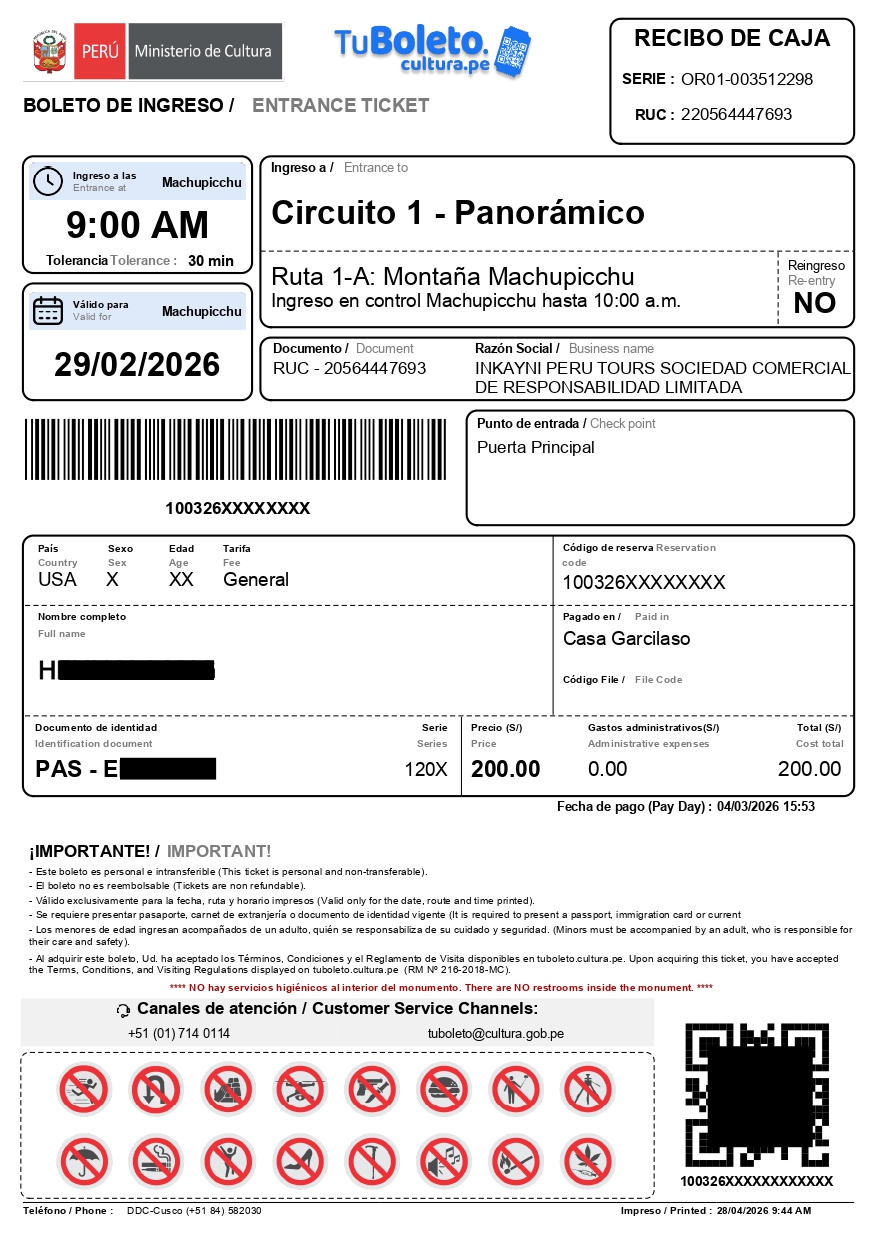
Official Machu Picchu Mountain ticket for the Route 1-A hike.
Route 1-A allows entry to the panoramic sector of Machu Picchu and connects to the mountain hike. The official circuit includes points such as the Lower Platform, Upper Platform, Dry Moat, Temple of the Sun Viewpoint, Granite Chaos, Temple Plaza, Intiwatana Pyramid, Sacred Rock, Twelve Niches, Eastern Storehouses, Water Mirror Complex, Temple of the Condor, Pisonay Plaza, and the Archaeological Reserve, along with the detour toward Machu Picchu Mountain.
Keep this in mind:
Verify that your ticket says “Route 1-A: Montaña Machupicchu.” If you purchase a Circuit 2 or Circuit 3 route, you will have a different experience inside Machu Picchu but will not be able to climb this mountain.
What Route 1-A of Machu Picchu Mountain includes
Route 1-A belongs to Circuit 1, known as the Panoramic Circuit. Its design is built around a wide view of Machu Picchu and the mountain hike. This route moves through the upper platforms, the sectors associated with the classic photograph, and the access to Machu Picchu Mountain.

This is an important distinction from Huayna Picchu. Huayna Picchu belongs to Circuit 3 and connects with the lower sectors of the citadel. Machu Picchu Mountain belongs to Circuit 1 and pairs better with panoramic views and the postcard image. For travelers who want a mountain hike and also a wide-angle view of Machu Picchu, this route has a clear advantage.
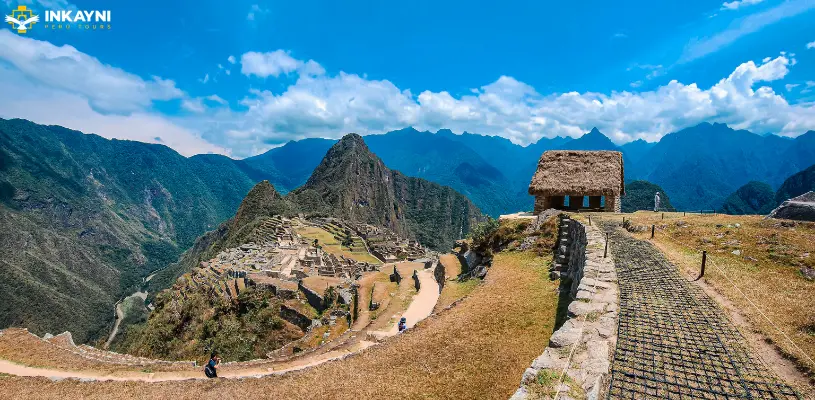
Panoramic view of Machu Picchu from a high section of the circuit.
Expert tip:
If your priority is to hike and come away with a wide panoramic view, Route 1-A works very well. If you want to move through more of the internal sectors of the citadel, check Circuit 2 as well before deciding.
Schedules and available spots for Machu Picchu Mountain in 2026
Machu Picchu Mountain has 350 daily spots in 2026, split between two time windows of 175 slots each.
| Group | Reference entry time | Official spots | What to consider |
| First group | 7:00 a.m. | 175 spots | Mist is possible early in the morning. |
| Second group | 9:00 a.m. | 175 spots | More logistical margin and more sun. |
Reference schedules based on the 2026 official dynamic capacity system. Verify the exact window when purchasing at tuboleto.cultura.pe or when confirming your itinerary with your agency.
Other Guides That Help Before Booking Machu Picchu Mountain
When to book your Machu Picchu Mountain ticket
Machu Picchu Mountain has less booking pressure than Huayna Picchu on some dates, but its spots are still limited. If you are traveling in regular season, look for availability at least a few weeks in advance. If you are traveling in high season, on a public holiday, or with a fixed date, book with more lead time.
The most important factor is coordinating the ticket with your train, bus, and accommodation. Buying the correct route too late can force you to change train schedules, spend an extra night in Aguas Calientes, or switch to a different circuit. In an organized trip, the agency can confirm Route 1-A together with the rest of the logistics, avoiding cross-purchases and miscalculated timing.
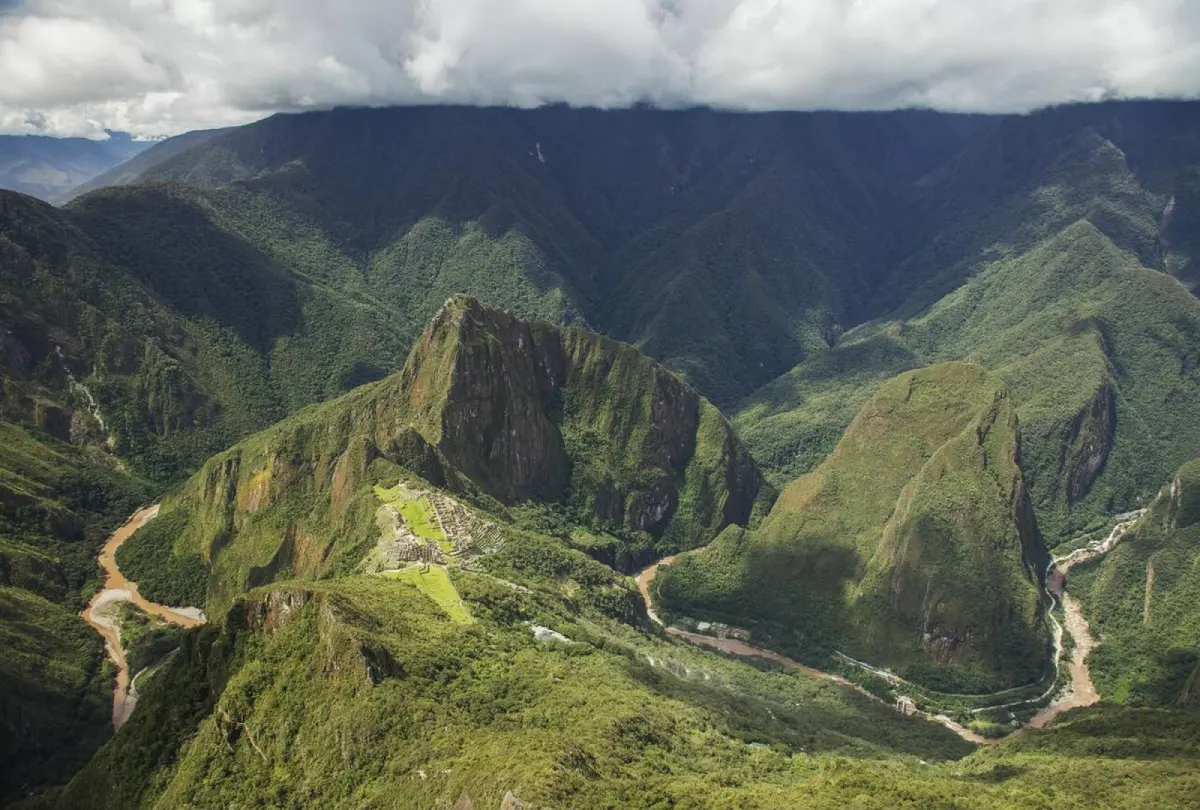
View of Machu Picchu from Machu Picchu Mountain, showing its location between mountains and the path of the Urubamba River.
| Situation | Practical recommendation |
| Regular season | Look for availability at least 1 month in advance. |
| High season | Book at least 2 to 3 months in advance, more if you need a specific date. |
Machu Picchu Mountain cost
The ticket price depends on nationality, age, and student status.
| Visitor type | Reference fare | What to verify |
| Foreign adult | S/ 200 approx. (~$54 USD) | ID, date, and Route 1-A. |
| Foreign student or minor | S/ 118 approx. (~$32 USD) | Valid student card or document. |
| Peruvian adult or Andean Community | S/ 112 approx. (~$30 USD) | National ID, residency, or applicable document. |
| Peruvian student or minor | S/ 80 approx. (~$22 USD) | Age or student status validation. |
Foreign amounts are reference figures and must be confirmed at the time of purchase. National and Andean Community promotional rates may vary depending on current regulations and document validation.
How to get to Machu Picchu Mountain from Cusco
To reach Machu Picchu Mountain you first need to reach the citadel. The most common route starts in Cusco, continues by road to Ollantaytambo, continues by train to Aguas Calientes, and ends with the bus that climbs to the entrance gate. From there you enter Circuit 1 and make your way to the mountain checkpoint.
| Leg | Mode | Approx. duration | What to watch |
| Cusco to Ollantaytambo | Transfer or tourist transport | 1 hr 30 to 2 hrs | Pickup and departure with margin. |
| Ollantaytambo to Aguas Calientes | Train | 1 hr 40 to 2 hrs | Arrival time. |
| Aguas Calientes to Machu Picchu | Bus | 25 to 30 min | Line and ticket. |
| Circuit 1 to the mountain | On foot | 3 to 4 hrs round trip | Physical pace and return time. |
On an independent trip, each leg is calculated separately. In an organized package, the agency can coordinate the full sequence: pickup, train, bus, entrance ticket, guide, mountain time slot, and return. That coordination is especially useful when you choose a long route like climbing Machu Picchu Mountain, where fatigue and departure time weigh more heavily at the end of the day.

The train to Aguas Calientes is part of the logistics before climbing Machu Picchu Mountain.
What the Machu Picchu Mountain hike is like
The route begins after entering Circuit 1. You first move through the panoramic sector with views toward the citadel, then advance to the mountain checkpoint. From there the ascent begins along a stone trail, staircases, and sections surrounded by vegetation. The route is wider than Huayna Picchu in several stretches, but maintains a steady gradient throughout.
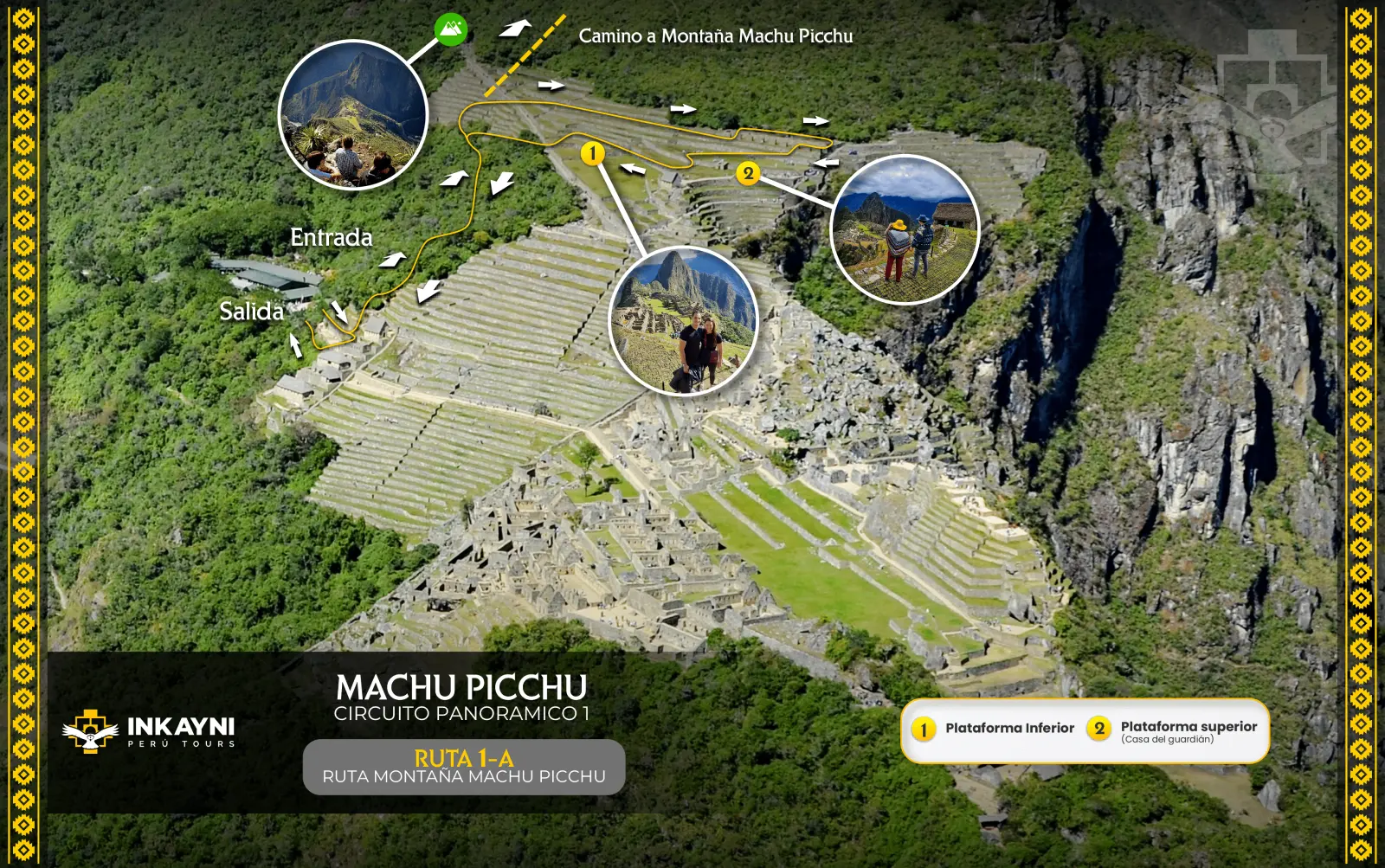
Visual overview of Panoramic Circuit 1 toward Machu Picchu Mountain.
The full hike typically takes between 3 and 4 hours round trip, depending on fitness, breaks, weather, and trail congestion. Many travelers take between 1 hour 30 minutes and 2 hours on the way up, and a similar or shorter time on the way down. The maximum stay on Route 1-A is 7 hours, which provides enough margin to hike, rest, take photographs, and exit without rushing.

Ascending stone staircases toward Machu Picchu Mountain.
1.- The ascent
The climb gains elevation steadily. At the start the body is still settling into the rhythm of the day, but irregular stone steps and sections that reward patience appear quickly. The route has less of an edge feeling than Huayna Picchu, though the gradient can feel longer and more repetitive.
2.- The view from the summit
From the summit, Machu Picchu appears farther away than from Huayna Picchu, but the landscape gains in breadth. The river, the mountains, the profile of Huayna Picchu, and the citadel come together in a view of the whole. On clear days the view from Machu Picchu Mountain is one of the most complete viewpoints in the entire sanctuary.

From Machu Picchu Mountain, the citadel is observed within a much wider landscape.
3.- The descent
The descent requires attention on the knees and the steps. If there is humidity, the stone can become slippery. Keep a steady pace, wear footwear with solid grip, and avoid stopping in the middle of staircases to take photographs. The most important thing is to save enough energy to exit the circuit without rushing.
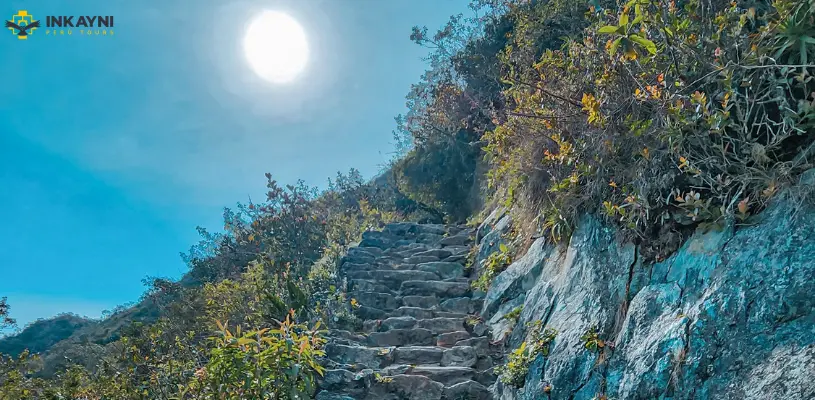
Stone staircases on the path toward Machu Picchu Mountain.
WORLD WONDER IN THE ANDESMachu Picchu
Discover the history, landscapes, and essential tips for visiting this world wonder.
Difficulty of the Machu Picchu Mountain hike
The difficulty of this route lies in its duration and the sustained nature of the ascent. The trail has around 1,600 steps, considerable elevation gain, and few genuinely flat sections to catch your breath. The altitude of the summit is also felt more than at the citadel level.
For an active traveler, the hike is manageable. For someone who does not walk frequently, it can feel demanding. People with knee problems, vertigo, cardiac conditions, or low tolerance for sustained effort should assess it carefully and, if relevant, consult a health professional before the trip.
| Factor | Level or recommendation |
| Physical effort | Moderate to hard due to duration and elevation gain. |
| Feeling of exposure | Less than Huayna Picchu in terms of exposure, but higher in altitude. |
| Risk in rain | Greater due to wet stone and staircases. |
| Recommended profile | Travelers with good stamina and a taste for longer hikes. |
Expert tip:
The route can feel longer than it looks on the map. If you are arriving tired from a previous trek or have a tight return train, calculate your timing carefully before choosing this mountain.
Machu Picchu Mountain or Huayna Picchu?
Both mountains offer strong hikes, but the experience differs considerably. Huayna Picchu is more famous, narrower, and more vertical. Machu Picchu Mountain is higher, longer, and more panoramic. The decision should be based on your tolerance for sustained effort, the type of view you are looking for, and the circuit you want to follow.
| Comparison | Machu Picchu Mountain | Huayna Picchu |
| Circuit | Circuit 1, Route 1-A | Circuit 3, Route 3-A |
| Altitude | 10,111 ft (3,082 m) | 8,835 ft (2,693 m) approx. |
| Daily spots 2026 | 350 daily, two windows of 175. | 400 daily, two windows of 200. |
| Trail feel | Longer, wider, and more panoramic. | Narrower, steeper, and more vertical. |
| Main photograph | Panoramic view and classic shot via Circuit 1. | Aerial view from an iconic mountain. |
| Best for | Travelers who want breadth, a longer hike, and less exposure. | Travelers who want a more intense, famous, and vertical route. |
Alternatives if the Machu Picchu Mountain ticket is sold out
If Route 1-A is no longer available, you can still check other hiking routes and viewpoints within the current system. Some are available year-round and others only during high season. The key is to buy a route that genuinely matches the kind of experience you are looking for.
| Alternative route | Type of experience | Circuit | Availability |
| Huayna Picchu | Steep, intense hike in very high demand. | Circuit 3, Route 3-A | Year-round |
| Sun Gate (Inti Punku) | Historical view from the ancient entrance gate. | Circuit 1, Route 1-C | High season |
| Inca Bridge | Short route with historical significance and edge landscape. | Circuit 1, Route 1-D | High season |
| Huchuy Picchu | Shorter and lighter hike. | Circuit 3, Route 3-D | High season |
What to bring for the Machu Picchu Mountain hike
The route demands comfort, solid grip, and minimal weight. Carrying a large bag complicates the ascent and can be awkward on the staircases. The priority is to walk with your hands free, protect yourself from the sun, and have a light layer for rain or mist.
- Passport or ID: must match the document used when purchasing the entrance ticket.
- Route 1-A ticket: digital or printed, as indicated at the time of purchase.
- Hiking shoes or trail sneakers: with solid grip for stone and staircases.
- Light waterproof layer: useful even in the dry season.
- Water: bring a personal bottle and avoid carrying excess weight.
- Sunscreen and a hat: exposure can be strong during the ascent.
- Insect repellent: the cloud forest environment can have insects.
- Camera or phone: with enough battery and kept safely stowed on staircase sections.
Rules and restrictions during the hike
Machu Picchu Mountain forms part of an archaeological and natural sanctuary. The route must be followed along the authorized trails and within the assigned time window. Control staff may remove visitors who fail to comply with the rules, damage structures, or put other travelers at risk.
- Do not leave the marked trail.
- Do not litter or collect plants, stones, or any elements from the environment.
- Do not bring drones, tripods, unauthorized poles, or large umbrellas.
- Do not enter with bulky backpacks.
- Do not smoke, vape, or light any fire.
- Do not climb or lean against walls or archaeological structures.
- Respect the direction of travel of the circuit.
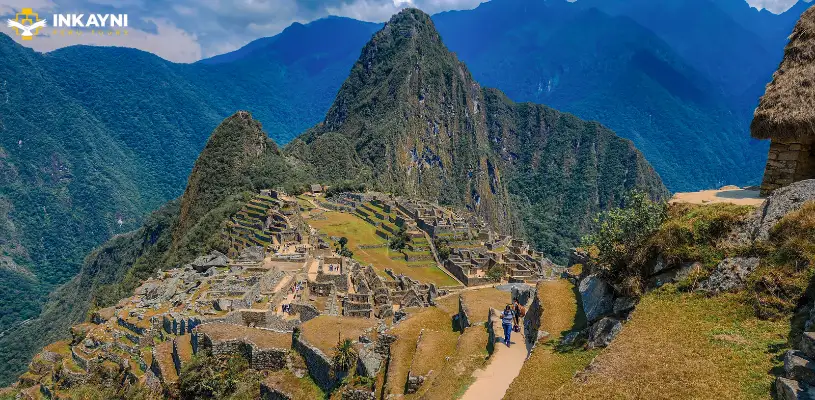
Panoramic view of Machu Picchu from a high section of the circuit.
Machu Picchu Mountain demands time, legs, and solid planning
Machu Picchu Mountain is one of the best routes for travelers who want to see the citadel from a greater scale. The hike is long, the ascent is felt in the legs, and the reward is looking at Machu Picchu within the complete landscape: mountains, valley, river, and architecture integrated into a single scene.
At Inkayni Peru Tours, we can help you integrate this route into a complete Machu Picchu itinerary, coordinating the entrance ticket, train, bus, guide, and real connection times. If you choose Route 1-A, building the day around the hike and booking in advance is the right approach.
Frequently asked questions about Machu Picchu Mountain
What is Machu Picchu Mountain?
It is the peak located to the south and southwest of the citadel. It is visited with the Circuit 1, Route 1-A ticket and offers one of the widest panoramic views of Machu Picchu.
Which ticket do I need to climb Machu Picchu Mountain?
You need the Circuit 1, Route 1-A: Machu Picchu Mountain Route ticket. Any other ticket does not allow entry to this mountain’s checkpoint.
Does Machu Picchu Mountain belong to Circuit 1?
Yes. Under the current system, Machu Picchu Mountain belongs to Circuit 1, also known as the Panoramic Circuit, under Route 1-A.
What is the altitude of Machu Picchu Mountain?
The summit sits at approximately 10,111 ft (3,082 m) above sea level, around 1,970 ft (600 m) above the Machu Picchu citadel.
How many spots does Machu Picchu Mountain have in 2026?
Machu Picchu Mountain has 350 daily spots in 2026, distributed across two time windows of 175 spots each.
How long does the Machu Picchu Mountain hike take?
The hike typically takes between 3 and 4 hours round trip, depending on pace, breaks, and weather. The official route allows a maximum stay of 7 hours.
How difficult is the hike?
Moderate to hard. The trail is well marked, but there are many steps, significant elevation gain, and few flat sections. It requires stamina and solid footwear.
Is Machu Picchu Mountain harder than Huayna Picchu?
It depends on the type of difficulty. Huayna Picchu is narrower and more vertical. Machu Picchu Mountain is longer, higher, and requires more sustained physical endurance.
Can you get the classic Machu Picchu photograph on this route?
Yes. Route 1-A belongs to the Panoramic Circuit and moves through the upper areas linked to the classic Machu Picchu photograph, in addition to the mountain hike itself.
How far in advance should I book?
In regular season, look for availability at least 2 to 3 weeks in advance. In high season, book at least one month ahead or earlier if you have a fixed date.
Is the route suitable for children?
It can be suitable for children accustomed to walking, always accompanied by responsible adults. The route requires stamina, patience, and attention on the staircases. Always check current conditions when purchasing.
Do I need a guide to climb Machu Picchu Mountain?
A guide is generally not mandatory for the mountain hike, but traveling with a guide or agency helps coordinate the schedule, circuit, entry, site interpretation, and return.
What should I bring?
Bring your ID, ticket, water, a light rain layer, sunscreen, insect repellent, a small daypack, and footwear with solid grip.
What happens if I arrive late to the checkpoint?
You may lose the opportunity to climb. The entry time matters, so calculate your train, bus, main entrance control, and walk to the access point with enough margin.
Is this route worth doing on a day trip from Cusco?
Yes, but it requires precise coordination of train, bus, entry, hike, and return. For many travelers, an agency reduces the risk of errors and miscalculated timing.
Autor
Shared:



If you liked this article and the information you found, give us 5 stars!
 (1 votos, promedio: 5.00 de 5)
 Loading...