


Choquequirao Trek vs Inca Trail
For most travelers, the Classic Inca Trail is the better first-time Peru trek if permits are available and Machu Picchu is the main goal, because it combines the country’s most iconic destination with a more structured route, regulated logistics and archaeology throughout the trail. The Choquequirao trek is usually the better fit for hikers who want fewer crowds, more flexibility, a lower guided price in many cases and a more remote archaeological experience, but it is not the easier option.
Table of Contents
For most travelers, the Inca Trail is the stronger first-time Peru trek if permits are available and Machu Picchu is the priority. Choquequirao is better for hikers who already know they want solitude, serious elevation change and a less standardized archaeological experience. Price matters too: guided Choquequirao tours are often cheaper than the Classic Inca Trail, but the lower price does not mean an easier trek.
Cusco concentrates some of the most powerful hikes in South America, and few comparisons generate as many practical questions as this one: How much does each trek cost? What will I actually see? Which route is harder? Do I need a permit? Can I go without a guide? How early should I book? Those questions matter more than romantic labels. The right trek is the one that fits your body, budget, dates and travel style.
| USD 450-700+Choquequirao guided range | USD 790-1,300+Inca Trail guided range | Permitrequired for Inca Trail | Canyon wearChoquequirao’s main challenge | AltitudeInca Trail’s main challenge |
Choose the Inca Trail if…
- You want to reach Machu Picchu via the most iconic historic route.
- You want Inca sites throughout the trail, not only at the end.
- You can book several months in advance.
- You prefer regulated logistics, official camps and a licensed operator system.
- You value the ceremonial arrival through Inti Punku, the Sun Gate.
Choose the Choquequirao trek if…
- You want a much less crowded Inca citadel.
- You prefer flexibility because Inca Trail permits are sold out.
- You want a demanding canyon trek with serious elevation change.
- You are comfortable with more basic and operator-dependent logistics.
- You want an archaeological site that still feels like a frontier.
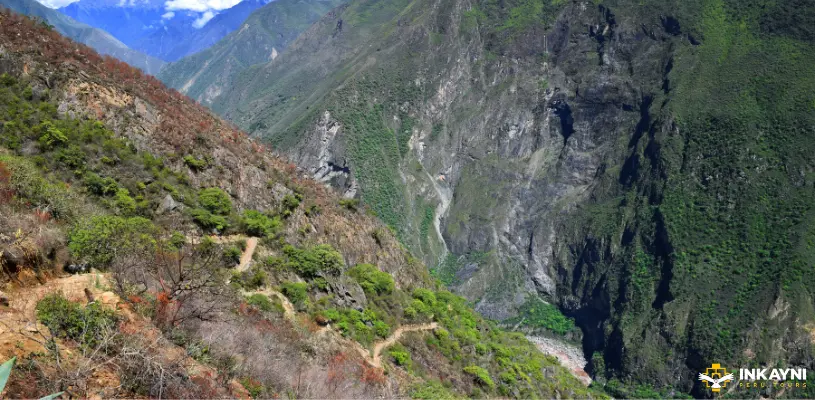
The Choquequirao trek trail above the Apurímac Canyon.
What Will You Actually See?
A traveler comparing these two treks is usually not only asking for distance or altitude. The deeper question is: what do I get for the effort? The answer is very different on each route.
| Experience factor | Choquequirao trek | Classic Inca Trail |
| Final destination | Choquequirao archaeological complex, a large and remote Inca site above the Apurímac Canyon. | Machu Picchu, reached through the Sun Gate after several days on the historic route. |
| Archaeology during the route | The archaeological reward is concentrated mainly at Choquequirao and its nearby sectors. | Archaeology appears throughout the route: Llactapata, Runkuracay, Sayacmarca, Phuyupatamarca, Intipata and Wiñay Wayna. |
| Main landscape | Deep canyon, dry lower sections, steep switchbacks, remote ridges and views toward Vilcabamba. | Cloud forest, high passes, Inca paving, stone stairways, mountain views and gradual approach to Machu Picchu. |
| Most memorable visual moment | The scale of Choquequirao, the Ushnu, terraces and the Sun Llamas sector. | The first view of Machu Picchu from Inti Punku and the dense sequence of Inca sites. |
| Emotional feel | Remote, physical, quiet and raw. | Historic, iconic, regulated and symbolically powerful. |
Before choosing, compare the right pages
PERU’S LEGENDARY HIKEInca Trail to Machu Picchu
Follow the historic trail through mountain passes, Inca sites, and cloud forest paths to Machu Picchu.
What Are the Choquequirao Trek and the Inca Trail?
- The Classic Inca Trail is the most famous trekking route to Machu Picchu. It departs from the Piscacucho / Km 82 area, crosses several sections of the Qhapaq Ñan and links sites such as Llactapata, Runkuracay, Sayacmarca, Phuyupatamarca, Intipata and Wiñay Wayna before the final entry through the Sun Gate. More than a simple hike, it functions as a continuous archaeological sequence.
- The Choquequirao trek leads to one of the largest and least visited Inca complexes in the southern Andes. The classic route uses the Cachora-Capuliyoc access axis, descends toward the Apurímac Canyon and then climbs toward Choquequirao. It is commonly sold as a 4-day / 3-night route or a more balanced 5-day / 4-night version.
LOST CITADEL TREKChoquequirao Trek
Hike to one of Peru’s most impressive and least crowded Inca archaeological sites.
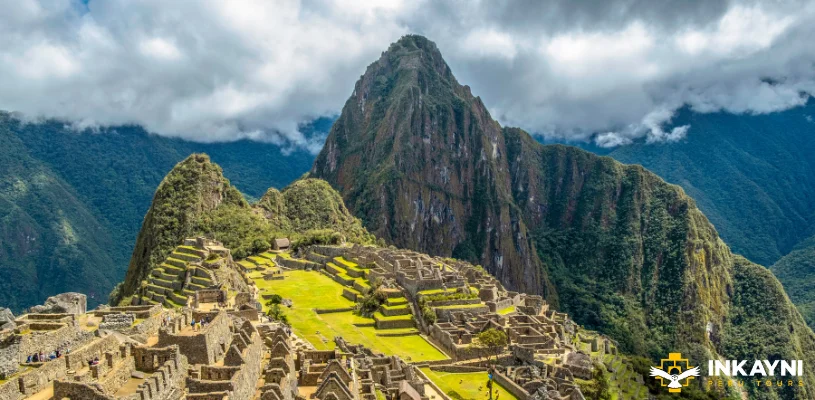
Machu Picchu, the symbolic final destination of the Classic Inca Trail.
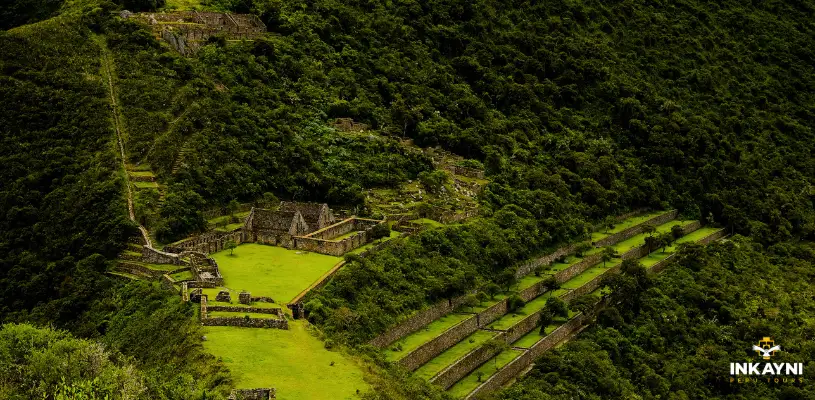
Choquequirao, a quieter archaeological destination reached by a demanding canyon trek.
Main Comparison: Choquequirao Trek vs Inca Trail
| Decision point | Classic Inca Trail | Choquequirao trek |
| Destination | Machu Picchu, reached through the historic Inca Trail and the Sun Gate. | Choquequirao archaeological complex, reached through a remote trek in the Apurímac Canyon. |
| Typical duration | 4 days / 3 nights. | 4 days / 3 nights or 5 days / 4 nights. |
| Distance | About 26-27 mi / 42-43 km. | About 38.5-39.7 mi / 62-64 km round trip. |
| Maximum elevation | About 13,829 ft / 4,215 m at Warmiwañusca. | About 10,000-10,400 ft / 3,050-3,150 m around the archaeological area. |
| Main difficulty | Altitude, stone steps, high passes and sustained ascent. | Cumulative elevation change, canyon heat, long descents and the return climb. |
| Typical shared tour price | Usually around US$760-950+ per person. | Usually around US$500-700 per person. |
| Booking pressure | Higher. Permits are personal, non-transferable and often need to be booked months ahead. | Lower. More flexible overall, but dry-season departures and strong operators still fill up. |
| Independent trekking | No. It must be booked through an authorized operator. | Possible for experienced hikers, but you handle transport, food, camping, route planning and safety. |
| Seasonal closure | Officially closed in February. | No fixed February closure, but rain can affect safety, road access and trail conditions. |
| Atmosphere | More iconic, regulated and usually busier. | Quieter, wilder and more solitary. |
| Best for | Travelers who want the classic Machu Picchu arrival and the historic route. | Travelers who want remote ruins, fewer crowds and stronger trekking value. |
Route Versions
This section should appear early because “Choquequirao vs Inca Trail” is not always a one-to-one comparison. A traveler may really be comparing 4-day Choquequirao vs 4-day Inca Trail, or a slower 5-day Choquequirao against a more classic Machu Picchu itinerary.
| Route | Duration | Distance | Final destination | Best for |
| Choquequirao Trek 5 Days | 5D / 4N | About 38.5-39.7 mi / 62-64 km round trip | Choquequirao | Travelers who want the same route with more time at the ruins and better recovery. |
| Classic Inca Trail | 4D / 3N | About 26-27 mi / 42-43 km | Machu Picchu via Sun Gate | Travelers who prioritize the most iconic historic route. |
| Short Inca Trail | 2D / 1N | About 6.2-6.8 mi / 10-11 km | Machu Picchu via Sun Gate | Travelers who want a shorter historic route with less physical load. |
Important:
Do not compare the 4-day Choquequirao trek only by distance. It may look straightforward on paper, but the long descent, valley heat, climb from the canyon and return through the same terrain create a different type of fatigue from the Inca Trail.
Choquequirao Trek vs Inca Trail: The 6 Factors That Matter
1. Final Destination
- The Inca Trail ends at Machu Picchu, Peru’s strongest travel icon. The final arrival through the Sun Gate matters because it turns the route into a narrative: several days of walking, multiple Inca sites and then the first view of Machu Picchu from above.
- The Choquequirao trek ends at Choquequirao, a much quieter archaeological complex linked to the Vilcabamba region. It does not have Machu Picchu’s global fame, but it offers a rare mix of solitude, scale, canyon landscape and ongoing archaeological recovery.
| Destination detail | Choquequirao | Machu Picchu via Inca Trail |
| Name meaning | Often translated as “Cradle of Gold,” though the meaning should be read with caution. | Usually translated as “Old Mountain.” |
| Site elevation | About 10,000 ft / 3,050 m, depending on the sector referenced. | About 7,972 ft / 2,430 m at the citadel. |
| Excavation / restoration feel | Partially excavated and still less standardized. | Extensively studied, regulated and highly visited. |
| Access | On foot by multi-day trek for now. | Train, bus, road access and trekking routes. |
| Best emotional reward | Silence, scale and feeling of discovery. | Iconic arrival and cultural recognition. |
2. Difficulty
On the Inca Trail, the section that demands the most physical effort is usually the ascent to Warmiwañusca, also known as Dead Woman’s Pass. Even fit hikers can feel the altitude there. The stone steps and high mountain passes make Day 2 the hardest stretch for many travelers.
On the Choquequirao trek, the maximum elevation is lower, but the physical demand takes a different form. The route descends into the Apurímac Canyon, climbs back toward Marampata and Choquequirao, then repeats that logic on the return. The main wear comes from heat, long descents, quads, knees and cumulative fatigue.
| Difficulty factor | Choquequirao trek | Classic Inca Trail |
| Total distance | Longer: about 38.5-39.7 mi / 62-64 km round trip | Shorter: about 26-27 mi / 42-43 km |
| Highest point | 3,050 m / 10,007 ft; Lower elevation than the Inca Trail | Higher altitude at Warmiwañusca, about 13,829 ft / 4,215 m |
| Main physical stress | Descent, ascent, heat, repeated canyon effort and leg fatigue | Altitude, steps, passes and sustained uphill effort |
| Altitude sickness risk | Lower, but not zero | Higher, especially with poor acclimatization |
| Who may suffer more | Travelers with weak knees, low leg strength or poor heat tolerance | Travelers sensitive to altitude or poorly acclimatized |
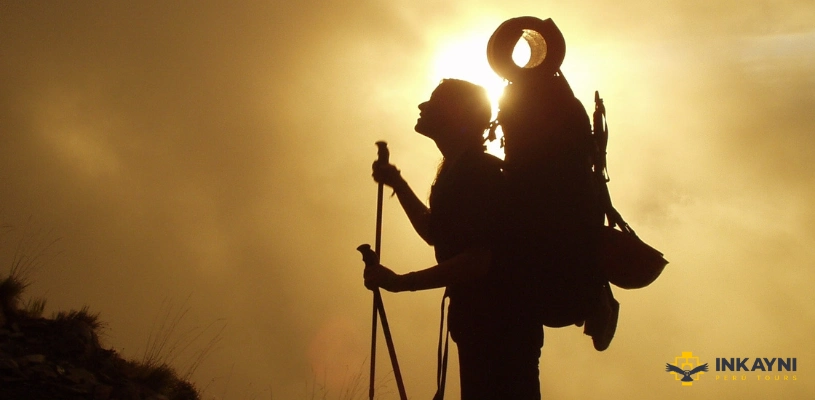
Choquequirao difficulty is felt in long descents, steep climbs, heat and repeated elevation change.
3. Foot Traffic and Trail Experience
- On the Inca Trail, everything is more regulated. Spaces are limited, group flow is controlled and campsites are assigned within the official system. That creates clearer logistics, but it also means you will share the route with other groups.
- On the Choquequirao trek, the experience feels more open and raw. You can go long stretches with very few people. The trade-off is that infrastructure is more basic and the route depends more on weather, operator standards and current trail conditions.
| Trail factor | Choquequirao trek | Classic Inca Trail |
| Groups encountered | Low to very low on many days | More constant, especially in high season |
| Infrastructure | More basic and operator-dependent | More structured and regulated |
| Overall feel | Expedition, silence, canyon and remoteness | Historic route, shared flow and regulated camps |
| Trail signage | More variable | Defined within the official route system |
| Best for | Trekkers who accept rougher logistics for solitude | Trekkers who prefer a classic, organized, heritage-heavy route |
4. Permits and Availability
The Inca Trail depends on a personal, non-transferable permit issued through the official system and managed by authorized operators. Names must match passports, dates are fixed and changes are very restricted. If permits sell out, there is no simple last-minute replacement for the Classic Inca Trail.
The Choquequirao trek does not operate under the same closed personal quota system. That gives travelers more flexibility, especially when Inca Trail permits are unavailable. But flexible does not mean careless: weather, route conditions, camping standards and operator quality still matter.
| Booking factor | Choquequirao trek | Classic Inca Trail |
| Personal permit | No Inca Trail-style personal trekking permit; entrance and local rules still apply. | Yes, personal and non-transferable. |
| Daily quota | No equivalent to the Inca Trail quota system. | Limited total daily entries, including trekkers and support staff. |
| Recommended lead time | Usually 1-3 months is enough, but earlier is better in dry season. | Usually 4-6 months; more for peak travel windows. |
| Date changes | Depends on operator policy and route conditions. | Very restricted because the permit is tied to passport and date. |
| When it decides the trip | Usually when weather or logistics are the issue. | Often when permits are sold out. |
Keep this in mind:
There is also a Choquequirao to Machu Picchu trek. It follows a completely different planning logic: more days, higher cost, stronger endurance demands and Machu Picchu ticket availability added to the equation.
5. Real Cost and What You Are Paying For
- On the Inca Trail, the price rises because the route is regulated and includes the permit, Machu Picchu entry, staff logistics, porter work, camps, meals, guide and return train arrangements. On Choquequirao, the price depends more on group size, service type, mule support, camping gear and how much of the logistics the operator actually includes.
| Cost factor | Choquequirao trek | Classic Inca Trail |
| Typical organized tour price | US$450–700 per person for a standard 4–5 day shared group. Private or higher-comfort services can rise to US$700–1,200+. | US$780–950+ per person for a standard 4-day group with a local operator. Private and luxury versions can cost much more. |
| Lowest realistic option | Independent travelers may spend around US$245–395 if they manage transport, food, camps, entrance and optional mule support themselves. | There is no true independent option. The route must be booked through an authorized operator. |
| What the price usually pays for | Transport to/from Capuliyoc, guide, meals, camping gear, muleteer support, entrance fee and logistics, depending on the operator. | Inca Trail permit, Machu Picchu entry, guide, porters, cooks, campsites, meals, camping logistics, bus/train arrangements and regulated trail operations. |
| Entrance / permit logic | No Inca Trail-style trekking permit is required. | The permit is central to the package. Access is limited. |
| Support load | Mules usually carry camping equipment and sometimes a limited personal duffel. | Porters carry group equipment. A personal porter and duffel allowance may be included. |
| Best value reading | Better value if you want remoteness, fewer crowds and flexibility. | Higher cost, but stronger logistical structure. |
Practical tip:
Do not compare only the final price. Compare what is included: entrance fees, transport, meals, camping gear, guide quality, emergency plan, staff treatment, porter or mule support, equipment condition and what happens if weather or permits affect the plan.
6. Best Season and Weather
On both routes, the general pattern is similar. The dry season from May to September offers more stable conditions. April and October can work well as transition months. November through March requires more tolerance for rain, mud and possible changes.
The key distinction is that the Inca Trail closes in February for maintenance. Choquequirao does not follow the same fixed closure every year, but heavy rains can still make access unsafe or unreliable.
| Months | General conditions | Choquequirao trek | Inca Trail |
| May to September | Drier and more stable | Best window for most travelers | Best window, but permits sell out faster |
| April and October | Transition months | Good option with weather margin | Good option with proper planning |
| November to January | More rain and mud | Only if you accept a higher risk of changes | Possible with preparation, but less stable |
| February | Peak rainfall | Check route conditions before booking | Closed for maintenance |
What Makes Each Route Unique
Archaeological Sites That Change the Experience
On the Inca Trail, the archaeological value accompanies the entire route. The sites do not appear only at the end; they reveal themselves as you advance through stairways, tunnels, terraces and stone enclosures. Each day adds landscape and history at the same time.
On the Choquequirao hike, the archaeological weight concentrates primarily in the main complex and its immediate surroundings. First comes the physical demand of the route, then the reward: plazas, terraces, ceremonial spaces, views and sectors still less impacted by tourist flow.
| Site or notable point | Choquequirao trek | Classic Inca Trail |
| Llactapata | No | Yes |
| Runkuracay | No | Yes |
| Sayacmarca | No | Yes |
| Phuyupatamarca | No | Yes |
| Intipata | No | Yes |
| Wiñay Wayna | No | Yes |
| Sun Gate / Inti Punku | No | Yes |
| Choquequirao plaza, Ushnu and terraces | Yes | No |
| Sun Llamas terraces | Yes | No |
Choquequirao: Rougher, Quieter and Less Standardized
Choquequirao rises on a high ridge above the Apurímac Canyon, within the broader Vilcabamba landscape. Unlike the Classic Inca Trail, the route is not built around a sequence of famous archaeological stops before the final site. Here, the strongest part of the journey is the canyon itself: the descent from the Capuliyoc area, the river crossing, the climb toward Marampata and the gradual arrival at a remote Inca complex.
Once inside Choquequirao, the visit usually focuses on the main plaza, agricultural terraces, ceremonial areas, viewpoints and partly restored sectors spread across the mountain. One of the most memorable areas is the Stone Llamas of Choquequirao, where white stone llama figures are embedded into the terrace walls.
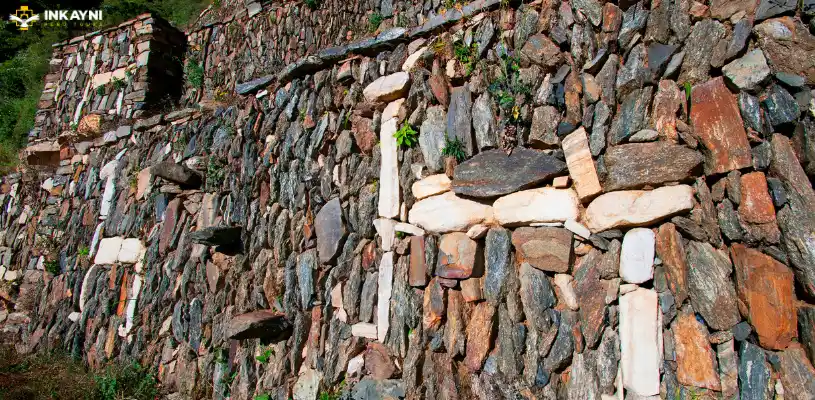
The Sun Llamas terraces: one of the most singular sectors in Choquequirao.
The Apurímac Canyon Landscape
Those who look only at distance underestimate the canyon. The Choquequirao trail does not move through a single climate or a uniform elevation. There is sun, valley heat, dry sections, steep switchbacks, changing vegetation and a muscular demand very different from a high-puna route. That is why this hike stays in the body as much as in the memory.
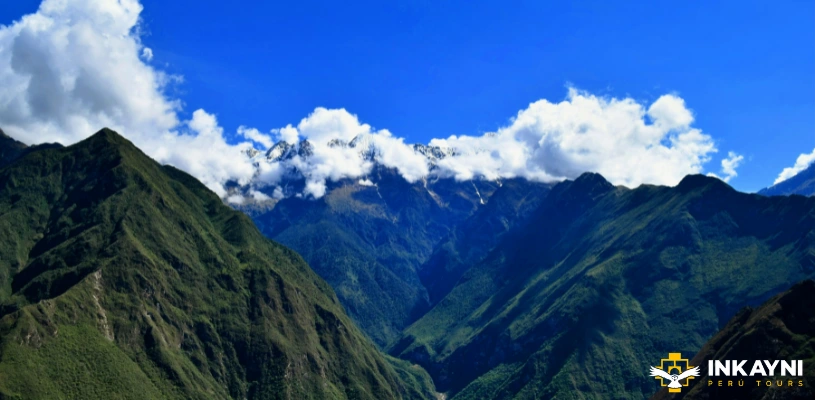
The Apurímac Canyon stays in the memory as much as the ruins.
The Inca Trail: Archaeology Distributed Throughout the Journey
What makes the Inca Trail unique is not only the final entry to Machu Picchu. Its strength is the way history appears throughout the hike. The route adds stone, context, scenery and symbolic continuity day by day, which is difficult for other Cusco treks to match.
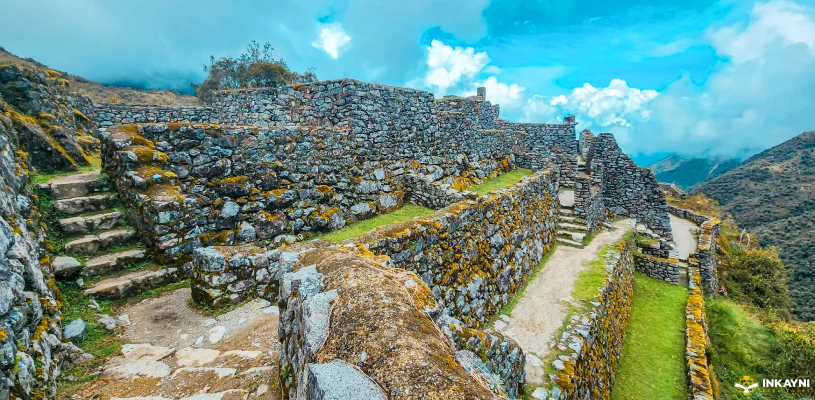
Sayacmarca, one of the sites that makes the Inca Trail a continuous archaeological route.
Practical Comfort: Camps, Water, Toilets and Support
A good comparison has to include practical comfort. A tourist deciding between these routes wants to know what daily life feels like, not just how the route looks on a map.
| Practical detail | Choquequirao trek | Classic Inca Trail |
| Campsites | More variable by operator and itinerary: Chiquisca, Santa Rosa, Marampata or nearby sectors may appear depending on pace. | Defined within the official system; common names include Wayllabamba, Pacaymayu and Wiñay Wayna depending on allocation. |
| Infrastructure | More basic, with fewer fixed facilities and more dependence on the operator’s setup. | More regulated but still camping; do not expect luxury unless booking a premium service. |
| Water | Requires planning, purification or operator-managed supply. | Usually managed by the operator within the regulated route. |
| Bathrooms | Basic; standards vary by camp and service. | Basic but more structured along the official route. |
| Load support | Muleteers and horses are common. | Porters operate within the Inca Trail system. |
| Signal and isolation | More remote and less predictable. | Still remote, but more trafficked and structured. |
Choose the Choquequirao route with the right level of support
Which Route Gives Better Value?
Better value depends on what you want from the trek. The Classic Inca Trail gives you Machu Picchu, a historic route and clearer logistics. Choquequirao gives you more solitude, more flexibility and a tougher expedition feel, but with rougher conditions.
| Your priority | Better value | Why |
| Machu Picchu arrival | Classic Inca Trail | It ends at Machu Picchu through the Sun Gate. |
| Archaeology along the route | Classic Inca Trail | You see several Inca sites before reaching Machu Picchu. |
| Solitude and fewer hikers | Choquequirao trek | It feels more remote and far less crowded. |
| Flexible dates | Choquequirao trek | It is not limited by the same Inca Trail permit system. |
| Lower overall cost | Often Choquequirao trek | It usually avoids the same permit and Machu Picchu ticket costs. |
| Easier logistics | Classic Inca Trail | It is more regulated, structured and predictable. |
| Lower altitude concern | Choquequirao trek | Its highest point is lower, but acclimatization still matters. |
| Tougher physical challenge | Choquequirao trek | The canyon descent and return climb make it more exhausting. |
| First major trek in Peru | Classic Inca Trail | It is demanding, but easier to organize and understand. |
| No Inca Trail permit available | Choquequirao trek | It is one of the strongest alternatives. |
Campsites: Where You Sleep on Each Route
Choquequirao Trek Campsites
The Choquequirao campsites vary by operator and by whether you choose the 4-day or 5-day version. Common route names include Chiquisca, Santa Rosa, Marampata, camps near the complex and intermediate return points. Infrastructure is more basic, so the real quality depends heavily on the operator.
Inca Trail Campsites
On the Inca Trail, campsites are assigned within the official system. Names such as Wayllabamba, Pacaymayu and Wiñay Wayna appear often in the classic operation. That makes the route more predictable, but still rustic: you are camping, not sleeping in lodges.
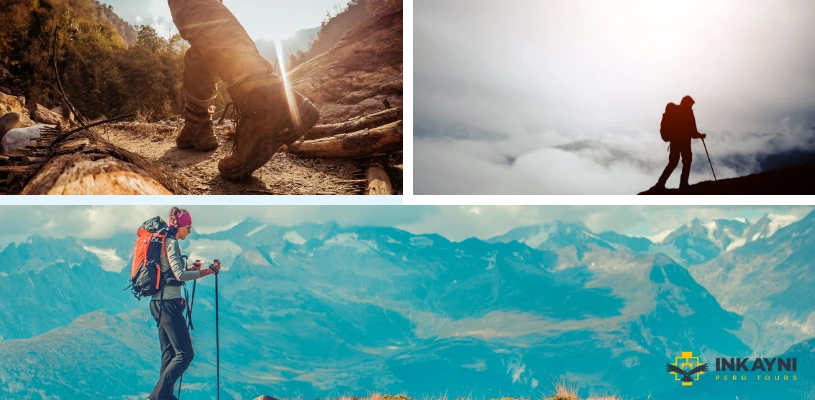
The relative emptiness of the trail is part of what draws people to the Choquequirao trek.
How to Choose an Operator
Choosing between Choquequirao and the Inca Trail is not only about the route. It is also about who operates it. A good operator should make the trek safer, clearer and more respectful to staff, the route and the archaeological sites.
| Ask before booking | Why it matters |
| What exactly is included? | Entrance, transport, meals, tents, sleeping mat, mule or porter support and emergency plan should be clear. |
| What is not included? | Sleeping bag, poles, tips, upgrades, extra circuits, train upgrades and first/last meals often create extra cost. |
| How much weight is carried for me? | Choquequirao usually uses mule support; Inca Trail uses porters under a regulated system. |
| What happens if weather affects the route? | Choquequirao is especially sensitive to heavy rain and canyon conditions. |
| Is the company licensed for the Inca Trail? | Only authorized operators can run the Classic Inca Trail. |
| How is staff treated? | Cheap prices often hide pressure on cooks, porters, muleteers or equipment quality. |
Related comparisons and planning guides
Choose the Trek That Matches Your Trip
If you want the most famous historic route to Machu Picchu and you can secure the permit, choose the Inca Trail. If you want a tougher, quieter and less standardized expedition, choose Choquequirao. If you still cannot decide, the safest question is this: Do you want the iconic route to Machu Picchu, or do you want the most remote-feeling Inca trek near Cusco?
Inkayni Peru Tours operates both experiences, so the choice does not need to be forced. The right route is the one that matches your dates, fitness, budget and the kind of memory you want to bring back from the Andes.
Frequently Asked Questions: Choquequirao Trek vs Inca Trail
Which is harder, the Choquequirao trek or the Inca Trail?
Which trek is cheaper?
How much should I expect to pay in 2026?
Do I need a permit for the Choquequirao trek?
Do I need a permit for the Inca Trail?
How far in advance should I book the Inca Trail?
Can I do Choquequirao without a guide?
Can I do the Inca Trail without a guide?
What will I see on the Inca Trail that I will not see on Choquequirao?
What will I see in Choquequirao that I will not see on the Inca Trail?
Which route is better for archaeology?
Which route is better for avoiding crowds?
Which route is better if I only have four days?
Is the 5-day Choquequirao trek worth it?
What about Inca Trail vs Quarry Trail?
Can I visit Choquequirao and Machu Picchu in one trek?
Autor
Shared:


If you liked this article and the information you found, give us 5 stars!
 (2 votos, promedio: 5.00 de 5)
 Loading...