Stone Llamas of Choquequirao
The Stone Llamas of Choquequirao are white-stone camelid figures built into the agricultural terrace walls of Sector VIII, also known as the Llama Terraces. They are one of the site’s most distinctive features because they are not carved statues or living animals, but inlaid designs set directly into darker retaining walls.
Perched above the Apurimac Canyon, Choquequirao is often compared with Machu Picchu. The stone llamas give this site a different visual identity: a group of camelid figures built into terrace walls, away from the main plaza, in a sector many travelers do not see unless they ask for it.
This article focuses on those figures: where they are, how they were built, what they may represent, how to include them during the trek and what to keep in mind before visiting Sector VIII, the area many travelers search for as the Choquequirao llama terraces or the Llama Terraces of Choquequirao.
| Sector VIIILlama Terraces |
25figures often cited |
1.25-1.94 mapprox. motif height |
May-Octbest trekking season |

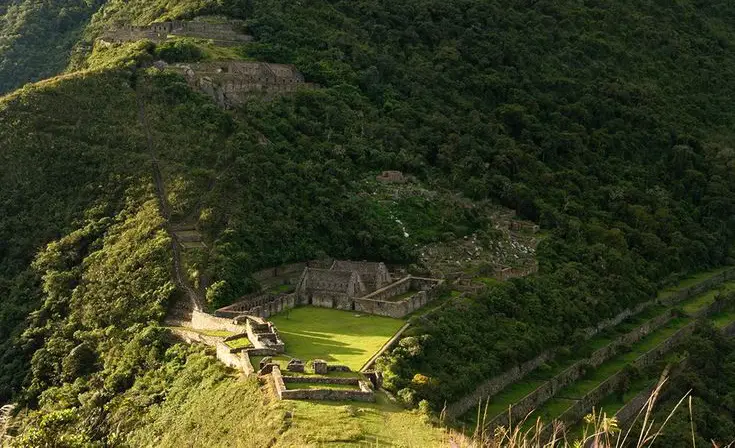
Photo by: Ninoska Montufar. Choquequirao from above, where terraces and mountain slopes hide one of the site’s most unusual Inca details.
LOST CITADEL TREKChoquequirao Trek
Hike to one of Peru’s most impressive and least crowded Inca archaeological sites.
Read our guide
Main Machu Picchu and trekking guides
Where Are the Stone Llamas of Choquequirao?
The stone llamas are in Sector VIII, on the western side of the Choquequirao complex. This area is commonly known as the Llama Terraces or Llamas del Sol sector. It is not the first area visitors see when they arrive at the main archaeological zone, so it should be planned as part of the site visit from the beginning.
To reach the sector, you move away from the central archaeological area and follow an internal path toward the terraces. The walk is not technical, but it includes a descent and a climb back. After the approach trek to Choquequirao, that short internal detour can feel harder than expected.

Infographic showing the stone llama figures built into Choquequirao’s agricultural terraces.
| Detail |
What to know |
| Exact area |
Sector VIII, also called the Llama Terraces or Llamas del Sol sector. |
| Location inside the site |
Western side of the Choquequirao complex, away from the main plaza. |
| Access inside Choquequirao |
Internal detour with a descent and return climb. |
| Best visit moment |
During the full exploration day of a 5-day Choquequirao itinerary. |
| What to ask your guide |
Ask directly for Sector VIII, the Llamas del Sol or the stone llama terraces. |
Why Are the Stone Llamas So Special?
The stone llamas are part of the terrace wall itself. Instead of being painted on the surface, the figures were created by placing light-colored stones into darker retaining walls. The contrast makes the camelid shapes visible from a distance.
That technique gives the panel its value. The figures are tied to agriculture, stonework, mountain movement and landscape. They work as an image built into the slope, not as an isolated object placed beside the site.
| What makes them unique |
Why it matters |
| Inlaid stone figures |
The silhouettes are built into the terrace walls rather than added later as a surface decoration. |
| Light stone on dark wall |
The contrast helps the llama shapes stand out from the retaining wall. |
| Agricultural terrace setting |
The figures are connected with land, crops and mountain management. |
| Caravan-like arrangement |
The repeated camelid forms suggest movement across the mountainside. |
| Distinct Choquequirao identity |
This sector gives Choquequirao a visual feature that many travelers do not associate with other Inca sites. |
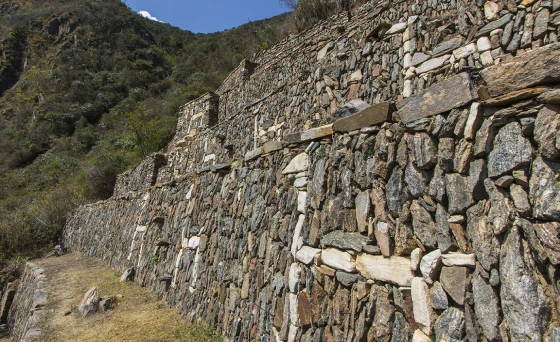
Photo by: Arte Peruano. Stone llamas inlaid into the retaining walls of Choquequirao’s agricultural terraces.
How Many Stone Llamas Are There?
Archaeological references commonly mention 25 semi-naturalistic figures in the Sector VIII panel. In travel content, you may still see 24 or other close counts. The difference usually comes from what each source decides to count: only the clearest camelid figures, or also related motifs and less obvious shapes in the same panel.
For a traveler, the exact count is less important than the scene. You are not looking at one isolated animal, but at a planned group of camelid figures arranged across the Choquequirao terraces.
Did you know…?
The name Llamas del Sol is commonly used for this sector, but it should not be reduced to one fixed meaning. The panel is usually read through its relationship with light, agricultural terraces, mountain landscape and Andean sacred geography.
How Were the Stone Llamas Built?
The figures were made with white calcocuarcita, a quartz-carbonate sandstone, set into darker schist walls. This contrast gives the panel its visibility. Some documented figures are described as roughly 1.25 m to 1.94 m high, so the image was meant to be seen as part of the slope.
The builders were creating retaining terraces and, at the same time, composing a visual message inside the wall. That is why the white stone llamas built into a terrace wall at Choquequirao sit between engineering, landscape design and symbolism.
| Construction detail |
What it means |
| White calcocuarcita |
Quartz-carbonate sandstone used to form the llama silhouettes. |
| Darker schist wall |
Creates the contrast that makes the figures visible. |
| Inlaid technique |
The image is part of the wall, not a painted or carved surface. |
| Approximate figure size |
Published descriptions cite figures roughly from 1.25 m to 1.94 m high. |
| Terrace integration |
The panel belongs to the agricultural and retaining-wall system. |

Photo by: Inkayni Peru Tours. Choquequirao’s walls and terraces show how Inca builders adapted architecture to the mountain.
What Do the Stone Llamas Represent?
In the Inca world, llamas were essential for transport, fiber, ritual life and movement across mountain routes. At Choquequirao, their placement inside agricultural terraces suggests a connection with land, work, circulation and the managed mountain landscape.
The meaning should be handled carefully. The panel probably had symbolic value, but there is no single final interpretation. A good explanation should connect the materials, the terrace setting, the repeated figures and the surrounding mountains without reducing everything to one simple story.

Photo by: Omar Jabri. Llamas remain part of Andean life, movement, textiles and mountain symbolism.
Understand the Llama Terraces in context
How to See the Stone Llamas During the Trek
Seeing the stone llamas has two parts. First, you need to reach Choquequirao by trekking. Second, once inside the archaeological complex, you need enough time to include Sector VIII.
On a 5-day Choquequirao itinerary, the best moment is usually the full exploration day at the site. That gives the guide enough room to include the main plaza, ceremonial areas and Llama Terraces without rushing. On shorter visits, Sector VIII can be skipped if the group is tired, delayed or short on daylight.
| Planning point |
Recommendation |
| Best itinerary length |
5 days gives more room for a calm visit to Sector VIII. |
| Best light for Choquequirao photos |
Morning or late afternoon, when side light improves contrast on the terrace wall. |
| Trail condition |
The detour includes descent and return climb; rain can make it slippery. |
| Guide instruction |
Ask for Sector VIII, Llamas del Sol or the Llama Terraces before the site visit starts. |
| Respectful visit |
View from a safe distance; do not touch, climb or step on terrace walls. |
Care and safety tips
- Do not touch, climb or step on the terrace walls.
- Use hiking shoes with good grip, especially during the wet season.
- Carry water, sun protection and a light rain layer.
- Ask your guide where to stand for photos without damaging the site.
- Do not force the detour if weather, daylight or group fatigue makes it unsafe.
Is It Worth the Detour to Sector VIII?
Yes, if you came to Choquequirao for more than the main plaza. The Llama Terraces are one of the details that make this site different from other Inca places, and they are easy to miss when the visit is rushed.
The detour is worth it for travelers interested in archaeology, symbolism, photography and quieter areas inside the site. Skip it only if weather, limited daylight, group fatigue or trail safety makes the return climb a bad decision.
<div style="background-size: 400px 400px; border: 1px solid #c8c8c8; border-bottom: 3px solid #caa85e; color: #1f2933; padding: 26px 30px; margin: 34px 0; border-radius: 12px; font-family: Calibri, 'Segoe UI', sans-serif;">
<h3 style="font-family: Cambria, Georgia, serif; color: #111111; margin: 0 0 10px; font-size: 20px; font-weight: 600; letter-spacing: 0.2px; text-align: left;">Quick Answer</h3>
The <strong data-start="39" data-end="71">stone llamas of Choquequirao</strong> are located in <strong data-start="87" data-end="131">Sector VIII, known as the Llama Terraces</strong>, a quieter area of agricultural terraces just beyond the main circuit of the citadel. Here, the figures are formed by <strong data-start="250" data-end="299">light stones inlaid into darker terrace walls</strong>, and they are best visited <strong data-start="327" data-end="350">from May to October</strong>, when trail conditions are more stable.
</div>
<p style="text-align: center;"><em>Perched high above the Apurímac River, Choquequirao is often called the “other Machu Picchu” for its architecture and remote setting. But what truly sets it apart is a rare scene: stone llamas inlaid into the walls of its agricultural terraces.</em></p>
<p style="text-align: center;"><em><strong>What do these figures represent?</strong> Why are they located in a quieter, less-visited area? And how can you see them during the trek?</em></p>
<p style="text-align: center;"><em>In this blog, we explain what the <strong>stone llamas of Choquequirao</strong> are, why they’re such a remarkable discovery, and how to reach them step by step.</em></p>
[caption id="attachment_24953" align="aligncenter" width="727"]<img class="wp-image-24953 " src="https://www.inkayniperutours.com/blog/wp-content/uploads/the-citadel-of-choquequirao-and-the-stone-flames-Inkayni-Peru-Tours.webp" alt="Aerial view of Choquequirao citadel ruins on an Andean ridge, stone terraces and temples above the Apurimac canyon near Cusco, Peru." width="727" height="444" /> Choquequirao’s carved worldview from above.
<h2>Where Are the Stone Llamas of Choquequirao?</h2>
<strong>The stone llamas are located in Sector VIII</strong>, a set of agricultural terraces built on a steep slope. To see them, you’ll take a short internal detour from the main core of the site, heading down and then climbing back up a short but steep section. If you’re visiting with a guide, ask directly for “Sector VIII” or the “Llama Terraces.”
<img class=" wp-image-28702" src="https://www.inkayniperutours.com/blog/wp-content/uploads/Choquequirao-Stone-Llamas-Terraces-Infographic.webp" alt="Infographic of stone llama figures built into agricultural terraces at Choquequirao Archaeological Park above the Apurímac Canyon." width="757" height="953" /> White stone llama figures built into Choquequirao terraces above the Apurímac Canyon.
<h3>How many llamas can you see?</h3>
You’ll often hear the number 24, but in specialized studies the total can vary when additional motifs on the panel are included, which is why some counts mention 25 or a similar total. In practice, what matters is that you’ll see a clear, carefully planned scene of stone llamas, unique for both its technique and its setting.
<h3>Why is it such a unique discovery?</h3>
<table style="border-collapse: collapse; width: 100%;">
<tbody>
<tr>
<td style="width: 25%; text-align: center;"><strong>Unique composition</strong></td>
<td style="width: 25%; text-align: center;"><strong>High contrast</strong></td>
<td style="width: 25%; text-align: center;"><strong>Meaningful location</strong></td>
<td style="width: 25%; text-align: center;"><strong>Specialized technique</strong></td>
</tr>
<tr>
<td style="width: 25%; vertical-align: top;">
<ul>
<li style="text-align: left;">Not a carved relief: it’s a panel built from individual pieces.</li>
</ul>
</td>
<td style="width: 25%; vertical-align: top;">
<ul>
<li style="text-align: left;">Light stone on a dark wall so the silhouette stands out.</li>
</ul>
</td>
<td style="width: 25%; vertical-align: top;">
<ul>
<li style="text-align: left;">Located in a less-visited section of the site, on agricultural terraces.</li>
</ul>
</td>
<td style="width: 25%; vertical-align: top;">
<ul>
<li style="text-align: left;">Inlaid piece by piece, planned to match the structure of the terrace wall.</li>
</ul>
</td>
</tr>
</tbody>
</table>
<img class="wp-image-24955 size-full" src="https://www.inkayniperutours.com/blog/wp-content/uploads/stone-flames-of-choquequirao-Inkayni-Peru-Tours.webp" alt="stone llamas of Choquequirao, retaining walls on a mountainside, with rugged Andes scenery near Cusco, Peru." width="560" height="342" /> A cradle of gold in stone.
<h2>How to See the Stone Llamas of Choquequirao During the Trek</h2>
Seeing the stone llamas takes two steps: first, completing the trek to reach the archaeological complex, and then, once inside, taking a detour to Sector VIII. Since they aren’t on the main visitor route, it’s best to ask your guide to include the stop and set aside enough time to go down, view them calmly, and return without rushing.
<h3>Quick recommendations</h3>
<table style="border-collapse: collapse; width: 100%;">
<tbody>
<tr>
<td style="font-weight: bold; text-align: center;" colspan="2">Practical information for seeing the stone llamas</td>
</tr>
<tr>
<td style="text-align: center;"><strong>Visiting hours</strong></td>
<td style="text-align: center;">07:00 a.m. to 04:00 p.m. (hours may change locally)</td>
</tr>
<tr>
<td style="text-align: center;"><strong>Best light for photos</strong></td>
<td style="text-align: center;">Morning or late afternoon (side light boosts contrast)</td>
</tr>
<tr>
<td style="text-align: center;"><strong>Internal access</strong></td>
<td style="text-align: center;">Detour with a descent and a short, steep climb back</td>
</tr>
<tr>
<td style="text-align: center;"><strong>Entrance fee</strong></td>
<td style="text-align: center;">Included in the archaeological park ticket (about S/ 60, subject to change)</td>
</tr>
<tr>
<td style="text-align: center;"><strong>Recommended season</strong></td>
<td style="text-align: center;">May to October (more stable trails)</td>
</tr>
</tbody>
</table>
<h3>Care and safety tips</h3>
<ul>
<li>Do not touch or step on terraces or walls (they are fragile, protected structures).</li>
<li>In the wet season, move carefully: the trail can be slippery.</li>
<li>Bring water and sun protection: some sections have little shade.</li>
</ul>
<h2>How Were the Stone Llamas of Choquequirao Built?</h2>
Unlike carved reliefs or petroglyphs, the stone llamas of Choquequirao <strong>aren’t sculpted onto the surface</strong>. Instead, the figures were <strong>assembled from light-colored stones inlaid</strong> into the terrace wall, so the contrast against the darker rock “draws” the silhouette.
<h3>Technique and materials</h3>
Studies by Zenobio Valencia and Gori Echevarría describe an intentional contrast: light stones commonly described as quartz-rich material set into darker walls of schist or mica schist. The goal was clear visibility, so the figures stand out even at a distance.
<img class="wp-image-24616 size-full" src="https://www.inkayniperutours.com/blog/wp-content/uploads/Choquequirao-Ruins-Inkayni-Peru-Tours.webp" alt="Ancient stone walls and agricultural terraces at the Choquequirao archaeological site in the mountains of Peru." width="650" height="396" /> Traces of a lost empire waiting for you to find them.
<h2>Is It Worth Hiking to the Stone Llamas of Choquequirao?</h2>
Yes, it’s worth it. Seeing the panel up close is one of the most memorable moments in Choquequirao because it’s not just a photo stop, it’s a rare piece of Inca visual storytelling built into agricultural terraces. It does require a detour down and back up, but the payoff is big: a quieter area and a scene you won’t find easily at other Inca sites.
<ul>
<li><strong>The highlight:</strong> a planned scene of stone llamas inlaid into terrace walls.</li>
<li><strong>The challenge:</strong> you’ll feel the return climb, since everything you go down, you must climb back up.</li>
</ul>
<img class="wp-image-24954 size-full" src="https://www.inkayniperutours.com/blog/wp-content/uploads/the-citadel-of-choquequirao-Inkayni-Peru-Tours.webp" alt="Wide panorama of the Choquequirao archaeological complex in lush cloud forest, with stone terraces and plazas on a steep Andes slope near Cusco, Peru." width="580" height="354" /> Choquequirao, where the mystery feels priceless.
<p style="padding-left: 40px;"><strong>
</strong><strong>Expert tip:</strong>
If you want to understand the scene, ask your guide about the llama in the Inca world: economy, ritual, and landscape. With that context, the figures become a cultural message, not just a pretty photo.</p>
<h2>The Symbolism of the Stone Llamas of Choquequirao</h2>
In the Inca world, the llama was far more than an animal. It supported everyday life and imperial power as pack transport, a food source, and fiber for high-value textiles. That’s why the llama came to represent work, wealth, sustenance, and a deep connection to the land.
With that context, the stone llamas at Choquequirao weren’t placed there just to decorate. They appear along a series of agricultural terraces in a section often referred to as <strong>“Llamas of the Sun”</strong>, forming an intentional scene that looks like a caravan of llamas moving across the mountainside.
Most likely, the panel worked as a symbolic message: a tribute to the llama’s importance and a request for protection and fertility for these farming terraces. There isn’t one definitive interpretation, but the location, repetition, and technique strongly suggest a ceremonial meaning tied to agriculture.
<img class="wp-image-24694 size-full" src="https://www.inkayniperutours.com/blog/wp-content/uploads/Baby-llamas-on-the-Ausangate-route-Inkayni-Peru-Tours.webp" alt="Two baby llamas standing on a rocky Andean hillside on the Ausangate route near Cusco, Peru, common wildlife on high altitude treks." width="650" height="396" /> A hymn to life.
<p style="padding-left: 40px;"><strong>
</strong><strong>Did you know...?</strong>
Research on Sector VIII suggests this panel functions as a “visual message” oriented toward the sacred landscape, often linked in interpretation to the sun and the tutelary mountains (apus).</p>
<h2>Choquequirao Trek with Inkayni Peru Tours</h2>
If you’re looking for an authentic experience without crowds and with professional support, <a href="https://www.inkayniperutours.com/es">Inkayni Peru Tours</a> offers a safe, complete route that includes the <strong>stone llamas of Choquequirao</strong> and a full exploration of the site.
<strong>Ready to see them in person?</strong> Write to us and we’ll help you plan dates, acclimatization, and logistics.
<h3>What does the trek include?</h3>
<ul>
<li>Specialized local guides.</li>
<li>Transportation, full meals, mules, and camping equipment.</li>
<li>Entrance to the archaeological complex and a tour of main sectors, including Sector VIII.</li>
</ul>
The itinerary of <a href="https://www.inkayniperutours.com/es/">Inkayni Peru Tours</a>, in its <a href="https://www.inkayniperutours.com/es/05-dias-caminata-a-choquequirao-servpriv/">private 5-day version</a>, includes Sector VIII during the full exploration day at the site.
<img class="aligncenter" src="https://www.inkayniperutours.com/blog/wp-content/uploads/Choquequirao-is-considered-one-of-the-last-bastions-of-resistance-and-refuge-of-the-Incas.-Inkayni-Peru-Tours.webp" alt="Choquequirao is considered one of the last bastions of resistance and refuge of the Incas." width="735" height="448" />
<p style="padding-left: 40px;"><strong>
Important note:</strong>
To reach Sector VIII, you’ll take a short but steady descent and then climb back up. With a good pace and photo stops, plan about <strong>30 to 45 minutes each way</strong>, depending on the trail and your fitness.</p>
<h2>Ready to Visit Choquequirao?</h2>
<p style="text-align: center;"><em>The stone llamas of Choquequirao are not only an archaeological mystery, they’re also a symbol of what still lives in the Andes: history, art, and meaning embedded in the landscape.</em></p>
<p style="text-align: center;"><em>If you’re looking for an authentic experience without crowds and with professional support, <a href="https://www.inkayniperutours.com/es">Inkayni Peru Tours</a> offers a safe, guided route that includes the llamas and much more.</em></p>
<p style="text-align: center;"><em>Ready to meet them in person?</em></p>
<h2>Frequently Asked Questions</h2>
<h3>What do the stone llamas of Choquequirao represent?</h3>
They are widely interpreted as an intentional scene of camelids in motion, built into agricultural terrace walls. Their setting and repetition suggest symbolic meaning connected to the land, farming, and the sacred landscape.
<h3>How many stone llamas are there?</h3>
Popular accounts often mention 24, but specialized counts can vary when additional motifs on the panel are included, which is why some sources report 25 or a similar total.
<h3>How difficult is it to reach Sector VIII within the site?</h3>
It’s a short detour with a descent and a climb back up. No technical gear is needed, but good footwear, water, and caution on wet ground are important.
<h3>What’s the best time to visit Choquequirao trek?</h3>
May to October is usually the most stable season for trails. During the rainy months, mud and slippery sections can make the route more challenging.
<h3>How much is the entrance fee to Choquequirao?</h3>
The general reference fee is around S/ 60, with possible discounted categories (such as students). Fees can change, so it’s best to confirm locally.
<h3><strong>Ready to see them in person?</strong></h3>
If you want a smooth, well-paced visit, <em><a href="https://www.inkayniperutours.com/es">Inkayni Peru Tours</a> </em> can handle the logistics and guide you to Sector VIII with enough time to explore it calmly.
A guided Choquequirao trek gives more context to the route, the ruins and Sector VIII.[/caption]
Visit the Stone Llamas with Inkayni Peru Tours
A guided Choquequirao trek helps you reach the site safely and understand what you are seeing once you arrive. For the stone llamas, that context matters because Sector VIII is a terrace system with a specific visual composition, materials and symbolic reading.
Our 5-day Choquequirao Trek gives more room for a full site exploration day, including Sector VIII when conditions and group pace allow. The service includes transport, meals, camping equipment, mule support, entrance arrangements and a local guide.
The Lost city of the IncasChoquequirao trek
Book Now
Frequently Asked Questions About the Stone Llamas of Choquequirao
What are the stone llamas of Choquequirao?
They are camelid figures built into terrace walls at Choquequirao using light-colored stones placed into darker retaining walls. They are one of the most distinctive visual features of the archaeological park.
Where are the stone llamas located?
They are located in Sector VIII, also known as the Llama Terraces or Llamas del Sol. This sector is reached by an internal detour from the main archaeological area, so you should ask your guide to include it before the visit starts.
Are the Choquequirao llamas carved into the rock?
No. They are not carved reliefs. The figures were formed by placing lighter stones into darker terrace walls, creating a mosaic-like silhouette inside the retaining wall.
How many stone llamas are there?
Archaeological references commonly document 25 semi-naturalistic figures in Sector VIII. Some travel accounts mention 24 or similar counts because they may count only the clearest camelid figures.
What are the stone llamas made of?
The figures are described as made with white calcocuarcita, a quartz-carbonate sandstone, set into darker schist terrace walls. The contrast between the stones is what makes the silhouettes visible.
What do the stone llamas represent?
They are usually interpreted as a symbolic camelid scene connected with agriculture, movement, work and the mountain landscape. There is no single final interpretation, but their location and technique show intentional meaning.
Why are they called Llamas del Sol?
The name Llamas del Sol is commonly used for the Sector VIII panel. It reflects interpretations that connect the figures with light, terraces, landscape and Andean symbolism, but it should not be presented as one fixed meaning.
Can you see the stone llamas on every Choquequirao trek?
Not automatically. Some visits focus on the main sectors if time is short or the group is tired. If you want to see the stone llamas, ask
your operator or guide to include Sector VIII during the site exploration day.
Can I see the stone llamas on a 4-day Choquequirao Trek?
It may be possible, but it depends on the itinerary, group pace, weather and daylight. A 4-day route is more compressed, so Sector VIII can be skipped if the visit is rushed. A 5-day itinerary usually gives more room for this detour.
How hard is the detour to Sector VIII?
The detour is not technical, but it includes a descent and a return climb. It can feel demanding after several days of trekking, especially in heat, rain or low energy.
What is the best time to visit the stone llamas?
May to October usually offers more stable trail conditions. For Choquequirao photos, morning or late afternoon light can help the contrast between the light stones and the darker terrace wall.
Can you touch the stone llamas?
No. Visitors should not touch, step on or lean against the terrace walls. The figures are part of protected archaeological architecture and should be viewed from a respectful distance.
Are the stone llamas the same as the llamas in Machu Picchu?
No. The llamas at Machu Picchu are living animals that roam the citadel today. The stone llamas of Choquequirao are archaeological figures built into Inca terrace walls.
Do I need a guide to find the stone llamas?
A guide is strongly recommended because Sector VIII is not always obvious for first-time visitors. A guide can help you locate the terraces, understand the construction technique and avoid unsafe or damaging viewpoints.
Is Sector VIII included in Inkayni’s Choquequirao trek?
The 5-day Choquequirao Trek gives more room for a full site exploration day, including Sector VIII when conditions and group pace allow. Mention the stone llamas before booking so the visit can be planned properly.
-
I love words, sound, and the collective. I am 24 years old, born in Callao, and graduated as a journalist.
I write because I am not indifferent to what surrounds me or to what dwells within me. I seek to cultivate a narrative style committed to a kinder future.
Ver todas las entradas
-
My path has been shaped by art, language, and constant travel. My creative training and stage experience have honed my way of observing and narrating, and my passion for languages allows me to connect cultures through words.
Ver todas las entradas








 Loading...