


Table of Contents
The Andean Trilogy explains how Andean peoples understand a world in balance. It is represented by three animals: the condor (the spiritual), the puma (everyday life), and the snake (the inner world and transformation). More than a legend, it is a way to remember that everything is connected: nature, people, and community.
If you want to better understand its meaning and why it is still alive in Andean culture, I invite you to read the article carefully, because during your visit to Cusco you will see many clues and examples in stone walls and many different interpretations.
The Andean Trilogy is one of the most important concepts for understanding the cultural heritage of the Andes and the worldview that still guides many Andean communities today. The Andean Trilogy isn’t an abstract idea or an isolated myth from the past. It’s a framework of thought that organizes life, explains natural cycles, and defines values like balance, reciprocity, and collective responsibility. Understanding it deeply allows travelers to better interpret Cusco’s culture and experience more authentic and conscious journeys.
Did you know…?
Andean culture was organized under the Andean Trilogy
But what exactly is the Andean Trilogy? Below, we’ll answer the main questions about this fundamental concept of Andean cosmovision.
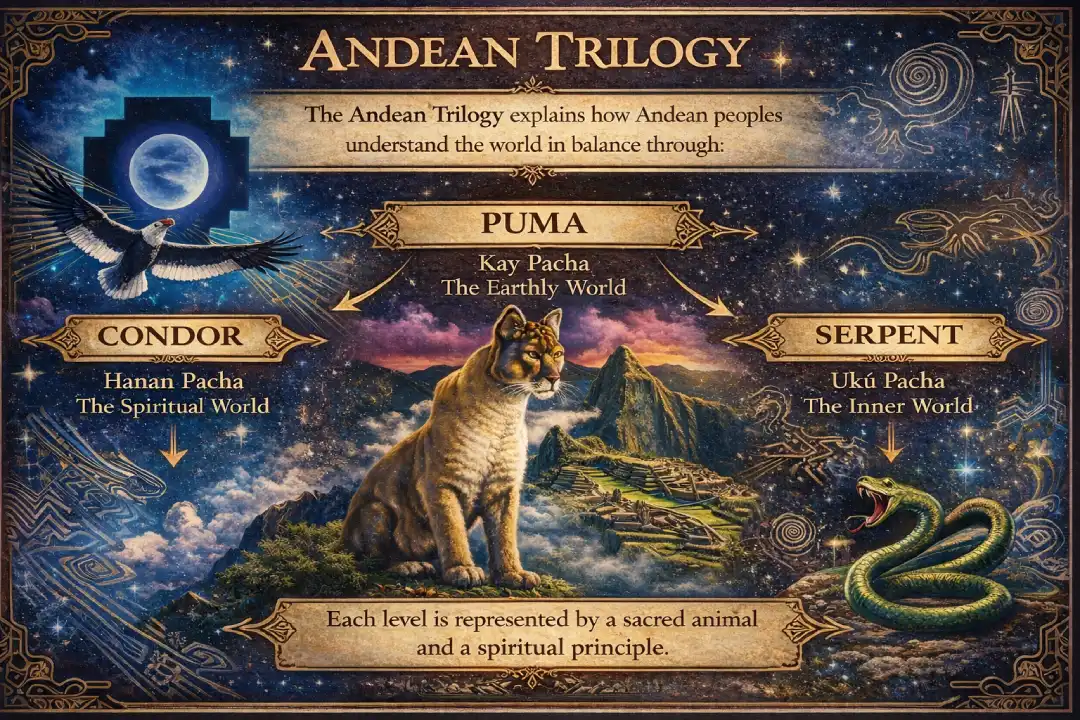
Unlike many Western cosmovisions that separate the spiritual from the material or the human from nature, the Andean vision understands everything as part of the same living system. Each of the three pachas is inhabited by different beings and energies, but all are deeply interrelated: each action in one of the worlds has direct impact on the others, and balance between them guarantees harmony of the cosmos and daily life.
This integration between time-space, spirit-matter, and human-nature transforms the Andean Trilogy into not just an explanation of the universe but a practical guide for living in reciprocity and balance with all forms of existence.
MOUNTAIN OF SEVEN COLORSRainbow Mountain Peru
Hike through the Andes to one of the most famous mountain of natural mineral colors.
Ukhu Pacha – The Inner and Subterranean World
Ukhu Pacha represents the inner, deep, and hidden world—the plane of the germinal, the ancestral, and the transformative. It’s the space of origin, the past, and ancestors, but also of gestation, transformation, and constant renewal of life.
In Andean mentality, this world isn’t associated with punishment or negativity. On the contrary, it’s not hell or a place of condemnation but the vital space where fundamental processes of existence are generated: it’s the place of seeds, roots, springs, caves, and the dead who reintegrate into the earth to regenerate it. Here occurs the fertility of the land, crop growth, and perpetual renewal of life.
Remember this:
Represented by the snake, an animal symbolizing change, adaptation, rebirth, and ancestral wisdom through cycles of renewal
Ukhu Pacha reminds us that every growth process involves a return to what’s essential and deep, and that death isn’t an ending but a transition toward regeneration that feeds life anew.

Kay Pacha – The World of the Present
Kay Pacha represents the current world, the visible and tangible reality where humans, animals, plants, and natural elements live. It’s the plane of the present, consciousness, and daily life where balance or imbalance from the other worlds materializes.
This is the space of action, work, social relationships, and agriculture, where all human, social, and cultural activities unfold. It symbolizes the direct relationship with nature and traditions, manifesting as the place of daily coexistence with the environment.
Remember this:
Represented by the puma, symbol of strength, intelligence, courage, instinct, balance, and active presence
Kay Pacha is where you directly experience whether harmony or imbalance exists in the cosmos, and where each action of reciprocity and respect contributes to maintaining balance between the three worlds.

Kay Pacha, represented by the PUMA
Hanan Pacha – The Upper World
Hanan Pacha is the celestial world, the upper plane where gods, major divinities, celestial bodies, and cosmic forces reside. It’s not a “heaven” in the Christian sense of absolute separation but a space of potentialities and superior energies that directly influence earthly life.
Here dwell central deities of Andean religion like Wiracocha (the creator), Inti (the Sun), Mama Quilla (the Moon), Pachacámac (creator of the earth), Mama Cocha (mother of the sea), and Illapa (god of lightning and storms), along with stars and other celestial manifestations.
Remember this:
Represented by the condor, sacred bird and messenger between sky and earth, symbolizing perpetual connection between the elevated and the earthly
Hanan Pacha reminds us that the divine isn’t disconnected from the everyday but that superior forces descend and constantly integrate with present life and the deep earth. In the Andean world, opposites don’t contradict—they complement. Duality and balance are vital principles; therefore, they didn’t speak of individual rights but of shared responsibilities.

Importance of the Three Worlds in the Andean Trilogy
The importance of the three worlds transcends philosophy to become practical daily guidance. In agriculture, the Andean farmer doesn’t just plow the land but recognizes they’re participating in a sacred act involving all three planes. Before planting, they perform ceremonies for Hanan Pacha asking for timely rains, work the land of Kay Pacha with respect, and make payments to Ukhu Pacha so seeds germinate. In traditional medicine, healers diagnose illnesses as imbalances between worlds. A person can be sick because their energy is unbalanced (Hanan Pacha), because their social relationships are broken (Kay Pacha), or because they’ve lost connection with their ancestral roots (Ukhu Pacha). Healing involves restoring balance between the three planes through rituals, medicinal plants, and spiritual counsel.
Snake (Ukhu Pacha)
The snake is associated with Ukhu Pacha, the inner and subterranean world. In Andean cosmovision, it symbolizes profound knowledge—that which isn’t visible at first glance but sustains life. Its movement close to the earth and its link with the subsoil make it an emblem of origin, fertility, and energy emerging from the world’s depths.
One of its most important meanings is transformation. The capacity to shed skin represents constant rebirth, adaptation to change, and the need to leave behind the old to make way for new cycles. Therefore, the snake is closely linked to agricultural processes, crop growth, and regeneration of Pachamama.
In Andean cultural interpretation, the snake’s appearance can be interpreted as a message of change, warning, or readjustment, both in personal life and in the balance of community and nature.
| Snake (Ukhu Pacha) | Description |
| Primary Symbolism | Ancestral wisdom and constant renewal. |
| Relationship with Ukhu Pacha | Linked to the inner world, the past, and the deep energy of the earth. |
| Key Idea | Shedding skin symbolizes rebirth, transformation, and leaving behind the old. |
| Cultural Interpretation | Its appearance is interpreted as a sign of changes, warnings, or necessary adjustments in daily life and agricultural cycles. |

Puma (Kay Pacha)
The Puma represents Kay Pacha, the world of the present and action. It’s the animal embodying vital force, courage, and practical intelligence necessary to face daily life. In Andean culture, the puma doesn’t symbolize excessive aggression but balance between power and control.
This feline is a reminder that acting with determination must be accompanied by respect for the environment and responsibility toward the community. Its figure is associated with conscious leadership, firm decision making, and mastery of one’s own instinct without losing harmony. The Puma also reflects the direct relationship between humans and nature. Its presence in Andean symbolism emphasizes that life in Kay Pacha demands attention, discipline, and balance between body, mind, and environment.
| Puma (Kay Pacha) | Description |
| Primary Symbolism | Strength, courage, and practical intelligence. |
| Relationship with Kay Pacha | Represents daily life, the tangible and visible in the world of the present. |
| Key Idea | Teaches you to act with determination while maintaining balance and control. |
| Natural Fact | It’s agile and silent; can make long jumps and move with great precision. |
Did you know…?
The Andean puma is a protected species. Its illegal hunting or capture can result in penalties and legal proceedings according to current regulations.

TURQUOISE LAKE HIKEHumantay Lake
Discover bright turquoise waters beneath the snowy peaks of the Andes.
Condor (Hanan Pacha)
The condor, or kuntur, is the supreme symbol of Hanan Pacha, the upper or celestial world. It’s considered the sacred bird par excellence and the principal messenger between earth and the gods. Its ability to fly at great heights makes it a metaphor for spiritual elevation and broad vision of the cosmos.
In Andean cosmovision, the condor’s flight represents connection with the divine, superior wisdom, and understanding of universal order. Observing it in freedom is interpreted as a sign of protection, guidance, and harmony between worlds.
The condor also symbolizes spiritual responsibility: it invites you to elevate consciousness, look beyond the immediate, and understand that human life is part of a greater balance involving nature, ancestors, and cosmic forces.
- Primary symbolism: spiritual connection and superior wisdom.
- Relationship with Hanan Pacha: upper world, divine energy, and cosmology.
- Key idea: represents the capacity to elevate your gaze and understand cosmic order.
- Cultural interpretation: its flight is interpreted as a sign of strength, guidance, and harmony between worlds.
| Condor (Hanan Pacha) | Description |
| Primary Symbolism | Spiritual connection and superior wisdom. |
| Relationship with Hanan Pacha | Represents the upper world, divine energy, and Andean cosmology. |
| Key Idea | Symbolizes the capacity to elevate your gaze and understand cosmic order. |
| Cultural Interpretation | Its flight is interpreted as a sign of strength, guidance, and harmony between worlds. |

Notable Characteristics of the God of the Skies, the Andean Condor
- The condor is a large bird, monogamous and sedentary, with certain crepuscular habits.
- Its head is bare, without feathers.
- The female is slightly smaller than the male, doesn’t have a crest, and both possess extraordinary vision.
- The male has a crest on the forehead and part of the beak, is larger in size, and has yellowish brown eyes.
- Its beak is strong, with an apical hook and sharp edges.
- It has a voluminous crop that’s noticeable when feeding.
- Its legs are robust, with strong toes, though with relatively blunt claws.
- As for plumage, the young condor has brown or ochre tones, while the adult has bluish black feathers, a collar of white down, and large white patches on the wing tips.
Where Can You Observe the Andean Trilogy?
The Andean Trilogy isn’t just an abstract philosophical concept but a living reality that permeates the art, architecture, traditions, and landscape itself of Cusco and its surroundings. Visitors have multiple opportunities to connect directly with these sacred symbols through archaeological sites, artisan markets, ceremonial experiences, and specialized tours.
Manifestations in Architecture and Archaeological Sites
Cusco: The City Shaped Like a Puma
The capital of the Inca Empire was designed in the shape of a puma, with Sacsayhuamán fortress located at the puma’s head and Qorikancha positioned at the tail. Though it requires imagination to visualize on modern maps, Cusco’s museums display historical maps that clearly show this urban design honoring the puma as guardian of Kay Pacha.
Sacsayhuamán doesn’t just form the puma’s head but its stone structures evoke the feline’s ferocity and solidity. The megalithic walls of this complex, with stones fitting together with millimeter precision, represent the strength and power the Incas attributed to this sacred animal.
Qorikancha (Temple of the Sun) was the empire’s most important spiritual center. At Qorikancha you can see engravings and carvings of snakes, signaling its connection with Ukhu Pacha. This temple, where Inca and colonial architecture converge, houses representations of the three worlds in its various chambers dedicated to the Sun, Moon, and other divinities.
Machu Picchu: Sacred Architecture
Machu Picchu is one of the most emblematic places where you can observe and learn about the Andean Trilogy. The Temple of the Condor is particularly impressive: using natural rock formations, the Incas carved a three dimensional representation of the condor with extended wings, while the bird’s head and neck are sculpted at the structure’s base.
The Temple of the 3 Windows symbolizes this worldview: the world of the gods, the world of the living, and the world of the dead. Each window represents one of the three pachas, allowing sunlight to illuminate the interior at specific times of year.
Tours and Specialized Experiences
Condor Flight at Chonta Canyon
One of the most impactful experiences for directly observing one of the Andean Trilogy symbols is the tour to Chonta Canyon. The Condor Flight at Chonta Canyon is one of Cusco’s most striking nature tours, located in the Apurímac River canyon.
Cusco City Tour
The City Tour Cusco explores the city designed in the shape of a puma and visits Sacsayhuamán fortress, allowing visitors to understand how Inca urban planning reflected their tripartite cosmovision.
Museums and Cultural Centers
The Pre Columbian Art Museum and the Inka Museum in Cusco house extensive collections of ceramics, textiles, and metalwork featuring representations of the Andean Trilogy. These spaces offer historical context and detailed explanations about the meaning of these symbols.
Frequently Asked Questions About the Andean Trilogy
1. What is the Andean Trilogy?
2. Where can I see the Andean Trilogy in Cusco?
3. What does each animal of the Andean Trilogy mean?
4. What’s the best tour to learn about the Andean Trilogy?
5. When is the best time to visit Chonta Canyon to see condors?
6. Why does Cusco have the shape of a puma?
7. Is the Andean Trilogy still practiced today?
8. What does the Temple of the Condor at Machu Picchu represent?
Autor

Shared:



If you liked this article and the information you found, give us 5 stars!

 (1 votos, promedio: 4.00 de 5)
 Loading...