


What Is the Intihuatana in Machu Picchu?
The Intihuatana in Machu Picchu is a carved Inca ritual and astronomical stone located in the sacred sector of the citadel, commonly interpreted as “the place where the sun is tied.” It is best understood as a ceremonial and solar marker linked to observation, agriculture, sacred geography, and the relationship between architecture and the sky, not as a simple modern sundial. For visitors, the practical point is that access is controlled, direct contact is restricted, and the stone is most closely associated with the classic Circuit 2 route logic, so you should verify your exact ticket before planning your visit around it.
Table of Contents
A few places in Machu Picchu concentrate as much symbolism as the Intihuatana. Set high within the sacred sector of the Inca city, this carved stone has been described as a solar marker, a ceremonial point and a symbolic bridge between the earthly world, the sun and the surrounding mountains.
The most useful way to understand the Intihuatana is with balance. It is not a mystical object that can be reduced to tourist legends, and it is not only a “sundial” in the modern sense either. It is an Inca ritual and astronomical stone whose meaning is tied to observation, agriculture, sacred geography and the relationship between architecture and the sky. For the wider site context, start with our Machu Picchu travel guide. If you need to know which ticket may let you see this sector, review the Machu Picchu circuits and routes before booking.
| Sacred Sectormain location | Circuit 2classic route logic | 1.70 m5.6 ft approx. height | View onlyverify access first |
WORLD WONDER IN THE ANDESMachu Picchu
Discover the history, landscapes, and essential tips for visiting this world wonder.

The sun standing still before the Intihuatana. Photo by: Formentí Natural.
What Is the Intihuatana?
The Intihuatana is a carved Inca stone located in Machu Picchu’s sacred sector. Its Quechua name is usually explained from Inti, meaning sun, and watana or huatana, meaning to tie or fasten. This is why it is often translated as “the place where the sun is tied” or “the hitching post of the sun.”
Its meaning is not limited to one function. The stone is commonly associated with solar observation, seasonal cycles, ceremonial practice and the symbolic relationship between the Inca world and the sky. It likely helped connect time, agriculture, ritual and sacred landscape in one highly visible point inside the citadel.
| Key idea | What travelers should understand |
| Quechua meaning | Usually interpreted as “the place where the sun is tied,” linked to Inti, the sun. |
| Function | Probably combined solar observation, ceremonial practice and symbolic connection with sacred geography. |
| Material | Carved from granite bedrock within Machu Picchu. |
| Visitor access | Direct access is restricted. Visitors should verify whether their current route allows a view of the stone. |
| Best context | It is best understood with a guide who can explain astronomy, ritual use and the route system. |
The Intihuatana at Machu Picchu
Carved directly into the mountain’s bedrock, the Intihuatana shows planes, edges and a raised central form that have often been interpreted in relation to shadows, the movement of the sun and ritual timing. Its exact use is still discussed, but its importance inside Machu Picchu is clear.
The stone is often described as approximately 5.6 ft (1.70 m) high, with a perimeter of about 28.2 ft (8.60 m). These measurements should be treated as planning references, because the visitor experience today is based on observation from authorized areas, not close measurement or direct contact.
- Its carved surfaces and edges are commonly linked to solar observation.
- Its position in the sacred sector reinforces its ceremonial importance.
- Its raised central form may have helped create meaningful shadows during key moments of the year.
- Its value is cultural, astronomical, ritual and symbolic rather than purely decorative.

Why Was the Intihuatana Important?
The Intihuatana mattered because the Inca world did not separate astronomy, agriculture, ritual and political order in the same way modern categories do. Observing the sun helped organize planting and harvesting cycles, but the act of observing was also sacred. The sun was not just a light source. It was connected to life, power, time and reciprocity with the natural world.
Guides that help explain the Intihuatana
An Inca Stone Between Heaven and Earth
For the Incas, the Intihuatana may have worked as a point where the visible movement of the sun met the ceremonial life of the city. This is why many explanations describe it as a stone “between heaven and earth.” The phrase is poetic, but it points to something practical: in the Andes, time, harvests, mountain worship and solar observation were deeply connected.
Did you know?
The idea of “tying the sun” should be understood as a cultural and symbolic expression. It reflects the ritual importance of the sun in the Andean world, not a literal physical action.

The clouds caressing the view of the Intihuatana. Photo by: Cultura Genial.
Where Is the Intihuatana in Machu Picchu?
The Intihuatana is located in the upper part of Machu Picchu’s urban and sacred sector. Its position gives it visual and ritual importance because it stands above many of the architectural spaces connected with ceremonial interpretation.
Under the current route system, you should not assume that every Machu Picchu ticket lets you see the Intihuatana in the same way. The classic Circuit 2 logic is usually the most relevant for travelers interested in the sacred sector, but official routes and availability can change. Check your exact ticket before planning around this place.
Function of the Intihuatana Stone
The safest way to explain the Intihuatana is to speak of possible complementary functions. It was likely not only a clock, not only an altar and not only a symbol. Its meaning comes from the way those functions overlap.
Solar and Calendar Function
The Intihuatana is often described as a solar marker. Its carved form may have helped observe shadows and seasonal changes, especially around solstices or important agricultural periods. In a society where agriculture depended on careful attention to the environment, reading the sun was a practical and sacred act.
At the same time, travelers should avoid reducing it to a modern “sundial.” The Andes are complex, and Machu Picchu’s cloud-forest setting means that observation, ritual and landscape symbolism likely worked together.

The mountain watching over Cusco’s dream. Photo by: Larry Probst.

Time carved in stone. Photo by: Eric Miraglia.
Ceremonial Function
The Intihuatana was also part of a sacred landscape. The Incas honored Inti, the sun, and also recognized the power of the apus, the surrounding sacred mountains. Rituals at or near the stone may have been connected with solar cycles, agricultural fertility, protection from drought and the continuity of life.
This ceremonial dimension matters for travelers because it prevents a flat reading of Machu Picchu. The city was not only built to be beautiful. Its architecture, temples, rocks, water channels and mountain views were part of a larger worldview.
Symbolic and Landscape Function
The Intihuatana also helps explain how the Incas worked with place. Its value is not only in the stone itself, but in its position within the citadel, its relationship with the sky and its connection to nearby mountains. In this sense, it belongs to the same interpretive world as the Temple of the Sun, Sacred Rock and other places inside Machu Picchu.
The Intihuatana of Machu Picchu: Damage and Conservation
The Intihuatana is one of the most protected stones in Machu Picchu because it has already suffered damage and because high visitor traffic can wear down fragile cultural heritage.
The damage to the Intihuatana is a reminder that cultural heritage should never be used casually for promotional purposes.
- In September 2000, the Intihuatana was damaged during the filming of a beer commercial when equipment fell onto the stone and broke part of one corner.
- In recent years, direct access has been restricted to reduce wear and protect the monument from visitor pressure.
- Visitors should not touch, lean on or attempt to enter restricted areas around the stone.

The Intihuatana with one of its edges broken. Photo by: Waman Adventures.
Practical Information for Tourists
The most important practical point is this: seeing the Intihuatana depends on the current Machu Picchu route system. Do not buy a ticket assuming that every route gives the same access to the sacred sector.

Stone altar. Photo by: 500px.

Emerging from the white dream. Photo by: Samuel Alves.
Which Circuit Lets You See the Intihuatana?
The Intihuatana is most closely associated with the classic archaeological visit through Circuit 2. In official route logic, Circuit 2 includes the Inka City route, where the sacred sector is part of the broader interpretation of Machu Picchu. However, direct access to the immediate platform may remain restricted, and the exact viewing conditions can depend on visitor flow and official updates.
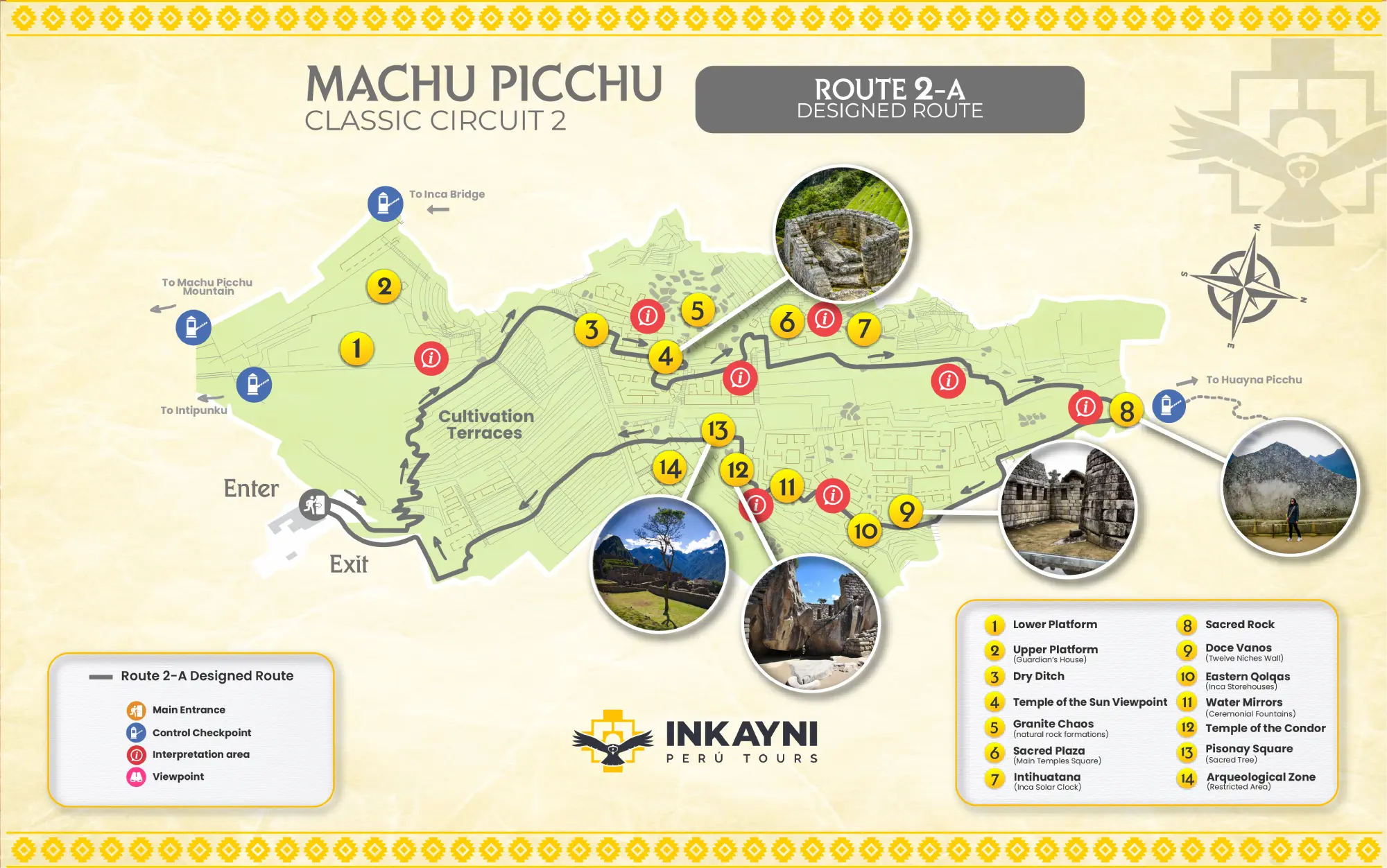
Map of Machu Picchu Circuit 2-A showing the classic route through terraces, temples and ceremonial areas.
| Planning point | What to check before booking |
| Best route logic | Check Circuit 2 routes, especially if your priority is the classic archaeological and sacred-sector visit. |
| Direct access | Do not assume you can stand next to the Intihuatana. Direct access may be restricted for conservation. |
| Guide value | A guide helps explain what you are seeing from the authorized route. |
| Ticket timing | Choose the ticket first, then plan your list of places inside Machu Picchu. |
| Official verification | Check current route names and availability on the official ticket platform before buying. |
Important note:
If seeing the Intihuatana is important to you, confirm your exact route before buying the ticket. The route printed on your ticket controls what you can see inside Machu Picchu.
Best Time to See It
Because direct access is restricted, there is no single “best time” for standing at the Intihuatana. For general visibility inside Machu Picchu, morning light can be softer and more atmospheric, while afternoon visits can feel calmer on some dates. Weather, route flow and visitor volume still vary.
For timing beyond the Intihuatana, compare the best time of day to visit Machu Picchu with Machu Picchu weather by month.
Conservation Rules in Machu Picchu
Follow official rules carefully. Machu Picchu is a protected archaeological site, and the Intihuatana is one of its most delicate symbolic structures.
| Allowed | Not allowed |
| Walking on marked routes. | Touching, leaning on or entering restricted structures. |
| Taking photos without disturbing visitor flow. | Using drones, tripods or professional equipment without authorization. |
| Carrying a small backpack within official limits. | Entering with large backpacks, food, alcohol or prohibited objects. |
| Listening to your guide and park staff. | Shouting, making loud noises or leaving the marked route. |
For current visitor behavior, review the official Machu Picchu code of conduct before entering the site.
Plan the Intihuatana with the right Machu Picchu logistics
PERU’S LEGENDARY HIKEInca Trail to Machu Picchu
Follow the historic trail through mountain passes, Inca sites, and cloud forest paths to Machu Picchu.
Other Intihuatanas in Cusco and Peru
The Intihuatana of Machu Picchu is the most famous, but the idea of carved stones, solar markers and ritual observation also appears in other Andean sites. These examples should be presented with care because some are well known, while others are possible or interpretive references rather than exact equivalents.
Pisac’s Intihuatana
At Pisac, in the Sacred Valley, the Intihuatana forms part of a larger ceremonial and agricultural complex. Surrounded by terraces and high mountain views, it helps show how solar observation and landscape planning were not limited to Machu Picchu.

The warm hues of the Pisaq Intihuatana. Photo by: Wikipedia.
Ollantaytambo’s Intihuatana
Ollantaytambo also preserves carved stone features associated with solar observation and the Temple of the Sun sector. The site is especially useful for travelers who want to compare Machu Picchu with another major Inca center in the Sacred Valley.

The landscape behind the Ollantaytambo Intihuatana. Photo by: Kantu Peru Tours.
Qenqo’s Ritual Stonework
Qenqo, near Cusco, is often discussed in relation to ritual stone carving, channels and ceremonial spaces. Its interpretations are more uncertain, so it is better to treat it as a ritual landscape rather than present it as identical to the Intihuatana of Machu Picchu.

The sky posing for the Qenqo Intihuatana. Photo by: Peru Travel.
Other Possible Intihuatana References in Peru
Some travelers and researchers use the term Intihuatana for other carved or aligned stones in Peru, including references in Huancavelica, Lima, Apurímac and Huánuco. These sites may have astronomical or ceremonial associations, but the evidence and visibility vary. They should not be presented as direct copies of Machu Picchu’s Intihuatana without careful local context.
- Pomacocha or Incahuasi references in Huancavelica: linked in some discussions to Inca ceremonial platforms and solar observation.
- Markahuasi, Lima: often surrounded by interpretive theories, so it should be treated cautiously.
- Incahuasi, Cañete: an important Inca administrative site where some structures may relate to solar alignment.
- Sayhuite, Apurímac: better known for its carved monolith and hydraulic or ritual interpretations than as a classic Intihuatana.
- Huánuco Pampa: an important Inca administrative center where solar and ceremonial interpretations appear in regional discussions.
Reading the Sun
The Intihuatana has survived as one of the most evocative stones in Machu Picchu because it gathers several layers of meaning: observation, ritual, agriculture, sacred geography and memory. It reminds travelers that the Incas did not only build with stone. They built with light, direction, mountain lines and the rhythms of the sky.
From Inkayni Peru Tours, we invite you to visit Machu Picchu with a route, guide and timing that help you understand what you are seeing, not only photograph it.

Illuminating the eternal. Photo by: Peru Travel.
Frequently Asked Questions About the Intihuatana in Machu Picchu
How do you pronounce Intihuatana?
What is the Intihuatana?
What does Intihuatana mean?
What was the purpose of the Intihuatana?
Was the Intihuatana a sundial?
Where is the Intihuatana located in Machu Picchu?
Can visitors touch the Intihuatana stone?
Which Machu Picchu circuit lets you see the Intihuatana?
Why was the Intihuatana not destroyed by the Spanish?
How was the Intihuatana damaged?
What happens if the Intihuatana breaks?
Is the Intihuatana open to visitors now?
Is the Intihuatana related to Inti Raymi?
Do I need a guide to understand the Intihuatana?
What other places in Machu Picchu are related to sacred interpretation?
Escrito por


Shared:



If you liked this article and the information you found, give us 5 stars!
 (1 votos, promedio: 5.00 de 5)
 Loading...