


Rainbow Mountain Peru
Rainbow Mountain Peru, also known as Vinicunca, is a geological formation located in the Vilcanota mountain range, in the Ausangate area. Its color bands are not a natural painting or an isolated phenomenon, but the result of sediments, minerals, geological pressure, tectonic uplift, and erosion accumulated over millions of years. The summit sits at around 17,060 ft (5,200 m) above sea level, so the real challenge is not just the distance — it is the altitude, the cold, the wind, and the lack of oxygen. If you are planning to visit Vinicunca, acclimatizing beforehand, departing before dawn, and arriving with realistic expectations about the colors are all worth planning for. What you see on the mountain changes depending on light, season, and sky conditions.
Table of Contents
Cusco holds some of the most recognized landscapes in the southern Andes, but few day trips have grown as fast in recent years as rainbow mountain Peru. The reason is straightforward enough when you first see it: the mineral bands stand out against a rough, open, cold geography where the air already feels thin before the hike even starts. What tends to get lost in photographs is that the actual experience depends less on perfect color and more on altitude, arrival time, weather, and the route you choose to ascend.
| 17,060 ftRainbow Mountain elevation (5,200 m) |
CusipataMost used route |
April–OctoberDry season |
1.5–2 hrsHiking time each way |
That is worth keeping in mind from the start. If you are thinking about visiting Peru’s rainbow mountain, what follows covers the decisions that matter most: where Vinicunca is, how it formed, how demanding the hike actually is, whether to go via Cusipata or Pitumarca.
What is Rainbow Mountain?
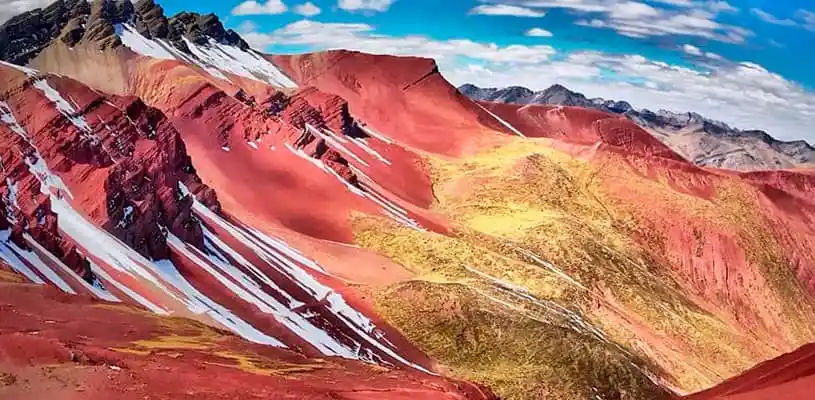
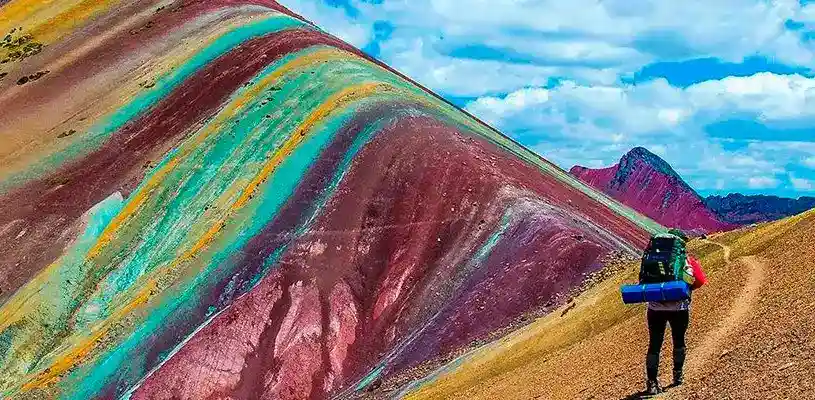
Rainbow Mountain, also called Vinicunca, is a sedimentary mountain in the Cusco region of Peru, known for the mineral bands that formed across its surface over millions of years. It sits within the Vilcanota mountain range, in the broader Ausangate area, and its current appearance is the product of a long geological process: layers of sediment, tectonic pressure, and erosion working together over deep time. The pinks, reds, ochres, greens, yellows, and whites you see there are not artificial effects, though their intensity varies considerably depending on light, weather, and the time of year.
When you arrive, what surrounds you is a wide, spare high-altitude landscape: bofedales (Andean wetlands), open grasslands, herds of alpaca, and at several points along the route, the Ausangate glacier marking the horizon behind everything. That combination of mineral color, altitude, and Andean setting is what makes the visit to Vinicunca distinct.
Did you know?
What makes this mountain so particular is the contrast between its pink, reddish, ochre, green, yellow, and white bands and the hard landscape surrounding it. It does not stand alone. Around it stretch wide slopes, wetlands, alpaca herds, and depending on where you are on the route, views of the Ausangate glacier — a dominant presence in this part of the southern Andes.

Rainbow Mountain, also known as Vinicunca
PERU’S LEGENDARY HIKEInca Trail to Machu Picchu
Follow the historic trail through mountain passes, Inca sites, and cloud forest paths to Machu Picchu.
Where is Rainbow Mountain and how high is it?
Rainbow Mountain Peru is located in the Cusco region, in an area connected to both Pitumarca and Cusipata, within the Ausangate glacier environment. From Cusco, the road transfer takes approximately three hours, though the actual time can vary depending on road conditions, weather, and the exact point where the hike begins.
The most important reference point is not the distance but the altitude. How high is rainbow mountain Peru? The summit sits at around 17,060 ft (5,200 m) above sea level, and the viewpoints most people use are already above 16,400 ft (5,000 m). That number changes everything about the experience. At that elevation, effort registers sooner, breathing shortens faster, and a stretch that would feel manageable elsewhere can become genuinely heavy for someone who arrived in Cusco recently or has little experience hiking at altitude.
Did you know…?
Many travelers assume Rainbow Mountain is easier than the Classic Inca Trail because it is usually sold as a one-day trip. In practice, the viewpoint sits far above Machu Picchu and even above the highest point of the Classic Inca Trail. That is why a shorter hike here can still feel harder than expected if you arrive poorly acclimatized.
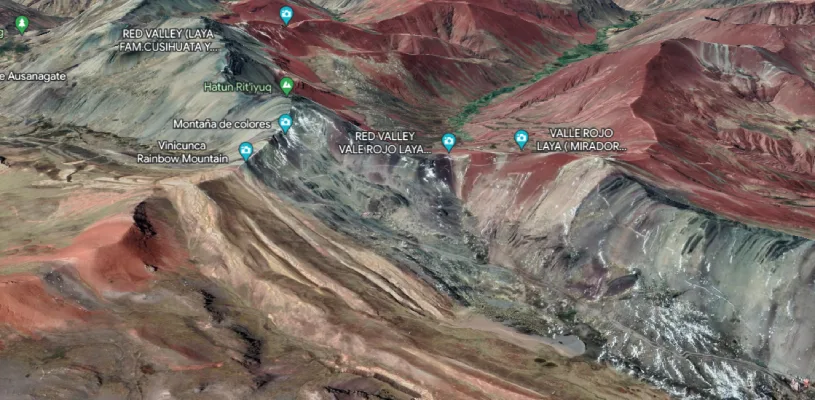
Satellite map of Rainbow Mountain’s location
Keep this in mind:
The Ausangate area and its mountains form part of a sacred space for local communities. The landscape carries meaning beyond geography: the relationship between apus (sacred mountains), water, herding, climate cycles, and communal memory is very much alive here.
| Key fact | Reference |
|---|---|
| Region | Cusco |
| Geographic setting | Vilcanota mountain range, Ausangate area |
| Summit altitude | Approx. 17,060 ft (5,200 m) |
| Distance from Cusco | Approx. 62 mi (100 km) by road, depending on route |
| Cusco altitude | 11,152 ft (3,399 m) |
Why is Rainbow Mountain Peru colorful? The geology behind the bands
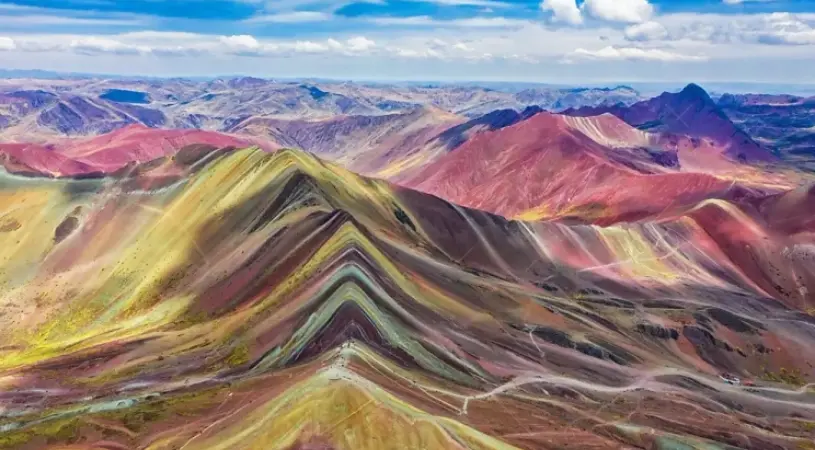
The name Vinicunca is often interpreted as “colorful mountain pass,” and the multicolored appearance of the slope has a long geological explanation. Over millions of years, marine, lacustrine, and fluvial sediments were deposited in this area. Over time those materials compacted, transformed into sedimentary rock, and were then exposed through tectonic uplift, erosion, water, wind, and temperature change.
Snow and ice covered this area for a long time. As that coverage diminished, the mountain became more visible to a wider range of visitors. That is also the source of the idea, repeated so often, that the mountain “appeared” only a few years ago. It did not newly form. What changed was its exposure and its rapid spread across social media.
| Visible color | Approximate mineral source |
|---|---|
| Pink | Red clays, mudstones, and sandstones |
| White | Quartzose sandstone and marls with calcium carbonate |
| Deep red | Iron-bearing mudstones |
| Green | Phyllites and clays rich in ferromagnesian minerals |
| Earthy brown | Fanglomerates with rock fragments and magnesium |
| Mustard yellow | Calcareous sandstones with sulfide minerals |

Mineralogical composition of Rainbow Mountain Peru
Brief history
- During the Inca period, the area formed part of the territory linked to the Canchis ethnic group and later to the Tahuantinsuyo.
- Local communities and ayllus (Andean community units) fulfilled roles in territorial control, production, and circulation across a zone demanding by climate and altitude.
- After the colonial and republican periods, the surrounding area remained occupied by local inhabitants tied to herding and communal life.
- The mountain’s international reach grew mainly from late 2015 into early 2016, when images began circulating widely across social media.
Are the colors real?
Yes, the colors are real. What is not always real is the intensity with which they appear in some edited images. The visual experience changes considerably depending on the time of day, cloud cover, soil moisture, time of year, and the angle from which you are looking. A clear dawn can bring out the bands more sharply. A flat sky or a fresh snowfall can dull the contrast significantly.
If you arrive expecting a saturated postcard like some photographs online, you may leave disappointed. If you arrive understanding that this is a high-altitude, shifting, mineral landscape, it becomes much easier to appreciate what it actually offers.
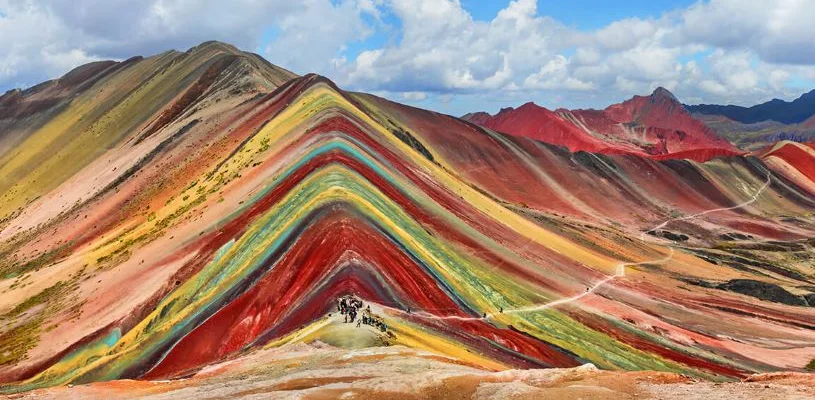
How Rainbow Mountain’s appearance can vary depending on editing and light conditions
Altitude, acclimatization, and altitude sickness
The main difficulty on rainbow mountain Peru is not technical. You do not need mountaineering experience to reach the viewpoint. The real issue is that the hike takes place above 15,090 ft (4,600 m) and finishes above 16,400 ft (5,000 m). For someone who just landed in Cusco or flew in directly from Lima, that difference registers immediately.
The sensible approach is to spend at least two days acclimatizing in Cusco before heading up. It is not an absolute guarantee, but it reduces the risk of a difficult day considerably. Eating light, staying well hydrated, avoiding alcohol the night before, and hiking at a steady pace rather than pushing from the start all help.
Expert tip:
If you need support during the hike, horse rental is available on the route. The typical price runs between $25–$32 USD (approx. S/80–S/120) per stretch, though in some operations it may be handled differently or offered only as emergency support.
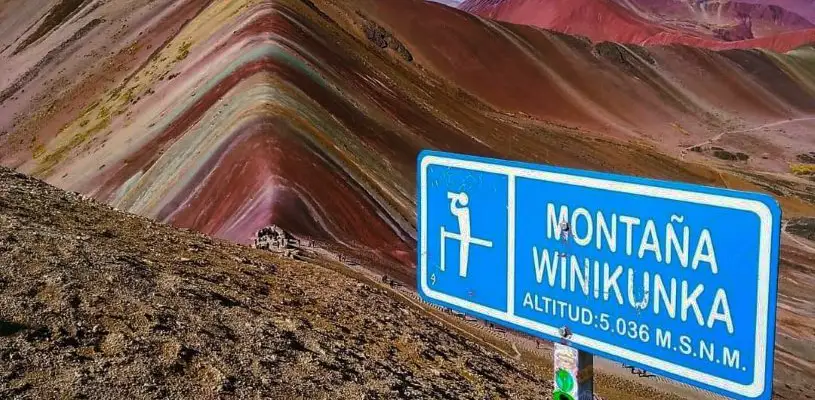
Viewpoint along the route toward Vinicunca
The most common symptoms of altitude sickness include headache, loss of appetite, nausea, unusual fatigue, and in stronger cases, difficulty breathing. Neither overstating nor dismissing those symptoms is useful. Most travelers feel only tiredness and heaviness, but some underestimate the altitude and end up ruining the excursion by arriving without rest or prior adaptation. If symptoms feel intense, inform your guide immediately. This information is not a substitute for medical advice — consult a doctor before the hike if you have concerns about altitude or related medication.
- Take one or two days to acclimatize in Cusco before the hike.
- Consult a doctor if you are considering medication for altitude.
- Stay hydrated the day before and the morning of the tour.
- Eat light and avoid excess alcohol, tobacco, and heavy meals.
- Walk slowly and take short breaks — do not try to keep pace with the fastest in the group.
- Coca tea (mate de coca) may help some people, though it does not replace acclimatization or medical evaluation.

Hydration and rest before a high-altitude hike
How much does a rainbow mountain Peru tour cost?
If you are comparing options, the most useful starting point is the range that agencies and travel platforms generally work with for this excursion. For group service, prices from $40 to $100 USD per person are common, depending on group size, departure time, and what is actually included. For private service, the range typically runs from $120 to $250 USD per person, though it varies with the number of travelers, transport quality, and the level of attention during the day.
| Service type | Reference range | What usually affects the price |
|---|---|---|
| Group service | $40–$100 USD per person | Group size, whether entrance is included, food quality, departure time, trekking poles, oxygen, and the overall level of the operation. |
| Private service | $120–$250 USD per person | Number of travelers, schedule flexibility, more personalized attention, entrance inclusion, and general service comfort. |
Important note:
If you find a price significantly below the average, it is worth checking carefully what is included. Some rainbow mountain tours include the entrance fee and others do not. Some work with larger groups. Others do not carry trekking poles or oxygen, and transport and food quality vary considerably.
If you make the trip independently, beyond the entrance fee you will need to account for transport, breakfast, lunch, and smaller incidental costs. If you book a tour, confirm calmly what the price covers. Some budget options do not include the entrance ticket, trekking poles, oxygen, a first aid kit, or enough time at the top to move at a comfortable pace.
How difficult is the hike to Rainbow Mountain?
The distance does not impress as much as the altitude. That is the central point. Many people arrive thinking it is a straightforward hike and feel the ascent much sooner than expected. The trail typically starts above 15,090 ft (4,600 m) and climbs to just over 16,400 ft (5,000 m). In that range, even moderate effort becomes heavy if you are not acclimatized.
In practical terms, the hike can be summarized this way: it is not technical, but it is demanding because of the altitude. Someone who arrives rested, acclimatized, and at a steady pace generally makes it. Someone who arrives unprepared, sleep-deprived, or overconfident feels it much more. Weather adds to the equation. With mud, snow, or heavy wind, the effort increases.

Other Guides That Help Before Visiting Rainbow Mountain
Best time to visit Rainbow Mountain Peru
The most stable season generally runs from April to October. During those months rainfall is lower and visibility is generally better. June, July, and August draw the most visitors, so if you prefer a less crowded experience, April, May, September, or October are worth considering.
Between December and March the trail can start the day wet, with mud, snow, or fog. The mountain does not always close, but the experience becomes more uncertain and the visual reward can drop considerably if the sky does not cooperate.
| Period | What typically happens | Practical read |
|---|---|---|
| April and May | Greener landscape, more stable than peak rainy season | Very good window to visit |
| June to August | Dry season with the most visitors | Good conditions, more crowds |
| September and October | Good weather generally holds with somewhat less tourist pressure | Highly recommended |
| November to March | More rain, mud, fog, and possible snow | More uncertain experience |

General characteristics of the Rainbow Mountain hike
What is the best time of day to do the hike?
On a standard departure from Cusco, groups leave between 3:30 and 4:30 a.m. That may sound excessive, but it has a clear rationale. Arriving early improves the chances of cleaner skies, less congestion on the trail, and better light for viewing the mountain. Waiting longer usually means more people, stronger wind, and a body already worn down by the progression of the day.
Most tours return to Cusco in the afternoon or early evening. Count on a full and demanding day, not a short outing. Even though the hike itself does not fill the entire day, the transfer, the stops, and the altitude make the whole excursion more taxing than the distance alone suggests.
Getting to Vinicunca from Cusco
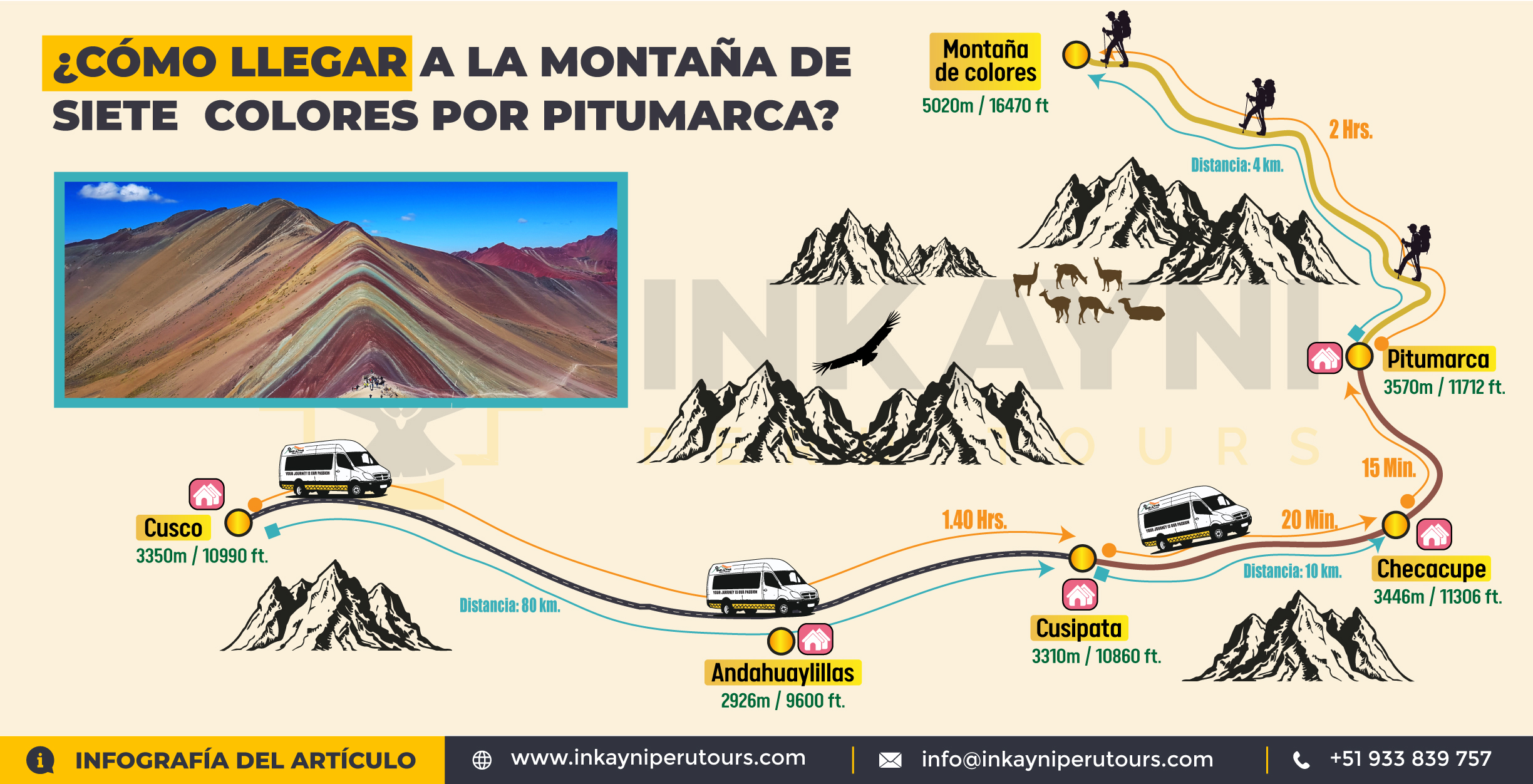
There are two access routes that come up when travelers research how to get to rainbow mountain Peru: Cusipata and Pitumarca. Both lead to the same general destination, but the experience differs in logistics, hiking duration, and the type of traveler each suits.
WORLD WONDER IN THE ANDESMachu Picchu
Discover the history, landscapes, and essential tips for visiting this world wonder.
Cusipata route
This is the most popular option for a day visit. From Cusco the road goes to the Phuluwasipata area, which serves as the starting point for the most commonly used trail. From there the hike proceeds on foot to the main viewpoint. The ascent typically takes between 1.5 and 2 hours, depending on pace, acclimatization, and trail conditions.
The advantage of Cusipata is clear: it is more practical, better established for regular tours, and usually the best choice for anyone who wants a direct excursion without overcomplicating the logistics. It is the route most visitors take.

Pitumarca route
Pitumarca offers a different approach. Some options combine this access with ATVs, which shortens the final hike to a much briefer stretch before the viewpoint. For certain travelers that can sound appealing, especially those concerned about sustaining a long uphill at altitude. Even so, even on this variant there is usually a final section on foot.
The advantage of Pitumarca lies more in a different experience and the motorized option than in logistical simplicity. For most first-time visitors, Cusipata remains the most direct and straightforward route to organize.
| Detail | Cusipata route | Pitumarca route |
|---|---|---|
| Current use | Most popular for day tours | Less common for first-time visitors, but used for the ATV option |
| Usual starting point | Phuluwasipata | Pitumarca access area |
| Typical hike | Approx. 1.5 to 2 hours each way | Shorter if you choose the ATV variant, but a foot section remains |
| Best suited for | Most well-acclimatized travelers | Those who want a different dynamic or prefer the motorized option |
Can you rent a horse?
Yes. On the most popular route it is common to find horse support for those who feel they will not be able to sustain the full ascent. This helps mostly people who run out of breath faster than expected or who want to conserve energy for the descent. Even so, the final stretch to the main viewpoint is typically done on foot.

What to pack for the hike to Vinicunca
The right approach here is not to overpack, but to carry what actually protects you through a cold morning, an exposed hike, and rapid weather shifts. At this altitude, one poorly chosen item can matter more than it ever would on a lower trail.
- Personal ID and some cash in small bills.
- Enough water for the hike.
- Hiking boots or trail shoes with solid grip.
- Layered clothing, a hat, gloves, and a waterproof outer layer.
- SPF 50+ sunscreen, UV-protective sunglasses, and a cap or wide-brimmed hat.
- A light pack with only the essentials.
- Easy-to-digest snacks: nuts, fruit, or energy bars.
- Any personal medications you need.
- Camera or phone with enough battery if you want to document the route.

Rainbow Mountain tour options with Inkayni Peru Tours
If you would rather not handle all the logistics yourself, it makes more sense to choose between clear formats than to sort through inflated itineraries. For most travelers, these are the options that actually matter:
Group Full Day Service
The most practical option for those who want to visit the mountain in a single day, departing before dawn from Cusco via the Cusipata route.
Private Full Day Service
Suited for those who want more control over pace, greater comfort, and a departure less dependent on a larger group’s schedule.
2-Day Route with Red Valley
A more measured alternative for those who want to extend the experience and not reduce Vinicunca to a quick round trip.
PERU’S LEGENDARY HIKEInca Trail to Machu Picchu
Follow the historic trail through mountain passes, Inca sites, and cloud forest paths to Machu Picchu.
What should a good service include?
- Professional bilingual guide.
- Hotel pickup and drop-off in Cusco.
- Full transport to and from the trailhead.
- Breakfast and lunch.
- Trekking poles.
- Oxygen bottle and first aid kit.
- Entrance fee included, or clear indication if it is paid separately.
Rather than looking for the lowest price, it is worth asking clearly what the service covers, how much time you will actually have at the top, whether the route goes via Cusipata or Pitumarca, and what support exists if someone in the group is significantly affected by the altitude.
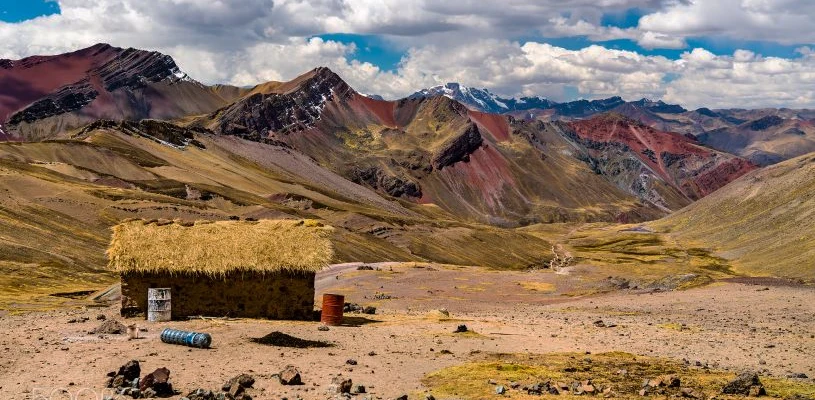
The hiking route in the Vinicunca area
Vinicunca rewards those who arrive prepared
Rainbow Mountain draws people in because of its mineral bands, but the experience begins before dawn, in the departure from Cusco, in the cold that is already present before the first step, and in that altitude where the body insists on slowing down. At the top you do not find only a slope with reddish, ochre, and green bands. You find open grasslands, dry wind, scattered herds, and the Ausangate glacier marking the landscape with a hardness that photographs do not fully convey.
Before booking, it is worth reviewing the route, confirming what the service includes, and honestly assessing your acclimatization. If you prefer to handle that logistics with local support, Inkayni Peru Tours can help you organize the experience with more clarity from the start.
Frequently asked questions about Rainbow Mountain Peru
Can you visit without a guide?
Yes, it is possible, but it is not always the most comfortable decision. The main reason is not that the trail is technically confusing, but that the logistics from Cusco require planning, a very early start, and coordinating transport in an area where public options do not run with the same reliability or frequency as in a city.
For someone with solid travel experience, patience for coordinating independent transport, and comfort navigating without organized support, it is feasible. For most others, a well-organized tour simplifies the day considerably. The point is not to use an agency out of fear, but to avoid letting logistics consume the energy you should be saving for a high-altitude hike.
Is Rainbow Mountain open year-round?
Generally yes, provided weather allows it. During the rainy season there can be cancellations or poor visibility conditions.
Can you see Rainbow Mountain without hiking?
Not fully. Even on a variant that cuts the effort significantly, a walking section usually remains. Beyond that, limiting the experience to “getting the photo” cuts out too much of what the route offers. Along the way you pass open slopes, herds of livestock, small apachetas (stone cairns built as offerings along Andean paths), high-altitude wind, and a landscape that, though demanding, explains why most people remember the full walk and not just the final point.
What is the best route for a first visit?
For most travelers, Cusipata is the most practical and straightforward option for a day trip.
Where is Rainbow Mountain?
Rainbow Mountain is located in the Cusco region of Peru, within the Vilcanota mountain range in the Ausangate area. It sits approximately 62 miles (100 km) from the city of Cusco by road, depending on the route taken.
How far is Rainbow Mountain from Cusco?
By road, the distance from Cusco to the trailhead is approximately 62 miles (100 km), depending on the access route. The transfer by bus or minivan takes around three hours each way.
How to get to Rainbow Mountain from Cusco?
Most travelers reach Rainbow Mountain from Cusco by organized tour, which includes transport to and from the trailhead. Departure is typically between 3:30 and 4:30 a.m. to arrive early and maximize conditions at the top. The two main access routes are via Cusipata, the most popular for day tours, and via Pitumarca, which is sometimes combined with an ATV option.
Is rainbow mountain worth it?
For most travelers who arrive properly acclimatized and with realistic expectations, yes. The hike is demanding because of the altitude, not because of technical difficulty, and the landscape along the way adds considerably to the overall experience. Those who find it less rewarding are usually those who expected the oversaturated images from social media or who underestimated the altitude. If you go prepared and at a sensible pace, the visit is worth the effort.
Is rainbow mountain worth visiting if I am not used to trekking?
It can be, but only if you acclimatize properly and accept that the main challenge is altitude, not trail difficulty. It is not a good idea to attempt it the day you arrive in Cusco.
Can children do the hike?
The altitude makes this excursion inadvisable for young children. If you are traveling with minors, evaluate their physical condition carefully and consult your operator before booking.
Are there restrooms on the route?
Yes, basic restroom facilities exist at certain points along the trail. They typically charge a small fee per use and function as basic amenities, not comfortable facilities.
Can you visit the Red Valley the same day?
Yes, many tours offer it as a complement to the main hike, though it depends on the group’s pace, the weather, and the time available during the day.
Does the mountain always look equally colorful?
No. The color changes considerably depending on light, cloud cover, the season, and soil moisture conditions.
Can I do the excursion independently and save money?
It is possible, but not always the better outcome. The logistics can become demanding and the actual savings depend on how you resolve transport, food, and timing on your own.
Shared:


If you liked this article and the information you found, give us 5 stars!
 (3 votos, promedio: 5.00 de 5)
 Loading...