


Quick answer
The 2 day Inca Trail or short Inca Trail is a regulated trekking route in Cusco, Peru, also known as the Short Inca Trail. It starts at Chachabamba (km 104), passes through Wiñay Wayna, and ends by entering Machu Picchu on foot through Intipunku (Sun Gate). The hike is approximately 10 km (6.2 miles) and combines stone-paved sections, cloud forest, and archaeological sites along the route.
It operates with limited permits (official limit of 250 users daily), so booking in advance is recommended, especially during the dry season (approximately May–September). Keep in mind that the Inca Trail closes in February for maintenance.
Table of Contents
If you did not get a permit for the Classic Inca Trail, or your trip simply does not allow for four days of trekking with campsites, the Short Inca Trail keeps what matters most in the decision: a real section of the original Inca road, archaeological sites along the way, and entry into Machu Picchu through the same ceremonial gateway. What changes is the volume of effort, the logistics, and the time the hike requires.
| 2 days1 night route | Km 104Train access only | ~7.5 miTotal trekking (~12 km) | 8,956 ftMax altitude (2,730 m) | 5–7 hrsDay 1 hiking | Feb closedAnnual closure |
WORLD WONDER IN THE ANDESMachu Picchu
Discover the history, landscapes, and essential tips for visiting this world wonder.
This guide explains how the Short Inca Trail works in practice: how it differs from the Classic Inca Trail, how permits, train access, prices, and acclimatization in Cusco affect the decision, and how the route fits within a broader Machu Picchu trip. It also helps separate this compact on-foot entrance from longer treks such as the Salkantay Trek, the Lares Trek, the Inca Jungle Trek, or the Choquequirao Hike.
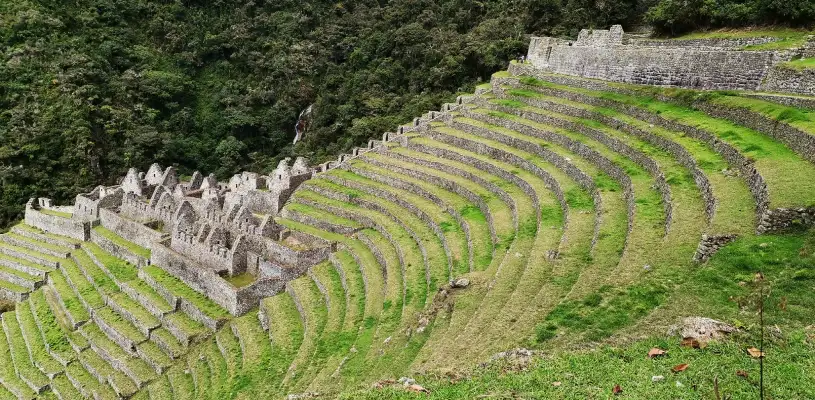
Wiñaywayna, one of the most important archaeological complexes on the Short Inca Trail section
Quick read:
The Short Inca Trail arrives at Machu Picchu through Inti Punku (the Sun Gate), the same ceremonial entrance used by hikers on the Classic Inca Trail. What it does not include is Dead Woman’s Pass, four full days of trekking, or high-altitude campsites. For travelers who want to reach Machu Picchu on foot with more compact logistics, this is the most direct option.
What is the Short Inca Trail (2 days)?
The Short Inca Trail or 2 day Inca Trail is the brief version of the Inca Trail designed for travelers with limited time or as an alternative to the classic 4-day version. This version preserves the experience of walking along the original network that connected ceremonial and control sites leading to Machu Picchu, with a guide, regulated schedule, and controlled access.
In practical terms, the Short Inca Trail condenses the most valuable part of the final stretch to Machu Picchu: original stone-paved trail, humid cloud forest, and archaeological sites along the route such as Chachabamba, Wiñay Wayna, and Inti Punku.


| Key fact | Reference |
| Starting point | Km 104, Chachabamba, train access only from Ollantaytambo |
| Approximate starting altitude | ~6,890 ft (2,100 m) |
| Maximum altitude | ~8,956 ft (2,730 m) at Inti Punku |
| Trek endpoint | Machu Picchu, entry through Inti Punku |
| Duration | 2 days / 1 night |
| Overnight | Hotel in Aguas Calientes |
| Annual closure | February |
Where does the Short Inca Trail start?
The starting point is Km 104, on the railway between Ollantaytambo and Aguas Calientes, at a stop called Chachabamba. It is only accessible by train, and for that reason coordination with train schedules is built into the structure of the route. Once there, the access control is done with passport and permit, and the hike begins almost immediately.
The route ends at Machu Picchu, entering through Inti Punku. After the entry and the descent to the citadel area, the night is spent in Aguas Calientes, and the following day the guided visit is done with more calm. Then comes the return by train and ground transfer to Cusco.
2 day Inca Trail Map (Short Inca Trail Map)

Illustrative Short Inca Trail map: from Km 104 to Machu Picchu via Chachabamba, Wiñaywayna and Inti Punku
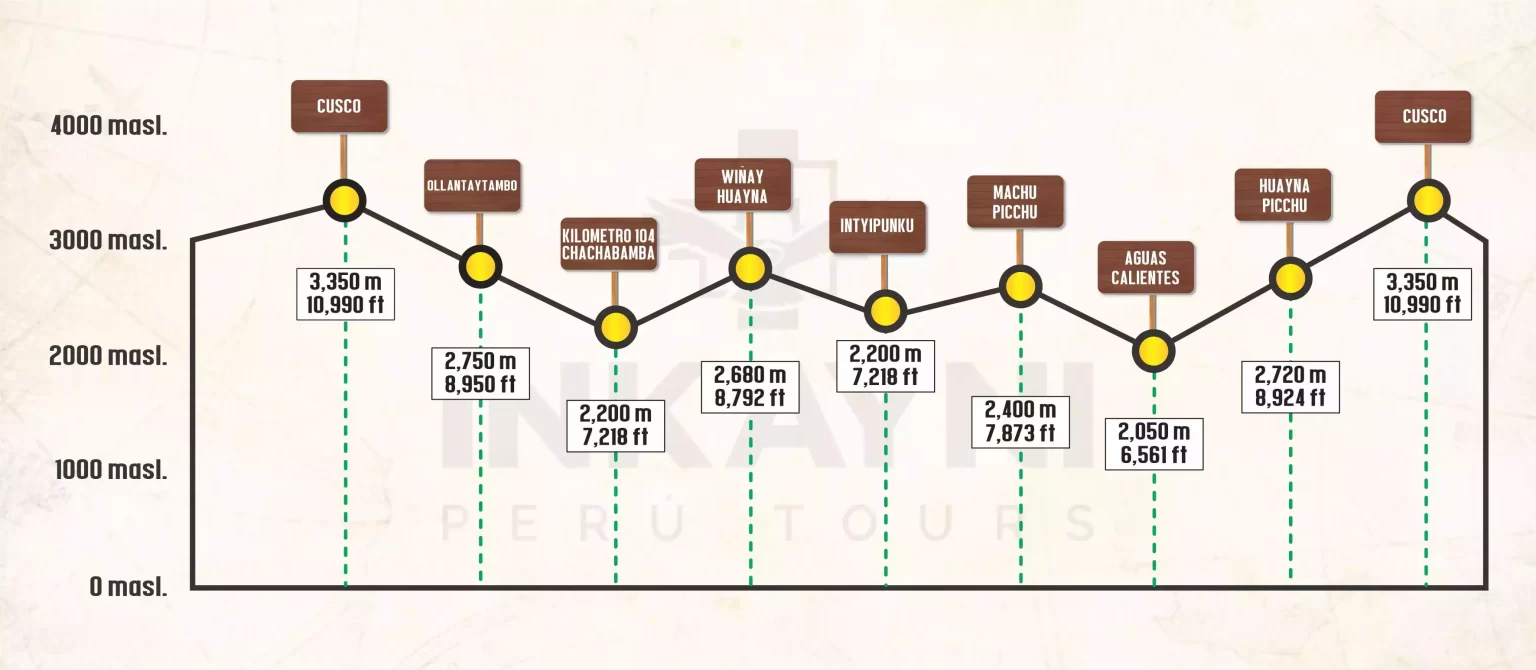
Elevations along the route
2 Day Inca Trail Difficulty
The difficulty level of the Short Inca Trail is typically described as easy to moderate for people with regular physical condition, and moderate if you are not used to climbing long stairways or walking for several hours straight. The first day’s hike normally takes 5–7 hours and covers around 10–12 km (6.2–7.5 miles), depending on the operator’s measurement and exact pacing. The Inca stone steps are irregular and, with rain or humidity, can become slippery during the rainy months.
For this reason, the right trekking shoes and a realistic walking pace matter more here than raw athletic performance.
| Factor | Data | What it means in practice |
| Maximum altitude | ~8,956 ft (2,730 m) | Considerably lower than the Classic. On this route, the staircases, humidity, and pace tend to matter more than altitude. |
| Hardest section | Chachabamba to Wiñaywayna | Staircases, humidity, and sustained cardiovascular effort. |
| Distance | ~7.5 mi (12 km) | Manageable for someone arriving with reasonable fitness. |
| Recommended acclimatization | 1 to 2 days minimum | Helps arrive with better margin, even though the route is lower than Cusco. |
Regarding ages, many travel agencies use a minimum age as internal policy, commonly around 8 to 12 depending on the service, and there is usually no fixed maximum age if the person is physically fit for a hike with these characteristics. If there are medical concerns, knee problems, or recent injuries, it is worth consulting a doctor before booking.

Short Inca Trail vs. Classic Inca Trail
| Key point | Short Inca Trail (2 days) | Classic Inca Trail (4 days) |
| Start | Km 104 (Chachabamba), access by train | Km 82 (Piscacucho area), access by road |
| Duration | 2 days / 1 night (hotel in Aguas Calientes) | 4 days / 3 nights (campsites) |
| Hike | Approx. 10–12 km (6.2–7.5 miles) | Approx. 43 km (26.7 miles) total |
| Focus | Final stretch + Wiñay Wayna + entrance through Intipunku | Complete route with more archaeological sites and high-altitude passes |
| Perceived difficulty | Moderate, with steps, humidity, and sustained ascent | More demanding due to consecutive days, altitude changes, and campsite recovery |
| Logistics | Hotel in Aguas Calientes; coordinated with trains and schedules | Campsites, porters, meals, and camp logistics on route |
| Permits | Limited daily spaces for the short route | Limited daily spaces shared with guides and support staff |
PERU’S LEGENDARY HIKEInca Trail to Machu Picchu
Follow the historic trail through mountain passes, Inca sites, and cloud forest paths to Machu Picchu.

Enjoy your 2 day Inca Trail to Machu Picchu / Short Inca Trail 2 days.
What to see on the Short Inca Trail to Machu Picchu?
During the hike you cross cloud forest ecosystems with ferns, orchids, bromeliads, and moss-covered trees. It is common to see hummingbirds and other birds, and with luck, wildlife such as vizcachas or even signs of the spectacled bear in the wider habitat. The route passes through four main points that give the day its logic.
| Point | Elevation | Time from start | What to see |
| Chachabamba (Km 104) | 2,200 m / 7,218 ft | Start | Official checkpoint, stone structures, terraces and water-related features. |
| Wiñay Wayna | 2,680 m / 8,793 ft | 3–4 hours | Major archaeological complex with terraces, stairs, enclosures and lunch area nearby. |
| Inti Punku | 2,730 m / 8,957 ft | 5–6 hours | First view of Machu Picchu from the Sun Gate. |
| Machu Picchu | 2,430 m / 7,972 ft | 6–7 hours | Upper arrival area, then guided visit the next day according to your assigned circuit. |
Chachabamba (2,200 m / 7,218 ft)
First checkpoint of the trail. This site functioned as an access and surveillance point to Machu Picchu. It preserves stone enclosures and ceremonial structures, and it marks the moment when the route changes from train logistics to walking on the Inca road.
Wiñay Huayna (2,680 m / 8,793 ft)
Wiñay Wayna is an archaeological complex covering an entire hillside. Its name means “Forever Young” in Quechua. It was a small settlement with agricultural terraces, stairways, water channels and a central area. The terraces also served for land retention and slope management. It is the most impressive and complete site on the short stretch and the place where the lunch break is usually taken.
Inti Punku (2,730 m / 8,957 ft)
The Sun Gate was the ceremonial entrance to Machu Picchu in Inca times. From here you get the first panoramic view of the citadel. The afternoon light, when you arrive from Wiñay Wayna, often makes the first view easier to photograph than during busy morning hours. You can also see the valley and surrounding mountains from this point.

Machu Picchu (2,430 m / 7,972 ft)
The final Inca citadel combines an urban zone with temples, residences and ceremonial spaces, and an agricultural zone of terraces, irrigation lines and retaining walls. The hydraulic engineering and the fitting of stones without mortar are examples of advanced Inca technique. For a full visit framework, use our Machu Picchu travel guide before choosing extra mountain tickets.

Short Inca Trail prices
The price of the Short Inca Trail 2 days varies considerably depending on the operator, group size, train type, hotel category in Aguas Calientes, and whether you choose group or private service. The ranges below are practical references; always verify what is included before comparing prices.
Group with hotel
$539–$595 USD
Common range among authorized operators for shared 2-day departures with hotel in Aguas Calientes.
Market range
$475–$700+ USD
Useful for understanding the full picture. Prices rise with train upgrades, hotel category, smaller groups, or more included services.
Private service
$529–$649 USD
As a direct reference, some private services come down when group size increases and rise when the party is very small.
| Reference | Observed price | Practical note |
| Standard group service | $539–$595 USD | Common range for 2D/1N with hotel and permits. |
| Private service | $529–$649 USD per person | Depends heavily on final group size. |
| Train upgrade | $50–$150 USD | Typically appears when upgrading to Vistadome or panoramic train. Compare with our Vistadome vs Expedition guide. |
| Additional mountain entry | $50–$150 USD | Huayna Picchu or Machu Picchu Mountain are usually paid separately. |
| Minor extras | $15–$100 USD | Trekking poles, extra night in Aguas Calientes, or single supplement. |
Expert tip:
Before comparing prices, confirm whether train tickets in both directions are included, whether the hotel in Aguas Calientes is basic or higher category, whether the bus down from Machu Picchu is covered, what type of guide the operator provides, and whether the price already includes the Inca Trail permit and Machu Picchu entrance.
Permits are mandatory
The Short Inca Trail to Machu Picchu requires a permit, and that permit is managed through an authorized operator. The booking depends on exact passport data, and the ticket is nominal. If the document does not match, the problem appears at the control checkpoint.
Availability tends to be more manageable than for the Classic Inca Trail, and it is still worth closing the booking early, particularly if the rest of the trip already has fixed dates or if you are targeting the dry season.
| Detail | Practical read |
| Can you do it independently? | No. Requires an authorized operator and a licensed guide. |
| Required document | Passport or valid document matching the booking |
| Transferable | No |
| Recommended lead time | The earlier you lock in the date, the more margin you have |
| Annual closure | February |

The Inca Trail permit is nominal and checked against the document at every control point
Before booking:
- The Short Inca Trail operates with a limited number of official spaces per day.
- The Inca Trail Network closes throughout February for maintenance and conservation.
- Access is validated at checkpoints. Km 104 / Chachabamba is the key point for the 2 day Inca Trail, and presenting your original identity document is mandatory.
- Tourist operations on the Inca Trail are conducted through organized trips by licensed tour agencies. It is not a do-it-yourself hike.
- The ticket is nominal, personal and non-transferable, valid for a specific route and date.
The 2-day Inca Trail itinerary
Day 1 — Cusco › Ollantaytambo › Km 104 › Chachabamba › Wiñaywayna › Inti Punku › Aguas Calientes
| Trekking distance: ~6.2–7.5 mi (10–12 km) | Hiking time: 5 to 7 hours |
| Altitude: ~6,890 ft (2,100 m) to ~8,956 ft (2,730 m) to 6,725 ft (2,050 m) | Difficulty: Moderate |
| Meals: According to service contracted | |
Day 1 concentrates nearly all the physical effort of the Short Inca Trail. After the control check at Km 104, the route passes through Chachabamba and the ascent moves into cloud forest. That is where the body feels the most: stone, humidity, staircases, and a sustained gradient. Even at this altitude, legs and breathing register the effort earlier than the distance would suggest.

Wiñay Wayna marks a clear shift in the experience. From there the route enters serious archaeological territory, with one of the best-preserved complexes on this entire trail network. Then comes the section toward Inti Punku, where the first view of Machu Picchu opens through the ceremonial gateway. From there the descent continues toward Aguas Calientes for the overnight stay.
Key moments: control check at Km 104, Chachabamba, cloud forest ascent, Wiñay Wayna, Inti Punku, overnight in Aguas Calientes.
Day 2 — Aguas Calientes › Machu Picchu › return to Cusco
| Main activity: guided visit to Machu Picchu | Difficulty: Easy |
| Altitude: 6,725 ft (2,050 m) to 7,972 ft (2,430 m) | Return: bus, train, and ground transfer |
| Meals: breakfast at hotel; rest according to contracted service | |
The second day allows the Machu Picchu visit to happen with more order and less accumulated fatigue than if everything had been compressed into a single day. The overnight in Aguas Calientes distributes the effort better and gives the visit proper space.

After the guided circuit, the return is by bus to Aguas Calientes, train to Ollantaytambo, and ground transfer to Cusco. The demanding part of the trek is already behind. Day 2 closes the experience without turning Machu Picchu into a rushed stop after the physical effort.
Worth knowing:
The view from Inti Punku remains one of the clearest distinctions between the Short Inca Trail and a standard visit by train and bus.

Inti Punku, the ceremonial gateway of the Inca Trail and one of the clearest first views of Machu Picchu
What’s included and what’s not included
| ✓ Included | ✗ Not included |
| Guides and assistance: Professional bilingual guide (Spanish-English) Assistant guide for groups +9 people First aid kit Emergency oxygen bottle |
Meals not included: Breakfast day 1 Lunch and dinner day 2 Water during trek (bring 2–3 liters) |
| Complete transportation: Hotel pickup in Cusco Bus Cusco – Ollantaytambo – Cusco Train Ollantaytambo – Km 104 Train Aguas Calientes – Ollantaytambo Bus Aguas Calientes ↔ Machu Picchu |
Optional extras: Huayna Picchu or Machu Picchu Mountain entrance Trekking poles rental Travel insurance |
| Accommodation and meals: Hotel in Aguas Calientes Box lunch (day 1) Dinner (day 1) Breakfast (day 2) |
Tips: Suggested at traveler discretion for guide and staff |
| Permits and entrances: Official Inca Trail permit Machu Picchu entrance according to assigned circuit and availability |
Important note:
The inclusions detailed above correspond to Inkayni Peru Tours service. Each operator handles different itineraries, schedules, service quality, hotel categories, train and bus types, prices, entrances, and included services. Always verify in detail what is included and what is not included in your specific package before booking with any agency.
Other Guides That Help Before Booking the Short Inca Trail to Machu Picchu
Weather on the Short Inca Trail
The Short Inca Trail crosses cloud forest, so humidity is present year-round. The trail passes through slopes where mist forms frequently and vegetation wakes up wet even if it has not rained. Stones retain dew water and can be slippery even on clear days.

Between April and October (dry season) the days are more stable: midday sun, temperatures between 10°C and 20°C (50°F–68°F), and occasional but not constant rain. The forest humidity remains, but the trail dries faster. Between November and March (rainy season) it rains more frequently and mist can block the view from Inti Punku. In any season, it is normal to start the hike with morning mist. As you progress, toward midday, the sun usually breaks through, but the forest humidity never completely goes away. For broader timing decisions, compare this route with the best time to hike the Inca Trail and Cusco weather by month guides.
What’s the best time to visit the Short Inca Trail to Machu Picchu?
The dry season, especially May to September, offers more stable days, lower rain probability, and drier trails. February remains the key exception because the Inca Trail network closes for maintenance and conservation.
| Season | Characteristics | Recommendation |
| Dry (Apr-Oct) | Sunny days, cooler mornings, drier stone steps, and clearer odds of seeing Machu Picchu from Inti Punku. | ✓ Best window May-Sep ideal |
| Rainy (Nov-Mar) | Frequent rain, mist, lush vegetation, and more slippery stone. February is closed. | ⚠ More rain Feb closed |

Machu Picchu restrictions
Machu Picchu rules are strict, and they matter more on the Short Inca Trail because day 2 is organized around your assigned entry time and official route. Non-compliance can result in denied access or expulsion, depending on the case.

Remember this:
Machu Picchu operates with entry time slots and official circuits/routes. Go up from Aguas Calientes with enough margin. If your entry time is missed, access may be denied depending on controls and availability.
| Allowed | Prohibited |
|
|
What to bring to the Short Inca Trail?
Bring only a compact daypack. Your main luggage stays in Cusco or is managed according to your operator’s logistics. The backpack should respect Machu Picchu limits: maximum 40 x 35 x 20 cm (16 x 14 x 8 in).
Essentials
- Original passport
- Waterproof trekking shoes or boots
- 2–3 liters of water for the hike
- Rain poncho
- SPF 50+ sunscreen
- Insect repellent
- Sun hat or buff
- Toilet paper + small waste bag
Recommended clothing
- Quick-dry technical shirt
- Trekking pants
- Waterproof jacket
- Fleece or polar layer
- Change of clothes for hotel
- Trekking socks
Which traveler the Short Inca Trail suits best
| A good fit if… | Worth considering another option if… |
| You want to enter Machu Picchu on foot without committing four full days. | You are specifically after the long experience with campsites that the Classic offers. |
| Your schedule is tight but you still want a real section of the Inca road and entry through Inti Punku. | You want to avoid the hike entirely and prefer only train and bus. |
| You arrive with reasonable fitness and some basic acclimatization. | You have serious knee problems or a difficult relationship with staircases and descents. |
| You could not get a Classic permit but still want to arrive at Machu Picchu walking. | You arrive in Cusco with no buffer and plan to start hiking almost immediately. |
2 Day Inca Trail with clarity and no surprises
The two day Inca Trail to Machu Picchu is a regulated route with limited quotas, control at Km 104, and entrance to Machu Picchu on foot through Inti Punku. If your dates are already set, book in advance, especially between May and September, and travel with an authorized agency to ensure permits, trains, entry times, and schedules without setbacks.
Choose your Inca Trail version
If you want to enter Machu Picchu walking along the original trail, choose between the Short Inca Trail (2 days) or the Classic Inca Trail (4 days), according to your time and fitness level.
You come for the Inca Trail; Inkayni Peru Tours handles permits, guide, and logistics coordination.
Frequently Asked Questions About the 2 Day Inca Trail
What is the 2 Day Inca Trail to Machu Picchu?
Is the Short Inca Trail the same as the 2 Day Inca Trail?
Can you do the Short Inca Trail to Machu Picchu independently?
How far in advance should I book the 2 Day Inca Trail?
Does the Short Inca Trail close in February?
Where does the Short Inca Trail start?
What is the shortest hike to Machu Picchu?
What documents do I need at the Km 104 checkpoint?
Can I change my Short Inca Trail permit date or transfer it to another person?
How difficult is the 2 Day Inca Trail?
What is the elevation gain on the 2 Day Inca Trail?
Is altitude sickness common on the Short Inca Trail?
What is the best time to hike the Short Inca Trail?
What happens if it rains during the Short Inca Trail?
Are there bathrooms on the Short Inca Trail?
Is there cell signal or internet during the hike?
What size backpack can I bring to Machu Picchu?
Are trekking poles allowed on the Short Inca Trail and Machu Picchu?
What shoes should I wear for the 2 Day Inca Trail?
What does a 2 Day Inca Trail tour usually include?
What is usually not included in the Short Inca Trail?
What rules should I respect inside Machu Picchu?
What happens if I arrive late to my Machu Picchu entry time?
Is the Short Inca Trail worth it if Classic Inca Trail permits are sold out?
Escrito por

Shared:


If you liked this article and the information you found, give us 5 stars!
 (2 votos, promedio: 5.00 de 5)
 Loading...