


When Huchuy Qosqo Makes Sense
Huchuy Qosqo suits travelers who want an archaeological site that is reached on foot, not one more stop on a vehicle-based Sacred Valley circuit. It works best if you already have some acclimatization, can give it one to three days, and are choosing consciously between a steep direct ascent from Lamay, a longer and calmer day hike from Chinchero or Taucca, or the broader 3-day route that continues toward Machu Picchu. Entry is free and no tourist ticket or special permit is required, but it is a poor fit for a first day in Cusco or for anyone looking for easy access and minimal effort.
Table of Contents
Huchuy Qosqo is not visited like other sites in the Sacred Valley. There is no bus that drops you at the entrance, no steady flow of groups arriving every half hour, and no quick visit that resolves itself in a short time. Huchuy Qosqo tends to suit travelers who want an archaeological outing with real hiking, fewer tour groups, and logistics that are still manageable in one or three days. Entry is free and no Cusco Tourist Ticket is required.
| 11,975 ftSite altitude (3,650 m) | Free entryNo Cusco Tourist Ticket required | 3 routesAccess on foot only |
| 15th centuryLinked to Inca Wiracocha | 1 to 3 daysDepending on the route chosen | No permitNo quota system like the Inca Trail |
It is worth looking carefully at the route you choose, the time you have, your prior acclimatization, and whether you want to keep the outing focused on the Sacred Valley itself or place it within a broader Cusco plan that may later include Machu Picchu, the Inca Trail, the Salkantay Trek, the Lares Trek, or even the more demanding Choquequirao Hike.

The plateau where Huchuy Qosqo sits commands a view over Lamay and a wide section of the Sacred Valley.
What is Huchuy Qosqo and why it is worth visiting
Huchuy Qosqo means “Little Cusco,” a name that spread because of the formal resemblance between certain sectors of the site and the architecture associated with the Inca capital. Colonial sources record earlier names such as Caquia Xaquixaguana or close variants, likely linked to the observation of the sky and storms from this elevation. The site sits in a position that commands a panoramic view of the valley: Lamay far below, the Vilcanota marking the floor, and the glaciers rising on the other side.
You do not have to push through large groups to look at a wall, enter a compound, or stop to read the relief of the valley. In Cusco and many other sites, that is no longer easy to find.
Did you know?
Huchuy Qosqo brings together in a relatively compact space several layers that rarely appear this way at other Inca sites. It has first-order political history, residential use, agricultural function, storage facilities, water management, and an unusual combination of building materials for a significant Inca site. Here, dressed stone shares the visual stage with large adobe sections.
Brief history
Huchuy Qosqo is typically linked to Wiracocha Inca, who is said to have used this place as a high-altitude residence during a difficult period for Cusco. According to the chronicles, he retreated here during the crisis brought on by the Chanka advance, shortly before Inca power changed direction. Seen that way, Huchuy Qosqo was not simply a compound built above the Sacred Valley.
It was also tied to a pivotal moment in Inca history, the one that ultimately opened the way for Pachacutec. The visit carries something beyond landscape and architecture: it brings you close to a place connected with a major transition in the Andean world.

The position of the compound allows visual control over a wide stretch of the Sacred Valley.
What to see inside the archaeological site
The site does not overwhelm with scale, but it concentrates structures, changes in level, different materials, and a very direct relationship with the mountain slope it occupies.

Huchuy Qosqo terraces from above, with hikers taking in the quiet Sacred Valley landscape.
The main buildings
These are the most visible structures and the ones that best show the site’s most distinctive architectural feature: the combination of dressed stone at the base and adobe on the upper sections. In one of the compounds this reading is very clear. The stone base provides stability and the adobe lightens the upper levels. That combination is not common in the more prestigious Inca compounds of the valley, which is why Huchuy Qosqo is recognized so quickly when you are standing in front of it.

The combination of stone and adobe is one of the clearest visual markers of the site.
Kallanka
This is a large rectangular hall at the edge of the escarpment. More than just a wide structure, it functions as a gathering space and at the same time as a natural balcony over the valley. From there, Lamay sits far below, the river traces the floor, and the glaciers completely change the scale of the place. That view helps make sense of why the site’s location was not chosen casually.

Three-storey building in Huchuy Qosqo
Storage facilities, terraces, and the agricultural system
Below the main compound, storage facilities and terraces are well preserved. That is a reminder of something important: Huchuy Qosqo was not an isolated palace disconnected from the surrounding territory. It also participated in a logic of production and storage. The terraces organized the agricultural use of the site and the storage buildings were part of a state economy based on the conservation and redistribution of goods.
The irrigation channel
Important sections of the channel are still visible, along with the way water was integrated into the overall design of the settlement. When you see it up close, Huchuy Qosqo stops reading as simply a high, attractive compound. It starts reading as a carefully conceived work designed to inhabit, produce, and sustain life at altitude.
The three routes to get there
| Route | Duration | Distance | Difficulty | Practical read |
|---|---|---|---|---|
| Tambomachay – Huchuy Qosqo – Machu Picchu | 3 days / 2 nights | ~24.8 mi (40 km) | Moderate | The most complete option. Combines landscape, Huchuy Qosqo, and Machu Picchu. |
| Chinchero / Taucca – Huchuy Qosqo | 1 day | ~9.3 mi (15 km) | Moderate | More scenic and quieter. A good choice for a full day hike. |
| Lamay – Huchuy Qosqo | 1 day / 3 to 4 hrs ascent | ~3.7 mi (6 km) | Hard due to gradient | The shortest and steepest. Works if you have limited time and strong legs. |
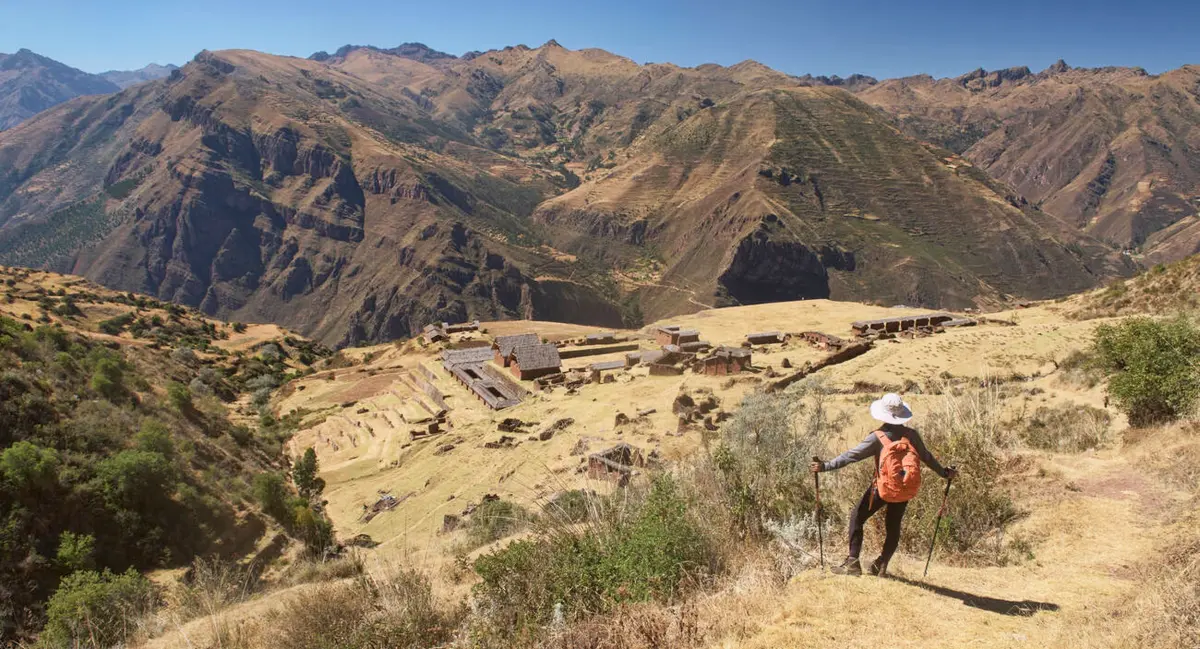
Huchuy Qosqo suspended above the Sacred Valley, on a hike where archaeology and landscape advance together.
Itineraries and practical read of each route
The decision comes down to something straightforward: how much time you have, how far you want to walk, and how your acclimatization is going. All three routes lead to Huchuy Qosqo, but they do not feel the same and they do not ask the same thing of the body.

View of the Pitusiray snow-capped mountain on the Chinchero-Huchuy Qosqo route.
Tambomachay – Huchuy Qosqo – Machu Picchu route (3D/2N)
This is the most complete version if you want to hike, visit Huchuy Qosqo without rushing, and close at Machu Picchu. It departs from the Tambomachay archaeological site, crosses high-altitude lakes and grasslands, sets up camp, enters Huchuy Qosqo from above, descends to Lamay, and connects to Ollantaytambo and the train to Aguas Calientes.

Final stretch to reach Huchuy Qosqo
| Total duration: 3 days / 2 nights | Approx. distance: 24.8 mi (40 km) |
| Highest point: Abra Ramicruz, 14,108 ft (4,300 m) | Physical read: moderate, with better distribution of effort |
| What it adds: combines high-altitude landscape, Huchuy Qosqo, and Machu Picchu without the permit pressure of an Inca Trail-style route. | |
The section between Qenqo and Huchuy Qosqo passes through León Punku and sections of ancient Inca road. There the route becomes more expressive: stone walls, a narrow pass, old stone underfoot, and an arrival at the site that feels earned.
Chinchero / Taucca – Huchuy Qosqo route (1 day)
This is one of the best options if you want a more open day hike with lakes and high grassland before entering the site. The starting point is typically in the Taucca area, near Piuray Lake. From there the route gains altitude more gradually than Lamay, crosses a high pass, and then descends to the compound.
| Total duration: 1 day | Approx. distance: 9.3 mi (15 km) |
| High point: ~13,287 ft (4,050 m) | Physical read: moderate |
| What it adds: a more open high-altitude landscape, lakes, and a quieter arrival at the site. | |
On clear days, this route gives a longer read of the high-Andean landscape. The lakes, the birds, and the dry open stretch before the valley all register more fully.
Lamay – Huchuy Qosqo route (1 day, direct ascent)
This is the shortest in distance and the most intense in gradient. From Lamay the route gains elevation almost without pause up to the compound. It works for those with limited time, good aerobic capacity, and a preference for direct access. For independent travelers, this is usually the most practical route, though it demands more from the legs than the Chinchero option.
| Total duration: 1 day / 3 to 4 hrs ascent | Approx. distance: 3.7 mi (6 km) |
| Elevation gain: ~2,300 ft (700 m) | Physical read: hard due to continuous gradient |
| What it adds: the simplest option for independent travelers and the most time-efficient when your schedule is tight. | |
Warning:
If you go independently from Lamay, bring enough water, some food, sun protection, and footwear with solid grip. There are no shops along the trail and no continuous tourist infrastructure. Mobile signal can come and go, so do not rely on it. The trail is more demanding than it looks in photographs, especially when the sun hits the slope hard.

Beautiful Inca cobblestone path on the route to Huchuy Qosqo
Difficulty of the route
The factors that affect the route most are the combination of altitude, elevation gain, and prior acclimatization. Huchuy Qosqo sits at a similar altitude to Cusco, but several routes cross passes above 13,120 ft (4,000 m). That changes considerably how the hike feels.
| Factor | Data | What it means in practice |
|---|---|---|
| Site altitude | 11,975 ft (3,650 m) | Manageable with 1 or 2 prior days in Cusco, but not worth underestimating. |
| High pass on Tambomachay route | Abra Ramicruz, 14,108 ft (4,300 m) | Without acclimatization, altitude sickness shows up quickly here. |
| Elevation gain from Lamay | ~2,300 ft (700 m) over 3.7 mi (6 km) | The shortest route is also the steepest. Demands steady legs and a consistent pace. |
| Technical demand | None required | The challenge is aerobic and altitude-driven, not technical. |
Expert tip:
Acclimatization cannot be replaced by fitness. One night in Cusco helps. Two nights are better. If you already have a headache, nausea, disturbed sleep, or marked fatigue, it is worth not forcing a high-altitude route the next day. This guide offers orientation but does not replace medical advice if you have respiratory or cardiovascular history.

Altitude profile on the Huchuy Qosqo route
Which traveler this route works best for
|
A good fit if…
|
Worth considering another option if…
|
Quick comparison with similar routes from Cusco
| Criteria | Huchuy Qosqo | Lares Trek | Short Inca Trail |
|---|---|---|---|
| Duration | 1 or 3 days | 4 to 5 days | 2 days |
| Maximum altitude | 14,108 ft (4,300 m) | 15,846 ft (4,830 m) | 8,956 ft (2,730 m) |
| Own archaeological site | Yes | Not as the main focus | Yes |
| Special permit required | No | No | Yes |
| Focus | Archaeology + landscape | Communities + mountain | Inca road + arrival through Inti Punku |
Other Guides That Help Before Booking Huchuy Qosqo
Climate and best season
The climate pattern follows the Sacred Valley: dry season from April to October and rainy season from November to March. At 11,975 ft (3,650 m), variation within the same day is more noticeable than in the valley floor: strong midday sun, cold wind in the afternoon, and the possibility of rain or hail if conditions change quickly.
| Season | Months | Conditions | Practical read |
|---|---|---|---|
| Dry | April to October | Firmer trails and better visibility | May and September tend to offer a particularly good balance. |
| Rainy | November to March | Mud, humidity, and more variability | Feasible, but less comfortable for a first visit. |

Huchuyqosqo trek map
Flora and fauna on the route
The altitude range of the Huchuy Qosqo routes allows you to encounter lakes, high-altitude grasslands, Andean birds, and transitional zones between the valley and the puna (high-altitude plateau). Wildlife sightings are not guaranteed, but the living environment carries more weight than many quick travel blogs suggest.
| Species | Where it tends to appear | Practical read |
|---|---|---|
| Huallata (Andean goose) | Lakes and high grasslands | One of the most visible birds on high-altitude routes. |
| Andean duck | Lakes on the higher routes | More likely on the Chinchero / Taucca route. |
| Vizcacha | Rocky sections | Can be spotted sitting still among rocks when the trail opens up. |
| Ichu and puna flora | High, open sections | Gives the route that dry, high-Andean tone that sets it apart from cloud forest hiking. |

The route shows the transition between valley and high ground clearly before the entrance to the compound.
Prices: what to expect
Huchuy Qosqo has an advantage that is rare in Cusco: entry to the site is free. The real cost is in the logistics. That varies considerably depending on whether you go independently, book a one-day hike, or choose the 3-day version with Machu Picchu. It also shifts based on group size, whether the service is private, and what the price actually includes.
| Service format | Useful published range | When it tends to appear | How to read it |
|---|---|---|---|
| Huchuy Qosqo 1 day large group or tiered pricing |
$73 to $132 USD pp | When the operator fills 3 to 10 people or applies volume discounts. | The lowest range, but it does not always reflect a small group or a more careful service. Worth checking whether the group is genuinely small and what lunch, transport, and guide actually cover. |
| Huchuy Qosqo 1 day small group or 2-person service |
$150 to $166 USD pp | When the departure runs with two travelers or as a more careful small service. | This range works better as a serious reference for comparing quality, pace, and logistical clarity, not just the headline price. |
| Huchuy Qosqo 1 day near-solo private |
$220 to $273 USD | When a single person travels or a highly personalized service is requested. | Not useful as a market floor. This is a comfort and personalization rate, not a general reference. |
| Huchuy Qosqo 3D/2N + Machu Picchu private with larger group |
$420 to $530 USD pp | When the service distributes costs across roughly 5 to 8 people. | Here the train, hotel in Aguas Calientes, and Machu Picchu entrance weigh heavily. The number looks high but you are no longer paying only for the hike. |
| Huchuy Qosqo 3D/2N + Machu Picchu private or small group of 2 to 4 |
$540 to $650 USD pp | When the group is small and logistics are more personalized. | The most realistic range for a better-structured version with fewer people. Worth verifying train category, hotel, meals, and Machu Picchu circuit before comparing it with cheaper options. |
How to read the price without being misled by the number alone
- For Huchuy Qosqo 1 day, the biggest factor moving the price is whether the departure is private, how many people share the service, and whether the operator genuinely works in small groups.
- For 3D/2N + Machu Picchu, the price already depends much more on the combination of train, hotel, Machu Picchu entrance, and group size.
- A very low price can still be valid, but it is worth checking which part of the logistics is left out or handled in a more basic format.
- Before comparing, the most useful step is to ask in writing exactly what the service includes, rather than just looking at the main figure.
What a good service should include
| Item | What to verify |
|---|---|
| Guide | Bilingual guide with solid historical knowledge of the site and good altitude pacing skills. |
| Transport | Pickup in Cusco, transfer to the starting point, and return well organized from Lamay or Ollantaytambo. |
| Meals | Which lunch is included and whether the 3-day version covers dinner and breakfast in Aguas Calientes. |
| Machu Picchu | Which circuit is included, what time slot, and whether the train is already booked. |
| Equipment | For the 3-day version, whether camping gear, a duffel bag, and porters are included. |
What to pack
The list changes depending on the route. For Lamay or Chinchero, a well-organized day pack is enough. For the 3-day version, the layering system and how you organize your gear matter more than loading extra items.
| Category | What to bring | Practical note |
|---|---|---|
| Documents | Passport if the route includes Machu Picchu, booking confirmation | No tourist ticket is required to enter Huchuy Qosqo. |
| Footwear | Hiking boots or trail shoes with solid grip | The Lamay route punishes flat soles and new footwear. |
| Layers | Base layer, fleece, waterproof jacket, hat, and warm layer | The same day can shift from strong sun to rain or hail. |
| Essentials | Water, snacks, sunscreen, UV sunglasses, and blister care | No shops along the trail and no consistent shade. |
| Overnight (3-day only) | Sleeping bag, headlamp, and a basic change of clothes | If the operator provides a duffel bag, confirm the allowed weight before departing. |
Huchuy Qosqo is still best understood on foot
Huchuy Qosqo brings together several things that rarely appear with this kind of calm in the Sacred Valley: Inca history tied to an important political moment, singular architecture, terraces, water management, open landscape, and an arrival that still depends on your own body and the real time you dedicate to it. The key is choosing the right route, arriving with some acclimatization, and going in with a clear sense of what kind of effort you want to take on.
If you want to visit Huchuy Qosqo with clear logistics and a more considered read of the site, Inkayni Peru Tours can help you organize the experience around your time, your pace, and the type of outing you are looking for.
Frequently asked questions about Huchuy Qosqo
Does entry to Huchuy Qosqo cost anything?
Recent tourism references continue to show it as free. Even so, it is worth confirming opening hours and access locally the day before, because at less visited sites, arrangements can change without much digital notice.
Can you visit independently?
Yes, particularly via Lamay. That is the most practical option for independent travelers. The Chinchero route is also possible but requires more trail-reading. The 3D/2N version makes more sense with an operator because of the subsequent connection toward Machu Picchu.
Which route is best if I have limited time?
If you want the most direct option, Lamay. If you want a more enjoyable day hike with better high-altitude scenery, Chinchero / Taucca.
Does the 3-day route require a special permit?
No Inca Trail-style route permit is required. What does need advance booking is Machu Picchu and the train, since those are the logistics that actually define whether the departure works.
Can it be done with children?
The 3-day version tends to be the most manageable for active families, as long as there is prior acclimatization and the children are already comfortable with long hikes. Lamay is shorter but harder because of the steep gradient.
Is it worth it compared to other Sacred Valley sites?
Yes, if you are looking for fewer crowds, a walking approach, and a quieter experience of the site. If you want straightforward logistical convenience, Pisac or Ollantaytambo are easier to arrange.
Autor
Shared:


If you liked this article and the information you found, give us 5 stars!
 (1 votos, promedio: 5.00 de 5)
 Loading...