


Choquequirao Trek Difficulty
The Choquequirao Trek is hard, but it is not technical climbing. What makes it difficult is the steep descent into the canyon, the long climb back up, the heat in the lower sections and the effort of hiking for several days in a row. For most active travelers, the 5-day route is the more manageable option because it gives better pacing and recovery than the faster 4-day version.
Table of Contents
The original attraction of Choquequirao is still here: an isolated Inca city, deep canyon views, quiet trails, and a route that feels far less crowded than Machu Picchu. But Choquequirao Trek difficulty should be understood before booking, because the challenge is not only distance, but also steep canyon descents, exposed climbs, heat, limited services and long hiking days. This guide explains what really makes the trek hard, which itinerary feels more manageable, how it compares with other Cusco treks, and how to prepare without underestimating the route.

Choquequirao is not a technical climb, but reaching it requires several demanding trekking days.
| Hardoverall difficulty | 4–5 daysclassic route | Up to 9,940 ft3,030 m approx. | No technical climbingbut steep terrain |
WORLD WONDER IN THE ANDESMachu Picchu
Discover the history, landscapes, and essential tips for visiting this world wonder.
So, How Hard Is the Choquequirao Trek?
The Choquequirao Trek is hard because it combines several difficulties at the same time. You walk for multiple days, descend into a deep canyon, climb back up on exposed trails, deal with heat in the lower sections, and sleep in basic conditions. The challenge is not one single mountain pass. It is the accumulation of effort.
For a prepared hiker, the trek is demanding but realistic. For a traveler who rarely walks long distances, the route can feel punishing, especially on the big climb after the river crossing and on the return day when tired legs must climb again toward the road.
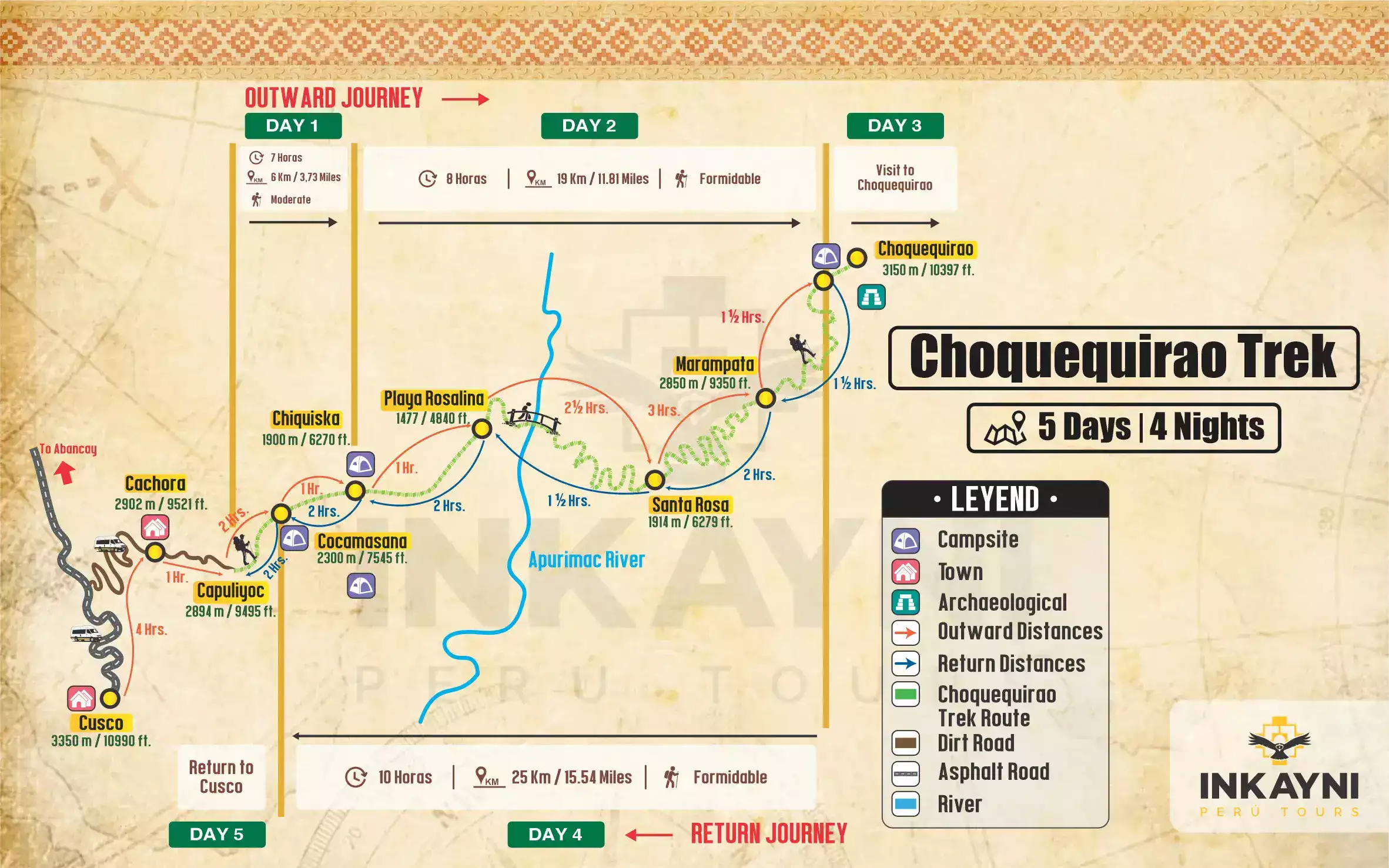
Route map for the 5-day Choquequirao Trek
Important note
Choquequirao is not the highest trek in Cusco. What makes it difficult is the canyon pattern: you start high, go down for hours to a hot river valley, and later climb back up on steep trails with little shade.
What Makes the Choquequirao Trek Difficult?
When people ask about Choquequirao Trek difficulty, they usually expect one answer: altitude, distance, or weather. In reality, the trek becomes hard because these factors overlap.
| Difficulty factor | What it means on the trail | Why it matters for travelers |
| Steep descents | You lose a lot of elevation before reaching the lowest canyon sections. | Your knees and calves work hard before the main uphill even begins. |
| Long uphill climbs | The route climbs from the river area toward the village and archaeological zone near Choquequirao. | This is usually where first-time trekkers feel the real difficulty. |
| Heat in the canyon | Lower sections can feel hot during late morning and afternoon. | Dehydration and slower pace become more likely if you start late. |
| Several trekking days | The classic route usually takes 4 or 5 days, depending on pace and itinerary. | Recovery, sleep and food matter as much as fitness. |
| Basic services | Camping areas and local stops are simpler than on more commercial routes. | Independent hikers must plan food, water, gear and camp logistics carefully. |
Difficulty by Altitude: Helpful, but Not the Whole Story
The Choquequirao Archaeological Complex sits at about 9,940 ft (3,030 m). That is lower than Cusco and much lower than the highest sections of routes such as Salkantay or the Inca Trail. Still, altitude can affect travelers who arrive in Cusco and start trekking too soon.
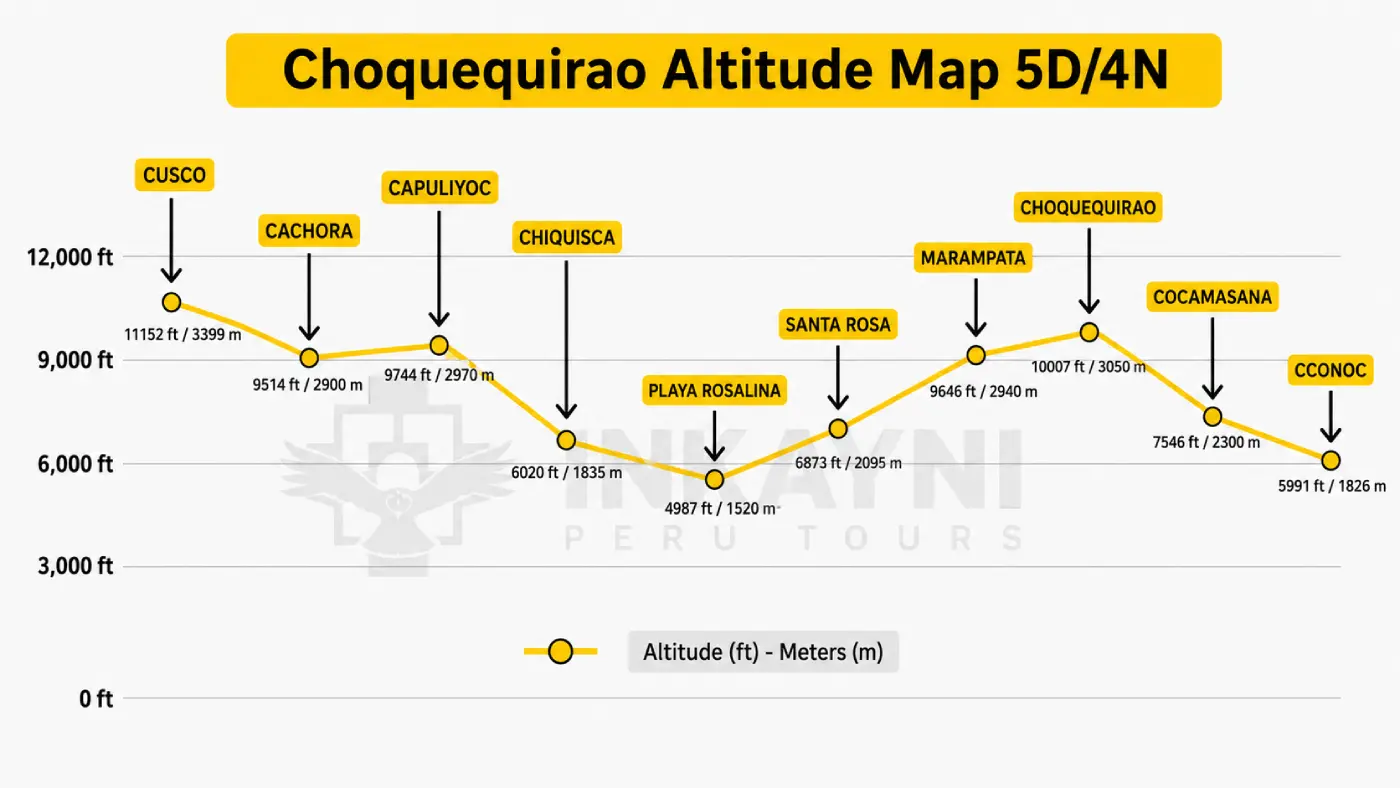
Altitude profile for the 5 day Choquequirao trek
The key point is this: altitude is part of the difficulty, but the canyon climb is the part most people remember. If you are sensitive to elevation, spend time in Cusco before the trek and understand the signs of altitude sickness in Cusco before committing to long hiking days.
Main Inkayni trekking guides
Where the Trek Feels Hardest
A tourist does not need to memorize every local name before understanding the route. Think of the trek in simple sections: viewpoint start, long descent, hot river crossing, steep climb, village area, archaeological site, and return climb.
| Section | What it feels like | Practical advice |
| Viewpoint start to lower canyon | Long downhill walking with exposed trail and pressure on knees. | Use poles early. Do not wait until your knees hurt. |
| River area to upper village zone | The hardest climb for many travelers. Hot, steep and mentally slow. | Start early, drink consistently and use short breaks before fatigue becomes heavy. |
| Village zone to Choquequirao | Shorter climb with better views and more motivation near the site. | Keep energy for exploring the ruins, not only for reaching the entrance. |
| Return to the trailhead | Tired legs face another major descent and climb. | Do not underestimate the return. Many hikers find the final climb harder than expected. |
Keep this in mind
The hardest day is not always the day with the highest altitude. On Choquequirao, the hard part is usually the sustained uphill after the low river canyon, especially when the sun is strong.
Terrain Difficulty: Dry Trail vs Rainy Trail
The trail has steep dirt paths, switchbacks, stone sections, dust in dry months and mud after rain. In dry conditions, the main problem is heat, dust and long exposure. In wet conditions, the same trail can become slower, slippery and more tiring.
Good footwear matters here. Hiking shoes or trail running shoes should already be broken in before the trek. Trekking poles also help on descents because they reduce pressure on knees and improve balance on loose ground.

Terrain changes the difficulty: dry trails are dusty and exposed, while rainy trails can be slippery.
Weather Difficulty During the Choquequirao Trek
Weather affects difficulty more than many travelers expect. As you go down into the canyon, the temperature can feel warmer and more humid, especially near midday. Higher sections and nights can feel cold, so the route demands both sun protection and warm layers.
For a better hiking rhythm, start early on the longest uphill days. A cool morning can make the difference between a steady climb and a slow, dehydrating ascent.
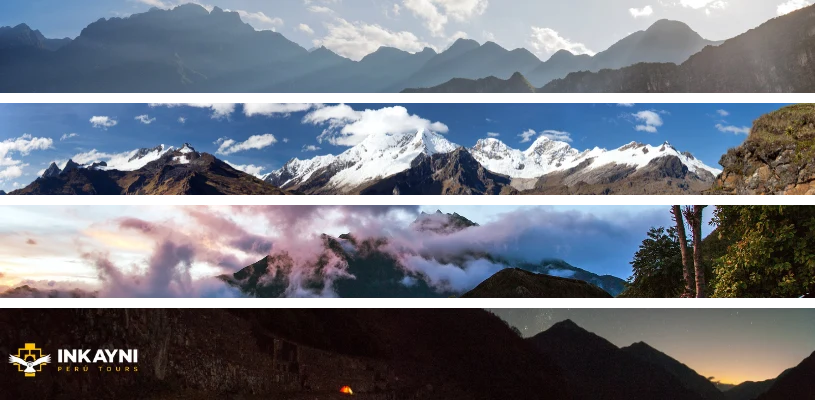
The same route can feel different in the morning, at midday and at night.
Warning
Do not treat rain as a small inconvenience on this trek. Rain can make steep descents slower, increase slipping risk, and turn a normal day into a much longer hiking day.
Choquequirao Trek Length and Daily Effort
The classic Choquequirao route usually covers about 40 mi (64 km) in 4 or 5 days, depending on the itinerary and exact start or end point. That distance is not extreme by itself, but the elevation change makes it feel harder than a flat multi-day walk.
The 5-day route is often more comfortable because it gives you a full day to explore the archaeological complex instead of arriving tired, taking quick photos and rushing the return.

The Choquequirao to Machu Picchu route is a different level of difficulty because of its length and logistics.
PERU’S LEGENDARY HIKEInca Trail to Machu Picchu
Follow the historic trail through mountain passes, Inca sites, and cloud forest paths to Machu Picchu.
Physical Condition: Who Can Realistically Do It?
The Choquequirao Trek is suitable for active travelers who can walk several hours a day and handle steep climbs. You do not need to be an athlete, but you should not arrive without preparation. If your normal routine does not include walking, hiking, stairs or cardio, start training weeks before the trip.
A good benchmark is simple: before the trek, you should be comfortable walking 4 to 6 hours with a small backpack and doing repeated uphill sections without needing long recovery after every climb.

Regular walking and hiking before the trip make the trek more manageable.
Trekking Choquequirao by Yourself: Is It Harder?
Yes, doing Choquequirao without support is harder. The trail can be done independently, but the difficulty increases because you must manage transport, food, water, camping gear, route timing and weather decisions. Carrying a heavy backpack also makes the steep climbs feel much tougher.
If you already have multi-day trekking experience, independent travel may be realistic. If this is your first remote trek in Peru, compare the added effort carefully before deciding to go Choquequirao without a guide.
| Option | What becomes easier | What remains difficult |
| Independent trek | More flexibility and lower direct tour cost. | More weight, more planning, more responsibility if something goes wrong. |
| Guided trek | Logistics, meals, camp setup, route timing and support are handled. | You still need to walk the same steep trail. |
Pro tip
If this is your first multi-day trek, reduce difficulty by choosing support, not by pretending the route is easy. A lighter backpack changes the whole experience on the canyon climbs.
How Does Choquequirao Compare With Other Cusco Treks?
Choquequirao is not the highest trek, but it is one of the most physically demanding because of its canyon profile. The Inca Trail has higher altitude and more stone steps. The Salkantay Trek has a much higher pass and colder mountain conditions. The Lares Trek also reaches higher elevations. Choquequirao feels different: lower altitude, but harder canyon climbing and fewer services.

The Inca Trail is harder by altitude, while Choquequirao is harder by canyon effort.
| Trek | Main difficulty | Altitude factor | Practical difference |
| Choquequirao Trek | Steep canyon descent and climb. | Moderate compared with higher Cusco treks. | Feels remote, physical and less supported. |
| Inca Trail | Stone steps, permits, fixed route and high pass. | Higher than Choquequirao. | More structured and more regulated. |
| Salkantay Trek | High mountain pass, weather and long days. | Much higher than Choquequirao. | Colder and more altitude-sensitive. |
| Lares Trek | High-altitude walking and rural mountain terrain. | Higher than Choquequirao. | Less canyon heat, more altitude exposure. |

Salkantay adds colder conditions and higher altitude to the trekking challenge.

Lares is usually more altitude-focused, while Choquequirao is more canyon-focused.
Preparation topics that change the difficulty
Choquequirao Trek With a Travel Agency
A travel agency does not remove the physical challenge, but it does reduce the practical burden. You still walk the route, climb the same trails and deal with the same sun, rain and canyon heat. The difference is that food, camp logistics, muleteers, safety support and route timing are organized for you, which is why many travelers choose to explore Choquequirao with a local operator such as Inkayni Peru Tours.
For most hikers, the smartest way to make the trek more manageable is to choose a 5-day itinerary, start early on the hardest climbs, use poles, carry only what you need and arrive in Cusco with enough time to acclimatize.
Frequently Asked Questions About Choquequirao Trek Difficulty
How hard is the Choquequirao Trek?
Is Choquequirao harder than the Inca Trail?
Can beginners do the Choquequirao Trek?
What is the hardest part of the Choquequirao Trek?
Is altitude the main difficulty on the Choquequirao Trek?
Is the 4-day or 5-day Choquequirao Trek harder?
Do I need trekking poles for Choquequirao?
Can I do Choquequirao without a guide?
Escrito por
Shared:


If you liked this article and the information you found, give us 5 stars!
 (Ninguna valoración todavía)
 Loading...