If you are wondering can you hike the Inca Trail without a guide or on your own?, the direct answer is no. The Inca Trail to Machu Picchu is not a free-access hiking route or a trail you can do independently as a self-guided traveler. It is a regulated trek inside the Historic Sanctuary of Machu Picchu, with official permits, route checkpoints, authorized tour operators, campsite assignments, conservation rules, and licensed guides responsible for each group.
This does not mean the experience is less authentic. It means the trail is protected because it crosses original Inca stone paths, archaeological sites, cloud forest, high passes, campsites, and fragile heritage areas before reaching Machu Picchu through Inti Punku, the Sun Gate.
| NoIndependent hiking | PermitRequired | GuideLicensed and registered | 500Approx. daily spaces incl. staff | FebruaryAnnual closure |
PERU’S LEGENDARY HIKEInca Trail to Machu Picchu
Follow the historic trail through mountain passes, Inca sites, and cloud forest paths to Machu Picchu.
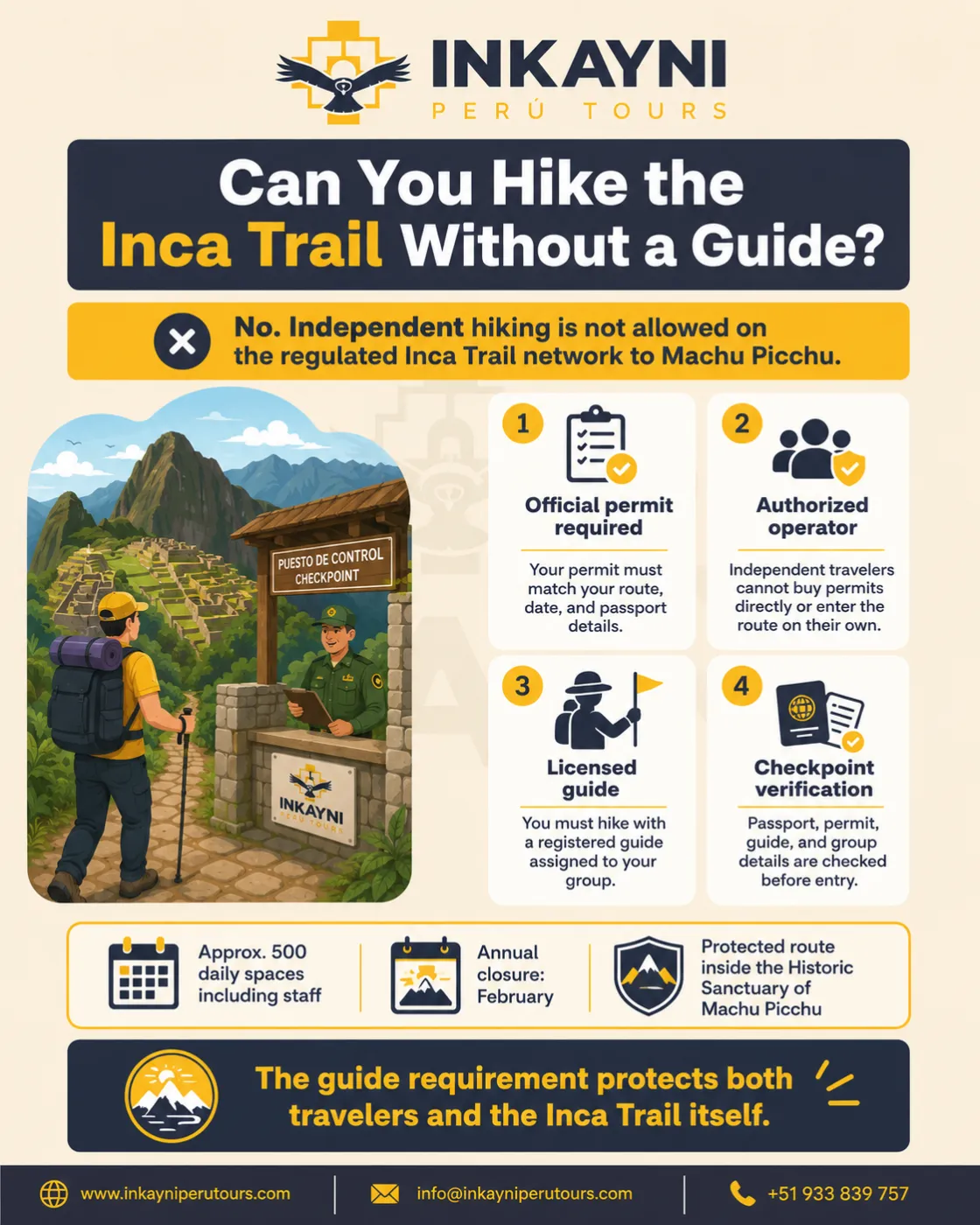
Infographic explaining why the Inca Trail cannot be hiked without an authorized guide.
Can You Hike the Inca Trail Without a Guide or On Your Own?
No. To hike the Classic Inca Trail, you must book through an authorized tour operator and hike with a licensed guide. You cannot buy an Inca Trail permit as an independent traveler, arrive at the checkpoint, and start hiking on your own, without a guide, without a tour, or without an authorized agency.
The permit is connected to a specific date, route, traveler identity document, guide, agency, and support team. At control points, the information must match. If your passport data is wrong, if you arrive without the registered guide, or if your agency has not secured the correct permit, entry can be denied.
Important note:
This rule applies to the regulated Inca Trail network to Machu Picchu, including the Classic Inca Trail and the Short Inca Trail. Other alternative treks near Cusco may work differently, but they still require responsible planning and a separate Machu Picchu ticket.

Why Is a Guide Mandatory on the Inca Trail?
The Inca Trail crosses a protected cultural and natural area. The route is not only a trekking path; it is part of an archaeological landscape with Inca stairways, retaining walls, campsites, cloud forest, water systems, and sites that require conservation.
A licensed guide helps manage three practical responsibilities:
| Responsibility | Why it matters |
| Safety | The guide monitors altitude symptoms, pace, trail conditions, group fatigue, and emergency decisions. |
| Conservation | The guide helps ensure visitors stay on authorized routes, respect archaeological sites, and follow waste rules. |
| Logistics | The guide coordinates checkpoints, campsites, schedules, meals, and final access to Machu Picchu. |
Without that structure, the trail would face more erosion, more disorder at campsites, greater safety risks, and more pressure on archaeological areas.
What Does Hiking the Inca Trail “On Your Own” Really Mean?
When many travelers ask if they can hike the Inca Trail on their own, they usually mean avoiding an agency, buying the permit directly, joining without a tour, or walking the route without a guide. For this specific trail, those options are not allowed. The Inca Trail works through a regulated system of official permits, authorized operators, licensed guides, checkpoints, registered campsites, and controlled group logistics.
What you can organize independently are other parts of the trip: flights, hotels, acclimatization days in Cusco, Sacred Valley visits, or even a train-based visit to Machu Picchu if you purchase the right tickets. But the regulated Inca Trail section, both the Classic Inca Trail and the Short Inca Trail, cannot be done independently or as a self-guided hike.
| Part of the trip | Can you do it on your own? |
| Classic Inca Trail | No. It requires an official permit, an authorized tour operator, and a licensed guide. |
| Short Inca Trail | No. It is also part of the regulated Inca Trail network. |
| Flights, hotels, and days in Cusco | Yes. You can organize these independently before the trek. |
| Machu Picchu by train | Yes, as long as you correctly book your train, bus, and Machu Picchu entrance ticket. |
| Alternative treks to Machu Picchu | It depends on the route. Some are more flexible than the Inca Trail, but they still require serious planning. |

Ascent along a stretch of the Inca Trail between mountains and clouds, heading to Machu Picchu
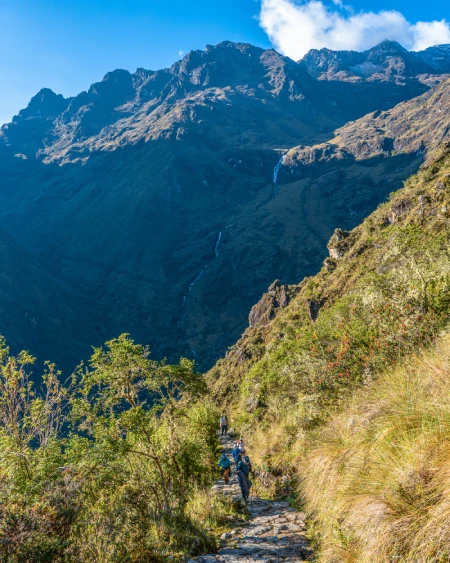
Section of the Inca Trail with a wide view of the valley and surrounding mountains.
What Is the Legal Basis for the Guide Requirement?
The obligation to hike with a licensed guide and authorized operator is not a policy set by tour agencies. It belongs to the regulatory framework for the sustainable tourist use of the Inca Trail Network within the Historic Sanctuary of Machu Picchu.
Under that regulatory framework, the route works through authorized operators, registered guides, controlled groups, official checkpoints, campsite assignments, and conservation rules. Travelers should understand this before comparing prices or assuming that the trail works like a normal mountain path.
| Legal point | What it means in practice |
| Authorized operation | The route must be organized under the official Inca Trail permit system. Independent travelers cannot simply arrive and enter. |
| Licensed guide required | The group must be accompanied by a guide registered for the route and date. |
| Daily visitor cap | The total number of spaces per day includes trekkers and all support staff. This limit is enforced at checkpoints. |
| Annual closure | The Inca Trail closes every February for maintenance and conservation work. |
This legal structure exists to preserve a route that crosses both a UNESCO World Heritage landscape and a nationally protected natural area. Violations are not handled as a simple gate fee; they can result in denied entry.
What Happens If You Try to Enter Without a Guide?
You should not plan on entering. The Inca Trail has official checkpoints where permits, passports, guide registration, and group details are reviewed. A traveler without the required permit and authorized guide will not be allowed to continue.
Trying to bypass the system also creates a real problem: it puts you outside the safety and conservation structure designed for the route. If something goes wrong, you would be in a protected area with limited communication, no authorized group leader, no registered itinerary, and no proper support team.
Is an Independent Guide Enough?
For the regulated Inca Trail, the key point is not simply “having someone who knows the route.” The trek must be organized through an authorized operator that can manage permits, register the guide and staff, coordinate campsites, and operate under official rules.
An independent local guide may be useful for other day hikes around Cusco or the Sacred Valley. For the Inca Trail to Machu Picchu, the permit and operator structure matters. Before booking, ask the agency to confirm:
- Whether it is authorized to operate the Inca Trail.
- Which route and date your permit covers.
- What passport information will be used for the booking.
- Which Machu Picchu circuit or route is included.
- How meals, campsites, and emergency support are handled.
How to Verify That Your Operator Is Authorized
Not every agency advertising Inca Trail tours operates under the same conditions. Before paying a deposit, verify that the operator can explain the permit process clearly and confirm the booking in writing.
Three steps to verify:
| Step | Action | What to look for |
| 1 | Ask for authorization details | The agency should be able to explain how it operates the Inca Trail legally and how permits are secured. |
| 2 | Ask for permit confirmation in writing | A serious operator can confirm your name as it appears on your passport, route, date, included services, and permit status. |
| 3 | Verify passport data before the trek | The name on the permit must match your travel document. Even a minor mismatch can create problems at the first checkpoint. |
If an agency cannot provide clear permit confirmation or asks you to travel with passport data that differs from your current document, treat that as a serious warning sign.
How Much Does the Inca Trail Cost?
The total cost of an Inca Trail tour reflects the official permit, licensed guide, campsite logistics, meals, support staff, Machu Picchu entry, train or bus coordination, and agency operation. Prices vary by operator, group size, service level, season, and whether the route is Classic or Short.
| Cost component | Approximate range | Notes |
| Classic Inca Trail tour | Commonly around $650–$950 USD per person | Usually includes permit, licensed guide, campsites, meals, support staff, Machu Picchu entry, and route logistics. Service levels vary. |
| Short Inca Trail tour | Commonly around $350–$550 USD per person | Usually includes train to Km 104, permit, guide, one night in Aguas Calientes, and Machu Picchu entry. |
| Very low prices | Warning sign if unclear | Low quotes may exclude essential services or reflect weak labor, gear, or permit practices. Always ask what is included. |
These figures are only market references. Confirm the current package price, exact inclusions, passport conditions, permit status, Machu Picchu ticket, train return, porter allowance, and cancellation rules before paying.
Related Guides Before Booking the Inca Trail
Inca Trail Altitude and Difficulty
| Route | Highest point | Practical read |
| Short Inca Trail | 2,730 m / 8,956 ft | Lower than Cusco, but still involves stairs, humidity, and several hours of walking. |
| Classic Inca Trail | 4,215 m / 13,828 ft | More demanding because of altitude, stone steps, cold camps, and four consecutive hiking days. |
If you are concerned about altitude, arrive in Cusco or the Sacred Valley at least 2–3 days before the trek. A guide can help monitor symptoms on the route, but acclimatization begins before the first step. Review our acclimatization in Cusco guide before booking tight travel dates.

How Far in Advance Should You Book?
For high season, especially May to September, booking several months in advance is the safest approach. Inca Trail permits are limited, personal, date-specific, and handled through authorized agencies.
| Travel window | Booking approach |
| May–September | Book 6–8 months ahead if possible, especially for June, July, and August. |
| April and October | Still popular. Book early at least 6 months ahead if your dates are fixed. |
| February | The Inca Trail closes for maintenance. |
If the Classic Inca Trail is sold out, consider the Short Inca Trail, Salkantay Trek, Lares Trek, Huchuy Qosqo, or the Inca Jungle Trek.
Plan the Inca Trail With the Right Structure
| Step | Action | Detail |
| 1 | Choose your route and dates | Decide between the Classic Inca Trail or the Short Inca Trail. Confirm your travel window and whether February is involved. |
| 2 | Verify permit availability | Contact authorized operators early. Peak season permits sell out months in advance. |
| 3 | Confirm operator conditions | Ask for written confirmation of passport data, route, date, included services, and guide coordination. |
| 4 | Plan acclimatization | Arrive in Cusco or the Sacred Valley at least 2–3 days before the trek. |
| 5 | Prepare gear and fitness | Review packing, footwear, weather, and physical preparation before departure. |
Inkayni Peru Tours can help you organize the Classic Inca Trail, Short Inca Trail, or an alternative route to Machu Picchu according to your dates, fitness level, and travel style.