Table of Contents
Ausangate Trek: A Challenging Adventure? Discover How Hard Is Ausangate Trek
In the Cusco region, there are different kinds of treks, each one offering a different but great challenge. Hidden among the towering peaks of the Andes lies the most challenging trek—a bold adventure! The Ausangate trek is a mountain challenge that promises a unique experience through natural landscapes, steep paths, and breathtaking views of Nevado Ausangate. Experience one of the most challenging treks and one of the few that still enjoys exclusivity because it is less crowded now!
But is it actually challenging? Is this journey only for experienced hikers? Get ready to uncover the truth behind the question “How hard is the Ausangate trek?” With Inkayni Peru Tours, we will traverse the Vilcanota Range and discover why “How hard is the Ausangate trek?” is a masterful challenge.
What is Ausangate?
Ausangate is a majestic snow-capped peak located in the Vilcanota Range in the southern Andes of Peru, near the city of Cusco. Standing at a height of 20,944 feet (6,384 meters). Ausangate is the highest mountain in the Cusco region and the fifth highest in the country, serving as an important source of water and energy for the region.
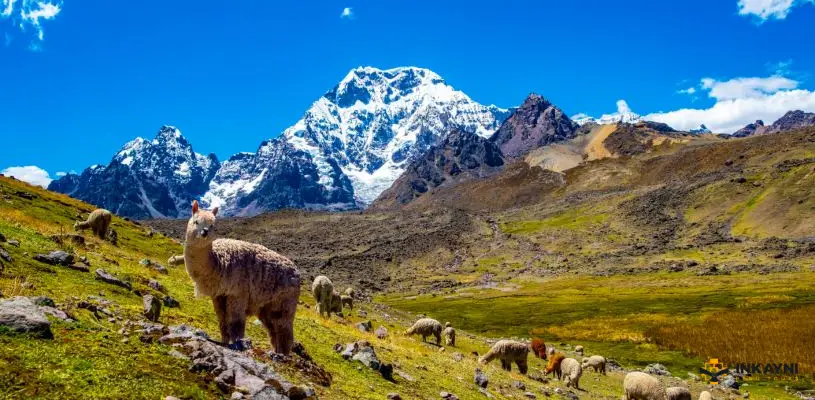
Panoramic view of Nevado Ausangate
What Does Ausangate Mean?
“Ausangate” is the name of the highest mountain in the Cusco region, located in the Peruvian Andes.
The word Ausangate originates from the Quechua and Aymara languages.
According to Aymara origin, it means “the caller of parents, the united family.”
In Quechua, “Ausangate” may derive from the word “Awsanqati”, which means “maiden of the water.” It could refer to the lagoons, glaciers, and water sources surrounding the imposing Nevado Ausangate, with the mountain’s meltwater being a vital water source for local communities.
What is the Ausangate Trek?
The Ausangate trek, or Ausangate hike, is a trekking circuit around Nevado Ausangate. It is one of the most spectacular treks in the Cusco region, alongside the Salkantay trek and the Inca Trail. However, unlike these two treks, the Ausangate trek is not as crowded, offering a unique sense of exclusivity. In summary, it is a challenging and dazzling hike in the majestic Peruvian Andes.

Panoramic view of Nevado Ausangate
Are There Incan Sites on the Ausangate Trek?
Unlike other more popular treks in the Cusco region, such as the Choquequirao trek, the Inca Trail, or the Inca Jungle, the Ausangate trek does not include Incan ruins along the trek. However, Apu Ausangate is considered one of the most revered deities in the Cusco region.
Apus is the Quechua term that refers to a protective deity or guardian spirit of a natural place.
An interesting fact is that within the Ausangate area, the famous expedition to the sanctuary of Señor de Qoyllurit’i takes place, one of the most sacred journeys in the Andes. It is usually celebrated from late May to June.
Therefore, while you won’t visit Incan sites on the trek, the entire area is considered one of the most sacred sites for Andean culture.
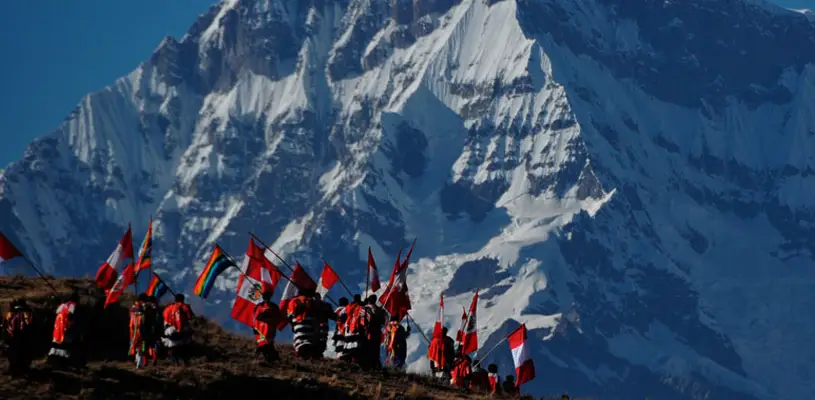
The Festival of Señor de Qoyllurit’i
The Best Season to Do the Ausangate Trek
The best season for trekking in Peru, including the Ausangate trek, is from May to September (the dry season in the Andes), when the weather is sunnier and the days are clearer to enjoy the beautiful landscapes.
Specifically, July or August are the driest months of the year, but keep in mind that it is also the high season. Therefore, Cusco, Machu Picchu, and the Inca Trail tend to be more crowded with hikers.
The rainy season is from October to April, with the wettest months being January to March. During these months, especially in February, the rain can be torrential, which may cause trail closures. A suggestion is to stick to the dry season or the intermediate season, which is in April and October.

How Hard Is Ausangate Trek?
Understanding how hard is Ausangate trek is crucial for preparing very well the package. The Ausangate trek is often questioned for its difficulty, and rightly so. So, how hard is Ausangate trek really depends on your physical fitness, hiking experience, and acclimatization to high altitudes.
In terms of actual hiking, the Ausangate trek is relatively moderate: covering 43 miles (69 kilometers) with a total elevation gain of approximately 13,000 feet (3,962 meters). However, at the time we evaluate the “How hard is Ausangate trek”, the altitude plays a significant role in its difficulty.
What is truly challenging is the altitude which is further amplified by its classification as Grade C: Quite long with many sections at high altitudes, which means elevations between 14,800 and 16,400 feet (4,500 – 5,000 meters) and 6-7 hours of hiking per day.
There will be steep sections that cause a quick increase in altitude in a short time. If you have a good hiking level, you can handle this route. It is strongly recommended that hikers have experience in multi-day hikes at high altitudes.
There are two mountain passes over 16,000 feet (4,876.8 meters). The highest is Palomani, reaching approximately 17,300 feet (5,273.04 meters). Additionally, you will sleep in two shelters:
- Machuraccay at 15,846 feet (4,829.8 meters)
- Huampococha at 15,748 feet (4,799.9 meters)
Altitude Sickness
Understanding the “How hard is Ausangate trek?” also involves being aware of altitude sickness. The Ausangate trek is a demanding hike in the Peruvian Andes, with stunning landscapes and natural beauty, but you will be hiking at high altitudes exceeding 13,123 feet (4,000 meters).
On the Ausangate trek, altitude sickness is a real possibility, so it is very important to take it seriously.
Symptoms of altitude sickness, usually occur above 6,566 feet (2,000 meters), include headaches, nausea, vomiting, fatigue, and dizziness. If it is not managed, they can lead to much more severe health issues.
Anyone experiencing these symptoms:
- Should immediately descend to a lower altitude.
- Drink plenty of water.
- Take pain relievers for headaches.
- Use supplemental oxygen tanks, if available.
- Can be offered coca leaves and coca tea.
Ausangate Trek + Machu Picchu
Generally, the 6-day Ausangate trek does not include a connection to the Historic Sanctuary of Machu Picchu, but if you have extra days, it can definitely be added.
On day 6, instead of ending in Tinqui, you would continue to Laguna Armaccocha, reach a viewpoint, and then Singrenacoccha Lake.
On day 7, you will walk alongside the river to Mallma.
On day 8, you will finally take a train to Machu Picchu Pueblo or Aguas Calientes and visit Machu Picchu.
NOTE: Machu Picchu is an activity that can be done in a single day starting from Cusco. This fact allows a Machu Picchu tour (Machu Picchu full day) to be added to Ausangate itineraries as an extra activity after completing the Ausangate trek in the city of Cusco.
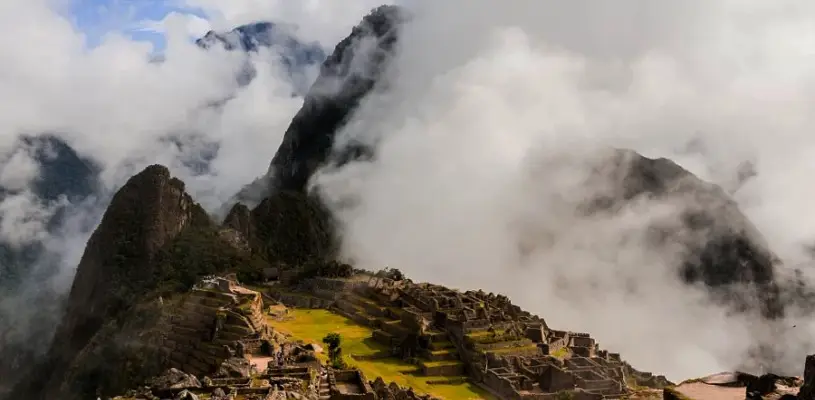
Panoramic view of Machu Picchu
Ausangate Trek + Rainbow Mountain
The Rainbow Mountain or Vinicunca Mountain is a very popular destination. You can see iconic mountains with varied mineralization that displays hues of reds, oranges, and yellows across an endless mountainous expanse. It’s a feast for the eyes!
This section of the route is traversed at an altitude of approximately 17,060 feet (5,199.8 meters) and is also one of Peru’s most frequented attractions.
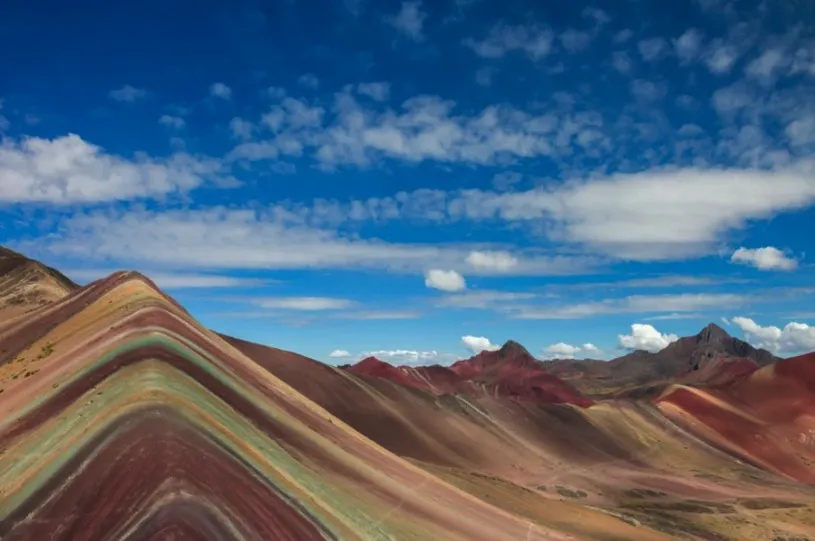
Vinicunca: A Natural Wonder
Difficulty of the 6-Day Ausangate Trek
Day 1. Cusco – Tinqui, Hike Tinqui – Upis
Cusco (11,152 feet) – Tinqui (13,123 feet) – Upis (13,451 feet)
Distance: 8.5 miles (13.7 kilometers)
Duration: 4 – 6 hours
Difficulty: Somewhat difficult due to the altitude of 13,123 feet (4,000 meters). The destination is the village of Upis, where you can enjoy the hot springs.
You start around 5:00 a.m. from Cusco (you can take a bus near Coliseo Cerrado) and arrive in Tinqui at 10:00 a.m., costing approximately $3 and paying an entrance fee to start the trail (10 soles). Then, you begin hiking.
You can sleep behind the viewpoint, as it is lower and will help protect you from the wind.
Challenges:
- During the hike, some sections may have steep climbs.
Day 2. Puca Cocha (15 km)
Upis (13,451 feet) – Paso Arapa (15,912 feet) – Laguna Puca Cocha (15,091 feet)
Distance: 4.5 miles (7.2 kilometers)
Duration: 3-5 hours
Difficulty: Still high due to the passes you will encounter.
You walk along the road up to a certain point, then you have to divert onto another path, where you can enjoy the tranquility and beauty of the mountains. On this stretch, the path is quite clear and easy to follow.
You reach Paso Arapa at 15,912 feet (4,850 meters), where you can see the first lake, Puqa Cocha, which has a small viewpoint where you can have lunch.
Along the way, you will see more lakes and many vicuñas, including Hatun Puqa Qocha, a glacial lake connected by waterfalls.
Challenges:
- Climbing Paso Arapa from Upis (2,297 feet of ascent)
- Descending to the Puca Cocha lagoons (984 feet of descent)
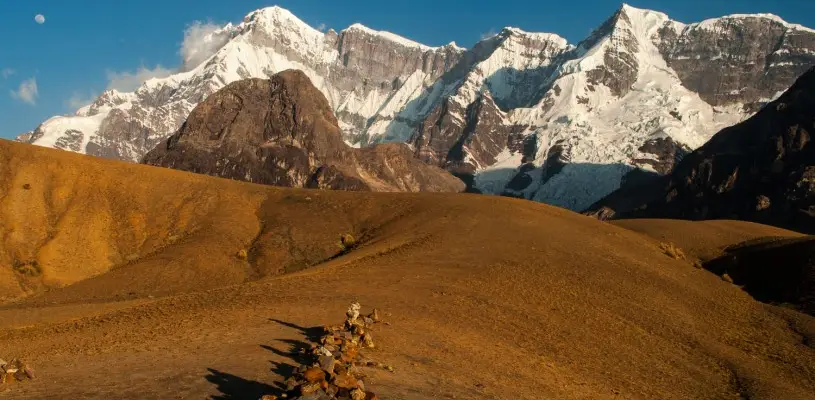
Apu Ausangate
Day 3. Puca Cocha – Ananta (13 km)
Puca Cocha (15,091 feet) – Paso Puca Cocha (16,591 feet) – Amanta (14,435 feet)
Distance: 9 miles (14.5 kilometers) (includes Rainbow Mountain and Red Valley)
Duration: 5 to 7 hours (longer if you decide to explore the area)
Difficulty: Moderate compared to previous days.
It’s a steep ascent to Paso Puca Cocha, where you start to see colorful mountains, mainly reddish, and many vizcachas. If you reach the campsite before noon, you can set up your tent, leave your backpack, and visit Rainbow Mountain on the same day, saving you time the next morning.
If you do not plan to hike to Rainbow Mountain from Puca Cocha, do not ascend the pass. Continue hiking along the lagoons towards Lake Ausangate, where you can camp. The huge scenery is incredible.
Challenges:
- Steep ascent from Puca Cocha campsite to Paso Puca Cocha (1,640 feet of ascent)
- Long descent to Ananta campsite (1,968 feet of descent)
Don’t forget to Visit Red Valley! The landscape is breathtaking, and you will also see Nevado Ausangate in the background. (Entrance fee is $10)
Day 4. Ananta – Rainbow Mountain – Lake Ausangate (15 km)
Amanta (14,435 feet) – Paso Ananta (14,764 feet) – Vinicunca Valley (14,107 feet) – Rainbow Mountain (16,404 feet) – Vinicunca Valley (14,107 feet) – Paso Ananta (14,764 feet) – Ananta (14,435 feet) – Lake Ausangate (14,107 feet)
Distance: 8.75 miles (14.1 kilometers)
Duration: 6 – 8 hours
Difficulty: Quite hard due to steep ascents and descents.
The hike from Ananta to Rainbow Mountain is a round-trip route along the same path.
The good thing is that you can leave your tent and backpack at the campsite and retrieve them on the way back. It is advisable to carry your important things with you.
It is recommended to wake up early if you do not want to encounter a crowd of tourists also visiting Rainbow Mountain. It will be a long day due to the hikes, but the spectacular view of the great Rainbow mountain (one of the most important points on the route) will reward you.
It is time to immortalize and capture the excitement of the trip, and preserve memories that will last forever in your photographs!
The return path is mostly downhill, it is not that hard, and will take less time.
Challenges:
- Ascend to Paso Ananta from the camping area: 328 feet of ascent.
- Ascend from the valley to Rainbow Mountain: 2,297 feet of ascent.
- Descend from Rainbow Mountain to the valley: 2,297 feet of descent.
- Ascend from the valley to Paso Ananta: 656 feet of ascent.
Day 5. Lake Ausangate – Jutumpata (13 km)
Lake Ausangate (14,107 feet) – Paso Palomani (17,060 feet) – Jutumpata (14,435 feet)
Distance: 10.5 miles (16.9 kilometers)
Duration: 7-9 hours
Difficulty: Quite difficult due to the altitude, and even more so if carrying a heavy backpack.
After the campsite, the route begins steep and long to Paso Palomani; at an approximate altitude of 17,060 feet (5,200 meters), which is the highest point.
You can enjoy a privileged and incredible view! Occasionally looking back, you will see stunning views of the valley and mountains.
There is no need to rush. Enjoy all the hike and take it easy; you can rest as much as you need. When you finally reach the summit and look across Paso Palomani, you will realize it was completely worth it.
The landscape is completely incredible—large glaciers, Rainbow Mountain, a red lake. It’s hard to decide which side to look at!
You can have lunch at the top of the pass, then begin descending towards the valley. The descent is quite steep; you must reach the Hutumpata Valley, with the pink lagoon and the river until you arrive at the campsite.
Challenges:
- Steep ascent from Lake Ausangate to Paso Palomani: 2,953 feet of ascent.
- Steep descent from Paso Palomani to the valley: 2,625 feet of descent.
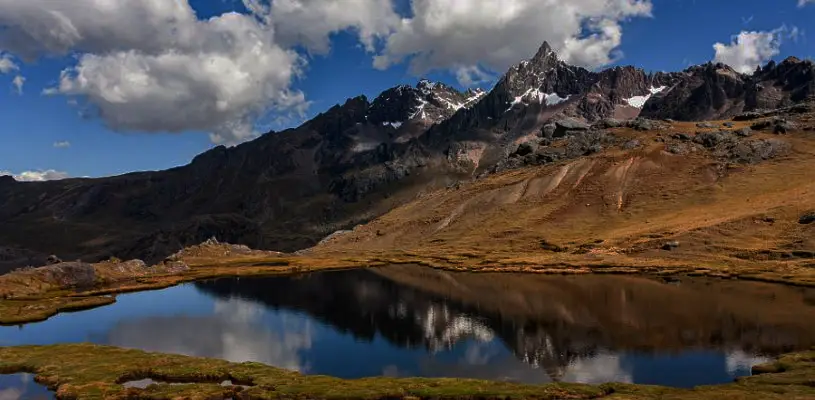
Ausangate trek: Discover the beauty of one of the highest mountains
Day 6. Jutumpata – Pacchanta – Tinqui (17 km)
Jutumpata (14,435 feet) – Paso Qampa (16,404 feet) – Pacchanta Village (13,451 feet) – Tinqui (13,123 feet)
Distance: 4 miles (6.8 kilometers)
Duration: 2 hours
Difficulty: Moderate
The last ascent on the trek is Paso Qampa, where you will see more colorful lakes, alpacas, and chinchillas during your journey. From the summit, you will begin descending to the valley, passing by several turquoise lakes where the water is icy cold! Finally, after walking approximately 5 hours, you will reach the village of Pacchanta.
If you do not feel like continuing hiking, you can stay and enjoy the Pacchanta Hot Springs, where the entrance fee is $1.25 and there are camping areas if it works for you, and continue to Tinqui the next morning.
Alternatively, you can take a local bus to Tinqui, that costs approximately $8, and it is approximately 30 minutes of travel, and to return to Cusco, take another bus from the town’s main square. Buses may be delayed or canceled if there are not enough passengers.
The trip takes approximately 2 hours and 30 minutes and costs around $4.
Challenges:
- Steep ascent to Paso Qampa: 1,968 feet of ascent.
- Descent from Paso Qampa to the valley: 2,953 feet of descent.

Shelters on the Ausangate Trek
One of the features of the Ausangate trek is the few high-altitude shelters you will find. These are unique shelters that are rarely found on other treks.
The fact that they are located beneath the highest peaks provides a privileged view. The accommodations are rustic, offering everything you will need: a warm fireplace, toilets, solar showers, and homemade Andean meals.
The shelters focus on environmental sustainability, as an initiative by local communities to provide lodging options in the remote nature and facilitate the trekking experience in the region.
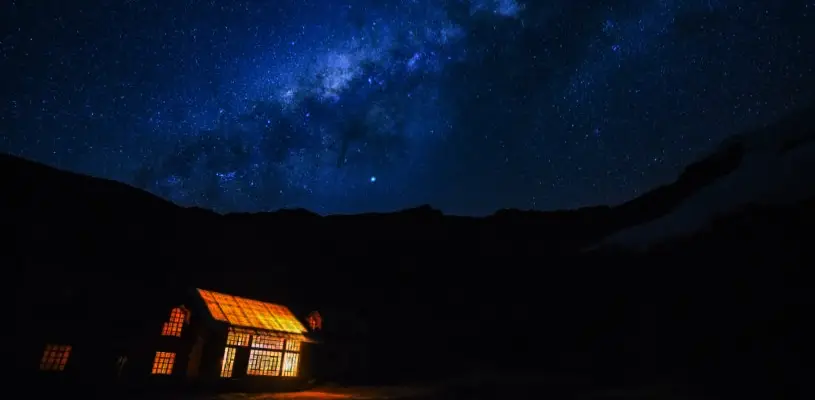
Comfy shelter on the Ausangate Trek
Cost of the Ausangate Trek
The 6-day Ausangate trek costs approximately $640 per person, and the 5-day trek costs approximately $550 per person. Both include guides, dishes, transportation, accommodations, tents, and sleeping mats. Equipment rental is additional (sleeping bags, trekking poles, etc.) and is not included in many cases.
If you don’t have much time and want to explore Nevado Ausangate, there is a 2-day version that includes Rainbow Mountain for approximately $279 per person.
If you undertake the trek without a travel agency, the cost is relatively lower, but you must consider the proper equipment, meals, and the logistics involved in organizing this route.
Is the Ausangate Trek Dangerous?
Like any outdoor activity conducted on mountainous and remote terrain, it carries certain risks and challenges that you should be aware of. To minimize risks and enjoy the Ausangate trek, it is recommended to:
- Choose the best time to travel, as the rain from December to February can erode the trail and even cause landslides. Not only is it unpleasant to hike in these conditions, but it can also be dangerous.
- It is advisable to spend at least 24 to 48 hours in the city of Cusco or the Sacred Valley before taking this trek, or to do less demanding hikes like the Salkantay trek, Inca Jungle, or Lares trek. You will enjoy the hike more when your body has acclimatized.
- If you plan to do the Ausangate trek independently, you should inform your family or friends, as there is not much phone reception. And remember, DO NOT HIKE ALONE ON THIS ROUTE.
- You might want to learn some Spanish words, because most locals do not speak English. It is advisable to know at least some basic phrases or have a dictionary.
- Yes, it is imperative to hire a travel agency. If you are hiking on your own, make sure to use water purification tablets before drinking water from natural sources.
- Like any outdoor adventure activity, the Ausangate trek is unpredictable. The trek may be canceled due to weather, landslides, etc.
- There is a risk of injury, so it is advisable to invest in travel insurance that covers your hike.
What to Bring on the Ausangate Trek
The weather is usually unpredictable in this part of the Peruvian Andes, so it is essential to bring appropriate clothing and necessary equipment to prepare for any climatic condition you might face.
We recommend bringing the following:
Clothing
- Long-sleeved hiking shirts
- Hiking pants
- Thermal shirt and sleeping pants
- Rainwear
- Underwear
- Non-slip socks
- Gloves
- Hat
- Sports bra
- Sunglasses
Backpack
- Minimum 50 L Backpack
- Waterproof cover for backpack
- Purification tablets
- Water bottle
- Trekking poles (optional)
- Sleeping Tent (if trekking independently)
- Sleeping Bag and Sleeping Mat (can be rented)
- Cooking equipment (if trekking independently)
Toiletries
- Toothbrush and toothpaste
- Travel towel
- Deodorant
- Soap
- Toilet paper
- Hand sanitizer
- Sunscreen
- Lip balm
Can You Do the Ausangate Trek on Your Own?
This incredible multi-day hike on the Ausangate trek can be done on your own; however, due to its difficulty, it is not ideal for beginner hikers. Understanding “how hard is ausangate trek” is essential before deciding to embark on it solo.
The Andes range is beautiful, but with beauty comes risk. Only 5% of hikers on the Ausangate trek do it on their own. Additionally, you must have the proper equipment and experience in high-altitude trekking. You need to organize your own logistics and find accommodations, which is challenging due to their scarcity, meaning you must carry your own camping gear and food.
Remember: NEVER HIKE ALONE.
Keep in mind that by booking with a travel agency, you do not have to worry about carrying food or the logistics of the trip. You can focus on enjoying the trail and minimizing the challenges.
Recommendations
- Acclimatization is key. Fortunately, the city of Cusco, where most travelers connect from Lima, is at 11,152 feet (3,399.1 meters).
- Drink as much water as possible. For example, the hot water for tea available at mountain shelters should be utilized; water helps during acclimatization to the high altitudes of the Andes.
- Avoid alcohol or be very moderate with it. You might want to enjoy a pisco sour (or two), but that will not help your body cope with the altitude.
- Consider seeing a doctor before your trek. For example, you can take acetazolamide (Diamox), which accelerates the rate at which your body acclimates to high altitudes. Nifedipine (Procardia) and dexamethasone are also used for altitude sickness, but ALWAYS CONSULT YOUR DOCTOR.
- During your trek, avoid leaving any trace of waste on the trail to preserve the nature of Nevado Ausangate.
- You should always respect the mountains by following the “Leave No Trace” philosophy and being respectful to nature and Apu Ausangate.
- Permits and Regulations: Ensure you have any necessary permits for the Ausangate trek. Check with local authorities or your tour operator about required documentation.
- Physical Preparation: Engage in regular cardiovascular and strength training exercises before your trek to enhance your stamina and muscle endurance, which are crucial for handling the demanding terrain of the Ausangate trek.
- Emergency Preparedness: Familiarize yourself with basic first aid and carry a well-stocked first aid kit. Know the locations of the nearest medical facilities along the trek.
You might also be interested in:
- RAINBOW MOUNTAIN PERU: A COMPLETE GUIDE TO EXPLORING THE NATURAL WONDER
- DISCOVER THE INCREDIBLE HISTORY OF WHY RAINBOW MOUNTAIN PERU IS COLORFUL
Have you wondered how hard is Ausangate trek? It’s time to discover it for yourself!
With Inkayni Perú Tours, dare to hike one of the most exclusive routes in the Peruvian Andes, from colorful lagoons to imposing glaciers. Are you ready for the challenge? Pack your adventurous spirit and passion for nature. Let us be your travel companion, and don’t worry about anything else but enjoying one of the most sacred and imposing snow-capped peaks in the Cusco region!

👉 𝗦𝗨𝗦𝗖𝗥𝗜𝗕𝗘 𝗢𝗨𝗥 𝗕𝗟𝗢𝗚 ▶ 👈
👉𝗦𝗨𝗦𝗖𝗥𝗜𝗕𝗘 𝗢𝗨𝗥 𝗧𝗜𝗞 𝗧𝗢𝗞 ▶ https://acortar.link/E4XQ8C👈
Shared: