


Table of Contents
If you are wondering what Pongo de Mainique is or how important it is, you would be fascinated with what you will read next. Pongo de Mainique is a small canyon which divides the upper and lower portions of the Urubamba River. The word Pongo may have appeared as a variation of the word “punku” which means Door, so Pongo de Mainique is also known as “Door of the Bear.”
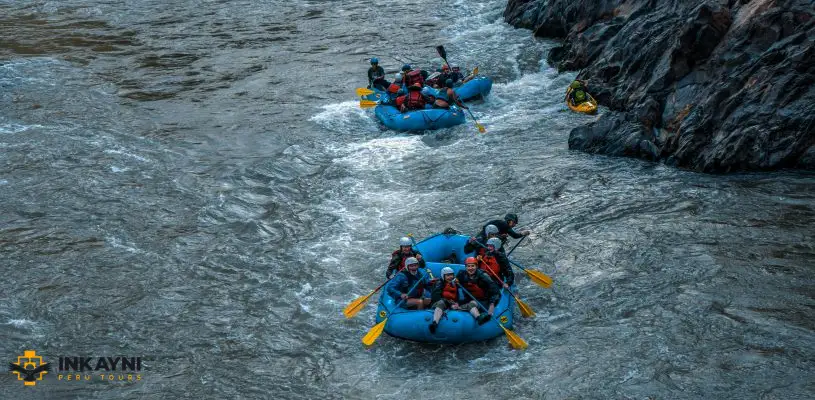
The Pongo de Mainique is used to refer indistinctly to both a gorge in the Vilcabamba mountain range and the rapids of the Urubamba River that are formed in this gorge. It would make sense to think of Pongo de Mainique as an area including both the canyon and rapids. This is the exact place where the Andes and the Amazon basin meet.

Pongo de Mainique river is constricted to a width of 45 meters. The Pongo de Mainique is 3 kilometres (2 mi) long. And the elevation of the river is approximately 450 metres (1,480 ft).
Its biological diversity is incomparable: scientists believe that the Pongo de Mainique may, in fact, contains more species of wildlife than any area of its size in the entire world.
Pongo de Mainique is part of the Megantoni National Sanctuary which is a protected area in Peru situated in the Cusco Region, La Convención Province, Echarate and Megantoni districts.

How to get there?
To get to Pongo de Mainique you need to follow the steps listed below:
- Take the bus from Cusco to Quillabamba. It is an eight-hour journey approximately.
- Once in Quillabamba, take the transportation that will take you to Tintiniquiato Port (Echarate, La Convención). It is a ten-hour journey approximately.
- In this Port, you can take the ship that will take you to Pongo de Mainique. It is a two-hour journey approximately.
You can also hire the service of a tourist agency. This is the safest and most recommendable option. In case of any inconvenience along the way, the tourist agency will be able to handle it.
Who and why Pongo de Mainique is important for?
For the ancient Inca people, Pongo de Mainique Peru was a magical and sacred place. The Machiguenga tribe know the place as the “Door of the Bear,” a reference to an ancient myth attributing the turbulent rapids at the center of the canyon to a thrashing, demonic bear hidden beneath the water, guarding the door to the afterlife. History shows that this region was used by the Incas to market their products and share their cultures with the Machiguenga native community living deep in the jungles along the Urubamba River.
What can you see in Pongo de Mainique journey?
The area is as beautiful as it is daunting. Inkayni Perú Tours guarantees that you will be fascinated by the adventure and mysticism that this area offers you.
Six square miles of forest around Pongo de Mainique have indeed an “extraordinarily high” level of biodiversity. River narrows and the shore seem to struggle to contain the vegetation, which overflows on the water.
You will also appreciate the diversity of the fauna in Pongo de Mainique. You will see animals like:
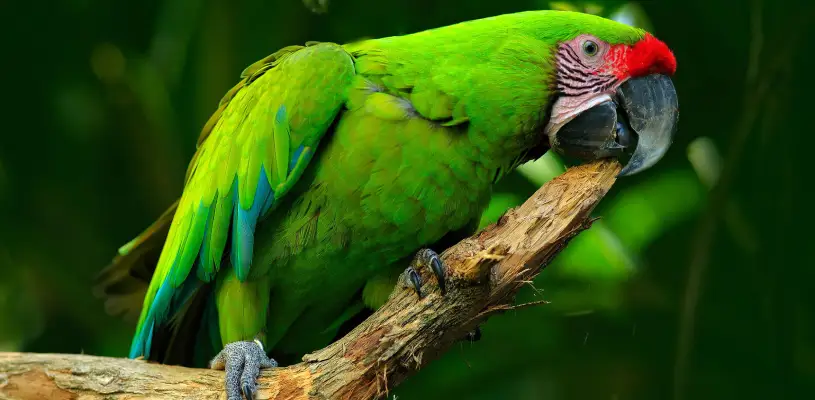
Military Macaw:
Order: Psittaciformes
Family: Psittacidae
The Military Macaw is all green with a red forehead. The bill is black. It has well defined black lines on the bare skin on the sides of the head. The flight feathers are blue. The tail feathers are red with a blue tip. It is one of the four unmistakable large macaws.
The Andean Cock-of-the-rock or Rupicola Peruvianus is also known as “Tunki” in the Quechua language. It is the national bird of Peru.
The male Andean cock-of-the-rock has a bright red-orange head, neck, breast, and shoulders. It has a black body, gray wings, and a large disk-shaped crest of feathers that extends over its bill. The female is a brownish-orange over her whole body and has a smaller crest. In both sexes, the wings and long tail feathers are black with a row of gray feathers along the inside edge.

Cock-of-the-rock is the national bird of Peru
Spectacled Bear:
It is called “ukumari” in the Quechua language. The name “spectacled”, given to the bear, is widely embraced due to the creamy-white colored line of fur encircling its eyes. It is completely black in color, with light-colored patches of fur on its chest and around the eyes. Its light-colored fur doesn’t always encircle the eyes completely, but when it does, it looks like the bear is wearing spectacles. Every bear has a different pattern of these light-colored patches on their body.
The spectacled bear population in The Andes is under great threat. The extinction of an important animal like this can destroy the entire ecology of the Andes, which in turn will only affect humans.

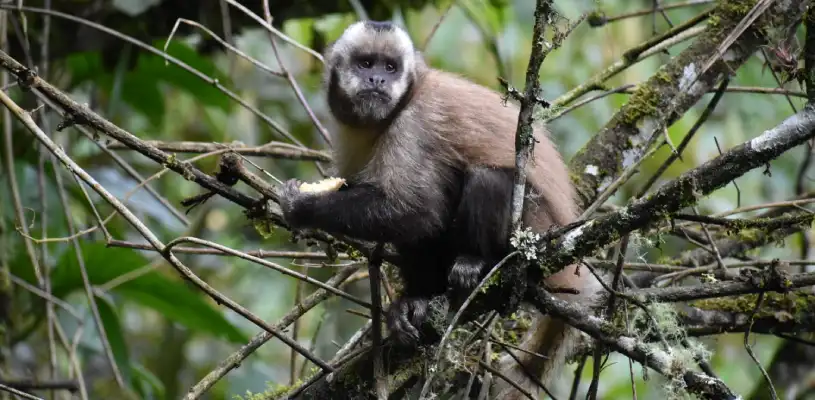
Black-capped capuchin Monkeys:
Pelage generally dark-chestnut to blackish-chestnut with slender, moderately long and not very dense hair. Crown with short blackish hair forming a cap that extends from the forehead to the back of the head. Crescent- shaped, creamy spot above each eye. Back, underparts, upper arms and thigh light-chestnut, forearms and lower legs dark-chestnut. Dark-brown band on the midline of the back from the neck to the base of the tail. Semi Prehensile tail with moderately long, dark-chestnut hair.
Groups comprise 5-15 individuals and are polygamous, with several adult males and females and their offspring.
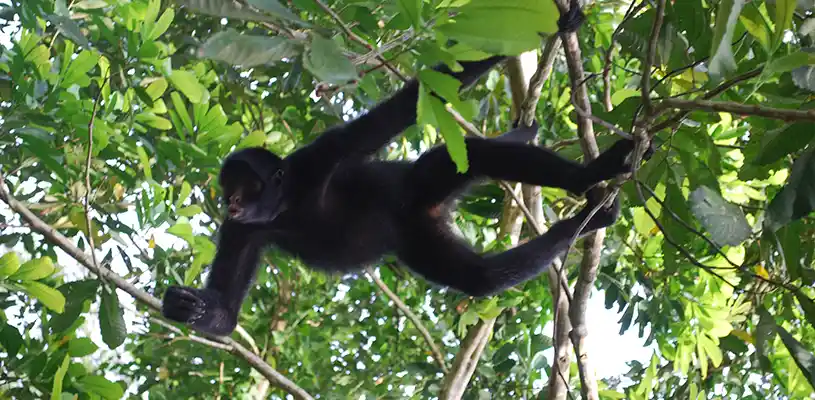
Spider Monkey:
Pelage with rough, little dense and long hair. Bare face dark-brown, except nose, surrounding of eyes and lips which are flesh-coloured. Tuft of long black hair on the head oriented towards the forehead, brow with transverse yellow-creamy band. Dorsal part of rump and external parts of arms with long black hair; ventral part of rump and inner side of arms with yellow-creamy hair; legs dark-orange. Prehensile tail black above, yellow-creamy below, terminal portion hairless below with dermatoglyphs.
Groups of up to 20 individuals are formed by adults, juveniles and infants of both sexes. Generally, one infant is born per birth and is carried and cared for by mother.
Tourists not only ask about what they will see, but also where they can sleep. Well, to be honest with you, you won’t find any hotel in the area. The only place you can sleep is in the Machiguenga Tropical Studies Center lodging.
Interesting fact: There are only 125 families approx. in all the native community.
What to bring to Pongo de Mainique:
It is very important to bring:
- Light clothes
- Waterproof jacket/rain poncho
- Camera and film
- Hats
- Sun cream (factor 35 or higher)
- Insect repellent
- Water, and snacks
- Original Passport
- Extra cash in Soles
- Toiletries and hand sanitizer
- Personal medication

“If you are always trying to be normal, you will never know how amazing you can be.” – Maya Angelou
Shared:


If you liked this article and the information you found, give us 5 stars!
 (Ninguna valoración todavía)
 Loading...