


Table of Contents
Peru has become the first world alpaca fiber producer in the past two years. Among its main markets are Italy and China. Since 2012, Peru has established August 1st as the “National Day of Alpaca” in order to increase the identity and economy of the high Andean regions of the country.
That is why Inkayni Peru Tours invites you to learn more about this important Peruvian camelid, not only because of its economic benefits, but also for the health benefits. You will like the information that we have prepared for you since at least one of your favorite outfits is made of alpaca fleece.

Would you like to know more about the Alpaca? Join us on this interesting tour:
Alpaca is a species of South American camelid mammal. It is similar to, and often confused with, the llama. The alpaca’s shaggy coat varies in colour from the usual black or brown through lighter shades of gray and tan to pale yellow and, occasionally, white. alpaca’s fleece is remarkably lightweight, strong, lustrous, high in insulation value, and resistant to rain and snow. This fact is what makes alpacas most important lamoids for fleece production and exportation to different countries in the world.
In Peru, there are two breeds of Alpaca:
Huacaya:
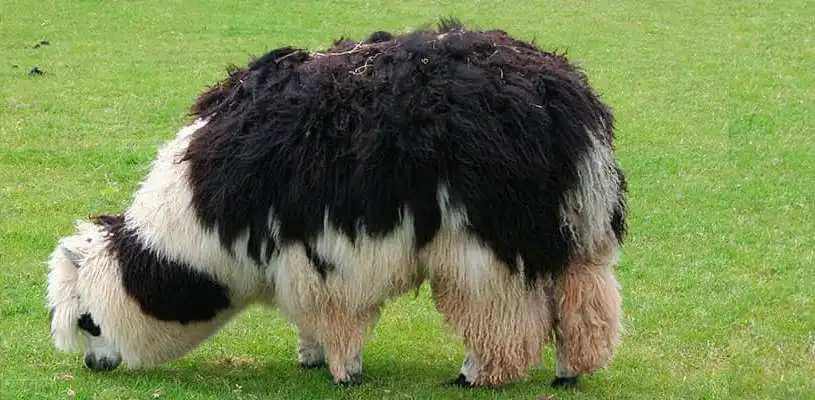
Huacaya alpacas are the most commonly found, constituting about 90% of the population. Their thicker fleece makes them more suited to survive in the higher altitudes of the Andes. These alpacas have fluffy, crimpy fleece that gives the animals a teddy bear-like appearance. The fleece of the huacaya is shorter and coarser by comparison.
Suri:
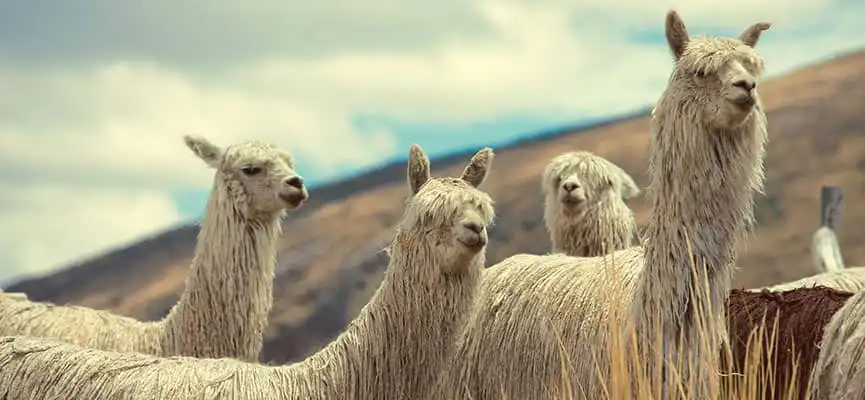
Suri alpacas represent a smaller portion of the total alpaca population, around 10%. They could be kept at a lower altitude where a thicker fleece is not needed for harsh weather conditions. The fleece of the suri is fine and silky and grows long enough to touch the ground if the animal is not sheared.
Characteristics of the Alpacas:
- These beautiful camelids usually weigh between 48 and 84 kilograms.
- An adult alpaca generally is between 81 and 99 cm.
- Alpacas are often noticeably smaller than llamas.
- They use spitting as a means of negative communication. They do get possessive around food, and thus may express annoyance by spitting at other alpacas that they perceive are encroaching on “their” food.
- Almost all of them are raised for their soft and luxurious fleece (sometimes called fiber). This fleece, often compared to cashmere, can be turned into a wide array of products.
- Alpacas usually eat 1.5% of its body weight for normal growth. They mainly need pasture grass, hay, or silage but some may also need supplemental energy and protein foods.
- Something interesting is that alpacas will chew their food in a figure eight motion, swallow the food, and then pass it into one of the stomach’s chambers.
Importance of the Alpaca fleece:
Peru is the leading producer of the Alpaca fleece. Alpaca fiber is sometimes combined with other fibers to make dress and lightweight suit fabrics and is also woven as a pile fabric used both for coating and as a lining for outerwear.
Finer grades of alpaca fleece (known commercially as “Baby Alpaca”) are believed to be hypo-allergenic, meaning it does not irritate your skin as sheep’s wool sometimes does. Unlike sheep’s wool, alpaca fleece contains no lanolin and is therefore ready to spin after only nominal cleaning. Prized for its unique silky feel and superb “handle,” alpaca fleece is highly sought-after by both cottage-industry artists (hand spinners, knitters, weavers, etc.) as well as the commercial fashion industry.
The fleece itself is recognized globally for its fineness, softness, lightweight, durability, excellent thermal qualities, and luster.
Fact:
Just like the alpaca, in Peru, there are other South American camelids that have fine fibers to make wonderful clothing items and ornaments. Among these camelids we can name llama, guanaco and vicuña.

Alpaca fleece fabrics:
Animal fibers are the best when it comes to protection against cold and wind. And with Alpaca fleece there is a great variety of outerwear to be made. Most of them are exhibited in important fashion runways. The outwear that can be made are:
- Ponchos
- Scarves, shawls
- vests
- Jackets, sweaters
- Blankets
Main regions of Peru that raise Alpacas:
Main regions where people raise alpacas and benefit from their fiber and meat are: Puno (39.6 %), Cusco (14.7 %), Arequipa (12.7 %), Huancavelica (8.3 %), Apurímac (5.9 %), Ayacucho (2.8 %), and Pasco (1.8 %).

Shared:



If you liked this article and the information you found, give us 5 stars!
 (Ninguna valoración todavía)
 Loading...