Table of Contents
The fantastic Manu National Park in Peru is one of the natural areas protected by the Peruvian government. Why? Because this sanctuary protects diverse ecosystems such as lowland rainforests, cloud forests and Andean grasslands.
If you are a nature lover, this tour will amaze you. On this blog, Inkayni Peru Tours provides further information about Manu National Park.

Manu National Park
A national park and biosphere reserve. UNESCO recognised it as a Biosphere Reserve in 1977. And in 1987, it was recognized as a World Heritage Site. Source: SERNANP
It was established by decree on 29 May 1973; during the dictatorship of General Juan Velasco.
Peruvian government increased the extension of the park to its current in 2002.
This National Park is very important since it is home to various ethnic groups like Matsiguenka, Harakmbut and Yine. There are also indigenous groups like Mashco-Piro. These groups make Manu a valuable and privileged place.
Some of the ethnic groups speak Quechua (language spoken by the Incas). They are 30 quechua speaking communities approximately.
Manu National Park has been recognized for the world’s records for having a great variety of species of butterflies and birds. According to research, there are 1200 species of butterflies and more than a thousand species of birds.

Location:
Manu National Park is located in the regions of Madre de Dios and Cusco in Peru. Its highest point is 4000 m.a.s.l, the summit of Apu Kañajhuay Mountain.
Extension:
Manu National Park covers an area of almost 2 million hectares, which comprises mountainous areas with elevations close to 4000 m.a.s.l and a portion of the Amazon Basin plains.
Climate:
Rainy season is from January to March. However, you can experience unexpected rain any time during the year. Temperature varies from 35 °C during the day to 20 °C at nights.
What can you observe in Manu National Park?
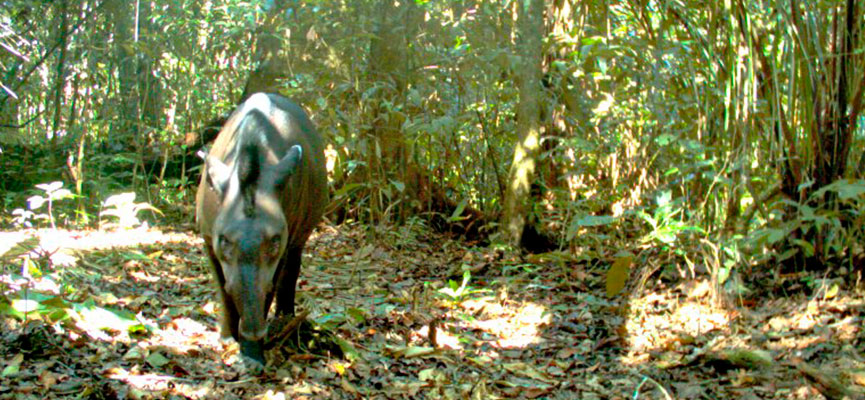
Manu National Park is a tropical forest that is home to an unrivalled variety of animal and plant species. 222 mammal species have been identified as inhabiting the Manu National Park, including the listed below:
- Jaguar (Otorongo)
- Black tiger
- South American tapir
- Peccary
- Deer
- Capybara
- Black Spider Monkey, among others.
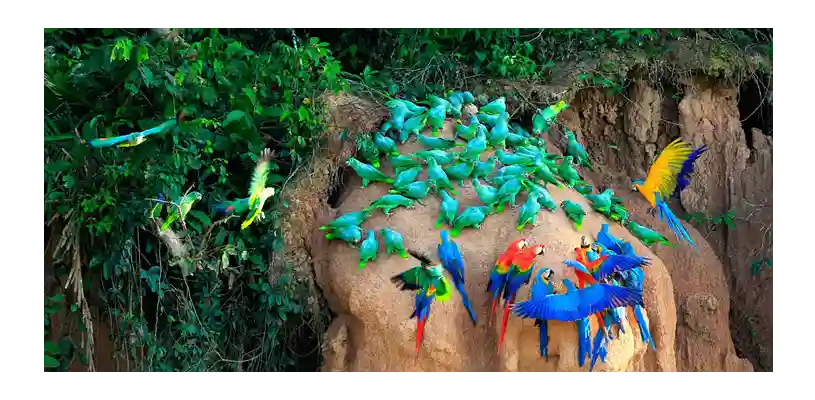
1,005 species of birds also live in the park, such as the harpy eagle, jabiru, roseate spoonbill, orinoco goose and the cock-of-the-rock. What’s more, it holds the world record for amphibian and reptile diversity, with 155 and 132 species respectively.. Visit our blog to learn more about the Cock of the Rocks, national bird of Peru.

Cock of the Rocks, national bird of Peru
Manu National Park has a range of interesting tourist attractions. For example, the Tres Cruces viewpoint, where there is a special panoramic view of the sun rise at over 3,600 meters above the Amazonian plain. In addition, it is possible to visit one of the most prestigious tropical research centers – the Cocha Cashu Biological Station.
How to get to Manu National Park?
Inkayni Peru Tours shares with you 3 options you have to get to Manu National Park. You can choose the one that works best for you:
First Option:
If you are in Cusco. it is better to take a bus from there to Shintuya or Atalaya (this will take about 10-12 hrs), then continue by the river to Boca Manu (another 8 hrs) and then another 8 hours until arriving to the area of Manu National Park.
Second option:
The second option is arriving in Puerto Maldonado. Then go to the Santa Rosa town. It takes from one to two hours. Once there you will have to cross the Inambari river by boat until Carlos Port.
Once there, you have to continue the journey until Boca Colorado town. It is 30 km far from the port and takes 1 hour to get there. Then, you have to continue the trip through the Madre de Dios river by boat until Limonal checkpoint. It takes 7 hours to get there.
Third option:
If you are in Lima, you can take a flight from Lima to Cusco. It takes one hour and 10 minutes approximately. Then take the bus from Cusco to Manu. It takes 9 hours to get there. Or if you want you can take the bus from Lima to Manu. The journey takes 22 hours to get there.
Entrance Fee:
The entrance fee to the Manu river lower basin Cuenca baja río Manu is S/. 150 PEN. While the entrance to the Acjanaco Sector is S/. 10 PEN (it may vary)
Note:
- If you are in Peru, you definitely should visit Manu National Park. The adventure is really worth.
- There are indigenous people who are living in voluntary isolation.
- Manu National Park is considered as one of the richest natural reserves in the world. There are places that aren’t yet studied like archeological sites.

Inkayni tips:
- Wear a hat and sunscreen to prevent from sun damage.
- Drink water to keep hydrated.
- Children must be under a parent supervision.
- Bring your personal documents and passport with you all the time.
- Take some cash (local currency preferable).
- If you get to Manu National Park with a tourist agency, always stick to your group arrangements. Don’t go on your own.

“Never get so busy making a living that you forget to make a life.”
Shared: