Table of Contents
The United Nations Educational, Scientific and Cultural Organization (UNESCO) declared Nazca Lines a World Heritage Site on December 17, 1994.
Although it has been 25 years now designated as a UNESCO World Heritage Site, and been studied for more than 80 years, they are still a mystery to researchers.
What are Nazca Lines?
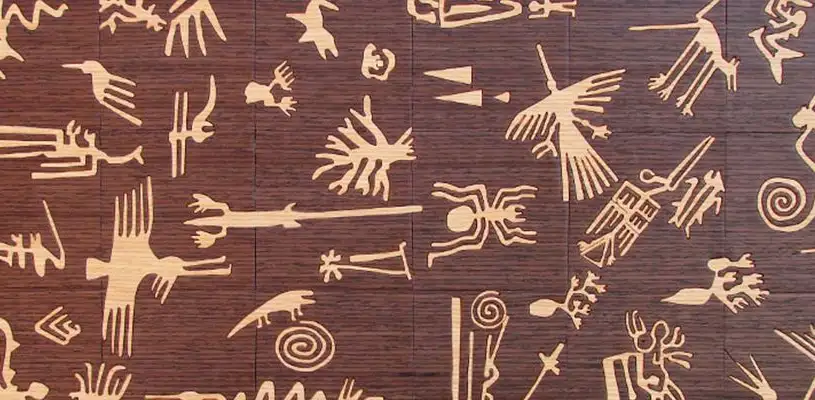
These ancient geoglyphs in the Nazca desert are made up of interesting figures of different designs on the surface of the land. There are three basic types of Nazca Lines: straight lines, geometric designs and pictorial representations.

Who made Nazca Lines?
Anthropologists believe that the Nazca culture, which began around 100 B.C. and flourished from A.D. 1 to 700, created the majority of the Nazca Lines. The Chavin and Paracas cultures, which predate the Nazca, may have also created some geoglyphs.
Description:
There are more than 800 straight lines on the coastal plain, some of which are 30 miles (48 km) long. Additionally, there are over 300 geometric designs, which include basic shapes such as triangles, rectangles, and trapezoids, as well as spirals, arrows, zig-zags, and wavy lines.
The Nazca Lines are perhaps best known for the representations of about 70 animals and plants, some of which measure up to 1,200 feet (370 meters) long. Examples include a spider, hummingbird, cactus plant, monkey, whale, llama, duck, flower, tree, lizard and dog.
How were Nazca lines discovered?
The first clues to the existence of the Nazca lines and geoglyphs date back to the year 1547 when Spanish historian and chronicler Cieza de León mentioned that he saw “signs in some parts of the Nazca desert.” This claim was forgotten with the passage of time until, much later, they were rediscovered by the first Peruvian commercial airline pilots.
The first researcher to study them was Julio César Tello, a Peruvian archaeologist, who in 1929 described these enigmas as “sacred highways.” That same year, Paul Kosok, from the United States, interpreted them as “the largest astronomy book in the world.” Years later, Toribio Mejía Xesspe theorized that the lines were part of a vanished religion. However, it was a German archeologist María Reiche Neumann who conducted in-depth studies that interpreted the Nazca lines and geoglyphs as a gigantic solar and lunar calendar for ancient Peruvian astronomers. They used the lines to predict the best time to harvest crops and the arrival of the rainy season.
It was Maria Reiche’s invaluable work, made with love and dedication that contributed Nazca Lines to be declared World Heritage Site by UNESCO.

Location and how to get to Nazca Lines:
Nazca Lines are located in the Peruvian coastal plain about 250 miles (400 kilometers) south of Lima, Peru, in Pampas of Jumana in the Nazca Desert, between the towns of Nazca and Palpa.
Once in Nazca, there are only two options for viewing the lines – take a flight or climb the nearby observation tower. However, flying is undoubtedly preferable as it offers a bird’s eye view of the most important etchings.
Inkayni Important note: Nazca’s tiny airport doesn’t serve passenger flights so almost all travelers arrive by bus instead.
These incredible Lines can only be fully appreciated when viewed from the air given their huge size.
Since some depictions measure up to 370 meters long, you may wonder why they built it.
As historian Maria Rostworowski explains, the figures were created to be seen from the sky. However, the purpose of this figure was not to understand the stars, but to pay homage to a winged god who was respected and feared by the people. It thus serves as an offering to keep this divinity from punishing them with droughts, which in an arid land like Nazca would have devastating consequences.
There are many conspiracy theories about the real origin of the lines and how were they really done without any planes, helicopters or advanced technology.
Famous figures you may see from the air include a monkey, a spider, a hummingbird, and so many more.
Hummingbird:
This figure is one of the most representative of all the geoglyphs, due to its harmonic dimensions. The wingspan of the hummingbird is around 66 m (216 ft.)
Monkey:
Curiously, this figure shows a monkey with nine fingers and a spiral-shaped tail. It is believed to be a depiction of Ursa Major. It measures around 135 m (443 ft.) across.

Frigate bird:
This figure is 160 m (525 ft.) long. Its unique feature is its head, which is made up of segments of circles with a radius of between 10 and 20 cm (4 and 8 inches). From the side, two circles of equal size could represent its eyes.
Giant Bird:
This bird is immense, at 300 m (985 ft.) long and 54 m (177 ft.) wide. Among the unique features of this figure is its snake-like neck with a beak pointing directly to the rising sun.

Spider:
It is part of an enormous network of lines located at the edge of a trapezoid on the surface. This figure is important because it shows the skill that was required to lay it out. It is approximately 46 m (151 ft.) long.
Inkayni tips:
- An original identity document is required (ID card or passport). Foreigners not carrying their passport can show a copy of their passport and an original ID card issued by their country of origin.
- The price of lodging ranges from $10 to $50 per night at the hostels closest to the town of Nazca.
- You must purchase an admission ticket to enter the area. We recommend booking in advance for the flyover, especially during the high season (June-August).
- The aircraft that flies over this attraction has a qualified guide on board, who will give you the most important information about each figure you see.
See our video:
We are Inkayni Peru Tours:

Our guides are chosen for their experience and responsibility. They share their enthusiasm and knowledge. We are a licensed agency working on tourism many years. We have a certificate submitted by DIRCETUR.
«Better to see something once than hear about it a thousand times»
Shared: