Table of Contents
Quick Answer:
Cusco’s Corpus Christi is one of the city’s most important religious and cultural celebrations. It takes place between May and June and combines Catholic liturgy with local expressions inherited from the colonial period. The central focus is the procession of sacred images that depart from different temples and gather at the Plaza de Armas, where they remain for several days as a symbol of encounter and unity.
In Cusco, these processions aren’t simple religious representations. Each saint is the living symbol of a parish, a neighborhood, and a specific community. Throughout the year they remain in their temples, but during Corpus Christi they “travel” to the heart of the city to gather at the Plaza de Armas, in an act that combines Catholic faith, local identity, and Andean heritage.
This complete guide will help you discover the saints of Corpus Christi, understand their meaning, explore the traditional gastronomy of the celebration, and plan your visit for 2026.
Corpus Christi dates in Cusco 2026
Corpus Christi is celebrated 60 days after Resurrection Sunday (Easter), which means the date varies each year according to the Catholic liturgical calendar. Here are the confirmed dates:
- Corpus Christi 2025: Thursday, June 19, 2025
- Corpus Christi 2026: Thursday, June 4, 2026
Activity Calendar
The celebration isn’t limited to a single day. Festivities extend for more than a week, with the following general structure:
- Wednesday before Corpus: “La Entrada” or “Descent of Saints” – images arrive at the Cathedral from their parishes (begins approximately at 10:00 AM and can extend until nighttime)
- Thursday (Central Day): Solemn Mass in the Cathedral and main procession with the Monstrance and the 15 saints around the Plaza de Armas (begins approximately at 11:00 AM)
- The following 8 days: The images remain together in the Cathedral
- “La Octava” (eighth day): New procession for the saints to return to their home parishes
Important note:
To experience the full celebration, plan to be in Cusco from the Tuesday before until at least the central Thursday. If you can stay until “La Octava,” you’ll witness the complete cycle of this centuries old tradition.
History and Origin: When the Inca past meets Catholic tradition
The celebration has more than 400 years of history in Cusco, and its roots connect with an ancient Inca ritual that preceded Inti Raymi. This cultural fusion is what makes Cusco’s Corpus Christi unique in the world.
The Pre Hispanic Ritual
The Incas performed a ceremony similar to Corpus Christi, dedicated to the worship of their ancestors’ mummies. These were removed from their temples and carried in procession through the city of Cusco at the beginning of Inti Raymi, the great festival of the Sun. This practice, known as the cult of the “mallquis” (mummies of nobles and rulers), was celebrated in what is now the Plaza de Armas.
The Colonial Transformation
With the arrival of the Spanish in the 16th century, the Catholic Church didn’t eliminate these processions but strategically adapted them. Ancestral figures were replaced by Christian images, giving origin to Corpus Christi as we know it today: a procession led by the Monstrance (carrying the consecrated host) followed by images of saints and virgins.
The result is a mestizo celebration where the Andean and the Catholic coexist, creating a unique religious syncretism that was declared National Cultural Heritage on August 6, 2004.
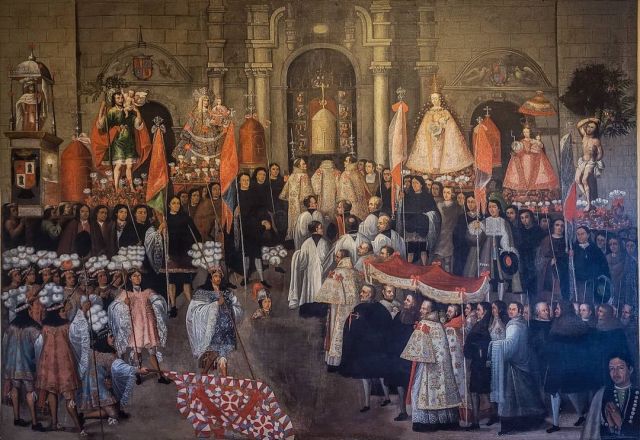
What do the saints represent in Corpus Christi?
In Cusco, each saint represents much more than a religious figure.
- A historic parish and its local memory
- A neighborhood or community with its own identity
- A collective symbol of devotion and prestige
- A social organization (stewards, devotees, responsibilities and promises)
During Corpus Christi, communities seek to honor their saint with impeccable clothing, flowers, and organization. For visitors, understanding this helps you view the event with more context and respect.
The Stewardship System: The social engine of the celebration
Preparations begin weeks and even months in advance under the direction of the “carguyoq” steward, who accepts responsibility for covering a large part of the celebration’s expenses. These expenses include:
- Masses and religious ceremonies
- New clothing for the Virgin or Saint
- Hiring musicians and bands
- Traditional orchestras for the celebration
- Food for guests
- Aguardiente, chicha, and beer
- Mementos and ceremonial materials
At the end of the celebration, amid festivities and drinks, the new steward is committed, meaning the person who will cover expenses for the following year. This system of reciprocity (ayni) is key to understanding how the tradition stays alive generation after generation.
The 15 saints of Corpus Christi
Below, a practical guide to discover the 15 saints of Corpus Christi. You don’t need to memorize everything: use it as a cultural map to understand what you see.
San Antonio Abad
Known as Saint Anthony the Great, he was a Christian monk from Egypt, born around 251 AD. Widely venerated for his life of spiritual retreat. Traditionally associated with the protection of animals and the rural world.
Key fact: San Antonio Abad is traditionally the first saint to arrive at Cusco’s Cathedral. His image comes from the temple of San Cristóbal, located at approximately 11,647 feet (3,550 meters) above sea level.
San Jerónimo
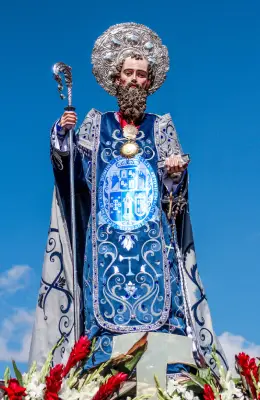
Known as one of the great Fathers of the Church, he’s especially remembered for translating the Bible into Latin, a version known as the Vulgate. He represents one of Cusco’s historic zones.
Curious fact: San Jerónimo and San Sebastián have an annual friendly competition to see who arrives first at the renowned gathering of saints. Accompanying them are devotees and dance troupes demonstrating their faith and devotion to their saint.
San Sebastián
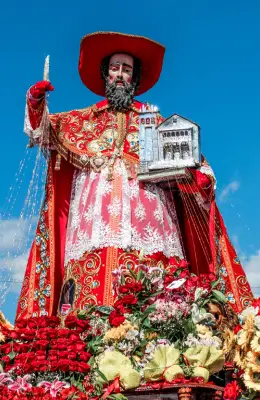
Strongly popular locally. San Sebastián is characterized by his organization and punctuality, and his presence draws large numbers of devotees. He expresses the identity of one of Cusco’s most representative districts, with deep historic roots.
Community importance: His district is one of Cusco’s oldest and most traditional, keeping ancestral customs alive.
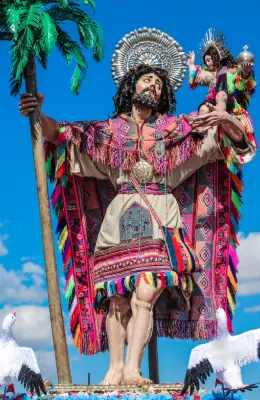
San Cristóbal
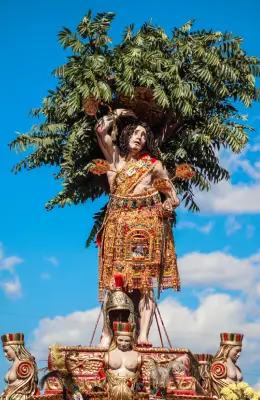
Recognized as protector of travelers. For many devotees, his image accompanies routes and journeys, a meaning easy for any visitor arriving in Cusco seeking protection on their travels to understand.
Symbolism: Represents protection on roads and journeys, being especially venerated by those undertaking long trips.
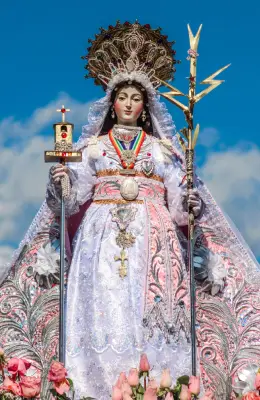
Santa Bárbara
Associated with protection from storms and natural dangers. Her ornaments tend to stand out for their visual richness and ceremonial character, with elaborate clothing requiring months of preparation.
Patronage: Protector against lightning, storms, and sudden dangers, highly venerated in regions with extreme climates like the Andes.
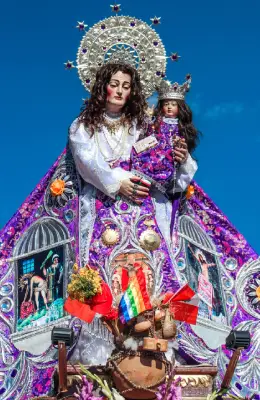
Santa Ana
Linked to family and home. In practical terms, you’ll notice intense devotion and marked community participation, especially from complete families who come to pay homage.
Family devotion: Mother of the Virgin Mary and grandmother of Jesus, she represents family values and the generational transmission of faith.
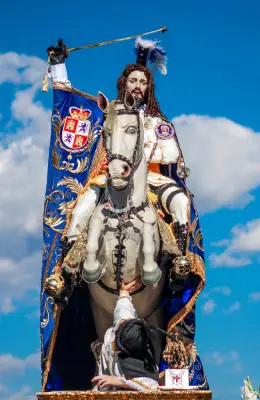
Santiago Apóstol
A figure of enormous historic weight in the colonial period. In the Andean world, his symbolism becomes more complex due to the mixture of European and local traditions. During the conquest, he was invoked as “Santiago Matamoros” (Saint James the Moor slayer) but in Cusco acquired his own nuances.
Syncretism: Represents the most evident cultural fusion between Spanish tradition and Andean cosmovision.
San Blas
Related to Cusco’s most famous artisan neighborhood. His presence connects Corpus Christi with the city’s artistic and cultural identity. The San Blas neighborhood, known as the “Artisans’ Quarter,” keeps this tradition alive.
Artisan connection: Patron of manual workers and artisans, his neighborhood is the nerve center of Cusco art.
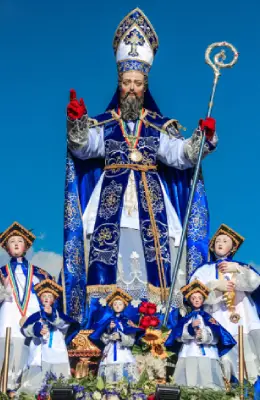
San Pedro
One of universal Catholicism’s most recognizable images. In Cusco, he’s associated with spiritual authority and religious continuity. His representation usually includes the keys to the kingdom of heaven.
Apostolic authority: First Pope of the Catholic Church, he represents the continuity and hierarchical structure of the Christian faith.
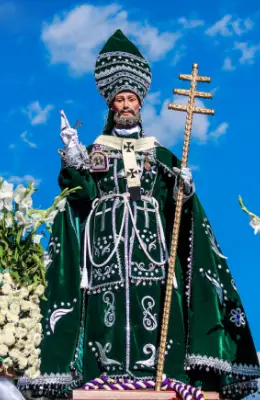
San José
Associated with work and family. He tends to have universal respect: devotees from different backgrounds recognize him as a figure of daily protection, especially carpenters and manual workers who see him as their patron saint.
Labor patronage: Foster father of Jesus and husband of Mary, protector of workers, especially carpenters.
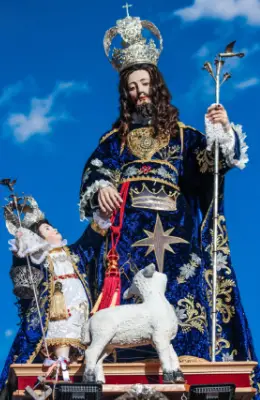
Virgen de Belén
Marian image with great veneration. She represents maternal protection and draws considerable attention during the celebration. Her parish maintains one of the celebration’s strongest organizations.
Maternal protection: Symbolizes maternal love and divine protection, being especially venerated by mothers and families.
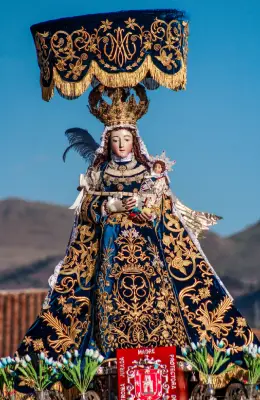
Virgen de la Natividad
Symbolizes birth and renewal. In broader cultural reading, she connects with life cycles and community continuity, resonating with Andean conceptions of pacha (time space) and natural cycles.
Vital cycles: Represents the beginning, birth, and constant renewal of life and faith.
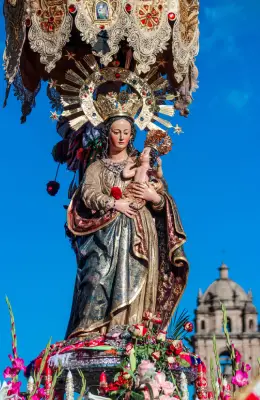
Virgen de los Remedios
Traditionally linked to requests for healing and miracles. It’s common to see personal promises and visible emotional devotion, with faithful who walk barefoot or on their knees as shows of faith.
Miraculous healing: Known for answering petitions for health and wellbeing, she generates deep emotional devotion.
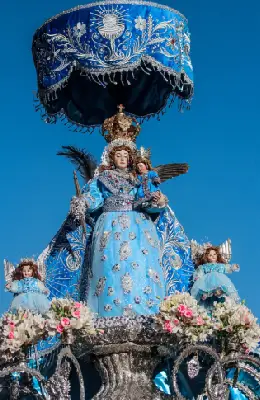
Virgen Purificada
Connects with ideas of symbolic cleansing and spiritual renewal. Her participation is usually understood as “order” and balance within the group, representing the purification necessary before major celebrations.
Ritual purification: Symbolizes the spiritual preparation and inner cleansing necessary to approach the sacred.
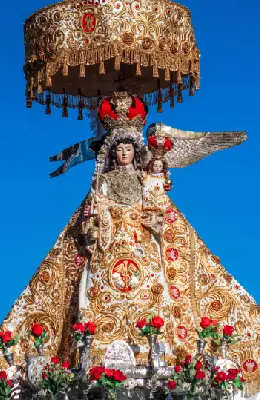
Virgen de la Inmaculada Concepción
One of Catholicism’s most important Marian figures. Within the group, her presence reinforces the sense of ceremonial closure and unity. She’s usually one of the last in the procession, marking the symbolic end of the route.
Ceremonial closure: Represents absolute purity and the culmination of the processional cycle, unifying the entire community in faith.
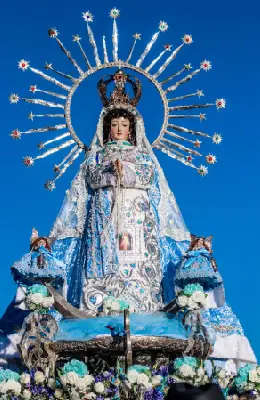
10
Saints
5
Virgins
15
Total
Remember this:
After the central Mass in Cusco’s Plaza de Armas, the 15 saints usually circle the entire plaza, giving blessings to all attendees. At the end of the procession, don’t forget to stop by Plaza de San Francisco and taste the delicious Chiri Uchu, flagship dish of the Cusco region.
Why exactly 15 saints?
The number was historically consolidated to represent Cusco’s traditional parish system and the ritual agreement among communities. Over time, maintaining the group of fifteen images became a way to preserve Corpus Christi’s ceremonial order and its cultural continuity.
Some historians suggest the number also has Andean symbolic resonances, though this is debated. What’s certain is that the number of 15 saints has remained stable for centuries, becoming an identity element of the Cusco celebration.

The Silver Carriage: The central element of the procession
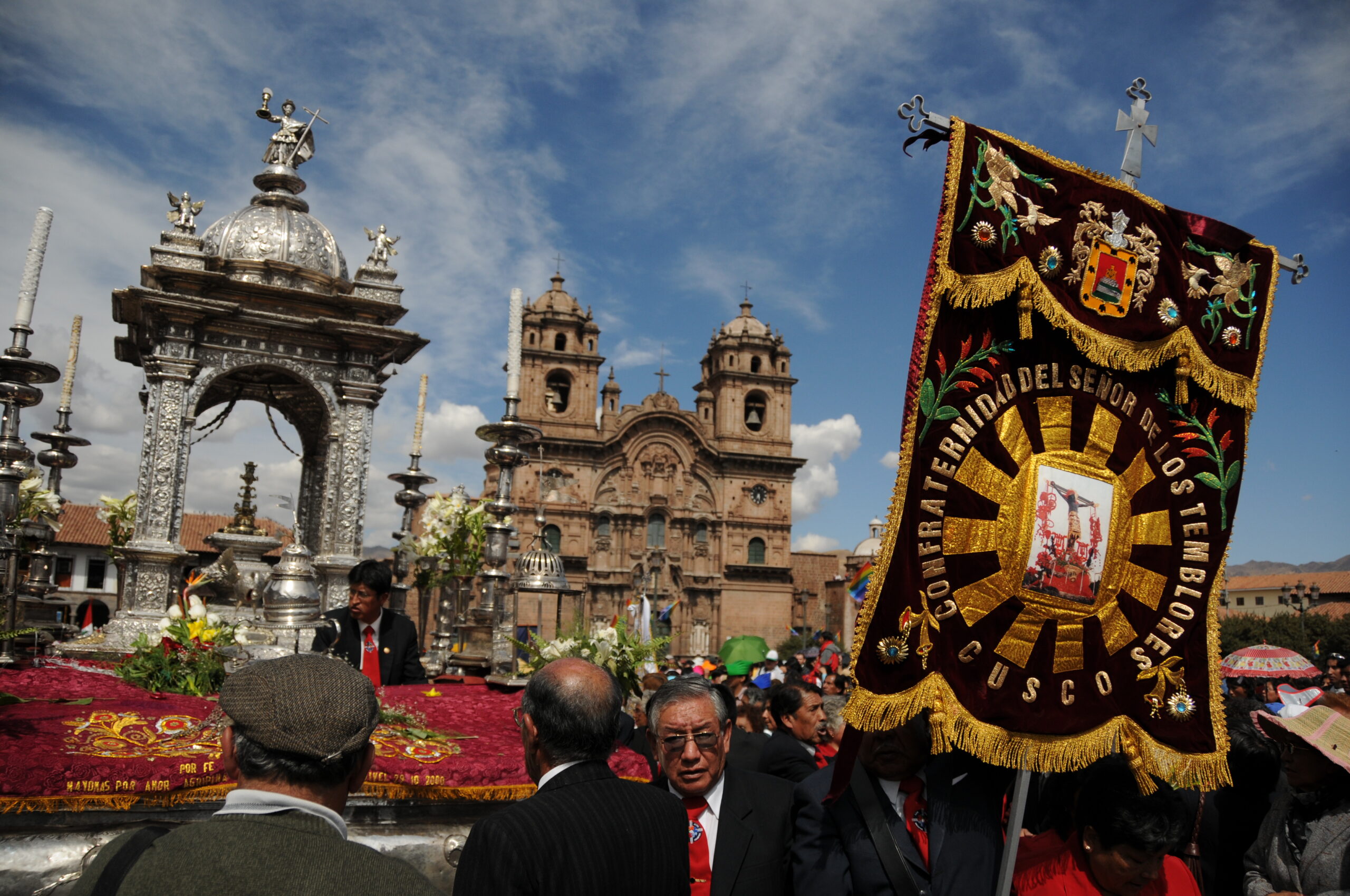
The Silver Carriage, adorned with fine silver details, is responsible for transporting the image of the Holy Sacrament of the Eucharist, the true liturgical center of the celebration.
Shaped like a small temple and covered with 366 pounds (166 kilograms) of silver, the carriage features a silver pelican piercing its own heart with its beak, symbolizing supreme love and self sacrifice. This pelican symbolism is a Christian metaphor for Christ’s sacrifice.
The Silver Carriage leads the central day’s main procession, followed by the 15 saints in an established order reflecting ceremonial hierarchies and community agreements.
Corpus Christi gastronomy: Chiriuchu and other traditional dishes
No description of Cusco’s Corpus Christi would be complete without discussing its emblematic gastronomy. Food isn’t a simple accompaniment: it’s a fundamental part of the ritual, the identity, and the community sense of the celebration.
Chiriuchu: The flagship dish of Corpus Christi
Chiriuchu is the flagship dish of the city of Cusco. It means “cold chili” or “cold spicy” in Quechua. This dish, dating from the Inca and colonial era, is a culinary manifestation of Cusco’s cultural syncretism.

What makes Chiriuchu special?
This dish combines ingredients from Peru’s coast, highlands, and jungle, making it the star dish of Cusco cuisine. Each ingredient represents a region of the ancient Tahuantinsuyo:
- From the Coast: Seaweed (cochayuyo) and fish roe
- From the Highlands: Roasted guinea pig, charqui (dried meat), potatoes, cheese, toasted corn
- From the Jungle: Rocoto and aromatic herbs
- Colonial contribution: Free range chicken, chorizo/blood sausage, corn fritter
The symbolic meaning of Chiriuchu
Chiriuchu represents the duality of the Inca world: as it was offered to the sun, a warm being, this dish had to be eaten cold. This logic of complementarity (hot cold, sun earth) is fundamental in Andean cosmovision.
The Chiriucheras Association: Guardians of tradition
The Cusco Civil Association of Chiriucheras is made up of 180 women, all mothers, who organized to promote this traditional dish during Corpus Christi celebrations. These women not only preserve ancestral recipes but also generate economic resources for their families through this culinary tradition.
Buying chiriuchu from these traditional vendors not only gives you an authentic experience but also directly supports Cusco families who keep this tradition alive.
Gastronomic recommendation: Corpus Christi in Cusco is also understood through food, and the most representative dish is Chiriuchu. If you want to know what ingredients compose it, its history, and where to try it in Cusco, check out this article: Chiriuchu or cold food
Other June festivities in Cusco
June is the most festive month on Cusco’s calendar. If you visit for Corpus Christi, you’ll likely coincide with other important celebrations:
Qoyllur Rit’i (Lord of Qoyllur Rit’i)
One of the Andes’ most important pilgrimages, celebrated in the days before Corpus Christi, approximately between late May and early June. Thousands of pilgrims climb to the Ausangate snow peak to worship a miraculous image of Christ.
Inti Raymi (Festival of the Sun)
Celebrated on June 24 at Sacsayhuamán Fortress. It’s the reconstruction of the ancient Inca ceremony of sun worship. It’s a massive, theatrical event that attracts thousands of tourists.
Tribute to Pachamama
The tribute to Pachamama marks the formal beginning of the Jubilee Month Festivities and takes place in Cusco’s Plaza de Armas on the first Sunday of June, with traditional offerings of coca and chicha.
San Juan Festival
Celebrated on June 24 (same day as Inti Raymi), it’s especially important in the Peruvian Amazon but also has manifestations in Cusco.
Strategic planning: If you have 7 to 10 days in June, you can combine Corpus Christi with Inti Raymi and experience both Catholic Andean syncretism and the reconstruction of Inca ceremonies.
Where to stay during Corpus Christi?
| Zone / Neighborhood | Advantages | Disadvantages | Ideal for |
| Historic Center (Most Recommended) | Proximity to Plaza de Armas; immediate access to processions; festive atmosphere | Noise; higher prices; many people | Those who want to be in the heart of the celebration |
| San Blas Neighborhood | Bohemian atmosphere; art galleries; restaurants; quieter than downtown | Steep streets (difficult with altitude); 10–15 minutes walking to Plaza de Armas | Those seeking artistic authenticity with proximity to downtown |
| San Sebastián or San Jerónimo | More local experience; more economical prices; participation in neighborhood processions | Distance from downtown (15–30 minutes by taxi); fewer tourist options | Travelers seeking cultural authenticity over tourist convenience |
If you visit Cusco during Corpus Christi with this guide in mind, you won’t just see a colorful procession. You’ll understand why Corpus Christi in Cusco is one of the most significant religious manifestations eagerly awaited by Cusco’s population, and why thousands of people continue dedicating months of preparation, economic resources, and emotional energy to keeping this tradition alive year after year.
Frequently asked questions about the 15 Saints of Corpus Christi
1. Who are the 15 saints of Corpus Christi in Cusco?
2. When is Corpus Christi celebrated in Cusco in 2026?
3. Why is it important to know the 15 saints of Corpus Christi?
4. What are the names of the 15 saints of Corpus Christi?
5. Do the 15 saints come out on the same day during Corpus Christi?
6. Which is the “most important” saint of Corpus Christi in Cusco?
7. Why exactly 15 saints in Cusco’s Corpus Christi?
8. What is Chiriuchu and why is it important in Corpus Christi?
9. What should a tourist observe to better understand the processions?
10. Is it respectful to take photos of the 15 saints of Corpus Christi?
11. What common mistakes do visitors make during Corpus Christi?
12. Do I need a guide to discover the 15 saints of Corpus Christi?
13. How do I prepare for Cusco’s altitude during Corpus Christi?
14. What language do I need to know to enjoy Corpus Christi?
15. Is it safe to travel to Cusco during Corpus Christi?
Autor

Shared: