


Table of Contents
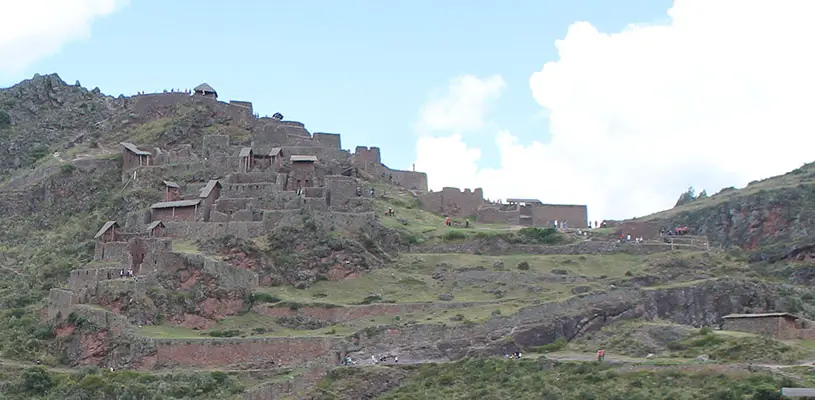
According to the history, the word Pisac comes from the Quechua word pisaq or p’isaqaq, which means partridge, a hen-like bird that inhabits the area. Likely Inca cities of Machu Picchu and Cusco, Pisac has the form of an animal precisely of which receives the name.

Archeological Complex of Pisac
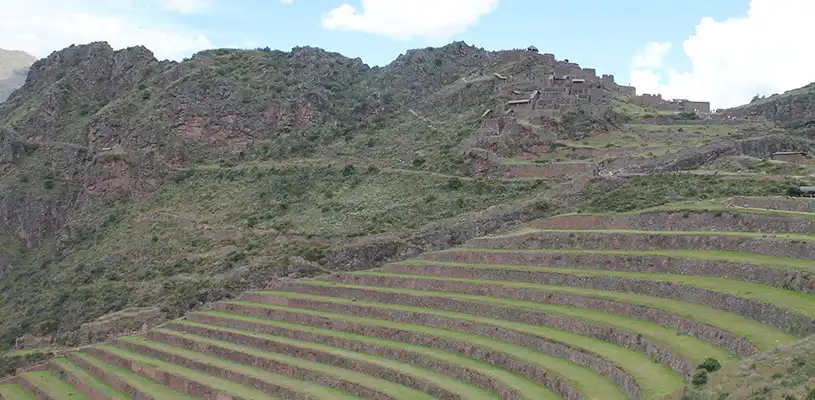
The Inca constructed agricultural terraces on the steep hillside, which are still in use today. They created the terraces by hauling richer topsoil by hand from the lower lands. The terraces enabled the production of surplus food, more than would normally be possible at altitudes as high as 11,000 feet.
Pisac is formed by a set of enclosures that possibly are dwellings, aqueducts, roads, bridges, a cemetery, and walls.
With military, religious, and agricultural structures, the site served at least a triple purpose. Researchers believe that Pisac defended the southern entrance to the Sacred Valley, while Choquequirao defended the western entrance, and the fortress at Ollantaytambo the northern. Inca Pisac controlled a route which connected the Inca Empire with the border of the rainforest.
Location:
Archeological Complex of Pisac is located in the district of Pisac, Province of Calca, in the Sacred Valley of the Incas. It is at an altitude of 2950 m.a.s.l. around 33 kilometers to the east, from the city of Cusco.
Climate:
Dry season: From May to October
The weather during this period is predominantly dry especially in June, July and August. Days are bright and sunny with a temperature of 16 °C (61 °F) while nights are much colder sometimes with a low temperature of 0 °C (32 °F).
Rainy season: From November to April
During this time Cusco receives a greater amount of rainfall. Average daytime temperatures are higher than the dry season at 18 °C (64 °F) while night temperatures can be as cold as 9 °C (48 °F).
What is the best season to visit Pisac?
Inkayni Peru Tours recommends visiting Pisa during the dry season, from May to October since there is less rain and the roads are safer.
What will you see in the Archeological Complex of Pisac?
In the Archeological Complex of Pisac, you will find the following interesting things:
1.- Acchapata Terraces:
The most impressive feature is the agricultural terracing, which sweeps around the south and east flanks of the mountain in huge and graceful curves, almost entirely unbroken by steps. The terracing is joined by diagonal flights of stairs made of flagstones set into the terrace walls.
2.-Towers or Pucaras:
About 20 towers were erected on the edges of the mountain. Below the towers are also formidable terraces – used for farming, but could also provide a lot of protection.
There are 2 types on towers in the site:
- The City of the Towers: It is believed that its developments served as water channels, which still exist today.
- Watchtowers: In positions overlooking the valley, these watchtowers stand in the way of the path up from where colonial Pisac is today located, and above the path to Pisaqa. The most important is known as Qoriwayrachina.
3.- Intihuatana:
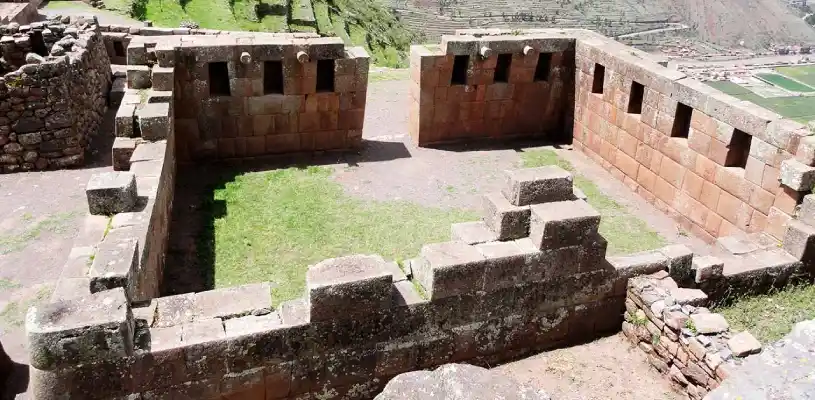
In the center of the ceremonial area is the Intihuatana, an important religious or astronomical tool of the Incas. It is located at the top of the mountain and from that point the whole valley can be appreciated. Its precise use is unknown, but the word means “place where the sun is tied” or “Sundial”, a hitching post of the sun. Its name suggests a relevance to the winter solstice and the festival of Inti Raymi.
The religious and ceremonial area of Pisac is considered one of the finest examples of Inca architecture. The stone work here is considered by many to be technically superior to most other Inca urban centers.
4.- Tianayuc:
In quechua it means “it has a seat”. If coming from the tunnel you will have to pass through what is perhaps an administration area with an interesting feature – you can find a perfect seat for two people, carved on a stone. Just above the ceremonial area, here you have views over the ceremonial area and the Intihuatana.
5.- K’alla Q’asa:
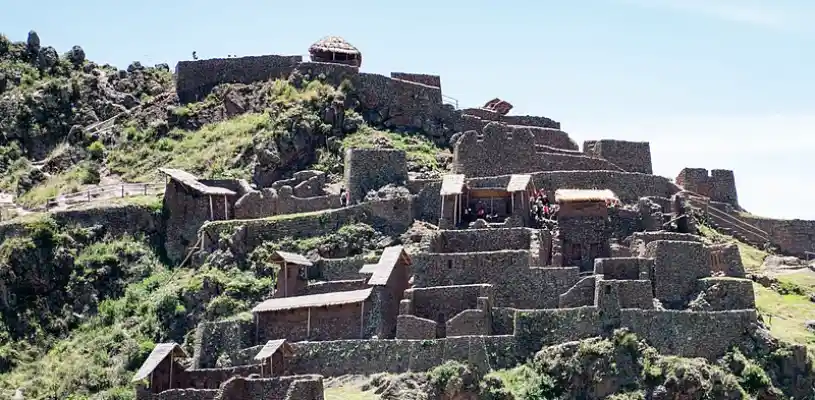
There are roughly 30 buildings here – living quarters in what is thought to be the residential area for those on guard at Pisac. As well as being a ceremonial center, administrative centre, cemetery, agricultural centre and urban area, Pisaq is thought to also have been garrisoned. Here the buildings are built rough field stone too, but a lot more engineering when into their construction. Hanging on to the side of the cliff, streets and steps are one and the same.
6.- Pisaq’a:
The urban area from which the ruins as a whole get their name, and from which the colonial town got its name is Pisaqa, the main residential zone also called the “old town”. Located directly below the ceremonial area on a large semi-circular ledge (an area clearly visible from the side soon after emerging from the tunnel) are a set of another 30 or so buildings with finer brick work than the other residential areas.
7.-Qanchis Raqay:
It looks to be a checkpoint that served to watch the Northeast side of Pisac town.
FAQs:
How to get to Pisac?
Pisac is located 34 km from Cusco (1 hour). On the route you will see Sacsayhuaman. You can take the public transportation on Puputi street, in Cusco.
Pisac Archeological site Opening hours:
From Monday to Sunday: 7:00 am to 6:00 pm.
Entrance Fee:
Cusco Tourist Ticket includes the entrance to the archeological site of Pisac. The cost of this ticket is 130 Peruvian Soles for foreigners and 70 Peruvian Soles for Peruvians.
What to Bring:
- Tourist ticket
- Sun hat
- Sunscreen with a Sun Protection Factor (SPF) of 35 or higher
- Waterproof jacket/rain poncho
- Water
- Camera and film
- Dried Fruit
- Personal ID

“Travel far enough, you meet yourself.” – David Mitchell
Shared:



If you liked this article and the information you found, give us 5 stars!
 (Ninguna valoración todavía)
 Loading...