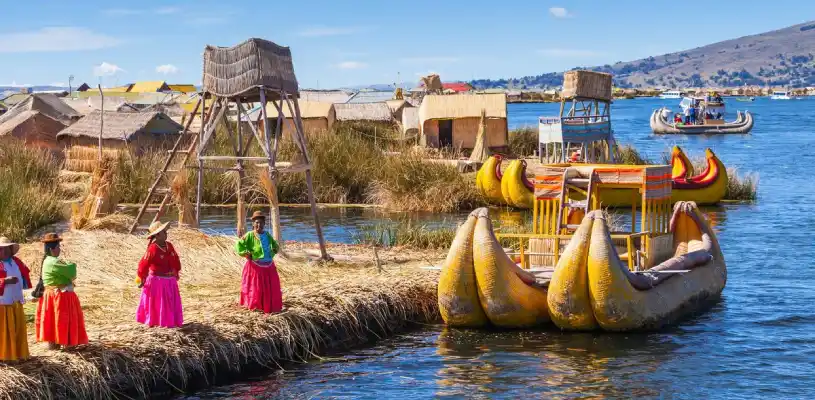
Uros islands are man-made floating islands of reeds where the indigenous Uros people have lived since before the time of the Incas. Nowadays, Uros people still live on 120 artificial islands that form an archipelago some 5 km (3 miles) from the port of Puno, in Peru. For people not native to the island, the sensation of walking on the reeds is quite unusual; with every step, one’s foot will sink a few inches into the reeds.
The Titicaca National Reserve, that includes the Uros floating Islands, was officially created on October 31,1978 by Supreme Decree No. 185-78-AA. It is located in the continental waters of Titicaca lake. It covers an area of 36,180 hectares.
Location:
Uros is located at 3,812 meters above sea level, in the Peruvian highlands in the highest navigable lake in the world, Lake Titicaca, in Puno. It is 7 km from the city of Puno.
Some History facts:
Before the Inca invaded the region around the lake, the Uros lived on the shore in conventional towns and villages. However, while other groups either bent the knee to the Inca conquerors or fled deeper into Bolivia, the Uros decided to let the Inca have the shore, and live on the lake itself. They constructed huge mats of the local totora reeds (which they also use to create nearly everything else the use), and set sail on the world’s highest navigable lake. They remained isolated in the center of the lake until a large storm in 1986 forced them closer to the shore to repair and get help. Since then, many Uros people have left the floating islands to join the society, but a large number have preserved their traditional lifestyle on the islands.
Pareja de pobladores en las islas de Uros compartiendo parte del día.
Climate:
The Floating Islands have two distinct seasons. The rainy season and the dry season.
Temperature:
☀️ Dry season
May through October. Bright, sunny days with clear skies ideal for photography and lake views.
Days: 16 °C · Nights: 0 °C
🌧️ Rainy season
November through April. Lush green surroundings, warmer nights, and noticeably fewer tourists.
Days: 18 °C · Nights: 9 °C
What makes Uros a great spot to visit?
The artificial islands are made from totora reeds, a type of plant endemic to the region. Because the reeds at the bottom of the islands weaken and rot over time, new reeds are continuously added to the top (a process tourists may get to witness).
Although this interesting fact of how the islands are made, Uros actually embrace modern technology, relying on solar panels to power electronic devices such as TVs and charge mobile phones. Astonishingly, there is even a community radio station on one of the biggest islands which broadcasts traditional music throughout the region. Young children attend school in a local island while older students must attend high school or university in the mainland.
The subsistence of the Uros community is based on fishing and hunting; they are also dedicated to the manufacture of wool tapestry fabrics. On the other hand, they participate in tourist activities. There are tours to the Uros Floating Islands of a few hours, but also complete experiences in which you become part of the Uros community.
Islas flotantes en el Lago Titicaca
What can you see in the Uros Floating Islands?
The Titicaca National Reserve is one of Peru’s most biodiverse wetland ecosystems. A total of 171 plant and 159 wildlife species have been recored within its boundaries, including 15 mammals, 105 birds, 9 amphibians, and more than 26 fish species.
Key plants
Totora — the giant bulrush used for construction
Llacho — aquatic plant used to feed livestock
Fish & birds
White Carachi (Blanco)
Mauri & Umantu
Suche & Trout
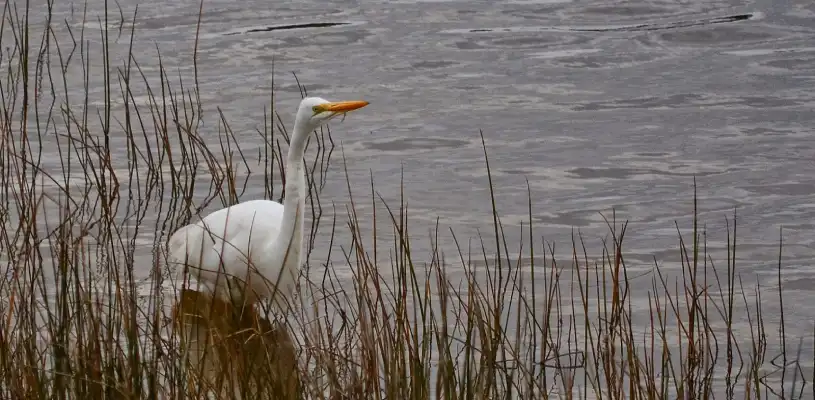
White & Gray Heron
Black-faced Ibis
Andean Duck (Qaqato)
Flora
A total of 171 plant species have been found within this biological spot.
As some examples, we can name:
Totora:
Giant bulrush or totora (Schoenoplectus californicus ssp. tatora) is a plant that grows both in the wild and is cultivated in ponds and wetlands, from sea level to 4000 m of altitude. It is also called chullu in the Uro language.
Llacho:
It is an aquatic plant (Elodea potamogeton) that is used to feed animals like the cattle.
Garza-blanca
How to get to Uros floating islands?
You need to arrive in Puno first. Once there you have to go to the port of the Titicaca Lake. There you can get on a ship or boat that will take you to the islands. You can go on your own or as part of a group with a tourist agency.
Fly or take a bus to Puno — the nearest city, well connected from Cusco (6 hrs bus / 30 min flight) and Lima (overnight bus).
Head to the port of Lake Titicaca — located at the end of Av. El Puerto, about 10 minutes from Puno’s main square by tuk-tuk.
Buy a boat ticket at the dock — shared motorboat or private tour. The crossing takes approximately 30 minutes each way.
Pay the entrance fee on arrival — a small fee goes directly to the Uros community. Keep cash (soles) handy.
What to pack:
Altitude and open water means sun exposure is intense and temperatures swing dramatically. Pack accordingly.
🪪 Original passport
🧥 Waterproof jacket / poncho
🕶️ Sunglasses
🧴 Sunscreen SPF 35+
🧢 Sun hat
🦟 Insect repellent
💊 Personal medication
📷 Camera
🎓 Student card (for discounts)
💵 Cash in soles
“Life is what we make of it. Travel is the traveler. What we see isn’t what we see but what we are.” – Fernando Pessoa