How the Sacred Valley Actually Works
The Sacred Valley is not one place but a route, usually read as the corridor between Pisac and Ollantaytambo, with stops like Chinchero, Moray, and Maras often folded into the same day even though they sit above the main axis. That distinction matters because the sites do not ask the same from your time, your legs, or your ticket. A standard tour can cover the route in one long day, but travelers who want better time at the strongest sites or a calmer pace usually do better with two days or an overnight in the valley.
Table of Contents
The Sacred Valley of the Incas is the Urubamba River corridor where several of the most visited towns and archaeological sites near Cusco are concentrated, including Pisac, Urubamba, and Ollantaytambo. In practice, many tours fold in places like Chinchero, Maras, or Moray within the same outing, even though not all of them belong to the same geographical axis. That is why when someone refers to the Sacred Valley, they are not thinking of a fixed point on the map but of a broad, heavily visited route almost always connected to the road toward Machu Picchu.
| ~37 miPisac to Ollantaytambo corridor (~60 km) | 9,160 to 12,342 ftAltitude range of the circuit (2,792 to 3,762 m) | 1 full dayMinimum for the standard tour |
| BTC Circuit 3Entry to Pisac, Ollantaytambo, Chinchero and Moray | S/70 (~$19 USD) foreignPartial Circuit 3 ticket, valid for 2 days | No advance permitNo months-ahead booking like the Inca Trail |
Not every site sits at the same altitude, not all of them require the same amount of time, and not all of them fit equally depending on your route, your pace, or the days you have in Cusco. Before choosing a Sacred Valley tour or organizing the route independently, it helps to understand which sites make up the valley, how they connect, and what kind of visit each one offers.

The Sacred Valley corridor with the Urubamba tracing the floor. At this scale it becomes clear why the Incas chose it as one of their most important productive axes outside of Cusco.
Brief history of the Sacred Valley
The valley was inhabited long before the Incas. When the Tahuantinsuyo consolidated in the 15th century, this stretch of the Urubamba became one of its most important productive spaces outside of Cusco. The river runs at an altitude where maize can be grown under better conditions than in Cusco, where the climate and elevation make that crop more limited. Maize sustained part of the food supply and also the production of chicha, a fermented drink that was central to the ritual, political, and redistributive life of the Inca state.
With the Spanish conquest in the 16th century, the valley entered a different phase. Inca compounds were partially dismantled, much of their material passed into colonial construction, and the population was reorganized under new forms of control.
Keep this in mind:
The Incas built agricultural terraces to make better use of mountain slopes, channels to carry water from ravines and glaciers, and storage facilities to hold production.

The Sacred Valley concentrates archaeological sites, Andean landscape, and living culture in a corridor accessible from Cusco by road.
Sacred Valley altitude
If you are coming from places below 3,280 ft (1,000 m) above sea level, acclimatizing to the change in altitude when you arrive in Cusco is strongly recommended. The following are the altitudes you will experience during a Sacred Valley tour:
| Site | Altitude | Note |
|---|---|---|
| Pisac | 9,751 ft (2,972 m) | |
| Ollantaytambo | 9,160 ft (2,792 m) | Lowest point in the Sacred Valley |
| Chinchero | 12,342 ft (3,762 m) | Highest point in the Sacred Valley circuit |

Knowing the altitude range before you leave helps plan the day’s pace and anticipate where altitude sickness might appear.
Expert tip:
The Sacred Valley destinations do not reach high mountain territory. There are no passes above 13,120 ft (4,000 m). Even so, the circuit involves climbing stairs at several sites, walking over uneven ground, and spending several hours in the sun between 9,200 and 12,100 ft (2,800 and 3,700 m). Arriving in Cusco at least two nights before the tour, staying well hydrated throughout the day, and eating a light lunch tends to make a real difference for altitude sickness.
Sacred Valley sites
Pisac: the ruins above and the market below
The town of Pisac, on the valley floor at 9,751 ft (2,972 m), holds a busy artisan market. The archaeological complex sits on the mountainside above and requires going up by vehicle or on foot. These are two distinct experiences with separate access points, something many travelers only understand when they arrive.
The complex is one of the most extensive in the valley. It has terraces covering the hillside for several kilometers, still-visible irrigation channels, ceremonial sectors, and an Inca cemetery with thousands of tombs that was looted during the colonial period.

Ollantaytambo: a living Inca town
At 9,160 ft (2,792 m), this is the lowest point of the circuit. Ollantaytambo is a colossal archaeological site combining defensive function, ceremonial use, and a construction project that was left unfinished by the conquest. The main blocks were carved at the Cachicata quarries on the other side of the river and then transported several miles. The Temple of the Sun, in the upper section, preserves some of the finest stonework in the valley.
Ollantaytambo is also the town where the train station for Aguas Calientes is located, making it a central logistical point for most trips to Machu Picchu.

Chinchero: real textiles and one of the clearest colonial overlays in the valley
At 12,342 ft (3,762 m), this is the highest point of the circuit. The town has Inca ruins and a 17th-century colonial church built directly on top of the original walls. Dressed Inca stone below and colonial construction above: here that layering is visible with a clarity that does not always appear so plainly elsewhere in the Cusco region.
In Chinchero, several families continue working with traditional weaving techniques, natural dyes, and backstrap looms. The textile centers in the town show the complete process. As with any tourist venue, a critical eye is useful, but here there tends to be more context and better explanation than at other markets on the circuit. On clear days, the view of the surrounding Andean landscape is also one of the cleanest on the entire route.

In Chinchero, the colonial overlay is literally visible on top of the Inca base.
Moray and the Maras Salt Mines
Moray consists of concentric circular terraces that descend roughly 100 ft (30 m) in a spiral. The most accepted interpretation is that they functioned as an agricultural experimentation space, since each level registers small temperature variations.
The Maras Salt Mines are more than three thousand evaporation pools that have been in use since pre-Hispanic times. Each pool belongs to a family from the Maras community, who maintains it and sells its production. The best light for photographing them tends to be in the morning.

The Maras salt mines are still active and follow a communal working logic that has not changed fundamentally in centuries.
The Cusco Tourist Ticket for the Sacred Valley
Entry to Pisac, Ollantaytambo, Chinchero, and Moray requires the Cusco Tourist Ticket (BTC). There is no individual ticket sale at the door. You either have the ticket or you do not get in.
| Type | What it includes | Foreign adult price | Validity |
|---|---|---|---|
| Full Ticket | 16 sites: Sacred Valley + archaeological city tour + museums + southern valley | S/130 (~$35 USD) | 10 days |
| Partial Ticket Circuit 3 | Pisac, Ollantaytambo, Chinchero and Moray | S/70 (~$19 USD) | 2 days |
| Student discount | Same as corresponding type | S/70 full / S/40 partial. Valid ISIC or university card, up to age 25. | Same as type |
Important note:
The Maras Salt Mines are not included in the tourist ticket. They have a separate entrance fee of approximately S/20 (~$5.50 USD) for foreign visitors.
Sacred Valley tour formats
Different routes are sold under the same name, and that difference matters because it changes the time at each site, the type of ticket you need, and the total cost of the day.
Classic Sacred Valley tour
- Normally includes Chinchero, Ollantaytambo, and Pisac.
- Approximate shared price: S/90 to S/150 (~$26 to $44 USD) per person.
- The BTC and sometimes lunch are usually not included, so worth confirming before paying.
- This is the most sensible version for those who want a general overview of the valley without adding extra detours or turning the day into a race.
Long or VIP Sacred Valley tour
- Usually includes Chinchero, Maras, Moray, Ollantaytambo, and Pisac in a single day.
- Approximate shared price: S/110 to S/180 (~$32 to $52 USD) per person.
- BTC, Maras entrance, and in several cases lunch are typically added on top.
- Works for those with only one day who prefer to cover more sites, but it means less time at the stronger ones, especially Pisac and Ollantaytambo.
Chinchero, Maras, and Moray
- A shorter route focused on the high plateau, agricultural terraces, and salt mines.
- Approximate shared price: S/60 to S/140 (~$17 to $41 USD) per person.
- BTC or the corresponding ticket and the Maras entrance are typically left out.
- A better fit for those who want a lighter day, who already know Pisac or Ollantaytambo, or who want to combine this outing with another activity without finishing exhausted.
Pisac and Ollantaytambo
- Focuses on the two strongest archaeological sites in the circuit.
- As a practical reference, it tends to fall close to the classic shared range or slightly above when the pace is more relaxed: S/100 to S/170 (~$29 to $49 USD) per person.
- BTC and meals if not agreed in advance are typically added separately.
- The most logical version for those who prioritize ruins and archaeological depth over the number of stops.
Private service
- Can be built around any of the routes above, with more flexible timing and less time lost on group detours.
- Approximate price: S/325 to S/635 (~$95 to $185 USD), depending on the route and group size.
- Entrance fees and sometimes lunch are usually separate.
- Makes more sense when what matters most is the pace of the day, stopping where it is worth stopping, and not rushing through every site at the same speed.
Important note:
The ticket also varies by route. Pisac, Ollantaytambo, Chinchero, and Moray are covered by the BTC Circuit 3 if the Sacred Valley is your only focus. If you plan to visit other circuits in Cusco as well, the full ticket may be the better value. The Maras Salt Mines are always separate and paid at the entrance.
| Ticket | Price | What it covers | When it makes sense |
|---|---|---|---|
| BTC Circuit 3 | S/70 (~$19 USD) | Pisac, Ollantaytambo, Chinchero and Moray | If your valley visit is concentrated in one or two days and you will not be doing other major circuits in Cusco. |
| Full BTC | S/130 (~$35 USD) | Valley circuits, archaeological city tour, museums, and other sites | If beyond the valley you also want to cover other tourist circuits in Cusco. |
| Maras Salt Mines | Separate, paid at the gate | Maras only | Whenever your route includes the salt mines, since they are not part of the BTC. |
How to get to the Sacred Valley from Cusco
| Origin | How to get there | What to know |
|---|---|---|
| From Lima | Flight to Cusco (~1h 20 min) + transport to the valley (30 to 90 min depending on the site) | Going to the valley the same day you land is not a good idea. The altitude jump from Lima at sea level to 11,150 ft (3,400 m) can bring on altitude sickness quickly. The most sensible approach is to spend at least one night in Cusco or the valley itself first. |
| From Cusco airport | 10 min by taxi to the historic center. Agencies pick up at hotels the following day. | The Chinchero airport, which will replace the current one and is projected for 2027 or 2028, is still under construction. For now all flights land in Cusco city. |
| From Cusco city | Tour with agency (hotel pickup between 8:00 and 8:30 AM), private taxi for the day (~S/300 to S/400), or shared minibuses from the Puputi terminal. | Shared minibuses cost S/5 to S/15 but are slow and unpredictable. Covering the full circuit in a day by that method is difficult. |
| From Machu Picchu or Ollantaytambo | Train from Aguas Calientes to Ollantaytambo. Once you step off the train, you are already in the Sacred Valley. | There is no direct vehicle from Machu Picchu to the valley. Many itineraries do the Sacred Valley and Machu Picchu on consecutive days, with Ollantaytambo as the hinge point. Valley on the first day, train to Aguas Calientes that afternoon, Machu Picchu the next day. |

Going independently is feasible. The critical factor is transport. Without a vehicle for the full day, completing the circuit in a single day is very difficult.

The Cusco historic center is where most agencies depart from. It is about 10 minutes from the airport by taxi.
Sacred Valley weather and best time to visit
| Month | Day / night temp. | Rain / demand | Best for | Watch out for |
|---|---|---|---|---|
| January | 54–66°F / 48–54°F | Rain / low | Those who prioritize lower prices and do not mind losing part of the afternoon | Persistent rain and less margin for improvising |
| February | 54–66°F / 48–54°F | Rain / low | Those who want the greenest valley and lower rates | Hail in higher areas and still-heavy rainfall |
| March | 54–66°F / 48–52°F | Rain / low-mid | Those who want green landscape with fewer tourists | The first half of the month remains unstable |
| April | 52–66°F / 48–52°F | Transition / mid | Those looking for a balance between weather, price, and calm | Easter week can push demand considerably higher |
| May | 48–66°F / 45–50°F | Dry / mid | Those who want good weather without the July peak | Cold nights in Chinchero |
| June | 46–66°F / 39–46°F | Dry / high | Those who prioritize clear skies and stable days | Strong cold in the afternoon and more people at sites |
| July | 46–66°F / 37–45°F | Dry / very high | Those who want the driest month of the year and do not mind high visitor numbers | Book well in advance; coldest nights of the year |
| August | 48–68°F / 41–48°F | Dry / very high | Those who want dry weather and an active tourist atmosphere | High demand; advance booking is necessary |
| September | 50–70°F / 45–50°F | Dry / mid | Those who want one of the best months of the year with fewer crowds than July and August | Still worth booking ahead, though with less pressure |
| October | 52–72°F / 48–52°F | Transition / mid | Those who want milder temperatures and fewer tourists | Isolated showers can begin from mid-month |
| November | 52–70°F / 48–52°F | Rain / low-mid | Those who want still-usable weather with less movement | Worth departing early as rain returns gradually |
| December | 52–68°F / 48–52°F | Rain / mid | Those who want green landscape and are not traveling during the holiday week | More frequent rain and higher movement between Christmas and New Year |
Best time to visit by traveler type
- Guaranteed weather, nothing else matters: June, July, and August. Completely dry days, clear skies, and sharp glacier views. The cost of that guarantee is more people at the sites, higher hotel prices, and the need to book well in advance.
- Best balance of weather and calm: May and September. The sky is just as clear as in July and August, nights are less cold, and the sites are noticeably less crowded. These are the two months that work best if there is any flexibility in dates.
- Green landscape and tighter budget: November, March, and April. Rain is manageable if you start early and bring a light waterproof layer. Hotel and tour prices drop, the sites are nearly empty, and the valley has a color that simply does not exist in the dry season.
- Avoid if possible: January and February. Not because the valley is inaccessible, but because the rainfall is the most intense of the year and the experience becomes more weather-dependent. For those arriving in those months, the key is not scheduling long outdoor activities in the afternoon.

During the dry season, the Sacred Valley sky is among the clearest in the entire Andean region.

The rainy season has its own concrete advantages: fewer people, intense green landscape, and lower prices.
What to pack
| Item | Why it matters |
|---|---|
| SPF 50+ sunscreen | UV radiation above 9,840 ft (3,000 m) is strong even when it does not feel hot. The terraces and ruins offer no shade. |
| Light waterproof layer | Weather can shift within the same day. A light layer weighs little and solves a lot. |
| Shoes with grip | All the archaeological sites have uneven stone steps and irregular terrain. Sandals or city shoes are a genuine risk. |
| Water, at least 50 fl oz (1.5 liters) | Staying hydrated reduces altitude sickness risk more than any pill. Refill points are not always available at the sites. |
| Cash in soles | The salt mines, pay toilets, and Pisac market do not accept cards. ATMs are scarce in the valley. |
| BTC if going without an agency | Without the tourist ticket you cannot enter Pisac, Ollantaytambo, Chinchero, or Moray. There is no individual sale at the gate. |
Additional activities
- Community experience in Mullakas Misminay. The community near Maras offers direct contact with Andean agricultural life, weaving demonstrations, field work, local gastronomy, and nighttime stargazing with readings in the Andean astronomical tradition. This is not a staged performance. It is a community that opened its daily activities to visitors as a source of sustainable income. Advance booking required. View community experience tour.
- Maras and Moray cycling. A route on dirt roads across the plateau with views of the Salkantay glacier. No technical cycling level required. Inkayni operates it as a full-day cycling tour.

The Mullakas Misminay community: a community experience that is not staged.
Prices
| Service type | Approximate price | What is usually included |
|---|---|---|
| Group tour | S/90 to S/150 (~$26 to $44 USD) per person | Transport, guide, and buffet lunch. The BTC may or may not be included, so always worth confirming. |
| Private tour | S/350 to S/450 (~$102 to $131 USD) per group | Exclusive transport, private guide, flexible schedule, and lunch at a restaurant of your choice. |
| Transport only, no guide | S/300 to S/400 (~$87 to $116 USD) per vehicle per day | Transport only. Entrance fees, guide, and food are your own responsibility. |
What to confirm before paying
- Whether the BTC is included or needs to be purchased separately.
- Whether the Maras Salt Mines are in the itinerary and who covers the separate entrance (~S/20, ~$5.50 USD).
- What type of lunch is included: buffet at a restaurant or on your own.
- How many people will be in the vehicle for group tours.
- Which Pisac is being visited: the town below, the ruins above, or both.
Hotels in the Sacred Valley
Staying one night in the valley changes the experience. You avoid the afternoon traffic, sites feel quieter in the early morning, and the pace of the day becomes more manageable. Staying in Urubamba or Yucay, between 9,186 and 9,514 ft (2,800 and 2,900 m), also helps those arriving with mild altitude sickness. It sits nearly 2,000 ft (600 m) lower than Cusco.
| Hotel | Area | Profile |
|---|---|---|
| Inkaterra Hacienda Urubamba | Urubamba | Luxury. Hacienda with gardens, Andean mountain views, and high-end local gastronomy. |
| Belmond Hotel Río Sagrado | Urubamba | Luxury. Riverside villas, spa, and its own excursion program. |
| Tambo del Inka, Marriott Luxury Collection | Urubamba | Luxury. Has its own train station, allowing direct departure to Aguas Calientes from the hotel. |
| Hotel Sol y Luna | Urubamba | Boutique luxury. Garden bungalows and a heated pool. |
| Explora Valle Sagrado | Urubamba | All-inclusive. Explora model, with in-house guides and daily excursions included. |
| Aranwa Sacred Valley Hotel & Wellness | Urubamba | Luxury. Colonial hacienda with spa and heated outdoor pool. |
| Casa Andina Premium Valle Sagrado | Yucay | Upper-mid. Reliable Peruvian chain with good value for money. |
| Sonesta Posadas del Inca Yucay | Yucay | Mid-range. Former colonial monastery with a central location in the valley. |
| Monasterio de San Agustín de la Recoleta | Urubamba | Upper-mid. Restored 17th-century convent. |
| Willka Tika | Urubamba | Wellness boutique. Therapeutic gardens and yoga. A very different model from the standard hacienda. |
| Skylodge Adventure Suites | Ollantaytambo | A singular experience. Transparent capsules on the canyon wall, accessed by climbing or via zip line. |
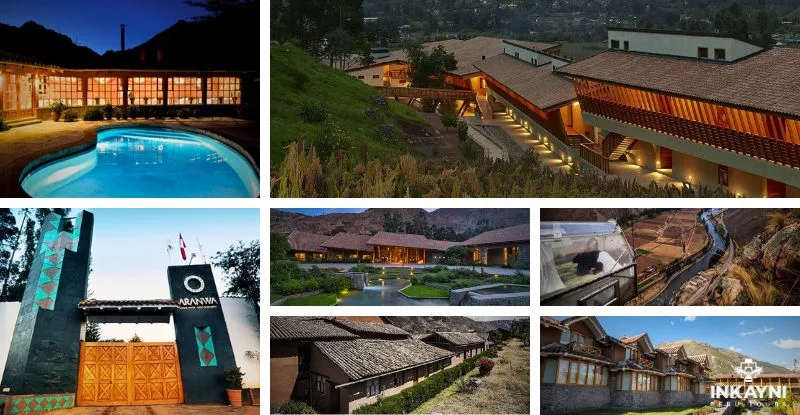
The Sacred Valley is home to some of the finest hotels in Peru. One night changes the pace of the entire visit.
What to buy and where
| Market | Profile | What it is best for |
|---|---|---|
| Pisac | The most lively and varied. Mixes local producers with Cusco-based distribution. | Ceramics, jewelry, Andean instruments, and diverse handicrafts. Bring cash in soles. |
| Chinchero | Verifiable artisan origin. Town families sell what they produce using natural dyes and backstrap looms. | Alpaca and wool textiles with real provenance. The best option when origin matters. |
| Ollantaytambo | Shops along the Inca streets. Less volume than Pisac and a more curated selection. | Alpaca clothing and quality handicrafts. A calmer setting for buying without being rushed. |
A route that rewards when done right
The Sacred Valley is not simply a list of ruins between Cusco and Machu Picchu. It is a route where altitude, weather, the pace of the day, the type of site you visit, and the logic of the trip all change. Understanding what to see, how much time to give each place, which ticket you need, and which tour version suits you makes a real difference.
If you want to cover it with a clear route, well-considered timing, and support before booking, Inkayni Peru Tours can help you choose the option that best fits your trip. You can contact us to get a quote, resolve questions, or book your Sacred Valley tour with greater clarity and less improvisation.
Frequently asked questions about the Sacred Valley Peru
Which Sacred Valley sites require the Tourist Ticket?
Pisac (the archaeological site), Ollantaytambo, Chinchero, and Moray. There is no individual ticket sale at the entrance to any of these sites. You either have the BTC or you do not get in. The Partial Ticket Circuit 3 covers all of them, costs S/70 (~$19 USD) for foreign visitors, and is valid for 2 days. The Maras Salt Mines have a separate entrance fee of approximately S/20 (~$5.50 USD) paid at the gate. The Pisac market and the town of Ollantaytambo are free to access.
Can you visit the Sacred Valley and Machu Picchu on the same day?
Not in any practical sense. The Sacred Valley requires a full day. What many itineraries do is combine both on consecutive days: Sacred Valley on day one, train to Aguas Calientes that evening from Ollantaytambo, and Machu Picchu the following day. That works well logistically and takes advantage of Ollantaytambo being the train departure point.
How much time is needed to visit the Sacred Valley properly?
One full day, roughly 8:00 AM to 6:30 PM, covers the main sites with a guide but leaves limited free time at each. Two days allow Pisac archaeological complex and Ollantaytambo to be visited more thoroughly, and those are the two sites that deserve the most time. For those who want to combine sites with Maras, Moray, and an overnight in the valley, two days are clearly more appropriate.
What is the Cusco Tourist Ticket and where is it purchased?
It is the official pass managed by COSITUC that grants access to archaeological sites and museums in Cusco and its surrounding area. It is not sold online. It can only be purchased in person at the COSITUC office (Av. El Sol 103, Galerías Turísticas, Cusco, Monday to Sunday 7:30 AM to 6:00 PM) or at the entrance to the included sites. The Partial Ticket Circuit 3 costs S/70 (~$19 USD) for foreign adults and S/40 (~$11 USD) for students with a valid ISIC or university card up to age 25. The Full Ticket costs S/130 (~$35 USD) and covers 16 sites with 10 days of validity. Machu Picchu is not included in any tourist ticket.
Is Chinchero in the Sacred Valley?
Geographically, no. Chinchero sits on the plateau above the valley at 12,342 ft (3,762 m), not within the Urubamba corridor. But almost all tours include it because it lies en route between Cusco and the corridor. It is a useful distinction to know, though it does not change the decision to visit it.
Are Moray and the Salt Mines in the Sacred Valley?
Geographically they are on the plateau above the valley, not in the Urubamba corridor. Tours include them because they fall along the route. Moray is covered by the BTC Circuit 3. The Salt Mines are not included in any ticket and are paid separately, approximately S/20 (~$5.50 USD) for foreign visitors, at the entrance.
Does the Inca Trail include the Sacred Valley?
No. The classic Inca Trail starts at km 82, within the Ollantaytambo district, and goes directly to Machu Picchu. Ollantaytambo functions as a logistical hub, but the trail does not pass through the valley sites. These are two separate itineraries that can be done on different days within the same Cusco trip.
Can you take a train from Cusco to the Sacred Valley?
Not directly to the valley circuit. PeruRail and Inca Rail trains run from Ollantaytambo toward Aguas Calientes in the direction of Machu Picchu, and they do not serve the main Sacred Valley sites. To visit those, ground transport is used: a tour, a privately hired taxi for the day, or shared minibuses from the Puputi terminal in Cusco.
Are there restrooms at the Sacred Valley sites?
Yes. All the main sites, including Pisac, Ollantaytambo, Chinchero, Moray, and the Salt Mines, have facilities at or near the entrance. Most charge between S/1 and S/2. At the archaeological sites there are not always restrooms midway through the circuit, so it is worth using them before starting to walk.
Does it snow in the Sacred Valley?
Not on the valley floor. Ollantaytambo at 9,160 ft (2,792 m) and Pisac at 9,751 ft (2,972 m) have mild climates and no snowfall. Chinchero at 12,342 ft (3,762 m) can experience overnight frost in the dry season and occasional isolated hail. To see snow, elevations of 14,760 ft (4,500 m) or higher are needed, such as the Ausangate area or the Salkantay corridor.
Is a guide necessary for the Sacred Valley?
Not mandatory, but it makes a real difference at Pisac and Ollantaytambo. Without a guide, the terraces and walls are impressive, but the logic of the complex and the historical context are easy to miss. A certified bilingual guide costs between S/80 and S/150 (~$23 to $44 USD) for the full day if hired independently in Cusco. With an agency, it is usually included. The freelancer option at the entrance exists, though quality varies considerably.
Where is the better place to buy textiles: Pisac or Chinchero?
Chinchero, if what matters is a genuinely artisan origin and a verifiable process. The Pisac market has more variety and energy, but it mixes local producers with Cusco-based distribution. In Chinchero, the textile centers show the complete production process and most of what is sold comes from families in the town itself. The price may be similar in both places, but the traceability of origin is considerably higher in Chinchero.
How do you tip a guide?
Tipping is not obligatory, but it is common practice when the service was good. It is handed directly to the guide at the end of the circuit. The most common range is S/30 to S/80 (~$9 to $23 USD) per person for a full day, depending on the quality of the service and the group size. If the driver also did a good job, an additional S/20 to S/30 (~$6 to $9 USD) is a reasonable gesture. Worth carrying cash in soles for this purpose.
Is the Sacred Valley accessible for older adults or people with limited mobility?
It depends on the site. The Pisac market and the town of Ollantaytambo are accessible at ground level. The Pisac archaeological complex above and Ollantaytambo’s terraced ruins involve stone stairs and uneven terrain, requiring good mobility. Chinchero and Moray allow vehicle access to the entrance and have less demanding walking circuits. A private tour allows better adaptation of pace and site selection to the group’s needs.
Are the Sacred Valley and Machu Picchu the same thing?
No. The Sacred Valley is the Urubamba corridor between Pisac and Ollantaytambo, accessible by vehicle from Cusco in a day. Machu Picchu is in the high jungle at 7,972 ft (2,430 m) and can only be reached by train from Ollantaytambo and then by bus from Aguas Calientes. They share an Inca context and the same region, but the experience and the logistics are completely different. Most 4- or 5-day itineraries include both on separate days.
How far is the Sacred Valley from Machu Picchu?
About 29 miles (46 km) in a straight line, but there is no direct road between the two. From the valley, access to Machu Picchu is by train from Ollantaytambo to Aguas Calientes, approximately 1 hour 30 minutes, and then by bus to the citadel. The alternative route via Santa Teresa reaches the Hidroeléctrica station by road and then continues on foot to the town, but it does not pass through the Sacred Valley.
Why is it called the Sacred Valley?
Because the Urubamba River runs in a direction that the Incas aligned with the Milky Way, and that correspondence between the terrestrial river and the “celestial river” was central to their cosmology. The valley was also the most important maize-producing center of the Empire, and maize carried ritual value beyond its use as food. It was the base ingredient for the ceremonial chicha that structured the State’s relationship with both the gods and the communities. The idea of “sacred” captures both dimensions: the astronomical and the productive.
Can you visit Humantay Lake from the Sacred Valley?
Yes, though most agencies depart for that trek from Cusco rather than from the valley. If you are staying in the valley, you can coordinate with an agency to adjust the pickup point. The lake entrance fee is approximately S/10 (~$3 USD) and is paid in the town of Mollepata before the hike begins.
Autor

Shared: