Table of Contents
International Mountain Day is celebrated on December 11 every year globally to raise awareness about the importance of mountains in our lives and to our planet.
Mountains provide numerous resources such as fresh water, food, and energy. And the scarcity of these resources is only going to increase over the next few decades as the human population continues to grow and use an even greater share of the Earth’s resources.

The United Nations declared December 11 “International Mountain Day.”
The celebration aims to increase awareness of the importance of mountains for the health of the planet and the well-being of billions of people.
Importance of the Mountains:
Mountains are not only important for inhabitants but also for millions of people living in lowlands. They are the sources of the world’s major rivers and also play a crucial role in the water cycle.
Inkayni Peru Tours aims to draw attention to the important roles that mountainous regions play in water and food supply.
14 Highest Mountains in the World:
There are 14 mountains in the world that rise above 8000 meters / 26,247 feet.
-
Mt. Everest:
found in Asia in the Himalayas. It is the world’s highest peak, at 8848 m (29,029 ft.)
-
K2:
also known as Chhogori. It is the second-highest peak on earth at 8611 meters or 28,251 feet. It is found along the border between Pakistan (Giglit-Baltistan Region) and China (Taxkorgan County, Xinjiang province).
-
Kangchenjunga:
At 8586 meters/28,169 feet, is the world’s 3rd highest peak. It is located along the border between India (Sikkim) and Nepal.
-
Lhotse:
At 8516 meters/27,940 feet. It is located along the border between Nepal and Tibet.
-
Makalu:
At 8485 meters/27,838 feet, Makalu is the world’s 5th highest peak. It lies along the border between Tibet and Nepal.
-
Cho Oyu:
At 8201 meters/26,906 feet. It is located along the border between Tibet and Nepal.
-
Dhaulagiri
Located in Nepal, is the 7th highest peak. Its summit sits at 8167 meters/26,795 feet.
-
Manaslu:
It is the 8th highest peak and is found in Nepal. Its elevation is 8163 meters/26,781 feet.
-
Nanga Parbat:
It is found in Pakistan and is the world’s 9th highest mountain. It rises to 8126 meters/26,600 feet.
-
Annapurna I:
Found in Nepal, is the 10th highest mountain on the planet at 8091 meters/26,454 feet.
-
Gasherbrum I
Also known as Hidden Peak or K5, is the 11th highest mountain on the planet at 8080 meters/26,444 feet. It lies along the border between China (Xinjiang) and Pakistan.
-
Broad Peak:
Also known as K3, is the 12th highest peak at 8051 meters/26,414 feet. The peak gets its name from its 1.5 kilometer long summit. It is found along the border between China and Pakistan.
-
Gasherbrum II:
Also known as K4. It is found on the border between China and Pakistan at an elevation of 8035 meters/26,362 feet.
-
Shishapangma:
Is located in Tibet. It rises to 8027 meters/26,335 feet.
Important Mountains in Peru:
Seen from above, Peru’s territory resembles a colossal sheet of wrinkled paper. The reason is the presence of the magnificent Andes that, like a giant backbone of rock and snow, cut across Peru from north to south and mold its geography and with it, the landscape and the people.
The Andes mountains separate the desert from the rainforest and run the length of the country. They are home to some of the highest mountain peaks in South America. This article takes a look at some of the tallest mountains found in Peru.
Read about the 7 tallest mountains found in Peru.
1.- Huascaran:
It is located in the Cordillera Blanca (White Mountain range), Huascaran is the Inca country’s highest mountain and the fifth highest mountain in the Western Hemisphere. Its highest peak stands at 6,768 m.a.s.l.
The Huascaran National Park surrounds this mountain and is a popular tourist destination. Climbers begin the ascent from the town of Musho, reaching the top takes between 5 and 7 days.
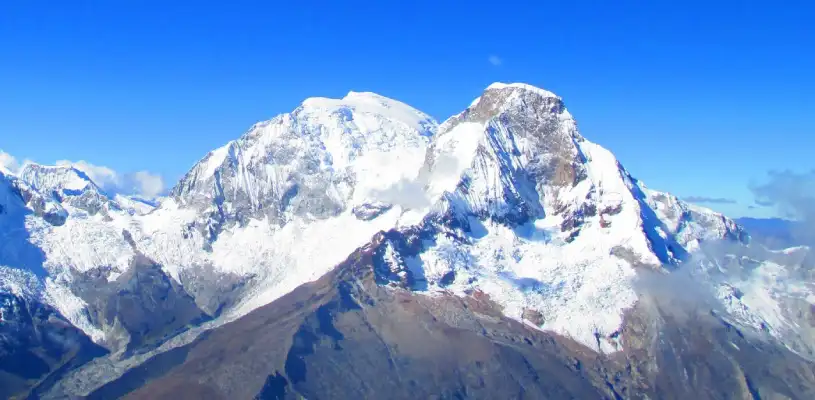
El Huascarán, está rodeada de numerosos picos por encima de 5,000 metros en el sector de la Cordillera Blanca, una cadena de montañas cubierta de nieve de 140 kilómetros de largo que se incluye a su vez en el Parque Nacional Huascarán de 340,000 hectáreas.
2.- Yerupajá:
It is the second highest mountain (6,6617 m.a.s.l.). It is located in the Ancash department of Peru but forms part of the Cordillera Huayhuash range, considered the most spectacular one of the Peruvian Andes, rather than the Cordillera Blanca.
The small city of Huaraz is the standard gateway to Yerupajá, from where climbers head to the town of Chiquián before approaching the mountain.

This snow-capped mount is one of the most difficult to climb. Even today, with modern equipment, successful ascents are rare.
3.- Coropuna:
It is the highest volcano in Peru, and, at 21,079 feet (6,425 m), the third-highest mountain. It’s located in Southern Peru, about 90 miles northwest of Arequipa.

According to Inca legend, Coropuna is a sacred mountain and is the site of the highest water irrigation system in the world.
For the Incas, it was home to one of the most sacred Apus, or mountain spirits, in the realm. Temples and Inca trails are still visible around the base and along the slopes of the mountain, but glaciers have covered or destroyed many of Coropuna’s archeological treasures.
4.- Huandoy:
It is located in the Cordillera Blanca, not far from Nevado Huascaran. The mountain has four distinct peaks, with each one rising up more than 19,685 feet (6,000 m). The tallest peak measures 20,981 feet (6,395 m), making it the second highest mountain in the Cordillera Blanca alongside Huantsan.
Huandoy mountain is also referred to as “Tullparaju,” or “tullpa” and “rahu” which roughly translates to “cooking-fire” and “snow.”

Since it stands in front of Huascaran and due to their proximity, legend tells that they were a princess and a soldier and god Huaylas turned them into mountains.
5.- Huantsan:
It is located in Ancash Region and is part of Cordillera Blanca. It is located at 6,395 m (20,981 ft), it’s the second-highest mountain in the Cordillera Blanca, alongside Huandoy.

Getting to the base of Huantsan is fairly easy, as it’s not too far east of Huaraz. But climbing Huantsan is a whole different prospect. Only experienced mountaineers should visit it.
6.- Ausangate:
It is located 100 km from Cusco city. It is part of the Vilcanota mountain range and stands at 6,384 m.a.s.l.
Note: Ausangate mountain was established as Regional Conservation Area on December 12, 2019.

It is the highest mountain in the Cusco Region of Peru, and the second-highest in southern Peru.
The Incas revered Ausangate as one of the most important Apus in Inca mythology.
Ausangate was the Apu of the Incas, a divine protective entity, which watches over the people that surround it. It is seen as the place, where the masculine energy that fertilizes the Pachamama (mother earth) was born.
The mountain is still venerated, and is central to the annual Señor de Qoyllur Ritti festival.
7.- Chopicalqui:
It is located in the Cordillera Blanca area in the Andes of Peru, in Yungay Province, Ancash.
It is at an altitude of 6345 m.a.s.l. (20,817 ft.). Despite its height, the mountain is easier to climb than other peaks in the range, such as Huascaran, Huandoy, and Huantsan.

As with many expeditions in the Ancash department of Peru, climbers typically start in the city of Huaraz. From there, a trip to the town of Yungay takes you close to the base camps for both Chopicalqui and Peru’s highest mountain, Nevado Huascaran.
You can contact us here:
- Inkayni Peru Tours: www.inkayniperutours.com
- Tripadvisor: www.tripadvisor.com.pe

We are Inkayni Peru Tours dedicated to promoting the natural and cultural heritage of Peru and committed to conserving it. We guarantee the best personal service to our clients. Our guides are chosen for their experience and responsibility. They share their enthusiasm and knowledge. You will love trekking with Inkayni Peru tours!
Shared: