Table of Contents
Galapagos islands are a unique and endemic archipelago with an extraordinary beauty in the world. They contain more distinct species of flora and fauna than any other place on earth.
Today, the Galapagos Islands are home to multiple thriving communities that largely live off of tourism and fishing. However, these communities are careful to keep their lifestyles in line with the natural life. The first wildlife sanctuaries were declared in 1934 and the Galapagos National Park was formed 25 years later. The aim was to preserve the stunning flora and fauna that inhabit the archipelago. Shortly after, the Charles Darwin Research Center opened its doors in 1964. It currently serves as an important point of research for hundreds of scientists and conservationists from around the world. Thanks to the work done the archipelago was officially classified as a Natural Heritage Site by UNESCO.
Brief History
Galapagos Archipelago was discovered by accident in 1535. It happened when Tomas de Berlanga, the Bishop of Panama, drifted off course while sailing from Panama to Peru. He reported his discovery to King Charles V of Spain. He included in his report a description of the giant galapago (tortoise) from which the islands received their name.
It is possible that the Indian inhabitants of South America were aware of the islands’ existence before 1535. However, there is no record of this.
The first rough charts of the Galapagos Islands were made by buccaneers in the late 17th century, and scientific exploration began the late 18th century.
Ecuador officially claimed the Galapagos Archipelago in 1832. For roughly one century thereafter, the islands were inhabited by a few settlers and were used as penal colonies, the last of which was closed in 1959.
Some islands were declared wildlife sanctuaries in 1934, and the archipelago officially became a national park in 1959. Organised Galapagos tours began in the late 1960’s.

Giant tortoises can be seen in their natural habitat in Galapagos.
The Islands
Galapagos consist of 13 major islands (ranging in area from 5.4 to 1,771 square miles [14 to 4,588 square km]), 6 smaller islands, and scores of islets and rocks lying athwart the Equator 600 miles (1,000 km) west of the mainland of Ecuador.
As a collection of volcanic island within a few hundred kilometers of the Ecuador, the Galapagos Islands provides incomparable landscapes and an exceptional climate.
How to get to Galapagos Islands?
First, you must get to mainland Ecuador by flying into either the capital city of Quito or Guayaquil. If you have the option, fly to Guayaquil to save time. Most flights from Quito have a stopover here on the way to the Galapagos.
Your best bet for getting to the Galapagos is to fly into Baltra Island before taking a bus and ferry ride to Puerto Ayora on Santa Cruz Island. Another option is to fly into the capital of Puerto Baquerizo Moreno on San Cristobal Island, but most cruises start in Santa Cruz.
Important Note: Passengers traveling to Galapagos must register their personal information to obtain their Transit Control Card (at the airport in Quito or Guayaquil). It is $20USD.
Then, you have to pay a $100USD National Park Entrance Fee (at the airport in Galapagos). This entrance fee helps finance conservation efforts throughout the entire archipelago.
What is the best time to travel?
It’s often said that the pleasant year-round weather makes the Galapagos Islands an ideal destination at any time of the year. Depending on which animals you want to see, which activities you want to focus on, and what your budget is for your vacation, there are certain times of the year that might accommodate your interests better than others.
Dry Season (June-December)
The dry season is also known as the “garua season” for its daily morning mists and drizzles. After the mist has cleared, the rest of the day is dry and sunny, with cooler temperatures ranging from 66°F (19°C) to 79°F (26°C). Water temperatures are also cooler during this time, meaning that although it might be less comfortable to stay in the water for long periods, there is considerably more marine life at the surface thanks to the upwelling of the cold, nutrient-rich water on which the marine species depend.
Wet Season (January-May)
The beginning months of the year experience hotter temperatures – 72°F (22°C) to 86°F (31°C) – with afternoon showers. This time of the year definitely has the most comfortable water temperatures, which allow snorkelers and divers to spend more time in the water, however the lack of phytoplankton & algae in the warmer surface water correlates to notably fewer marine species at the surface as well.
Finding the best deals
If you want the same great Galapagos vacation at a fraction of the price, there are a couple ways to take advantage of excellent deals, discounts, and promotions.
During the off-season, in April & May and September & October, there is less tourist traffic and hotels, cruises, and operators tend to offer heavily discounted prices in order to attract more clients.
If your schedule is more flexible, an alternative to traveling in the shoulder season is booking a last-minute cruise. Operators never want to set out with empty cabins, so they will offer major discounts in the weeks or even days before a cruise departs in order to fill the spot.
What to do and see?
Galapagos Islands offers everyone the possibility to enjoy a great variety of activities for all ages, interests, and fitness, ranging from the contemplative to the adventurous, and knowing that in everything you do you will experience the best of the wildlife and nature.
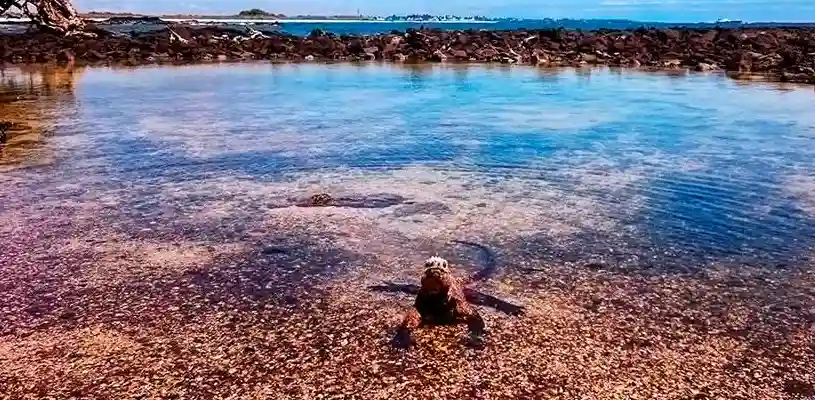
Isabela Island – Galapagos
Let’s review some of the main Islands:
1.- Santa Cruz Island:
- If you visit between January and February, you may even catch sight of the black turtles laying their eggs (hatchlings emerge and make their way to the sea between April and May). Even if you’re not a turtle-lover, you can still get up close and personal with the other beachcombers like marine iguanas and Sally Lightfoot crabs.
2.- Isabela Island:
- Isabela Island is the biggest island of the Galapagos in extension. A highlight of the island is a colony of penguins located on the rocks formation right in front of the village of Villamil reachable either by boat or kayak.
3.- Fernandina Island:
- Fernandina Island wildlife is plentiful. One of the noteworthy points is that the island has a sizeable population of land iguanas. These choose a precarious lifestyle, living on the edge of the volcano’s caldera, and additionally within the caldera itself.
4.- Española Island:
- In Gardner Bay, on the eastern side of the island, you will see sea lions of all sizes. Its rocky shores make this site a great place for diving and snorkeling.
5.- Seymour Island:
- North Seymour Island Wildlife is mostly bird-oriented, which makes it a lovely place for birdwatchers and ornithologists to visit. Blue footed boobies reside on the island and there are also lots of magnificent frigate birds. You may also get to see land iguanas, marine iguanas and sea lions on North Seymour Island.
6.- Bartolome Island:
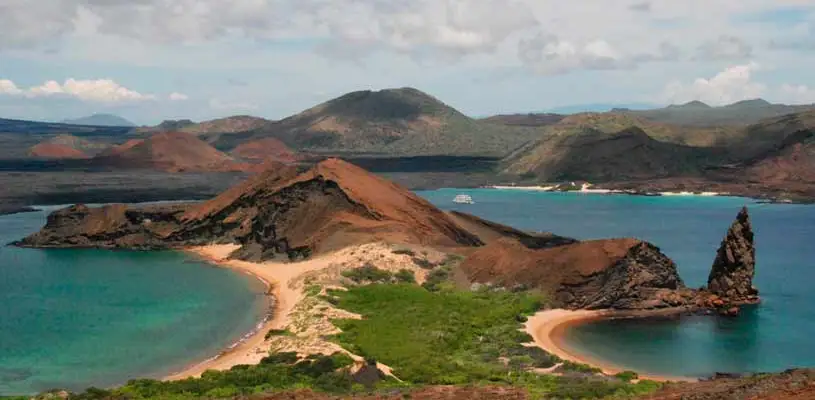
- The view from the top of Bartolome Island is perhaps one of the most photographed in all of the Galapagos Islands. Visitors climb a steep wooden stairway and then are rewarded with a 360-degree panorama of the island to enjoy. Another of the spectacular highlights is Pinnacle Rock. This is a lovely spot to visit as there is an interesting mix of wildlife living at its base. This offers a lovely photography spot, as well as great opportunities for snorkeling in the islands.
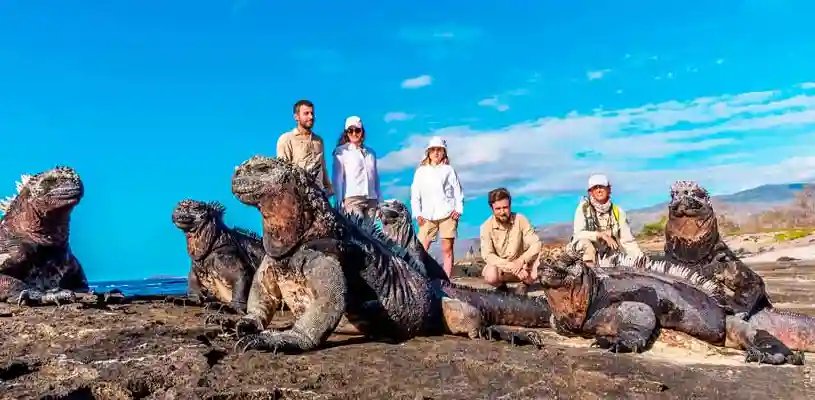
Marine Iguanas in Dragon Hill – Galapagos.
Transportation between islands
To get from one island to the next, there are only two options: speedboat and charter planes. There are numerous speedboat companies that will accommodate your schedule, but be sure to book it at least a day in advance so that you know when it departs and you are guaranteed a spot. The travel time on boats can be between half an hour and several hours.
The most popular trips are Santa Cruz (Ayora port) to San Cristóbal (Baquerizo Moreno port) and Santa Cruz to Isabela (Villamil port).
Galapagos Islands are considered one of the world’s most isolated and diverse ecosystems. Therefore, it is an expensive but worth visit.
Inkayni Peru Tours is happy to assist you when planning your visit to South America. We would love to take you on an extraordinary adventure in Peru. Don’t hesitate to contact us or visit our website.

“Remember that happiness is a way of travel – not a destination.” – Roy M. Goodman
Shared: