Table of Contents
Easter Island, Spanish Isla de Pascua, also called Rapa Nui, is the most isolated permanently inhabited island on the planet. Known as Rapa Nui (“Great Rapa”) or Te Pito te Henua (“Navel of the World”). The first European visitors, the Dutch, named it Paaseiland (“Easter Island”) in memory of their own day of arrival.
It is famous for its giant stone statues, called moai.

There have been researchers of the almost 900 giant stone figures that date back many centuries. The statues reveal their creators to be master craftsmen and engineers. They are distinctive among other stone sculptures found in Polynesian cultures. There has been much speculation about the exact purpose of the statues, the role they played, and the way they may have been constructed and transported.
Location
Easter Island is located at the eastern vertex of the so-called Polynesian Triangle, in the South Pacific Ocean. This great geographical triangle covers about thirty million kilometers. It has its northern vertex in Hawaii. And it includes the archipelagos of Samoa, Tonga, Cook Islands, French Polynesia among others.
Origin
Easter Island emerged as a result of the various volcanic eruptions. That happened thousands of years ago in this part of the Pacific Ocean. Despite the small size of Easter Island, along the whole surface can be counted several volcanoes. However, there are three main volcanoes that formed and gave rise to the triangular shape of the island : Rano Kau, Poike and Maunga Terevaka.
It was these volcanoes, especially Rano Raraku and Puna Pau, that provided the Rapa Nui with the raw material needed for the construction of their stone giants. The quarries of these volcanoes still seem to expect the return of the sculptors to finish a job that was unfinished and abandoned for unknown reasons.
Main Attractions in Rapa Nui
Moai statues are the most popular attractions on Easter Island. However, there is much more to do. Though, many of these other things may be somewhat related to Moais still. As a visitor, you’ll be based in Easter Island’s only town, Hanga Roa. The surface area (163.6 sq km or 63.2 sq miles) makes it easy to explore by driving, walking, or cycling.

Moais – Easter Island
What is the best season to visit?
The island is flat which means the Antarctic breezes can flow across the island making warmer temperatures feel cooler. Average highs during the summer months are around 82°F (27°C ). Cooler breeze can make the hot sun misleading. It is important to make sure you are wearing appropriate sunscreen or using other protection.
You can opt to explore Easter Island during the months of March, April, October or November. However, you should anticipate an average high of around 72°F (22°C ). As noted above, the breezes coming off the Antarctic ocean can make those temperatures feel much colder.
Don’t be surprised if you experience rain during a trip to Easter Island.
Accommodation:
You won’t have a problem finding the accommodation that best suits you. There is a wide range of hotels, hostels, cabins and campsites that adapt to any taste and budget.
Let’s talk about food!
Traditional Easter Island food is based mainly on sea products like fish, among them tuna, mahi mahi, swordfish or kana kana, and seafood like lobster, shrimp and rape rape, a type of small lobster native to the island. Nevertheless, various agricultural products are a cornerstone of the food, like sweet potatoes, taro, yams, plantain, and sugarcane; all of them introduced to Easter Island from the Marquesas Islands a very long time ago.
Famous dish is Umu Rapa Nui or curanto, which is cooked in a hole in the ground with firewood and red-hot stones. The hot stones are covered with plantain leaves. Then, meat, chicken, and fish is placed on the leaves and covered again with more leaves and stones. A second layer is placed on top with sweet potatoes, taro, and tapioca and is covered again with plantain leaves and dirt.
Other favorite dishes are tunu ahi, fish grilled on hot stones, or ceviche.
Po’e is a dessert that has mashed bananas, pumpkin and flour.
Requirements to enter Rapa Nui
From August 1st, 2018 comes into force the new law No. 21,070 that regulates the exercise of the rights to reside, stay and move to and from the special territory of Easter Island.
The intention of this new regulation is to favor a harmonious and sustainable development of the territory and to protect the island from a possible collapse by saturation of inhabitants, visitors and vehicles.
Every person, Chilean or foreign, will have the right to enter and remain on the island for a maximum period of 30 days.
Foreigners must present the following documents to enter Chile, and therefore Easter Island:
- The current passport, which must be presented to the International Police at the time of your entry.
- Citizens residing in the following countries can enter Chile as tourists presenting their current National Identity Document: Argentina, Bolivia, Brazil, Colombia, Ecuador, Paraguay, Peru, and Uruguay.
How to get there?
The most common way to get to Easter Island is by plane. Currently Latam Airlines has scheduled flights to Rapa Nui. It connects the island with a daily flight from the Airport Arturo Merino Benítez in Santiago de Chile (SCL). The duration of the flight from Santiago de Chile to Easter Island is about 5 hours and 40 minutes on the way and somewhat less, 4 hours and 45 minutes on the return due to the influence of the wind. There are also a couple of flights a week to / from Tahiti, which is the main access to the other islands of Polynesia.
You can also get there by ship or on a cruise.
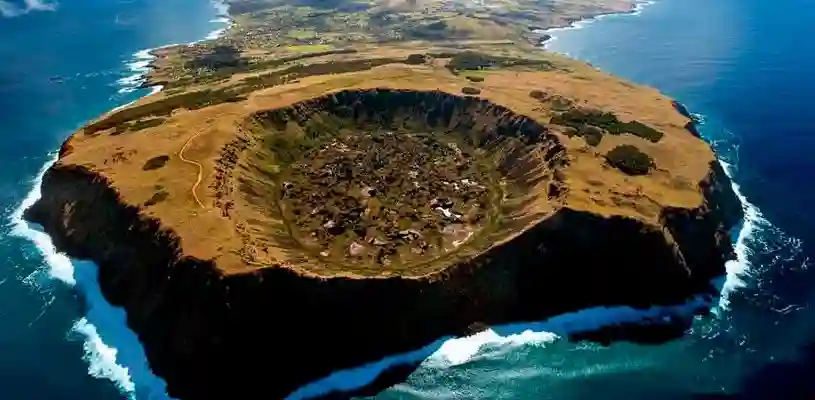
Aerial view of Easter Island or Rapa Nui.
The best attractions on the island are:
Hanga Roa:
Hanga Roa is Easter Island’s sole urban center. It is formed around two main streets. The first is called Atamu Tekena, home to restaurants, shops, the Chilean Navy, and the town hall. The second important street is called Te Pito, or Te Henua, meaning “the navel of the world” in the Rapa Nui language. It begins at the port and ends at the Santa Cruz Church, which was founded in 1937 by the priest, Sebastián Englert.
Rano Raraku:
This is the birthplace of the moai, a virtual quarry of statues. Here, hundreds of handsome heads and torsos sit in various stages of carving, still waiting to be transported to their various ahu located all over the island.
Orongo:
The ceremonial village, where during the 18th and 19th centuries, one of the most interesting political ceremonies happened once a year as different tribes competed to become the leader of the island. In a breath-taking sports event that involved climbing down cliffs, swimming out to the islets off the coast, the islanders came to this beautiful part of the island to see who would be their next ruler.
Anakena beach – Ahu Nau Nau:
Anakena beach belonged to the royal family in ancient times, and it is easy to see why. With its crystalline water, white sand, coconut palms and royal moai, it truly is one of a kind. You can go diving here.
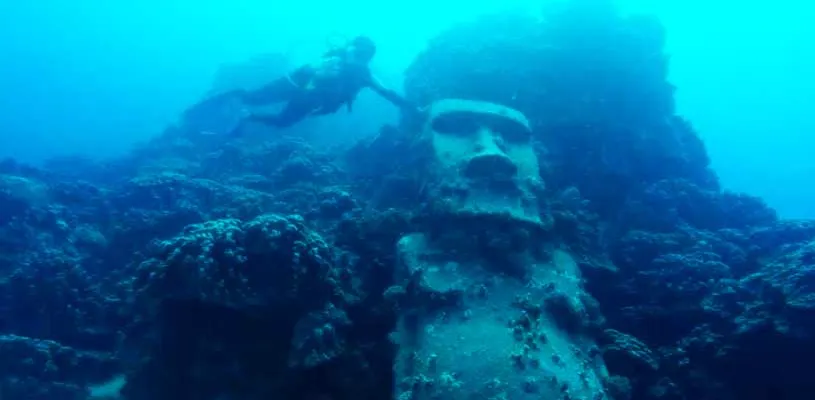
Moai underwater
Ana Te Pahu:
Ana Te Pahu is a series of lava tunnels spanning 7 km (2.4 mi), that were formed when rock solidified around a stream of molten lava. The formations served as cave dwellings used by the island’s inhabitants to shelter from the elements. There are lots of sweet potatoes, bananas, and taro.
Ahu Tahai:
Ahu Tahai is a highly photogenic site that contains three restored ahu (ceremonial platform). It is the ahu in the middle, supporting a large, solitary moai (large anthropomorphic statue) with no top knot.
Ahu Tongariki:
It is the largest ceremonial structure built on Easter Island and the most important megalithic monument in all of Polynesia. It represents the zenith of the sacred constructions called ahu-moai that were developed in Rapa Nui for more than 500 years.
The central platform, whose axis is oriented to the rising sun of the summer solstice, measures almost 100 meters long and with its wings or original lateral extensions reached a total length of 200 meters. During the last final phase of construction of the ceremonial altar, Ahu Tongariki held 15 moai, which made it the platform with the largest number of images of the whole island.
Papa Vaka petroglyphs:
It is an extensive petroglyph site where large petroglyphs are carved into the lava. There are all sorts of petroglyphs here including chickens, canoes, fish hooks, turtles, sharks and octopus. These ancient petroglyphs aren’t as visible as the Moai but are still part of the mysterious and interesting life of the early islanders.
In conclusion, we can say that visiting the Easter Island is a great chance to connect with nature and be fascinated by the mysterious moias. Inkayni Peru Tours recommends going to this beautiful destination. You won’t regret it!

“Don’t tell me how educated you are, tell me how much you traveled.” – Mohammed
Shared: