


Table of Contents
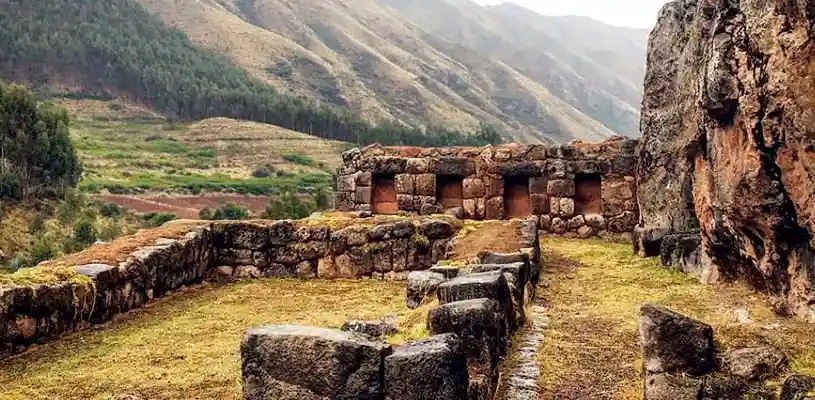
Puca Pucara is a fortification formed by platforms, stairs, passages, turrets, windowsills and a wall that defends the whole construction in a circular shape. Since it is located in the peak of a hill, it is believed that it was a military position and an administrative center. It may have served as a defense fortress of Cusco.
Puca Pucara or Pukapukara comes from Quechua and it means ‘Red Fortress’. This is because of the red granite that was used in its construction.

Location:
Puca Pucara is located at the top of the road to Pisac, about 7 km from Cusco. It is at an altitude of 3 850 m.a.s.l.
Climate:
Cusco and Puca Pucara have two distinct seasons: dry and rainy.
Dry season: From May to October
The weather during this period is predominantly dry, especially in June, July, and August. Days are bright and sunny with a temperature of 16 °C (61 °F) while nights are much colder sometimes with a low temperature of 0 °C (32 °F).
Dry season is widely considered the best time to come to Cusco, but it is also the busiest time to travel.
Rainy season: From November to April
During this time Cusco receives a greater amount of rainfall. Average daytime temperatures are higher than the dry season at 18 °C (64 °F) while night temperatures can be as cold as 9 °C (48 °F).
Best season to visit the Red Fortress:
Most people, including tour operators, recommend coming during the dry season, from May to October, since there is less rain and the roads are safer.
We recommend bringing your sunhat to prevent from sun damage. And since nights are colder, don’t forget to carry a warm jacket if you go out at nights.
What can you see in Puca Pucara?:
This is an important place in the history of Cusco. The Incas built three walls that establish the three levels of the site.
First Wall:
It looks like a curved wall that avoids the cutting protruding rocks. On the north side, at the back of the outer wall, you can find a total of 6 rooms of different sizes. To the west, there is the plaza of trapezoidal shape which is accessed from an exterior staircase.
Second Wall:
There are two walls surrounding the central elevated wide platforms to the east and south. On the backside of the wall, it is possible to find 3 rooms with typical Inca architecture.
Third Wall:
It is located at the top surrounding area; however there is no trace of existing buildings in this place.

Why is Puca Pucara important?:
According to some chroniclers of the time, Puca Pucara served as a Tambo or as lodging for the soldiers and dancers of the Inca. They weren’t allowed to enter Tambomachay, so they waited for the Inca in Puca Pucara. The Inca visited Tambomachay to pay homage to the water. It is believed that a Chincana or tunnel existed, and that it connected these two sites.
Inkayni Peru Tours takes you to Puca Pucara as part of our City Tour, in which you will visit 4 archeological sites.

How to get to Puca Pucara?
Getting to Puca Pucara is very simple. You can walk, but it will take 50 minutes approx from Plaza de Armas in Cusco.
You can also take a taxi. It will take 20 minutes only. And if you want to save some money and immerse in the culture, you can take the public transportation. It will take 30 minutes.
If you like everything settled for you in advance, then the best option is to hire the service of a tourist agency like Inkayni Peru Tours.
Entrance Fee:
Cusco Tourist Ticket includes the entrance to the archeological site of Puca Pucara. The cost of this ticket is 130 Peruvian Soles for foreigners and 70 Peruvian Soles for Peruvians.
Opening hours:
From Monday to Sunday: 7:00 am to 6:00 pm.

What to bring:
- Tourist ticket (not included in the tour price)
- Sun hat
- Sunscreen with a Sun Protection Factor (SPF) of 35 or higher
- Waterproof jacket/rain poncho
- Water
- Camera and film

“Perhaps travel cannot prevent bigotry, but by demonstrating that all peoples cry, laugh, eat, worry and die, it can introduce the idea that if we try and understand each other, we may even become friends.” – Maya Angelou
Shared:



If you liked this article and the information you found, give us 5 stars!
 (Ninguna valoración todavía)
 Loading...